D4.1.11 (HL)—Changes in allele frequency

Allele frequencies change when selection, mutation, migration, genetic drift or non-random mating alters reproductive contribution in evolving populations in evolving populations.

Syllabus
First assessment 2025
Objective
D4.1.11
Level
HL

Exam analysis

Chance of appearing4%of analysed past papers
Latest appearanceMay 2023
Most common paperPaper2
Typical marks1–4

Common command terms

  • Compare
  • Outline

Recent exam appearances

May 2023Paper1 ["HL"] · TZ116[ 1 ]D4.1.11 (HL)—Changes in allele frequency
May 2016Paper2 ["HL"] · TZ03(c)[ 2 ]D4.1.11 (HL)—Changes in allele frequency
May 2016Paper3 ["HL"] · TZ010(a)(i)[ 1 ]D4.1.11 (HL)—Changes in allele frequency
May 2015Paper2 ["HL"] · TZ24(c)[ 4 ]D4.1.11 (HL)—Changes in allele frequency
Practice this objective

Coverage 2015–2023 · Updated 16 Jul 2026

Natural Selection Changes Allele Frequency

HL only

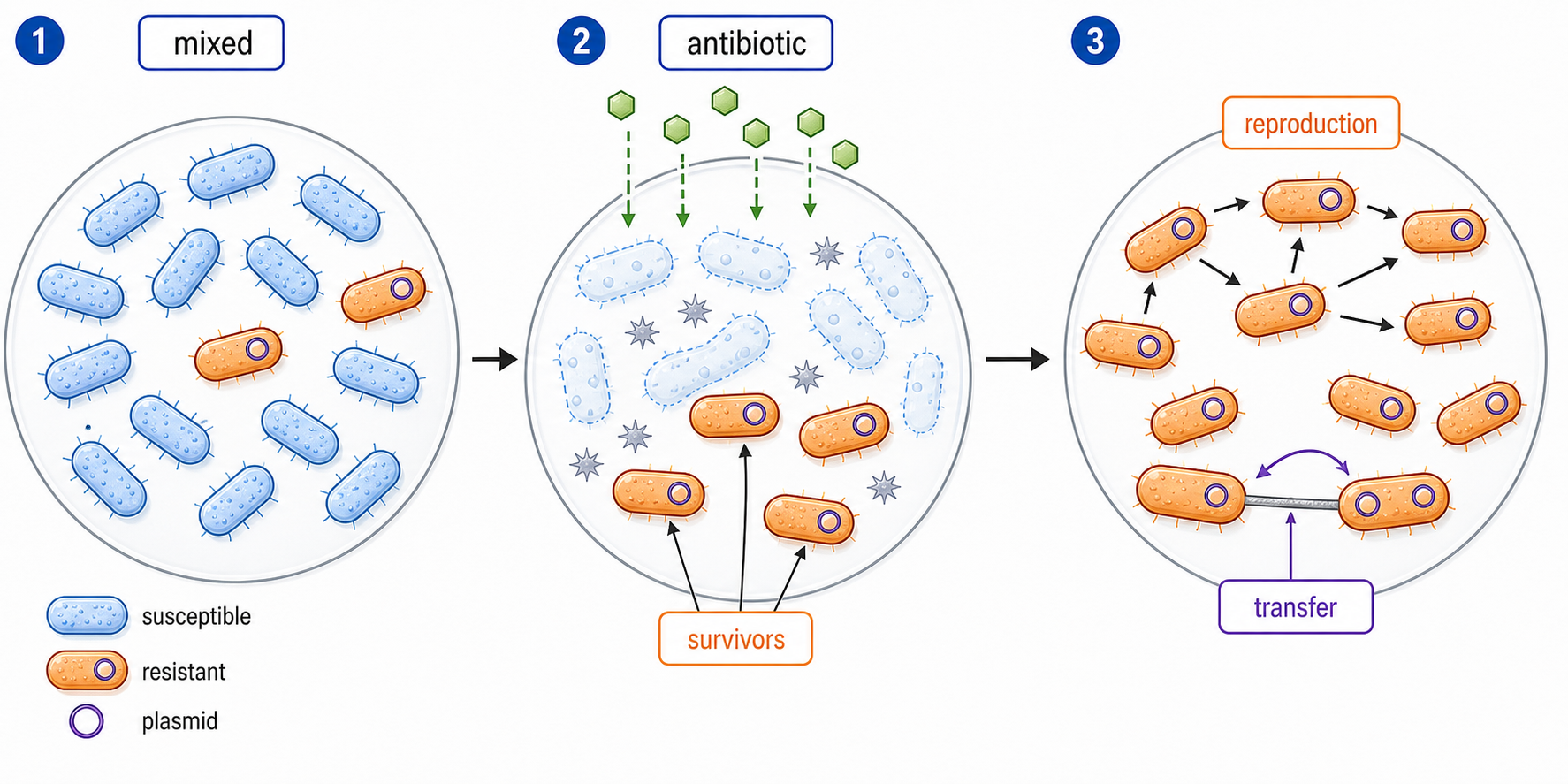
Neo-Darwinism links Darwin's selection mechanism with genetics: natural selection among individuals changes allele frequencies in the population gene pool.

Individuals differ in heritable traits → the current pressure causes different survival or reproductive success → successful individuals pass associated alleles more often → those allele frequencies rise in the next generation.

Selection acts on phenotypes of individuals, but evolutionary change is recorded as a change in inherited allele frequency across generations.

If an inherited phenotype increases seed production under drought, alleles contributing to that phenotype can become more frequent after repeated drought generations.

A phenotype becoming common is not enough: the trait must be heritable and its carriers must contribute disproportionately to the next generation.

Changes in allele frequency

HL only

Assessment in practice

1–3 marks
How it is assessed

This objective is assessed through essay response, commonly using Compare / Outline.

Command terms

Compare / Outline

What earns marks

Build the answer around this relationship: Selection changes allele frequencies through differential reproductive success.

Representative question

Question 1

[Maximum number: 4]

If a wild population of cats contained both curled ears and normal ears, explain how the proportion of these two phenotypes could change in the population.

Retrieve the HL Population Genetics Route

HL only

HL D4.1 turns selection into measurable population genetics. A gene pool changes when allele frequencies shift. Hardy-Weinberg gives a no-evolution baseline; selection graphs, isolated populations, artificial selection, and resistance show how forces move populations away from that baseline.

  • all alleles in an interbreeding population
  • directional, stabilizing, or disruptive selection favours different phenotype ranges
  • p and q calculate allele and genotype frequencies in equilibrium
  • selection, mutation, migration, drift, or non-random mating may be acting

HL Population Genetics

HL only

HL population-genetics questions ask students to quantify or model evolution. The answer starts with the gene pool and allele frequencies, then uses the model or selection graph to decide whether the population is at equilibrium or being shifted by selection, mutation, migration, drift, artificial selection, or isolation.

  • Use gene pool and allele frequency language to define evolution quantitatively.
  • Interpret selection graphs and isolated populations as changes in phenotype or allele frequencies.
  • Apply Hardy-Weinberg equations and equilibrium assumptions, then explain what deviations mean.

Concept essentials

  • Selection changes allele frequencies through differential reproductive success.
  • Genetic drift is random and strongest in small populations.
  • Migration can add or remove alleles from a population.