Cell and nuclear division coordinate DNA replication, chromosome movement, cytokinesis, meiosis, cell-cycle control and proliferation to produce new cells in organisms.
Syllabus
First assessment 2025
Topic
D2.1
Level
HL
Cell Division Extends an Existing Cell Lineage
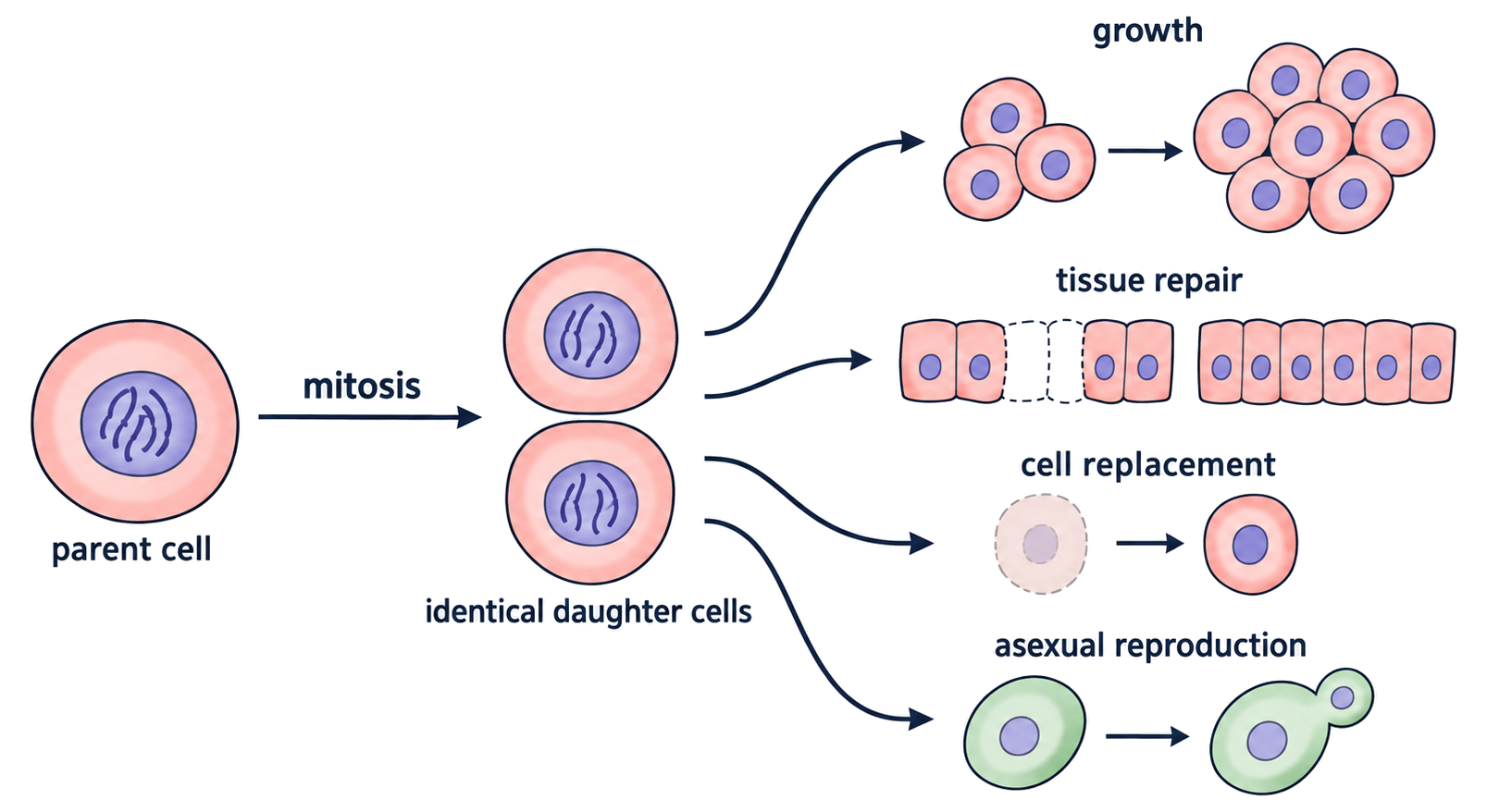
Every new cell arises when a pre-existing parent cell divides. The daughter cells inherit cellular material and DNA from that lineage; they are not assembled from non-living parts.
Cell division supplies new cells for:
growth of a multicellular organism
replacement of worn or damaged cells
tissue repair after injury
reproduction in unicellular organisms and some multicellular organisms
Cell division increases cell number. Growth of an individual cell increases cell size; organisms often require both processes.
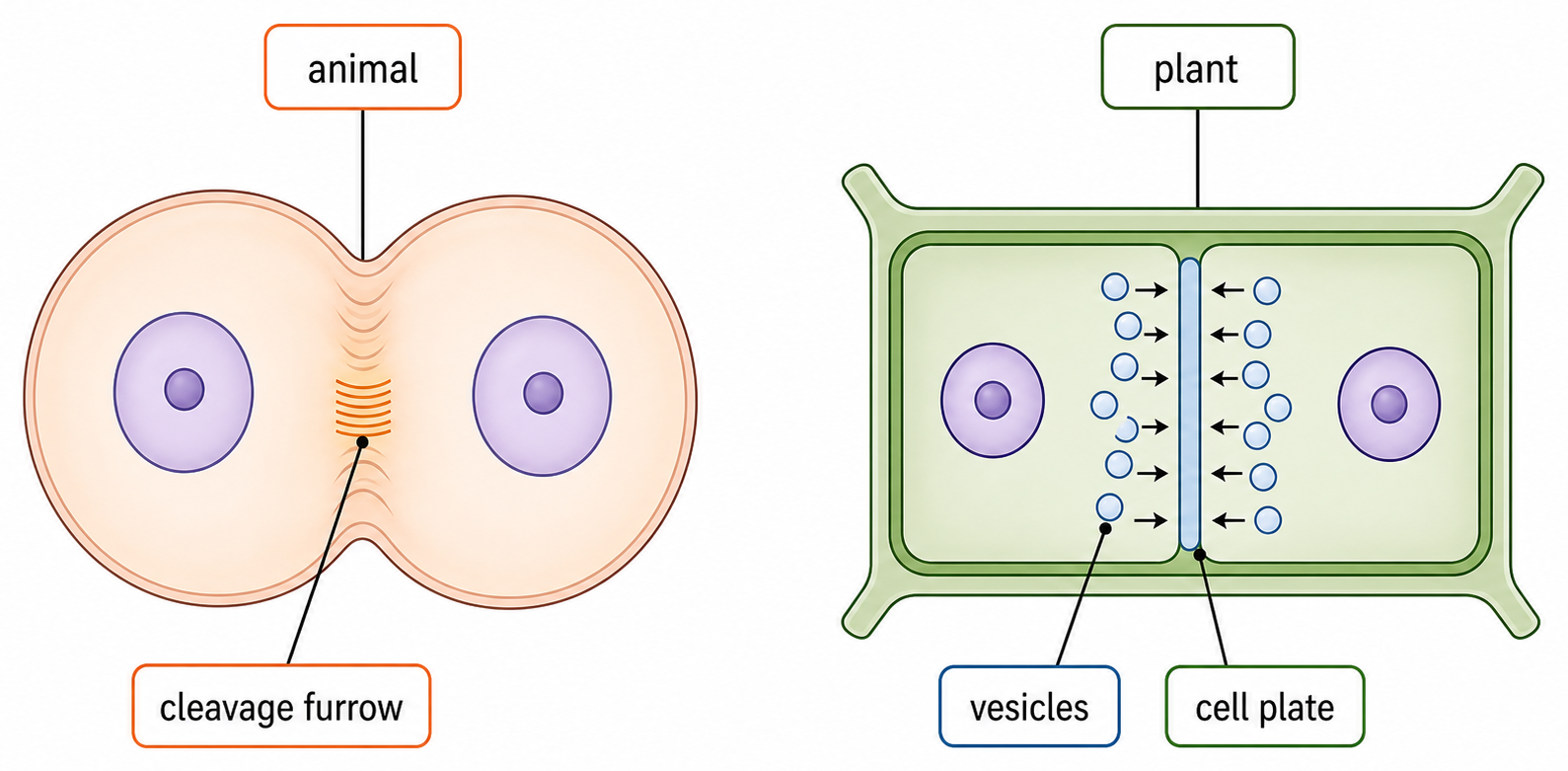
Animal Cells Pinch In; Plant Cells Build a Cell Plate
Cytokinesis partitions the cytoplasm after nuclear division so the daughter nuclei become separate cells.
Feature
Animal cell
Plant cell
starting constraint
flexible plasma membrane
rigid existing cell wall
mechanism
actin–myosin contractile ring tightens a cleavage furrow
Golgi-derived vesicles fuse at the equator
result
membrane pinches inward
cell plate becomes new membranes and wall between daughters
Both mechanisms divide one cytoplasm around two daughter nuclei, but they solve the mechanical problem in opposite directions: inward constriction versus construction from the centre outward.
Equal Chromosomes Do Not Require Equal Cytoplasm
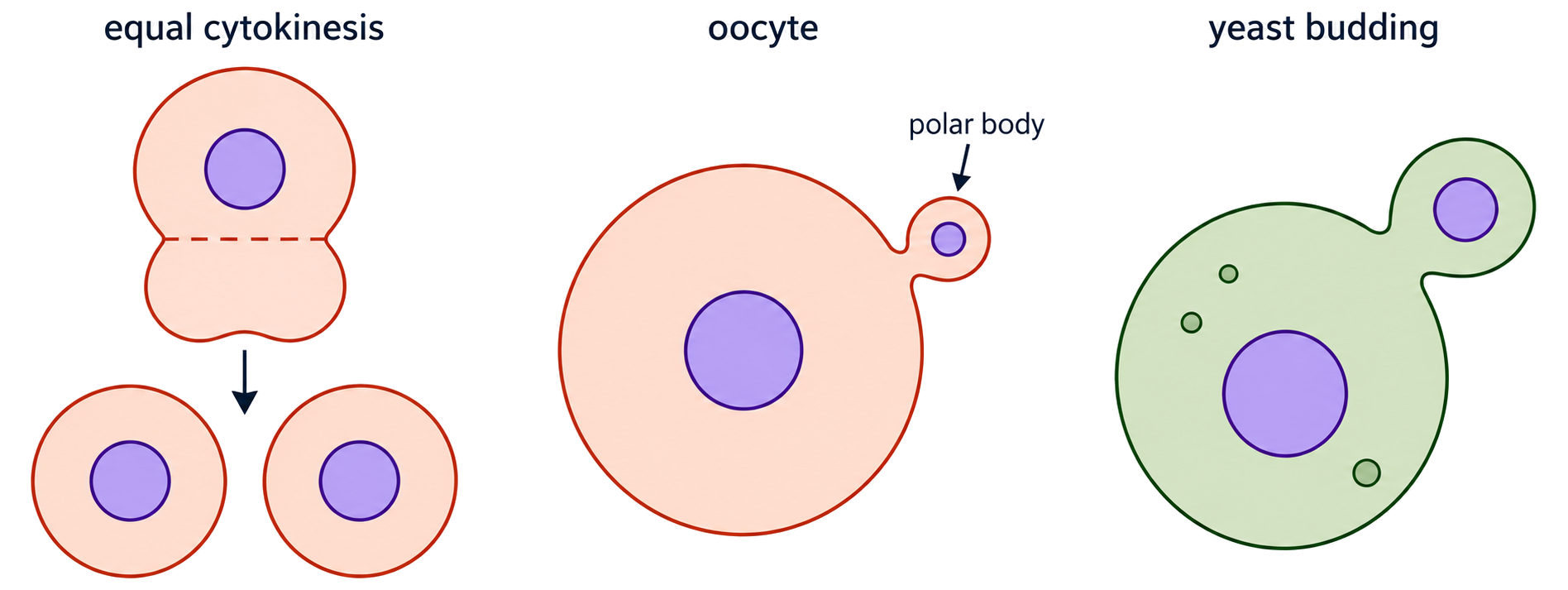
Cytokinesis often gives daughter cells similar cytoplasmic volumes, but the partition can be unequal when the daughters have different immediate functions.
Oogenesis: one cell retains most cytoplasm, organelles and stored nutrients to become the ovum; small polar bodies mainly remove extra chromosome sets.
Yeast budding: a smaller bud grows from the parent and separates after receiving a nucleus and essential cell components.
Unequal cytokinesis refers to cytoplasmic allocation, not deliberately unequal chromosome inheritance. Normal daughter nuclei still require the appropriate chromosome set.
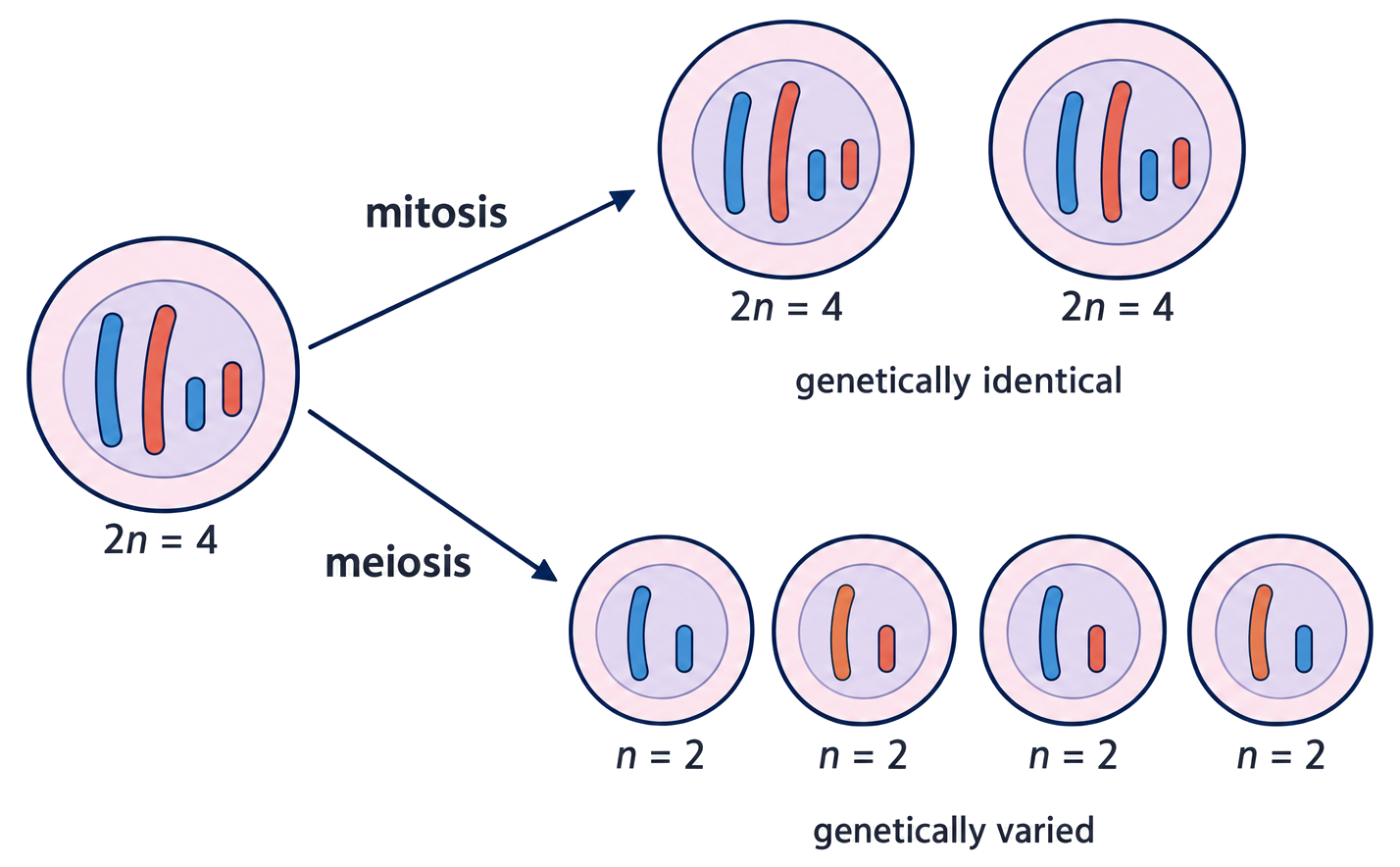
Mitosis Preserves Chromosome Number; Meiosis Reduces It
Dimension
Mitosis
Meiosis
nuclear divisions
one
two after one DNA replication
usual nuclei produced
two
four
chromosome number
maintained
halved
genetic relationship
normally identical to parent and each other
varied combinations
main roles
growth, replacement, repair, asexual reproduction
production of cells that develop into gametes
Diploid (2n) nuclei contain two homologous sets of chromosomes. Haploid (n) nuclei contain one set.
Mitosis and meiosis are nuclear divisions. Cytokinesis is the separate division of cytoplasm that usually follows.
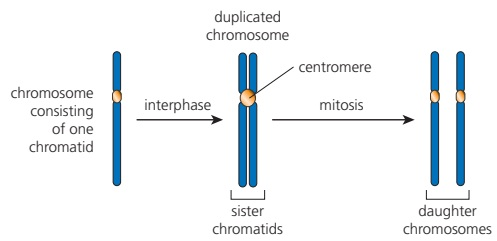
Replication Creates Sister Chromatids before Nuclear Division
1
Before S phase, one chromosome contains one DNA molecule. During S phase that DNA is replicated.
2
After replication, the chromosome consists of two nearly identical sister chromatids joined at a centromere. The chromosome count has not doubled, but the DNA amount has.
3
When the sister chromatids separate, each becomes an individual daughter chromosome. Sending one copy to each future nucleus preserves a complete genome.
Do not count chromatids as separate chromosomes while they remain joined at one centromere.
Condensation and Spindle Forces Make Chromosomes Movable
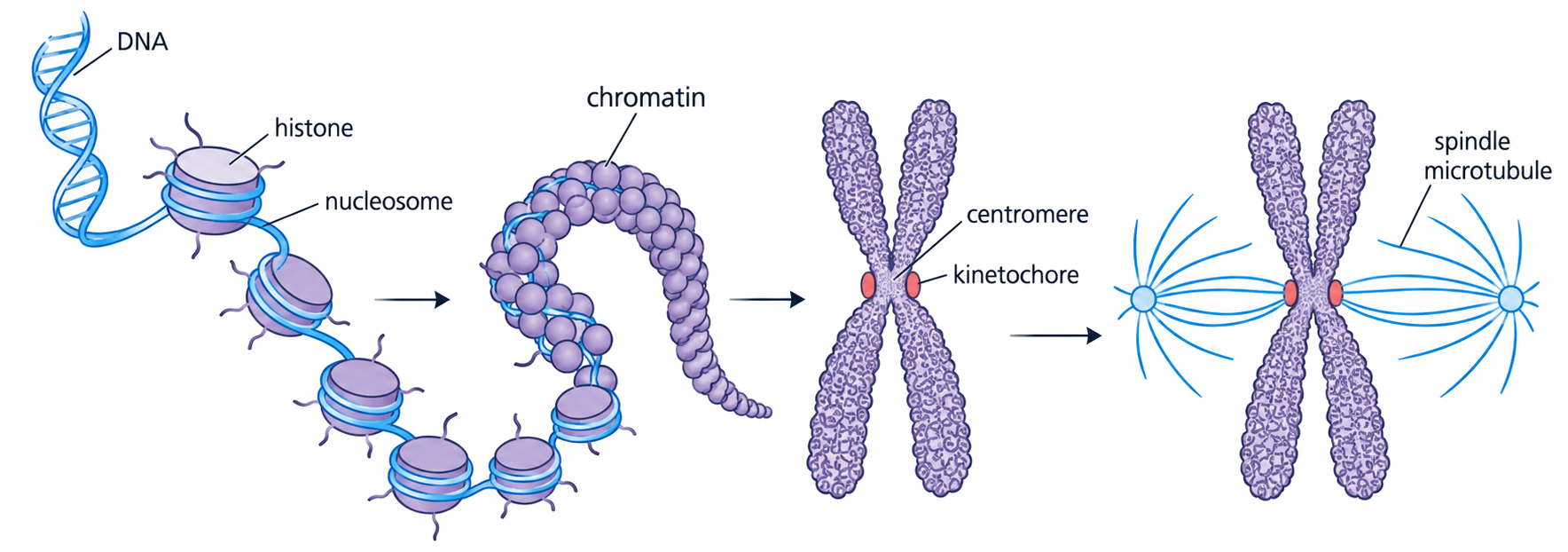
Each chromosome is one very long DNA molecule. Accurate division requires it to be packaged into a compact unit and attached to machinery that can position and separate it.
Mitosis and meiosis share three mechanical features:
DNA wrapped around histones and nucleosomes condenses into chromosomes.
Spindle microtubules attach through centromere-associated structures.
Microtubule dynamics and motor proteins position and move chromosomes.
Condensation does not copy DNA. It changes packaging so long molecules can move with less tangling or breakage.
Mitosis First Condenses Chromosomes and Aligns Their Centromeres
1
Prophase: chromatin condenses into visible duplicated chromosomes; the nucleolus disappears, the nuclear envelope breaks down, and the spindle forms.
2
Metaphase: spindle microtubules attach to the centromere region from opposite poles and position chromosome centromeres at the cell equator.
Identification cues:
condensed chromosomes still scattered or nuclear boundary disappearing → prophase
duplicated chromosomes arranged along one central plane → metaphase
Mitosis is continuous; phase names label dominant visible events rather than pauses between separate processes.
Mitosis Then Separates Sister Chromatids and Rebuilds Nuclei
1
Anaphase: centromere linkage is released and sister chromatids move to opposite poles. Once separated, each chromatid is a daughter chromosome.
2
Telophase: chromosomes reach the poles and decondense; nuclear envelopes and nucleoli re-form around the two chromosome sets.
Identification cues:
two separating groups, often V-shaped as centromeres lead → anaphase
two groups at opposite ends with new nuclear boundaries → telophase
Because sister chromatids were replicated copies and one moves to each pole, the two daughter nuclei normally contain identical chromosome sets.
Identify a Mitotic Stage from Chromosome Evidence, Not Cell Shape
Use a fixed observation sequence:
Are individual condensed chromosomes visible?
Are they scattered, aligned at one equator, separating, or already at opposite poles?
Is one nuclear envelope present, absent, or re-forming as two?
Dominant observation
Best stage identification
chromatin diffuse inside an intact nucleus
interphase, not mitosis
condensed chromosomes not yet aligned
prophase
chromosomes aligned at one equator
metaphase
daughter chromosomes moving apart
anaphase
two chromosome groups with re-forming nuclei
telophase
A stained root-tip squash contains many cells in different stages because division is not synchronized. Count only cells whose chromosome evidence is sufficiently clear.
A single still image may lie near a phase boundary. Record the visible cue and acknowledge uncertainty rather than forcing a label from cell outline alone.
Reconstruct How One Replicated Cell Becomes Two Daughter Cells
DNA replication creates joined sister chromatids → chromosomes condense and attach to the spindle → metaphase alignment checks bipolar attachment → sister chromatids separate → two nuclei re-form → cytokinesis partitions the cytoplasm
Continuity requirement
What supplies it
complete genome in each nucleus
replication followed by equal chromatid separation
controlled chromosome movement
condensation, spindle microtubules and motor proteins
two separate cells
animal cleavage furrow or plant cell plate
suitable daughter-cell contents
equal or functionally unequal cytoplasmic partition
To identify a stage, prioritize chromosome position and nuclear-envelope state. To explain the outcome, connect those observations to what is being separated.
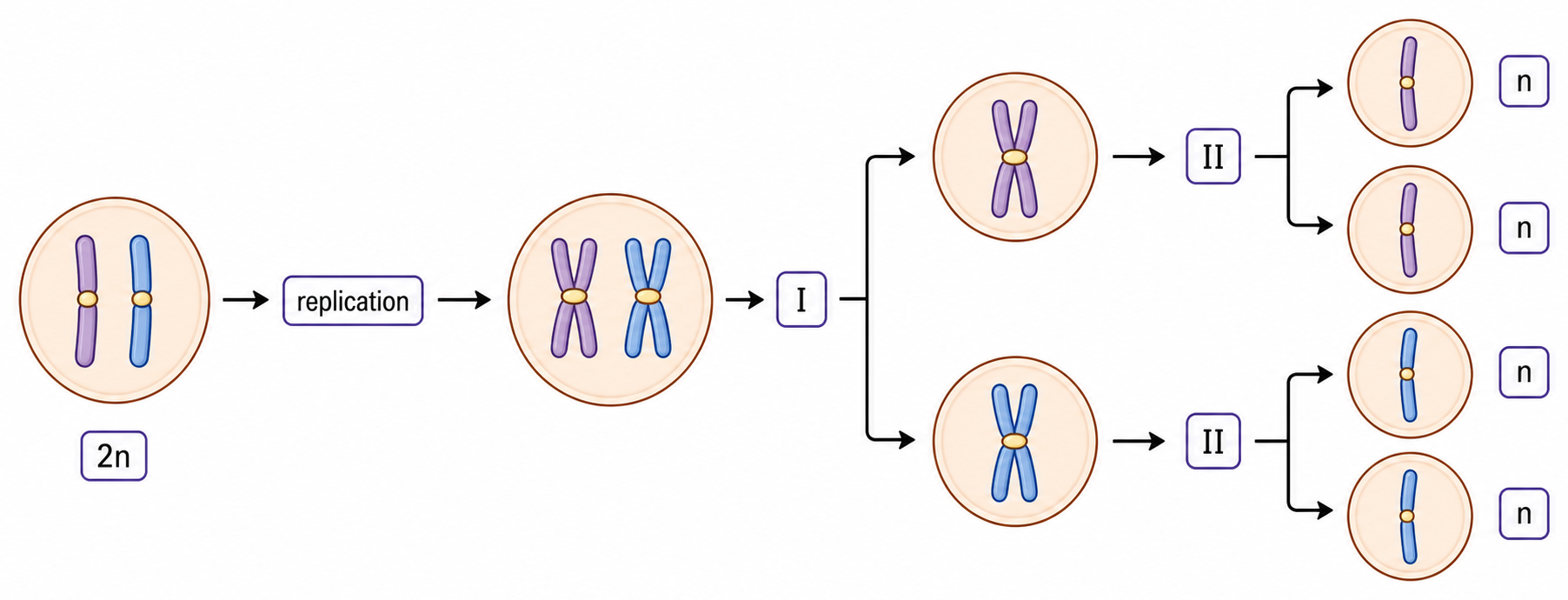
One DNA Replication Followed by Two Divisions Produces Haploid Nuclei
1
Before meiosis, S phase replicates every chromosome into two sister chromatids. The nucleus is still diploid because both homologues of each pair remain present.
2
In meiosis I, homologous maternal and paternal chromosomes separate into different nuclei. Chromosome number is reduced from diploid to haploid, although each chromosome still has two chromatids.
3
There is no second DNA replication. In meiosis II, sister chromatids separate, producing four haploid nuclei with one chromosome from each homologous pair.
Reduction prevents chromosome number doubling in every generation: haploid gametes fuse at fertilization to restore the diploid number.
Meiosis I Separates Homologues; Meiosis II Separates Chromatids
A bivalent is a paired set of duplicated homologous chromosomes: one maternal homologue and one paternal homologue, each made of two sister chromatids.
Question
Meiosis I
Meiosis II
what aligns?
bivalents
individual duplicated chromosomes
what separates?
homologous chromosomes
sister chromatids
do centromeres divide?
no
yes
chromosome-number effect
diploid → haploid
remains haploid
Use the object being separated in explanations: homologues move apart in anaphase I; sister chromatids move apart in anaphase II.
Calling both events 'chromosomes separating' hides the reason meiosis I is the reduction division.
Non-Disjunction Sends Both Copies to One Pole
1
A homologous pair can fail to separate in meiosis I, or sister chromatids can fail to separate in meiosis II. This failure is non-disjunction.
2
Both copies move to one pole while the opposite pole receives none. Later division therefore cannot give every gamete the standard chromosome number.
3
The affected meiosis produces gametes with an extra chromosome (n + 1) and/or a missing chromosome (n − 1), depending on when the error occurred.
4
After fusion with a normal haploid gamete, an n + 1 gamete can produce a trisomic zygote; an n − 1 gamete can produce a monosomic zygote.
Non-disjunction can create too many or too few chromosomes. It is not defined only by an extra chromosome.
Trisomy 21 Usually Begins with a Meiotic Separation Error
chromosome 21 non-disjunction during gamete formation → gamete receives two copies of chromosome 21 → fertilization by a normal gamete adds one more copy → zygote has three copies of chromosome 21
The resulting trisomy 21 gives the zygote 47 chromosomes rather than the usual 46 and can cause Down syndrome.
The developmental effects vary among individuals because an extra chromosome changes the dosage of many genes, not just one gene.
Down syndrome is a chromosome-number condition. It is not caused by a point mutation within chromosome 21.
Crossing Over Recombines Alleles within Homologous Chromosomes
1
During prophase I, duplicated homologous chromosomes pair closely as a bivalent. Corresponding gene loci align.
2
Non-sister chromatids break at corresponding positions and rejoin to the other homologue. The visible connection is a chiasma.
3
Equivalent DNA segments are exchanged, producing recombinant chromatids with new combinations of maternal and paternal alleles.
Crossing over is between non-sister chromatids of homologous chromosomes. It rearranges existing alleles; it does not necessarily create new alleles.
Random Orientation and Fertilization Multiply Gamete Variety
At metaphase I, each bivalent can face either pole independently of the others. The maternal or paternal homologue that enters a gamete is therefore random for each pair.
2n
For humans, n=23, so random orientation alone can produce 223—more than 8 million—chromosome combinations before crossing over is counted.
Random fusion of one genetically varied sperm with one genetically varied egg multiplies the possible allele combinations again.
Crossing over changes allele combinations within chromosomes; random orientation changes which whole maternal and paternal homologues travel together.
Track What Separates to Explain Reduction, Error and Variation
Event
What changes
Main consequence
replication before meiosis
each chromosome gains a sister chromatid
DNA prepared for two divisions
meiosis I
homologous chromosomes separate
chromosome number is halved
meiosis II
sister chromatids separate
four haploid products can form
non-disjunction
one required separation fails
aneuploid gametes may form
Variation is layered: crossing over recombines alleles within chromosomes, random orientation assort homologues independently, and random fertilization combines two independently produced gametes.
When explaining any meiotic outcome, name the stage, the chromosome object that should separate, the chromosome number before and after, and whether the result changes number, allele combination or both.
Cell Proliferation Repeats Mitosis for Growth and Repair
HL only
Cell proliferation is an increase in cell number through repeated cell growth and mitotic division. The new cells may remain unspecialized, differentiate or replace cells that were lost.
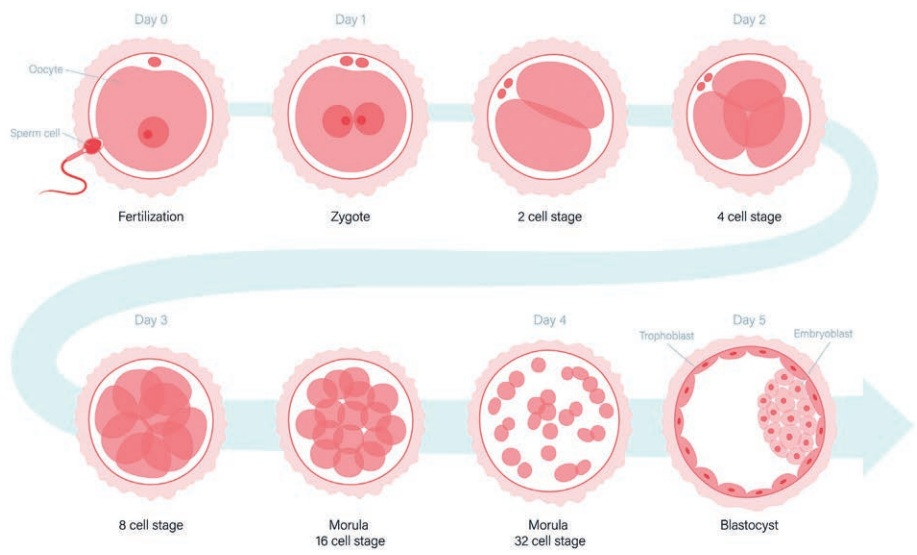
Early embryo: rapid divisions build cell number before extensive differentiation.
Plant meristems: dividing cells at apical or lateral growth regions supply new plant tissues.
Routine replacement: stem-cell lineages replenish short-lived cells such as epidermal cells.
Wound repair: fibroblasts and other cells proliferate to rebuild tissue and extracellular matrix.
Proliferation describes more cells. Cell enlargement and differentiation can follow, but they are different processes.
The Cell Cycle Alternates Preparation with Division
HL only
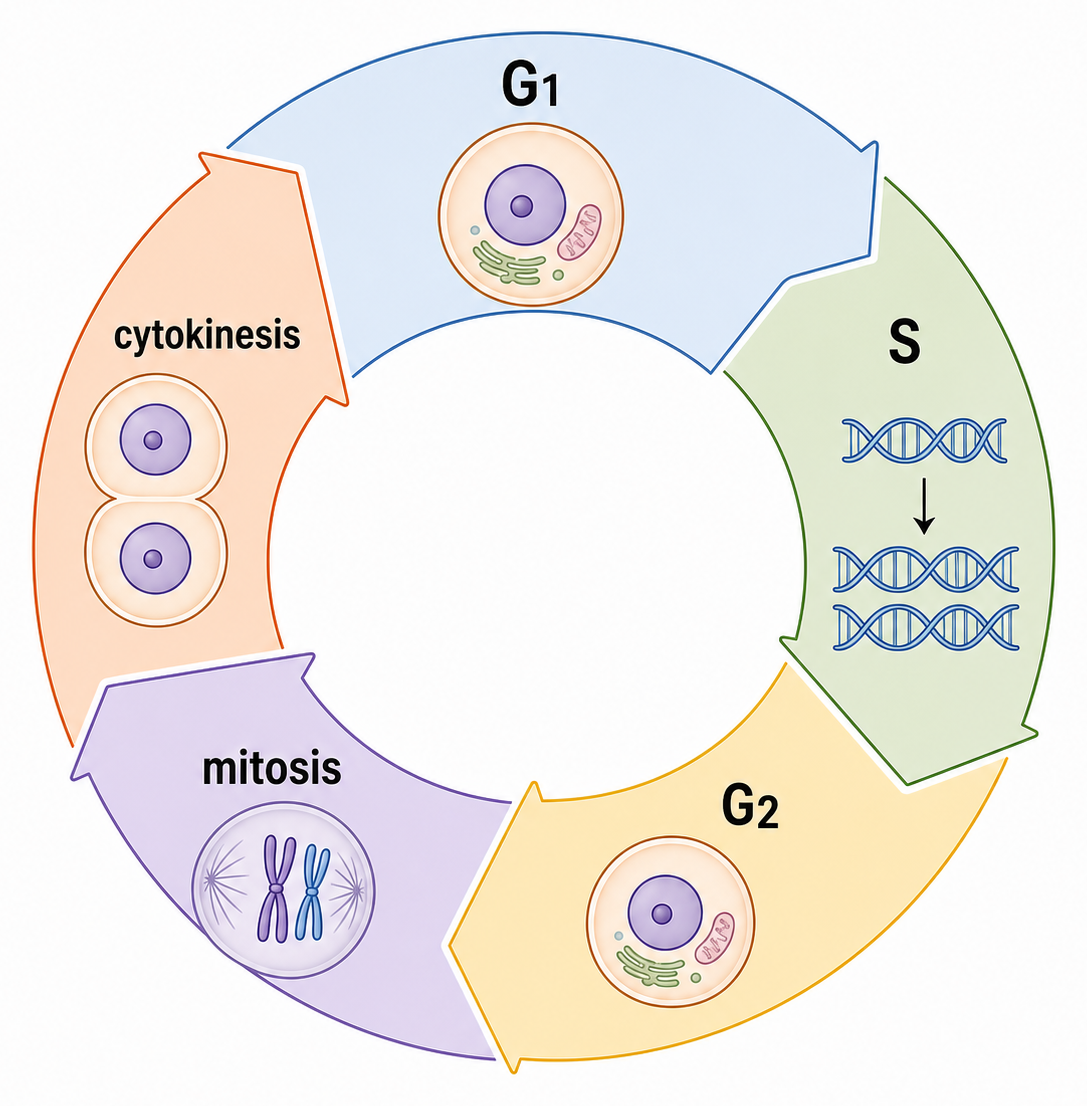
The cell cycle is the repeating sequence in which a cell grows and prepares during interphase, divides its nucleus by mitosis and partitions its cytoplasm by cytokinesis.
G1 growth and biosynthesis → S-phase DNA replication → G2 growth and division preparation → mitosis → cytokinesis → daughter cells enter a new cycle or leave active cycling
A cell is not in mitosis for most of its cycle. Interphase is usually the longest portion, so most cells in a tissue sample are expected to appear in interphase.
G1 Builds the Cell, S Copies DNA and G2 Prepares Division
HL only
Interphase stage
Main work
Chromosome state by the end
G1
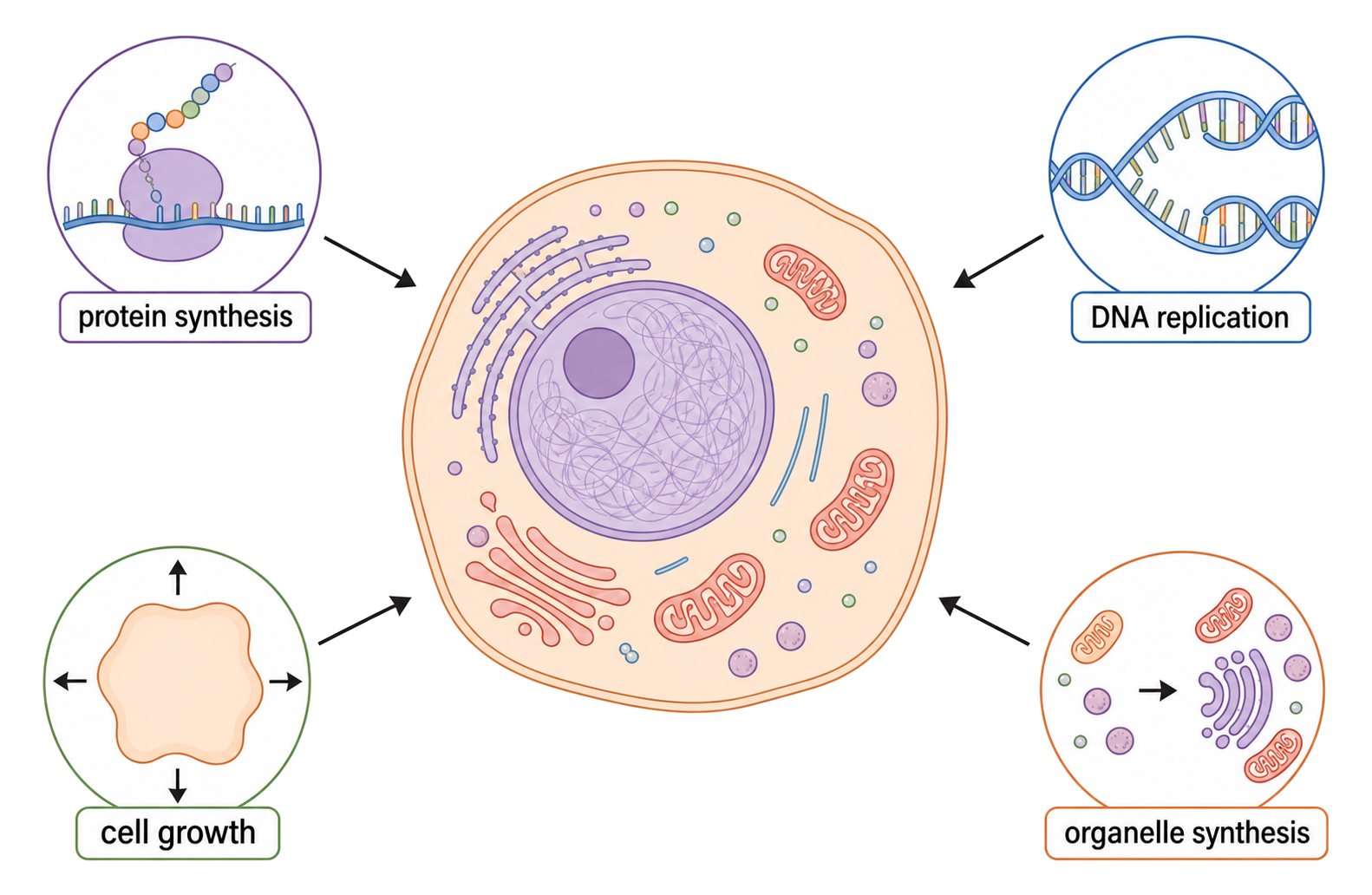
cell growth, metabolism, protein and organelle production
each chromosome has one chromatid
S
DNA replication
each chromosome has two sister chromatids
G2
further growth, protein synthesis and preparation for spindle formation
replicated chromosomes remain joined
The order matters: the cell first builds capacity, then copies the genome once, then checks and prepares the machinery needed to distribute those copies.
DNA quantity doubles during S phase, but chromosome number does not double because the sister chromatids remain joined at their centromere.
Interphase Is Active Even When Chromosomes Are Not Visible
HL only
During interphase the cell transcribes genes, synthesizes proteins, grows its cytoplasm, accumulates energy and increases organelles. DNA is dispersed as chromatin and remains accessible for gene expression.
Interphase duration varies with cell fate: rapidly proliferating embryo or meristem cells cycle quickly, many adult cells divide only when signalled, and some differentiated cells remain outside active division for long periods.
A nucleus that looks uniform under a light microscope is not resting. Lack of visible condensed chromosomes is evidence of chromatin state, not metabolic inactivity.
Cyclin–CDK Complexes Turn Cell-Cycle Transitions On
HL only
Cyclin-dependent kinases (CDKs) are present but require particular cyclins to become active. Cyclin concentrations rise and fall, giving the control system time-specific signals.
1
Cyclin accumulates and binds its CDK → the active complex phosphorylates target proteins → a checkpoint transition can occur once the relevant conditions and threshold are satisfied.
2
At the G2/M transition, cyclin–CDK activity forms mitosis-promoting factor (MPF), triggering chromosome condensation, nuclear-envelope breakdown and spindle assembly.
3
Cyclin is then degraded while CDK can be reused. Falling complex activity helps make the transition directional and resets control for a later cycle.
Cyclin level is part of checkpoint control, not the only input. DNA integrity, replication completion, spindle attachment and external signals also influence progression.
Cancer Risk Rises When Growth Signals Stick On or Checkpoint Brakes Fail
HL only
Gene class
Normal role
Cancer-promoting change
Analogy
proto-oncogene
stimulates division when an appropriate signal is present
gain-of-function mutation creates an oncogene with excessive or constant activity
accelerator stuck on
tumour-suppressor gene
stops the cycle, repairs damage or promotes apoptosis
loss-of-function mutation removes restraint
brake lost
A mutant Ras oncogene can keep growth-signalling pathways active without the normal extracellular signal. One activated allele may be sufficient to increase signalling.
Loss of p53 function can prevent arrest or apoptosis after DNA damage. Because a remaining functional copy can still supply p53, both copies often need to be lost in the affected cell lineage.
Cancer usually develops through accumulated mutations and clonal selection, not one mutation that instantly creates a fully malignant tumour.
Invasion and Metastasis Distinguish Malignant Tumours
HL only
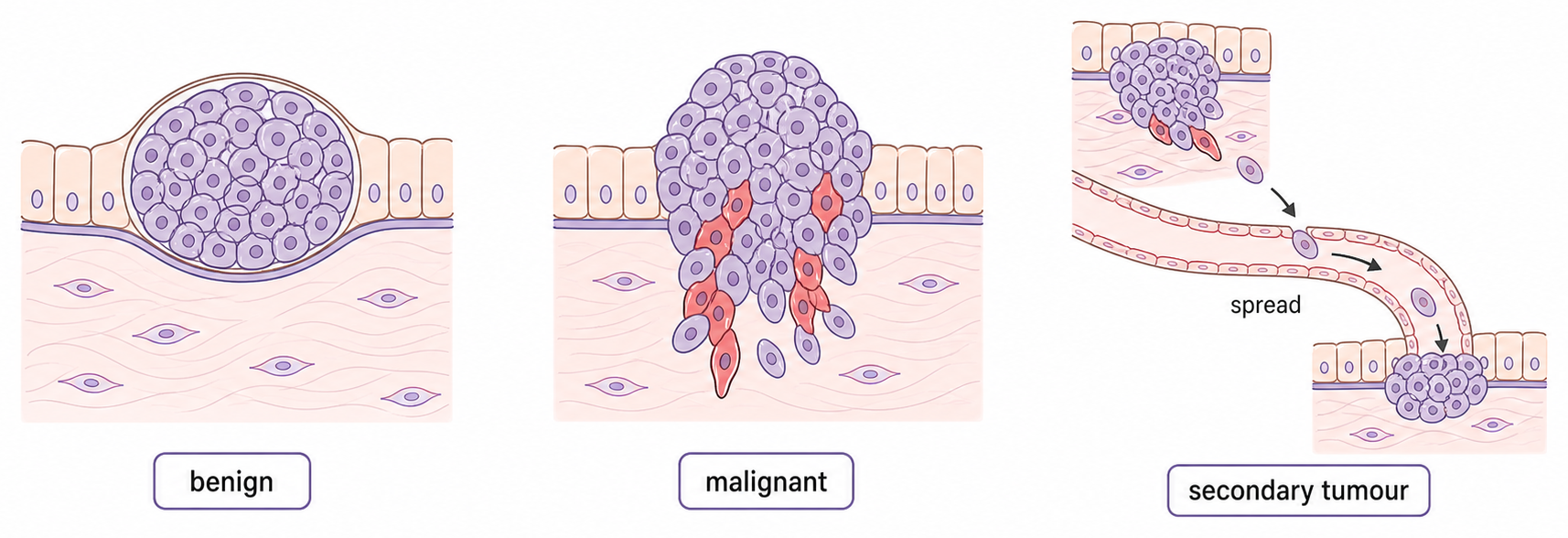
Property
Benign tumour
Malignant tumour
local growth
often slower and bounded
often faster and poorly controlled
invasion
does not invade neighbouring tissue
penetrates and damages neighbouring tissue
metastasis
absent
cells may detach, travel and form secondary tumours
Metastasis requires several steps: cells detach from the primary tumour, enter blood or lymph, survive transport, leave the vessel and establish a secondary tumour elsewhere.
A tumour is an abnormal mass produced by excess cell division. Not every tumour is cancerous; malignant invasion and metastatic capacity define cancerous behaviour.
Mitotic Index Estimates the Fraction of Cells Currently Dividing
HL only
MI=TM×100%
Let M be the number of cells observed in mitosis and T the total number of cells observed. If 10 of 95 visible cells are in mitosis,
9510×100%=10.5%
A higher mitotic index means a larger fraction of sampled cells was in mitosis at the observation time. It can support comparison of tissue proliferation or response to treatment.
Mitotic index is not a unique cancer diagnosis. It depends on sampling, stage-identification accuracy and how long cells remain in mitosis; replicate fields and other evidence are required.
Connect Normal Proliferation to Cell-Cycle Control and Cancer
HL only
Growth or repair signal → G1 growth → S-phase genome replication → G2 preparation and checkpoint control → cyclin–CDK activation → mitosis and cytokinesis → daughter cells differentiate, replace tissue or re-enter the cycle
Oncogene activation can increase positive growth signalling, while tumour-suppressor loss can remove arrest, repair or apoptosis. Accumulated changes allow an abnormal clone to proliferate.
Evidence scale
Question it answers
cell-cycle proteins and genes
why is checkpoint control altered?
mitotic index
what fraction of sampled cells is dividing now?
tissue boundary
is the tumour local or invading?
secondary growths
has metastatic spread occurred?
Rapid division alone is not the whole definition of malignancy. A strong explanation connects molecular control failure to clonal growth, tissue invasion and possible metastasis.
Generation of new cells
[ 1 ]
Which process contributes to growth of a multicellular body?
Cytokinesis exam focus
[ 8 ]
Compare and contrast the processes of mitosis and cytokinesis in animal and plant cells.
Equal and unequal cytokinesis
[ 1 ]
Daughter cells usually receive equal amounts of cytoplasm as parent cells undergo cytokinesis. Which of the following is an exception?
Roles of mitosis and meiosis
[ 5 ]
Distinguish between the processes of meiosis and mitosis.
DNA replication prerequisite
[ 1 ]
Distinguish between the quantity of DNA of the cell at G1 and G2.
Shared features
[ 1 ]
What occurs in cell division during both mitosis and meiosis?
Phases of mitosis
[ 9 ]
Describe the events that occur during mitosis.
Identification of mitosis phases
[ 1 ]
The following shows a micrograph.
How many cells are in metaphase?
Meiosis as reduction division
[ 5 ]
Outline what occurs in cells in the first division of meiosis.
Down syndrome
[ 4 ]
Describe how non-disjunction can cause Down syndrome.
Meiosis generates variation
[ 7 ]
Explain the stages and processes of meiosis leading to genetic variation.
Drawing canvas
Cell proliferation
HL only
[ 3 ]
Based on the data, evaluate the evidence for leptin promoting regeneration of liver tissue.
Cell cycle phases
HL only
[ 7 ]
Following germination of seeds, plants undergo a rapid increase in the number of cells. Describe stages in the cell cycle that result in this increase of cells.
Cell growth during interphase
HL only
[ 4 ]
Outline the processes occurring during interphase in the cell cycle.
Cell cycle control by cyclins
HL only
[ 4 ]
Explain how the cell cycle is controlled.
Mutations in cell cycle genes
HL only
[ 4 ]
Explain how changes to the cell cycle can result in tumour formation.
Tumour differences
HL only
[ 1 ]
Which processes occur during the development of secondary tumours?