D4.1.15 (HL)—Artificial selection

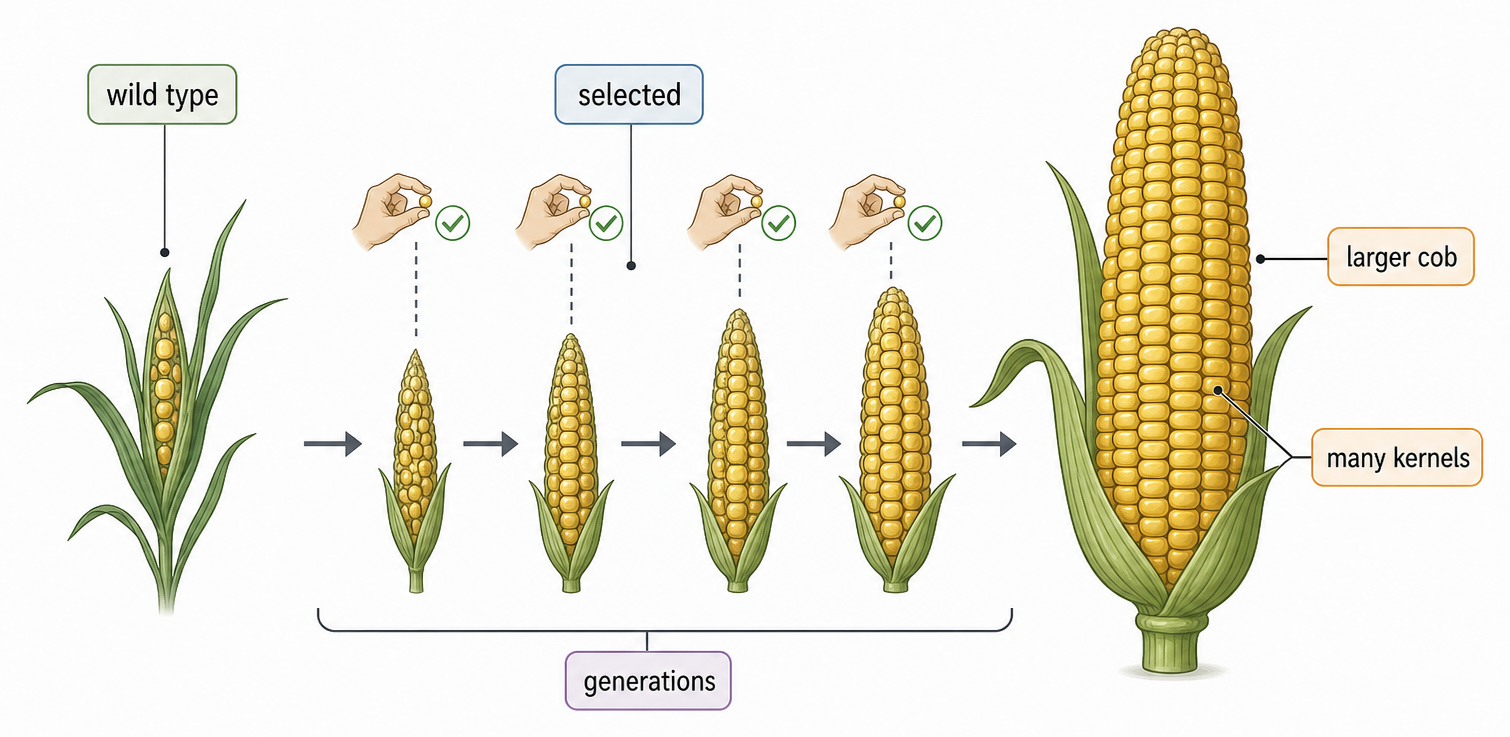
Artificial selection occurs when humans choose which individuals breed, increasing desired heritable traits over generations in evolving populations in evolving populations.

Syllabus
First assessment 2025
Objective
D4.1.15
Level
HL

Artificial Selection Uses Deliberate Breeding Choices

HL only

Artificial selection occurs when humans deliberately choose crop plants or domesticated animals with desirable inherited traits to breed.

Choose a heritable target phenotype → select parents showing it → breed them → measure offspring → repeat selection over generations, increasing associated alleles.

Case Selection type and reason
Repeatedly breeding wheat plants with high grain yield Artificial: humans deliberately choose breeders
Repeatedly breeding dairy cattle with high milk yield Artificial: humans deliberately choose breeders
Antibiotic-resistant bacteria becoming common during antibiotic use Natural: the antibiotic is a pressure, but humans do not choose individual bacteria to reproduce

Strong repeated choices can change a population quickly but may narrow genetic diversity or bring correlated undesirable traits.

Artificial selection changes who reproduces; it is not direct DNA editing. An unintended evolutionary consequence of a human action is not automatically artificial selection.

Retrieve the HL Population Genetics Route

HL only

HL D4.1 turns selection into measurable population genetics. A gene pool changes when allele frequencies shift. Hardy-Weinberg gives a no-evolution baseline; selection graphs, isolated populations, artificial selection, and resistance show how forces move populations away from that baseline.

  • all alleles in an interbreeding population
  • directional, stabilizing, or disruptive selection favours different phenotype ranges
  • p and q calculate allele and genotype frequencies in equilibrium
  • selection, mutation, migration, drift, or non-random mating may be acting

HL Population Genetics

HL only

HL population-genetics questions ask students to quantify or model evolution. The answer starts with the gene pool and allele frequencies, then uses the model or selection graph to decide whether the population is at equilibrium or being shifted by selection, mutation, migration, drift, artificial selection, or isolation.

  • Use gene pool and allele frequency language to define evolution quantitatively.
  • Interpret selection graphs and isolated populations as changes in phenotype or allele frequencies.
  • Apply Hardy-Weinberg equations and equilibrium assumptions, then explain what deviations mean.

Concept essentials

  • Artificial selection is human-directed selective breeding.
  • Only heritable traits can respond reliably to artificial selection.
  • Repeated selection can increase desired traits but may reduce genetic diversity.