D3.2.9—ABO blood groups
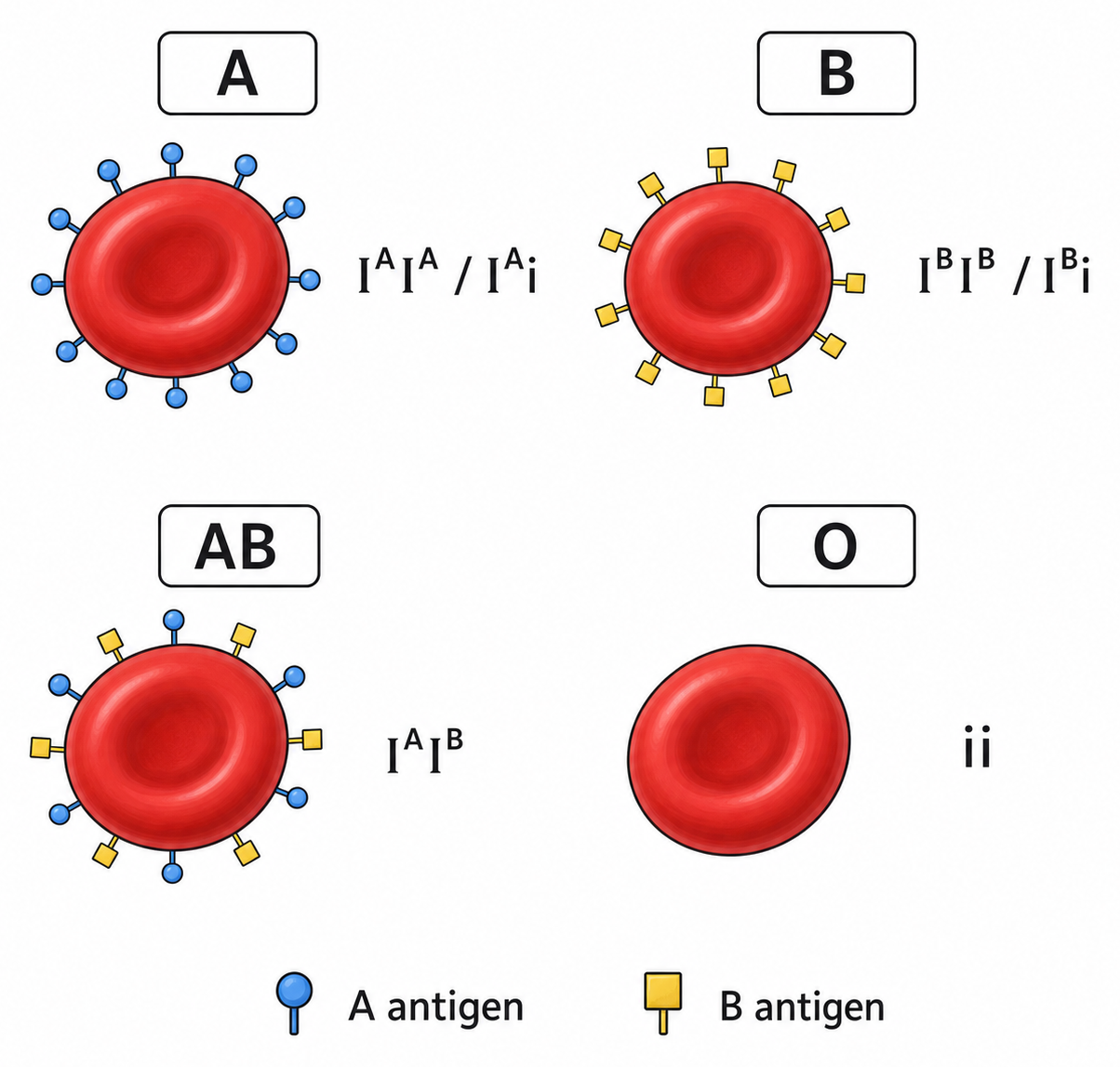
ABO blood groups depend on three alleles, with IA and IB codominant and both dominant over i in inheritance problems.
- Syllabus
- First assessment 2025
- Objective
- D3.2.9
- Level
- HL
ABO blood groups depend on three alleles, with IA and IB codominant and both dominant over i in inheritance problems.

Coverage 2013–2023 · Updated 16 Jul 2026
| Phenotype | Possible genotype(s) | Red-cell antigen(s) |
|---|---|---|
| A | IᴬIᴬ or Iᴬi | A |
| B | IᴮIᴮ or Iᴮi | B |
| AB | IᴬIᴮ | A and B |
| O | ii | neither A nor B |
Iᴬ and Iᴮ are codominant because both antigen products appear in IᴬIᴮ. Each is dominant to i, which produces neither A nor B antigen.
Blood group is a phenotype; Iᴬ, Iᴮ and i are alleles. A person with group A or B may hide an i allele, so phenotype does not always identify genotype.
A group-A parent could be IᴬIᴬ or Iᴬi, and a group-B parent could be IᴮIᴮ or Iᴮi. State the genotype assumption before predicting children.
| Iᴬi × Iᴮi | Iᴮ gamete | i gamete |
|---|---|---|
| Iᴬ gamete | IᴬIᴮ, group AB | Iᴬi, group A |
| i gamete | Iᴮi, group B | ii, group O |
With these heterozygous parents, A, B, AB and O phenotypes each have probability 1/4. If either parent is homozygous, the outcome changes.
ABO data can sometimes exclude a proposed parent–child relationship, but common blood groups cannot uniquely prove parentage because many people share the same phenotype and genotype.
homologous chromosomes carry two alleles in a diploid parent → meiosis separates one allele into each gamete → fertilization restores a two-allele genotype → allele relationship and environment shape phenotype → offspring data test the prediction
For any genetic cross:
| If the simple 3:1 expectation fails | First question to ask |
|---|---|
| heterozygote has a third phenotype | incomplete dominance? |
| both products appear | codominance? |
| phenotype changes with conditions | environmental or plastic response? |
| more than two alleles occur in the population | multiple-allele locus such as ABO? |
[ 9 ]
Describe the inheritance of ABO blood groups.