D3.2.17 (HL)—Dihybrid crosses

Dihybrid crosses track inheritance of two genes at once, using gamete combinations to predict offspring ratios in inheritance problems in inheritance problems.

Syllabus
First assessment 2025
Objective
D3.2.17
Level
HL

Exam analysis

Chance of appearing12%of analysed past papers
Latest appearanceNovember 2025
Most common paperPaper2
Typical marks1–2

Common command terms

  • Determine
  • Identify
  • State
  • Explain
  • Predict

Recent exam appearances

November 2025Paper2 ["HL"] · TZ36(a)[ 3 ]D3.2.17 (HL)—Dihybrid crosses
November 2024Paper2 ["HL"] · TZ03(b)(i)[ 2 ]D3.2.17 (HL)—Dihybrid crosses
November 2023Paper2 ["HL"] · TZ24(c)[ 1 ]D3.2.17 (HL)—Dihybrid crosses
November 2023Paper2 ["HL"] · TZ24(b)[ 3 ]D3.2.17 (HL)—Dihybrid crosses
November 2023Paper2 ["HL"] · TZ24(a)[ 1 ]D3.2.17 (HL)—Dihybrid crosses
Practice this objective

Coverage 2012–2025 · Updated 16 Jul 2026

Derive Ratios for Unlinked Dihybrid Crosses

HL only

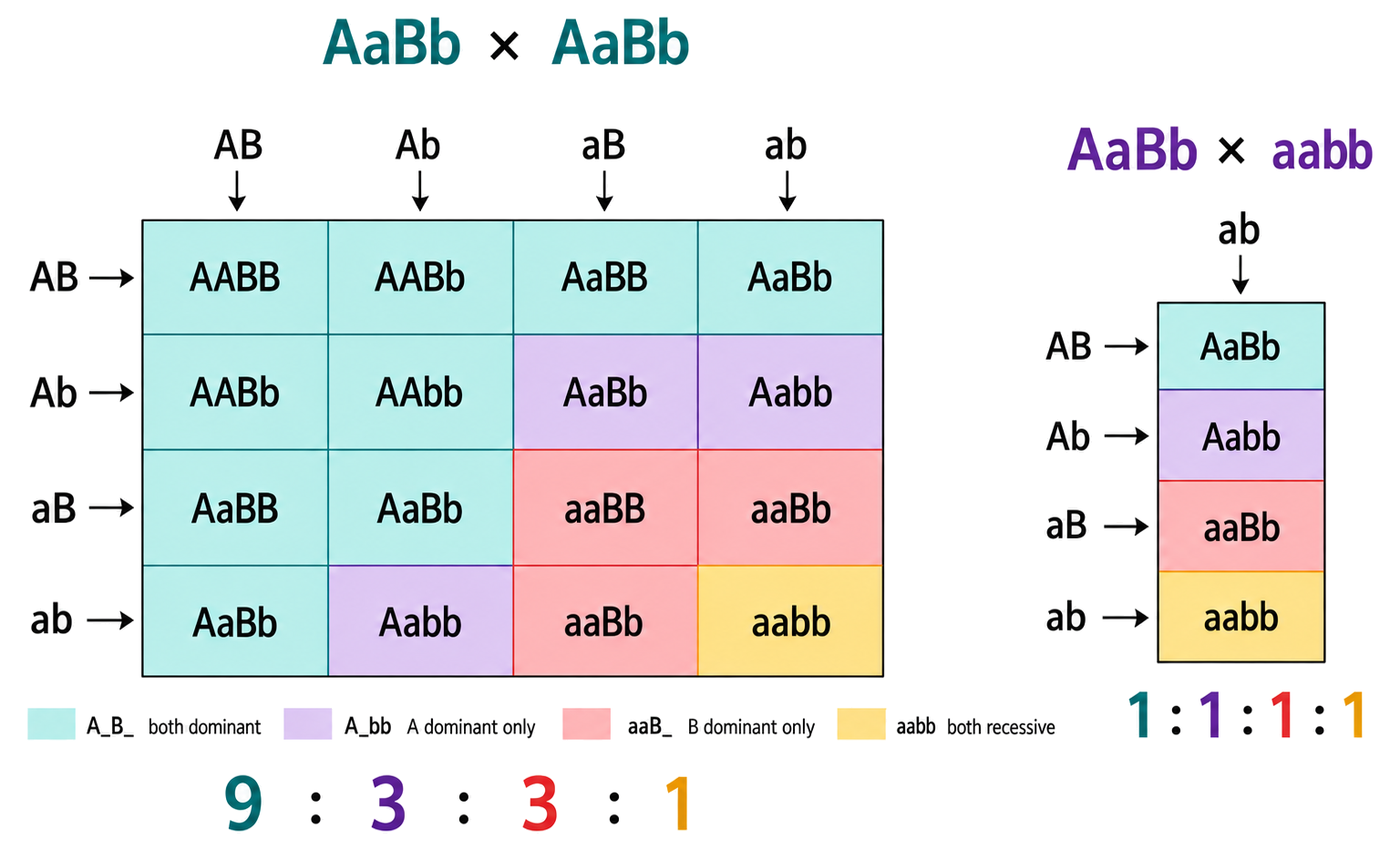
A dihybrid cross follows two loci at once; for unlinked autosomal genes, the four gamete types from AaBb are expected equally.

Cross under complete dominance Expected phenotypic ratio
AaBb × AaBb 9 A_B_ : 3 A_bb : 3 aaB_ : 1 aabb
AaBb × aabb (test cross) 1 A_B_ : 1 A_bb : 1 aaB_ : 1 aabb

Multiply the independent 3:1 monohybrid phenotype probabilities to obtain 9:3:3:1; in a test cross, each offspring directly reveals one of the heterozygote's four gamete types.

For AaBb × AaBb, P(A_B_) = 3/4 × 3/4 = 9/16, while P(aabb) = 1/4 × 1/4 = 1/16.

These ratios assume unlinked loci, complete dominance, equal gamete viability and a sufficiently large sample. Genes far apart on one chromosome may also approach 50% recombination.

Dihybrid crosses

HL only

Assessment in practice

1–2 marks
How it is assessed

This objective is assessed through structured response, commonly using Determine / Identify / State.

Command terms

Determine / Identify / State / Explain / Predict

What earns marks

Build the answer around this relationship: A dihybrid cross follows two genes simultaneously.

Representative question

Question 1

[Maximum number: 3]

The expected ratio of phenotypes in the offspring of a cross between a plant with narrow, yellow leaves and a plant heterozygous for the genes for leaf width and colour is 1: 1: 1: 1.

Justify this expected ratio using a Punnett grid or other diagram.

Retrieve the HL Inheritance Route

HL only

HL D3.2 is secure when chromosome behaviour explains the ratios: segregation and independent assortment produce unlinked dihybrid expectations, gene loci explain linkage, recombinants reveal crossing over, and chi-squared decides whether observed counts fit the expected model.

  • homologous chromosomes separate and random bivalent orientation assort unlinked genes
  • unlinked autosomal genes can produce 9:3:3:1 or 1:1:1:1 ratios
  • linked genes give more parental types and fewer recombinants after crossing over
  • observed counts are compared with expected ratios using df and p = 0.05

Solve HL Linkage and Chi-Squared Questions

HL only

HL inheritance transfer is about deciding whether the expected ratio should be Mendelian or linked, then testing the evidence. Start from meiosis and gene location, predict gametes or ratios, identify parental and recombinant classes, and use chi-squared when observed counts need a statistical conclusion.

  • Explain segregation and independent assortment from meiosis before using dihybrid ratios.
  • Use gene loci, linkage, crossing over, and recombinant frequency to interpret offspring classes.
  • Apply chi-squared with observed/expected values, degrees of freedom, p = 0.05, and a null-hypothesis conclusion.

Concept essentials

  • A dihybrid cross follows two genes simultaneously.
  • Independent assortment creates different gamete combinations for unlinked genes.
  • The 9:3:3:1 ratio applies only to particular heterozygous unlinked crosses.