D3.2.12—Haemophilia
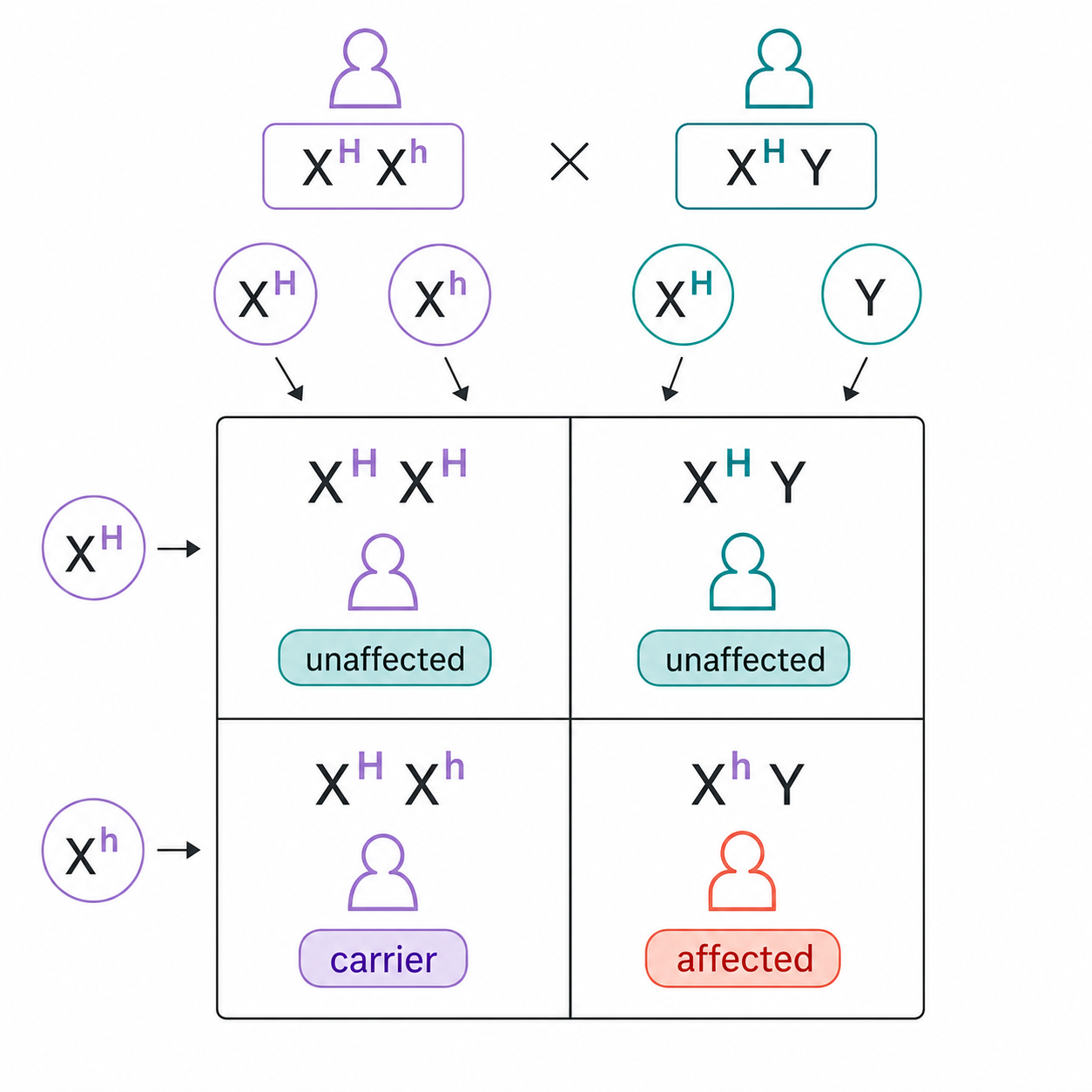
Haemophilia is an X-linked recessive disorder, so carrier females can have affected sons and affected males pass alleles through daughters.
- Syllabus
- First assessment 2025
- Objective
- D3.2.12
- Level
- HL
Haemophilia is an X-linked recessive disorder, so carrier females can have affected sons and affected males pass alleles through daughters.

Coverage 2013–2021 · Updated 16 Jul 2026
Haemophilia alleles on the X chromosome reduce a clotting factor; the recessive pattern makes affected XY individuals more common.
An XY individual has one X allele; an XX individual may have a second functional allele; a carrier mother can pass the allele to sons or daughters. Trace the allele combination through the stated biological mechanism before predicting the result.
Write X-linked genotypes and track which parent supplies each X.; compare the stated alleles and outcome
Carrier mother XH Xh and unaffected father XH Y can have an affected son Xh Y. This gives a concrete prediction from the stated parental information.
Probabilities describe a model, not one guaranteed child. Interpret the result within the stated inheritance model and its sample or environmental limits.
This objective is assessed through structured response, commonly using Identify / Deduce / Explain.
Identify / Deduce / Explain / Outline / State / Predict
Build the answer around this relationship: Males express an X-linked recessive allele if it is on their single X chromosome.
Representative question
Explain how males inherit hemophilia and how females can become carriers for the condition.
hemophilia is due to a recessive allele/is a recessive trait/ XH is normal allele and Xh is hemophilia allele;
hemophilia is sex linked;
allele/gene is on the X chromosome;
Marking guidance:
Reject disease/hemophilia carried on X chromosome.
(sex chromosomes in) females are XX while males are XY;
Y chromosomes do not have the allele/hemophiliac males are XhY;
males inherit their X chromosome from their mother/do not pass the allele to sons;
males have only one copy so recessive trait/allele is not masked;
males have a 50 % chance of hemophilia/receiving the allele if mother is a carrier;
carrier is heterozygous for the gene/is XHXh;
dominant/normal allele masks the recessive allele (so clotting is normal);
females inherit one X chromosome from father and one from mother;
affected/hemophiliac males have carrier daughters;
hemophilia allele could have been inherited from either parent;
Accept the points above explained either in text or clearly using a Punnett grid or genetic diagram, but not for simply reproducing an unlabeled Punnett grid or diagram without explanation.
Core D3.2 is secure when the student can move from allele rules into predictions and evidence: gametes form genotypes, genotypes can produce phenotypes, different dominance patterns need different notation, and pedigrees or plots require evidence-based interpretation.
Core inheritance exam questions reward disciplined reasoning. First identify the inheritance rule, then write the correct notation or evidence, then state the phenotype, ratio, or conclusion. This prevents the common mistake of writing definitions without solving the genetic problem.