D3.2.10—Incomplete dominance and codominance

Incomplete dominance blends heterozygote phenotype, while codominance expresses both alleles fully in the heterozygote in inheritance problems in inheritance problems.

Syllabus
First assessment 2025
Objective
D3.2.10
Level
HL

Exam analysis

Chance of appearing3%of analysed past papers
Latest appearanceNovember 2019
Most common paperPaper1
Typical marks1–6

Common command terms

  • Identify
  • Describe

Recent exam appearances

November 2019Paper1 ["HL"] · TZ013[ 1 ]D3.2.10—Incomplete dominance and codominance
November 2014Paper2 ["HL"] · TZ07(b)[ 6 ]D3.2.10—Incomplete dominance and codominance
May 2014Paper1 ["HL"] · TZ111[ 1 ]D3.2.10—Incomplete dominance and codominance

Coverage 2014–2019 · Updated 16 Jul 2026

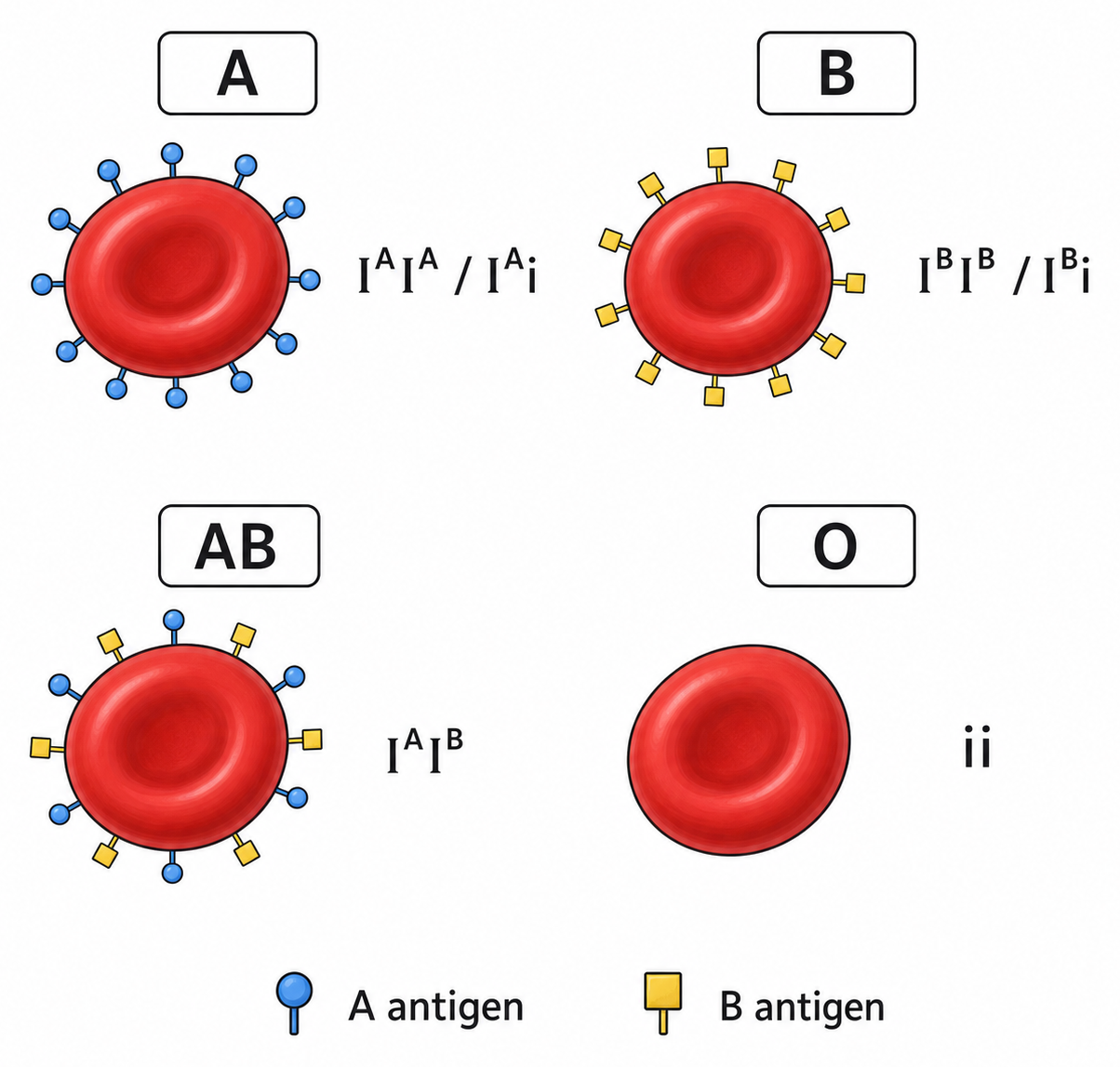
ABO Combines Three Alleles into Four Blood-Group Phenotypes

Phenotype Possible genotype(s) Red-cell antigen(s)
A IᴬIᴬ or Iᴬi A
B IᴮIᴮ or Iᴮi B
AB IᴬIᴮ A and B
O ii neither A nor B

Iᴬ and Iᴮ are codominant because both antigen products appear in IᴬIᴮ. Each is dominant to i, which produces neither A nor B antigen.

Blood group is a phenotype; Iᴬ, Iᴮ and i are alleles. A person with group A or B may hide an i allele, so phenotype does not always identify genotype.

Red blood cells show A antigen for blood group A, B antigen for group B, both antigens for AB and neither antigen for O, alongside the corresponding ABO genotypes.

The Heterozygote Separates Complete Dominance, Codominance and Incomplete Dominance

Allele relationship Heterozygote phenotype Example
complete dominance matches the dominant homozygote Tt pea is tall
codominance both allele products are detectably expressed IᴬIᴮ has A and B antigens
incomplete dominance intermediate between the two homozygotes red × white Mirabilis gives pink F1
Heterozygote × heterozygote Genotype ratio Phenotype ratio
complete dominance 1:2:1 3:1
codominance or incomplete dominance 1:2:1 1:2:1 when all three genotypes are distinguishable

Codominance is not blending: both products remain identifiable. In incomplete dominance, the heterozygote is intermediate rather than showing two separate products side by side.

Incomplete Dominance Makes Every F2 Genotype Visible

P generation: FᴿFᴿ red × FᵂFᵂ white → all FᴿFᵂ pink F1 offspring.

FᴿFᵂ × FᴿFᵂ Fᴿ gamete Fᵂ gamete
Fᴿ gamete FᴿFᴿ red FᴿFᵂ pink
Fᵂ gamete FᴿFᵂ pink FᵂFᵂ white

F2 genotype ratio = phenotype ratio = 1 red : 2 pink : 1 white because the heterozygote has its own recognizable phenotype.

Segregation has not changed: each heterozygote still makes the two gamete types equally. The different phenotypic ratio comes from how the heterozygous genotype is expressed.

Inheritance Predictions Move from Chromosomes to Alleles to Phenotypes

homologous chromosomes carry two alleles in a diploid parent → meiosis separates one allele into each gamete → fertilization restores a two-allele genotype → allele relationship and environment shape phenotype → offspring data test the prediction

For any genetic cross:

  • define allele symbols and their relationship
  • write parental genotypes, not only phenotypes
  • derive gametes before drawing the grid
  • combine gametes, then translate genotype to phenotype
  • state probabilities and the assumptions behind them
If the simple 3:1 expectation fails First question to ask
heterozygote has a third phenotype incomplete dominance?
both products appear codominance?
phenotype changes with conditions environmental or plastic response?
more than two alleles occur in the population multiple-allele locus such as ABO?

Incomplete dominance and codominance

[ 1 ]

A Mirabilis jalapa plant with red flowers was crossed with one with white flowers. All plants in the F1 generation had pink flowers. What phenotype ratio would be expected in the F2 generation?

Concept essentials

  • Incomplete dominance produces an intermediate heterozygote phenotype.
  • Codominance expresses both alleles in the heterozygote.
  • Non-Mendelian allele relationships can make phenotype ratios match genotype ratios.