D3.2.19 (HL)—Autosomal gene linkage
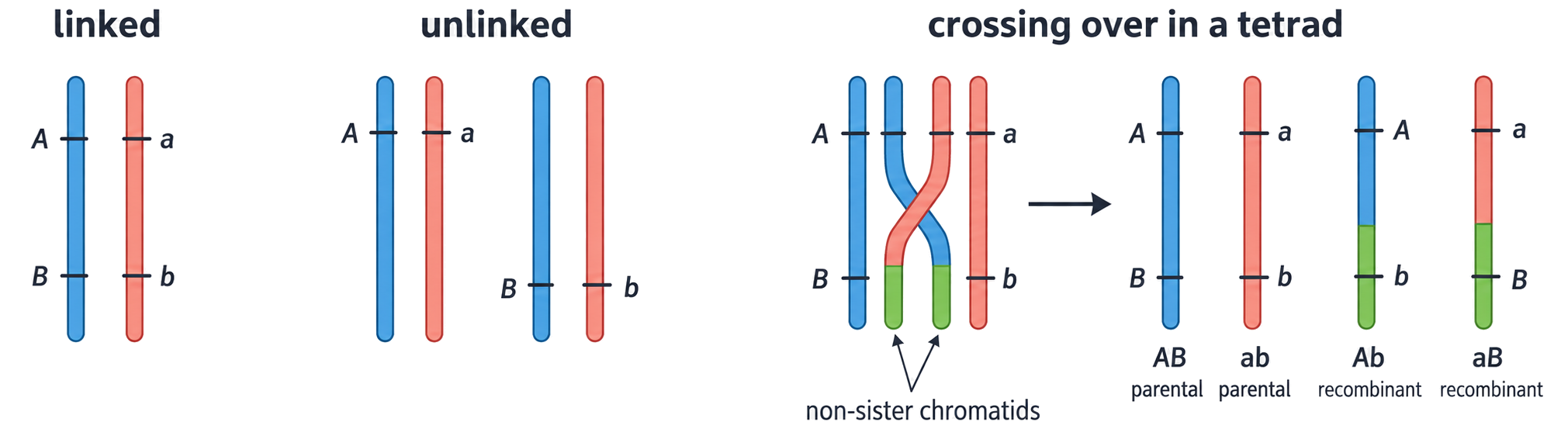
Autosomal gene linkage occurs when genes on the same non-sex chromosome tend to be inherited together unless crossing over separates them.
- Syllabus
- First assessment 2025
- Objective
- D3.2.19
- Level
- HL
Autosomal gene linkage occurs when genes on the same non-sex chromosome tend to be inherited together unless crossing over separates them.

Coverage 2013–2025 · Updated 16 Jul 2026
Autosomal linkage occurs when two genes lie on the same autosome and are therefore inherited together more often than expected by independent assortment.
The chromosome, not each allele, moves as a unit during meiosis unless crossing over occurs between the loci. Closer loci have a lower chance of being separated by a chiasma.
Show linked alleles beside two vertical lines representing homologous chromosomes—for example AB/ab for coupling or Ab/aB for repulsion—rather than writing only AaBb.
A test cross producing many AB and ab offspring but few Ab and aB offspring supports linkage in the AB/ab heterozygote.
Gene linkage means loci share a chromosome; sex linkage specifically means a locus lies on a sex chromosome. They are not synonyms.
This objective is assessed through structured response, commonly using Identify / Define / Compare.
Identify / Define / Compare / Explain / Distinguish / Outline
Build the answer around this relationship: Linked autosomal genes are on the same non-sex chromosome.
Representative question
Outline how it can be shown that the genes for shell base colour (Cc) and presence or absence of bands (Bb) are linked.
a. perform a cross/test cross
b. (if) double heterozygotes/CcBb are crossed with double homozygous recessives/ccbb
OR
Punnett square/genetic diagram showing CcBb crossed with ccbb
OR
CCB×CCb
c. (then) expected ratio (for unlinked genes) is 1:1:1:1
d. (if) double heterozygotes/CcBb are crossed together
OR
Punnett square showing CcBb crossed with CcBb
OR
Punnett square showing CcBb crossed with CcBb
e. (then) expected ratio (for unlinked genes) is 9:3:3:1
f. no/fewer than expected recombinants if genes are linked
OR
fewer pink banded/yellow unbanded if the genes are linked
OR
linked genes are expressed together more often than expected
g. use chi-square test (for significance of difference)
h. linked genes are on the same chromosome/diagram showing this
[3 max]
HL D3.2 is secure when chromosome behaviour explains the ratios: segregation and independent assortment produce unlinked dihybrid expectations, gene loci explain linkage, recombinants reveal crossing over, and chi-squared decides whether observed counts fit the expected model.
HL inheritance transfer is about deciding whether the expected ratio should be Mendelian or linked, then testing the evidence. Start from meiosis and gene location, predict gametes or ratios, identify parental and recombinant classes, and use chi-squared when observed counts need a statistical conclusion.