Q BankQuestion BankDocsDocuments

D1.2.18 (HL)—Polypeptide modification

Polypeptide modification can convert an inactive precursor into a functional protein through cleavage, folding or chemical processing after translation in cells.

Syllabus
First assessment 2025
Objective
D1.2.18
Level
HL

Exam analysis

Chance of appearing1%of analysed past papers
Latest appearanceMay 2016
Most common paperPaper2
Typical marks2

Common command terms

  • Suggest

Recent exam appearances

May 2016Paper2 ["HL"] · TZ01(g)[ 2 ]D1.2.18 (HL)—Polypeptide modification
Practice this objective

Coverage 2016–2016 · Updated 16 Jul 2026

Polypeptides Are Modified after Translation

HL only

New polypeptides can be folded, cleaved or chemically modified after translation before becoming functional proteins.

Processing can expose an active site, add a targeting group, join subunits or alter stability. The final protein depends on sequence and post-translational handling.

Name: initial chain; processing event; structural change; functional consequence.

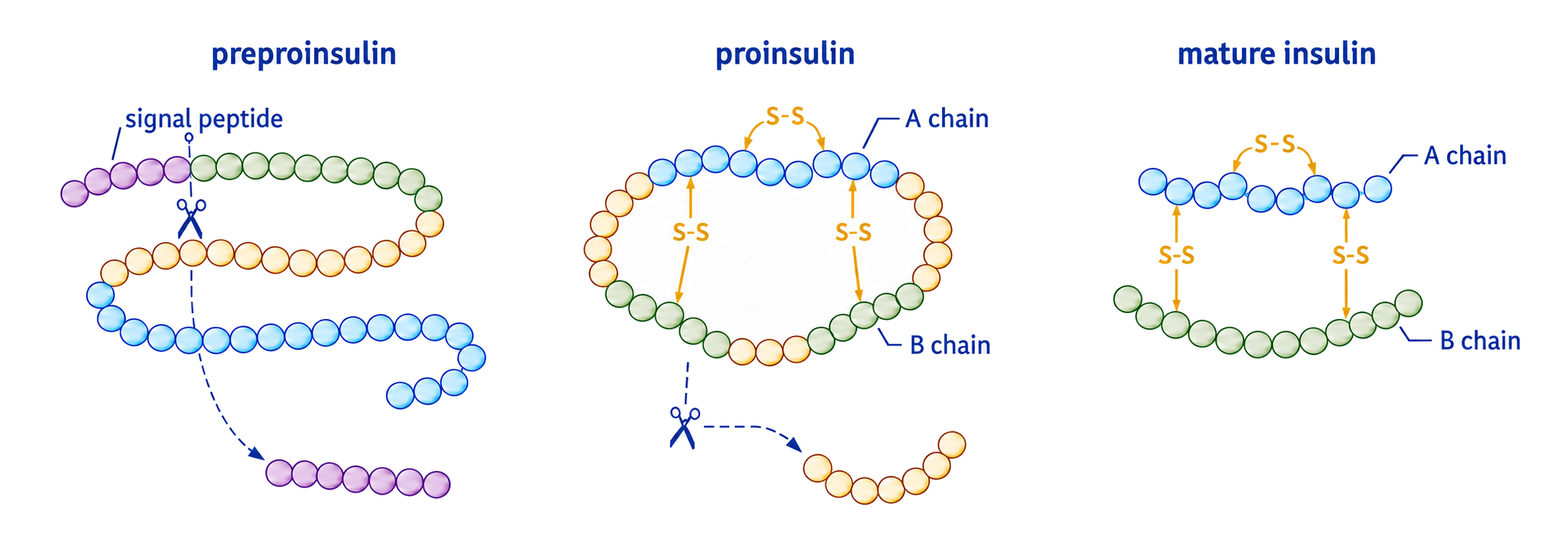
A precursor protein can be cleaved to remove a signal segment and reveal the mature active form.

Translation ending does not guarantee a functional protein; folding and processing may still be required.

Polypeptide modification

HL only

Assessment in practice

2 marks
How it is assessed

This objective is assessed through structured response, commonly using Suggest.

Command terms

Suggest

What earns marks

Build the answer around this relationship: A newly translated polypeptide may be an inactive precursor.

Representative question

Question 1

[Maximum number: 2]

Insulin is produced by cutting C -peptide from the precursor molecule proinsulin. Suggest why group 1 has a greater level of C-peptide than group 2.

HL Protein Synthesis Details

HL only

RNA polymerase reads template DNA 3' to 5' and synthesizes RNA 5' to 3'; ribosomes translate mRNA codons in the 5' to 3' direction. Promoters mark transcription start regions and orientation; transcription factors help RNA polymerase bind and initiate in eukaryotes. Non-coding DNA does not code for polypeptide amino acid sequences and includes introns, regulatory sequences, telomeres, rRNA genes, and tRNA genes. Eukaryotic pre-mRNA is modified before export and translation by adding a 5' cap and poly-A tail and removing introns by splicing. Alternative splicing joins different exon combinations from one pre-mRNA, so one gene can produce multiple protein variants in different cells or stages. Translation initiation assembles ribosomal subunits at the start codon AUG; initiator tRNA enters the P site and A, P, and E sites organize tRNA movement. Newly made polypeptides may be folded, cleaved, or chemically modified; preproinsulin processing to active insulin is a key example. Proteasomes degrade tagged, damaged, or unneeded proteins; amino acid recycling supports new protein synthesis and proteome quality control.

Concept essentials

  • A newly translated polypeptide may be an inactive precursor.
  • Cleavage can remove peptide segments to activate a protein.
  • C-peptide is produced when proinsulin is processed to insulin.
  • Protein function can depend on processing after translation.
ConceptIB Biology HL