D1.2.2—Hydrogen bonding in transcription

Hydrogen bonding allows RNA nucleotides to align with the DNA template during transcription through specific complementary base pairing with exposed bases.

Syllabus
First assessment 2025
Objective
D1.2.2
Level
HL

Exam analysis

Chance of appearing4%of analysed past papers
Latest appearanceMay 2024
Most common paperPaper1
Typical marks1

Common command terms

  • Determine

Scoring notes

Common mistake
Writing thymine in an mRNA sequence instead of uracil.

Recent exam appearances

May 2024Paper1 ["HL"] · TZ128[ 1 ]D1.2.2—Hydrogen bonding in transcription
May 2017Paper1 ["HL"] · TZ19[ 1 ]D1.2.2—Hydrogen bonding in transcription
November 2014Paper1 ["HL"] · TZ030[ 1 ]D1.2.2—Hydrogen bonding in transcription
May 2013Paper1 ["HL"] · TZ17[ 1 ]D1.2.2—Hydrogen bonding in transcription
November 2012Paper1 ["HL"] · TZ027[ 1 ]D1.2.2—Hydrogen bonding in transcription
Practice this objective

Coverage 2012–2024 · Updated 16 Jul 2026

Hydrogen Bonds Let the Template Open and Close

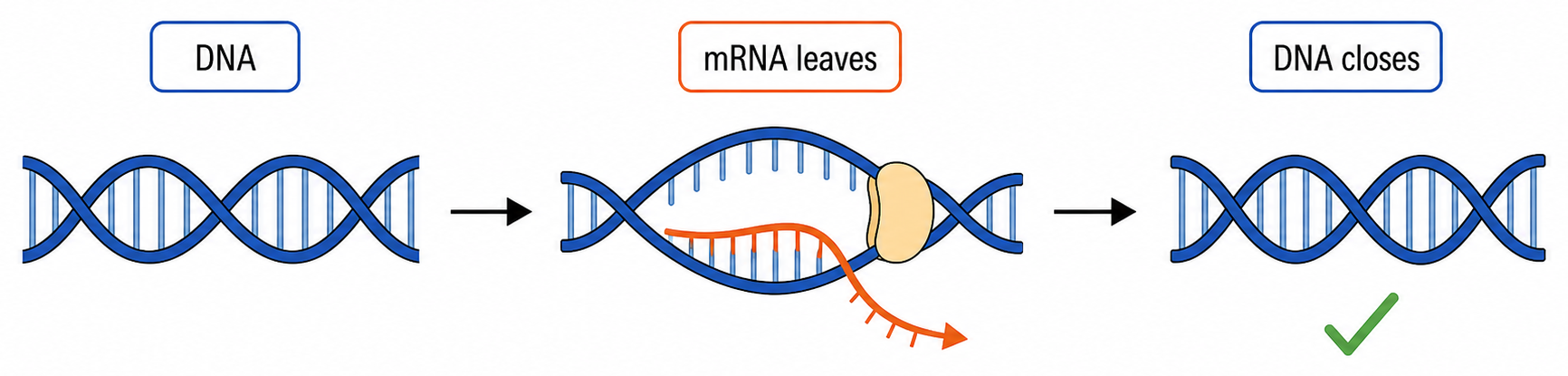
Temporary hydrogen bonds between complementary bases allow an RNA sequence to be specified from a DNA template during transcription.

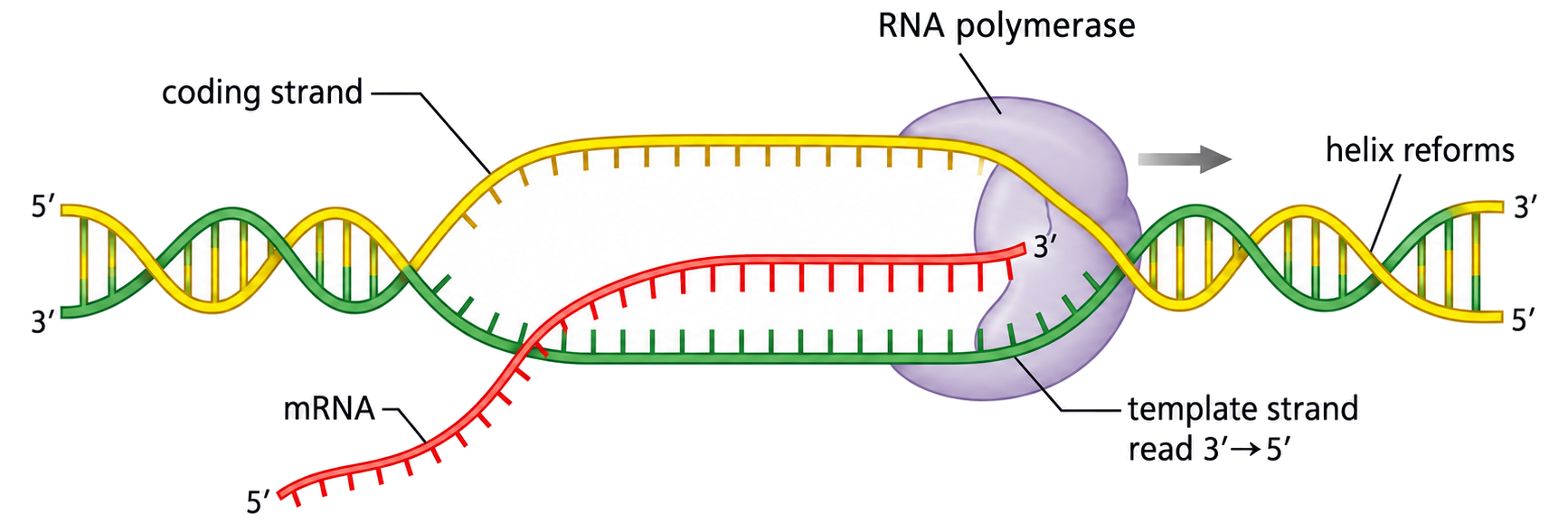
DNA hydrogen bonds separate locally while the covalent sugar–phosphate backbones remain intact. RNA nucleotides form complementary hydrogen bonds to exposed template bases before RNA polymerase joins them.

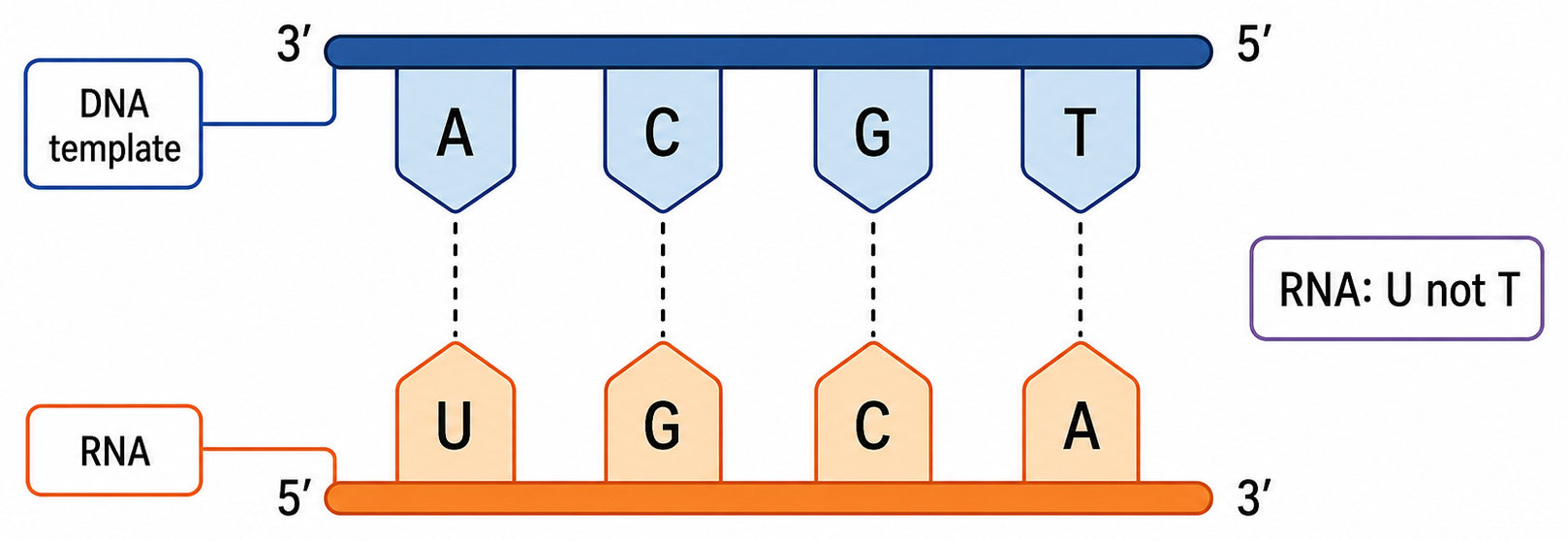
DNA template A pairs with RNA U; DNA template T pairs with RNA A; DNA C pairs with RNA G; DNA G pairs with RNA C.

A DNA template segment 3′-TACG-5′ specifies RNA 5′-AUGC-3′: template adenine is represented by uracil in RNA, not thymine.

Complementary does not mean identical. Hydrogen bonds guide base choice; phosphodiester bonds form the stable RNA backbone.

Hydrogen bonding in transcription

Assessment in practice

1 marks
How it is assessed

This objective is assessed through multiple choice, commonly using Determine.

Command terms

Determine

What earns marks

Build the answer around this relationship: RNA uses uracil instead of thymine during base pairing.

Watch for

Writing thymine in an mRNA sequence instead of uracil.

Representative question

Question 1

[Maximum number: 1]

The sequence of bases on a short section of the antisense strand of a gene undergoing transcription is shown:

5 CATG 35^{\prime} \text { CATG } 3^{\prime}

What is the sequence of bases on the resulting mRNA?

A

33^{\prime} CATG 55^{\prime}

B

5' GUAC 3'

C

33^{\prime} GUAC 55^{\prime}

D

3GTAC3^{\prime} \mathrm{GTAC} 5'

Core Protein Synthesis

  • Transcription: RNA polymerase builds complementary mRNA from the DNA template; A pairs with U and C with G.
  • Translation: ribosomes read mRNA codons 5′ to 3′ while tRNA anticodons deliver specific amino acids for peptide-bond formation.
  • Genetic code: codons are triplets; the code is degenerate and almost universal, with start and stop signals. Use mRNA—not DNA—when reading a code table.
  • Information flow: codon order determines amino-acid sequence, which determines protein folding and function.
  • Expression and variation: cells regulate which genes are transcribed. A mutation may change a codon, primary structure and phenotype, as in sickle-cell haemoglobin.

Concept essentials

  • RNA uses uracil instead of thymine during base pairing.
  • The mRNA strand is complementary to the antisense DNA template.
  • The sense DNA strand matches mRNA except for thymine and uracil.
  • Hydrogen bonds align RNA nucleotides before covalent bonds form.