D1.2.3—DNA template stability
The DNA template remains chemically stable during transcription because its sequence is read repeatedly without being consumed, copied permanently or altered.
- Syllabus
- First assessment 2025
- Objective
- D1.2.3
- Level
- HL
The DNA template remains chemically stable during transcription because its sequence is read repeatedly without being consumed, copied permanently or altered.
Chromosomal DNA is the long-term information store. Protein synthesis instead uses a short-lived messenger RNA (mRNA) copy of a selected gene.
selected gene in DNA → complementary mRNA copy → mRNA reaches a ribosome → nucleotide sequence directs amino-acid order
A working copy solves two problems:
mRNA carries information; it is not converted into protein matter. The ribosome reads its sequence while amino acids are joined into a separate molecule.
Hydrogen bonds between complementary bases can break and re-form. This lets a short DNA region open temporarily without breaking the covalent sugar–phosphate backbones.
After the mRNA leaves, the original complementary DNA strands pair again. The gene's base sequence is conserved and can be transcribed repeatedly.
Transcription copies one gene region into RNA; it does not duplicate the whole DNA molecule and does not consume the template strand.
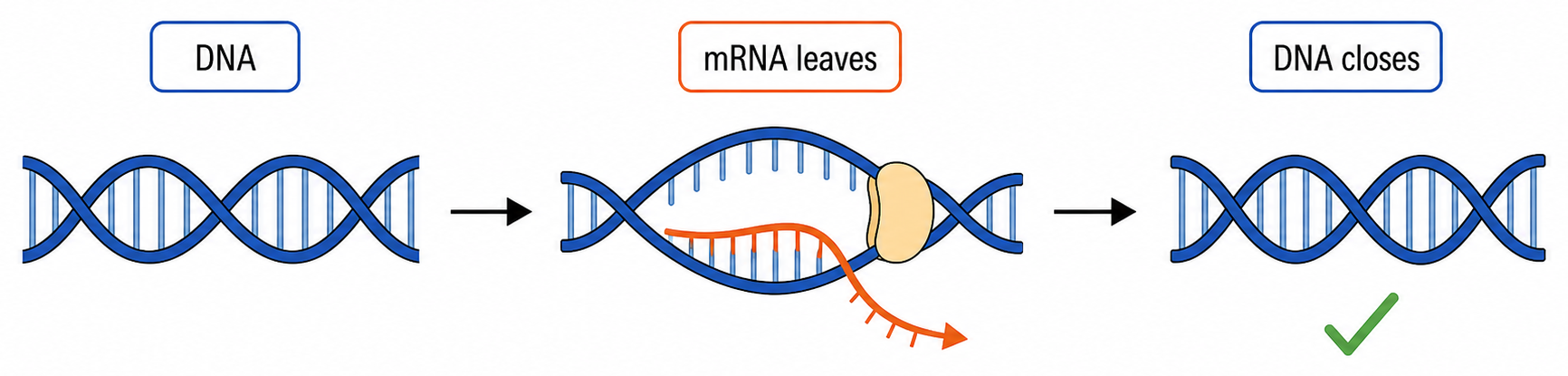
gene selected → DNA opens locally → RNA polymerase reads one template strand → complementary RNA nucleotides are joined → mRNA leaves → DNA re-forms unchanged
| Question | Correct check |
|---|---|
| Which DNA strand determines mRNA? | the template strand |
| Which base replaces thymine in RNA? | uracil |
| Which direction is mRNA written? | 5′→3′ |
| Why can the gene be reused? | DNA sequence and covalent backbones remain intact |
The mRNA now carries codons in an order that a ribosome can translate into an amino-acid sequence.