D1.2.17 (HL)—Translation initiation

Translation initiation and ribosomal tRNA sites organize start-codon recognition, amino acid entry, peptide transfer and tRNA exit during protein synthesis.

Syllabus
First assessment 2025
Objective
D1.2.17
Level
HL

Exam analysis

Chance of appearing5%of analysed past papers
Latest appearanceMay 2025
Most common paperPaper1
Typical marks1–3

Common command terms

  • Outline

Scoring notes

Common mistake
Putting the initiator tRNA into the E site or A site instead of linking initiation to the start codon and P site.

Recent exam appearances

May 2025Paper1A ["HL"] · TZ311[ 1 ]D1.2.17 (HL)—Translation initiation
November 2023Paper2 ["HL"] · TZ22(c)[ 3 ]D1.2.17 (HL)—Translation initiation
November 2022Paper1 ["HL"] · TZ028[ 1 ]D1.2.17 (HL)—Translation initiation
November 2019Paper1 ["HL"] · TZ027[ 1 ]D1.2.17 (HL)—Translation initiation
May 2017Paper2 ["HL"] · TZ26(b)[ 4 ]D1.2.17 (HL)—Translation initiation
Practice this objective

Coverage 2017–2025 · Updated 16 Jul 2026

Translation Initiation Sets the Reading Frame

HL only

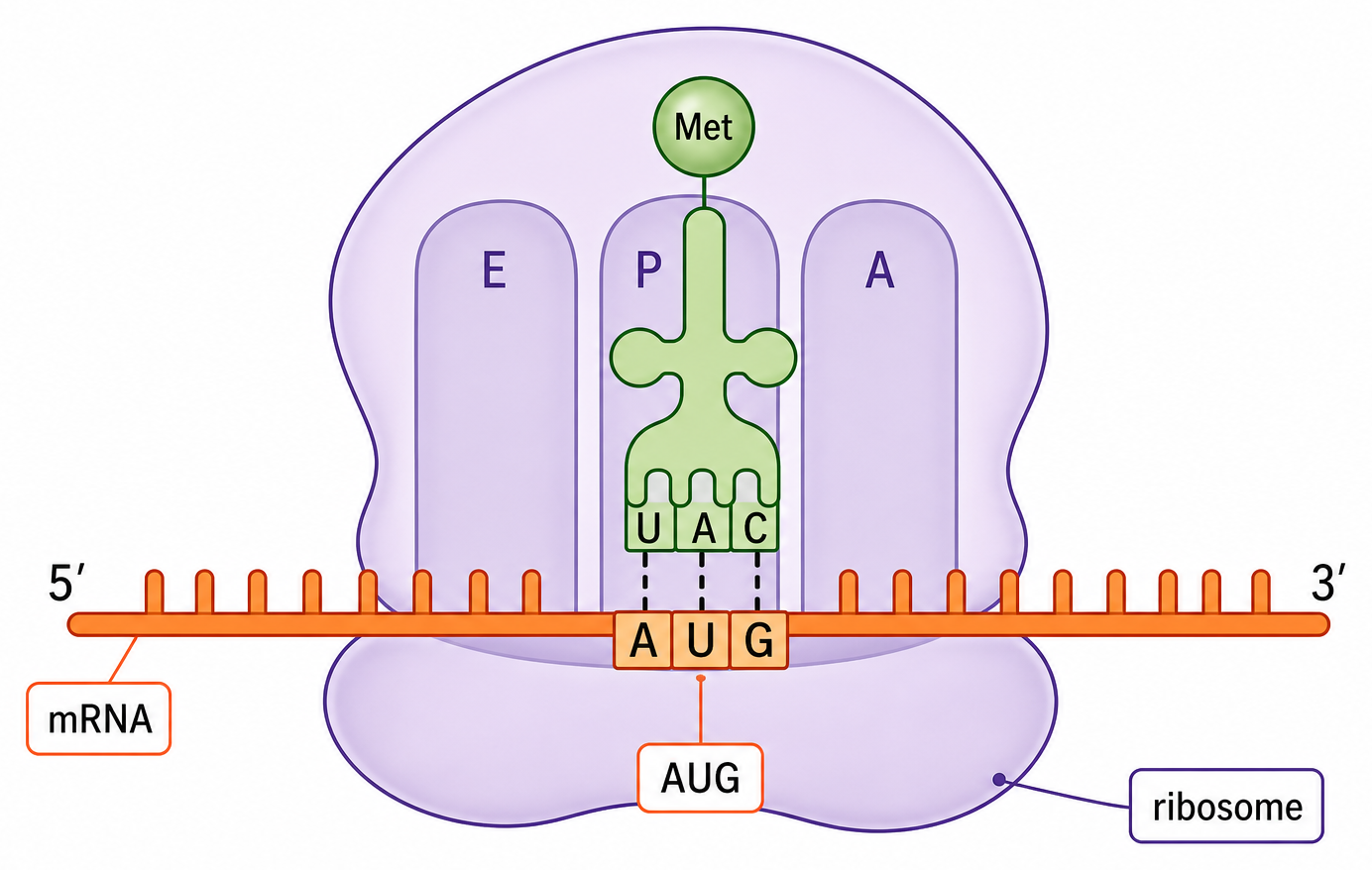
Translation initiation assembles the ribosome at the mRNA start codon and establishes the reading frame; A, P and E sites then organize tRNA movement during elongation.

The small ribosomal subunit attaches near the mRNA 5′ terminal and moves to the start codon. An initiator tRNA pairs with that codon; the large subunit attaches, and the next matching tRNA can enter.

Ribosome site Role during elongation
A (aminoacyl) Accepts the incoming charged tRNA
P (peptidyl) Holds the tRNA carrying the growing polypeptide
E (exit) Holds/releases the uncharged tRNA before it leaves

After peptide-bond formation and translocation, tRNAs shift through the sites: the growing-chain tRNA moves to P, the empty tRNA moves to E, and A becomes available for the next tRNA.

The start codon fixes the triplet reading frame. A/P/E describe tRNA positions, not three separate ribosomes.

Translation initiation

HL only

Assessment in practice

1–3 marks
How it is assessed

This objective is assessed through structured response, commonly using Outline.

Command terms

Outline

What earns marks

Build the answer around this relationship: The small ribosomal subunit binds mRNA early in initiation.

Watch for

Putting the initiator tRNA into the E site or A site instead of linking initiation to the start codon and P site.

Representative question

Question 1

[Maximum number: 4]

Outline the roles of the different binding sites for tRNA on ribosomes during translation.

HL Protein Synthesis Details

HL only

RNA polymerase reads template DNA 3' to 5' and synthesizes RNA 5' to 3'; ribosomes translate mRNA codons in the 5' to 3' direction. Promoters mark transcription start regions and orientation; transcription factors help RNA polymerase bind and initiate in eukaryotes. Non-coding DNA does not code for polypeptide amino acid sequences and includes introns, regulatory sequences, telomeres, rRNA genes, and tRNA genes. Eukaryotic pre-mRNA is modified before export and translation by adding a 5' cap and poly-A tail and removing introns by splicing. Alternative splicing joins different exon combinations from one pre-mRNA, so one gene can produce multiple protein variants in different cells or stages. Translation initiation assembles ribosomal subunits at the start codon AUG; initiator tRNA enters the P site and A, P, and E sites organize tRNA movement. Newly made polypeptides may be folded, cleaved, or chemically modified; preproinsulin processing to active insulin is a key example. Proteasomes degrade tagged, damaged, or unneeded proteins; amino acid recycling supports new protein synthesis and proteome quality control.

Concept essentials

  • The small ribosomal subunit binds mRNA early in initiation.
  • The start codon AUG establishes the reading frame for translation.
  • The A site receives incoming aminoacyl-tRNA.
  • The P site holds the growing polypeptide, and the E site releases empty tRNA.