D1.2.10—Elongation of polypeptide

Polypeptide elongation adds amino acids sequentially as ribosomes translocate along mRNA, while polysomes translate one transcript simultaneously in active cells.

Syllabus
First assessment 2025
Objective
D1.2.10
Level
HL

Exam analysis

Chance of appearing3%of analysed past papers
Latest appearanceMay 2019
Most common paperPaper1
Typical marks1

Common command terms

  • Explain

Scoring notes

Common mistake
Describing several ribosomes on one mRNA as several genes rather than one transcript being translated many times.

Recent exam appearances

May 2019Paper1 ["HL"] · TZ128[ 1 ]D1.2.10—Elongation of polypeptide
May 2018Paper1 ["HL"] · TZ128[ 1 ]D1.2.10—Elongation of polypeptide
November 2013Paper1 ["HL"] · TZ027[ 1 ]D1.2.10—Elongation of polypeptide

Coverage 2013–2019 · Updated 16 Jul 2026

Elongation Repeats Until a Stop Codon Ends Translation

1

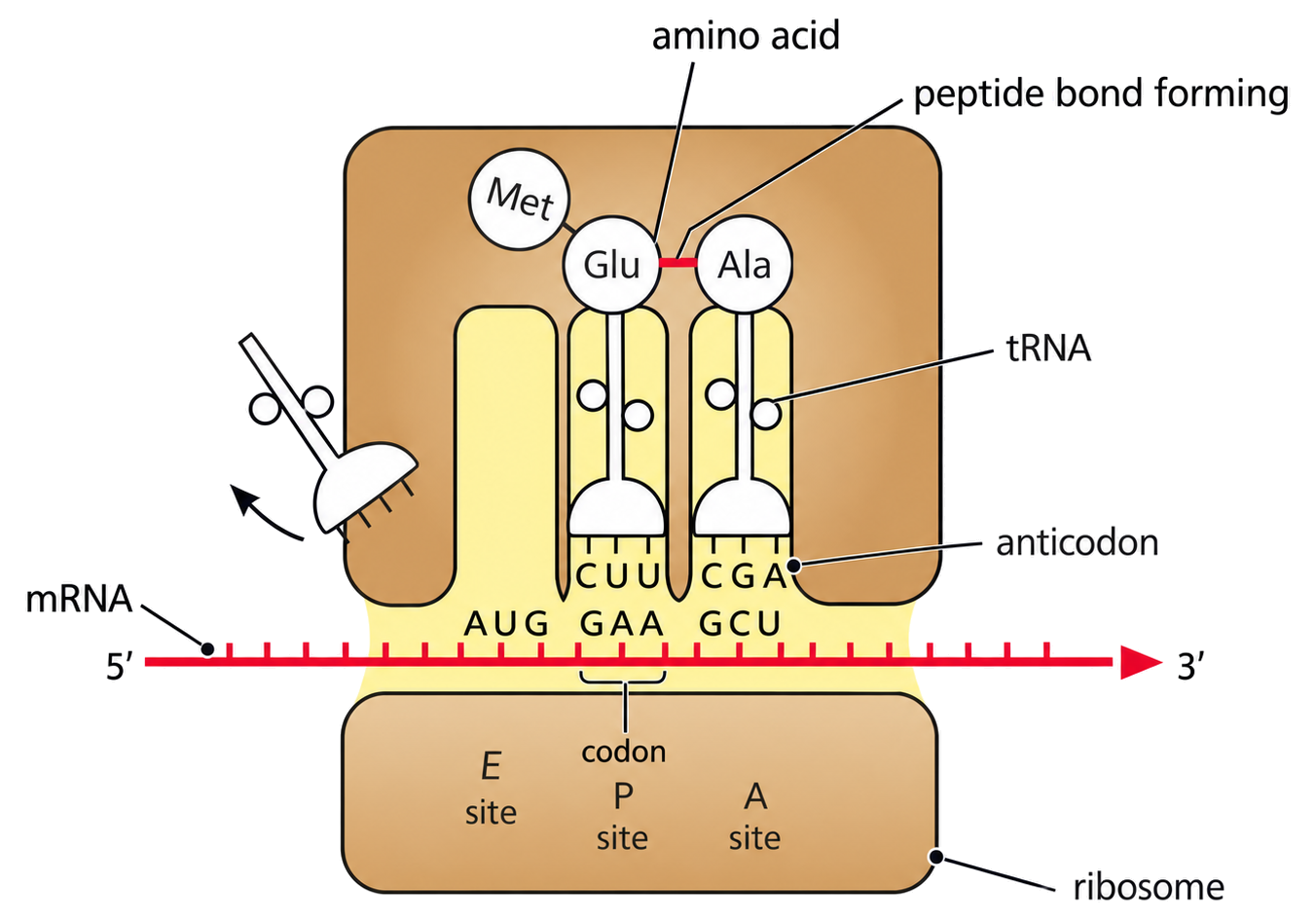
A charged tRNA with a complementary anticodon enters the A site beside the tRNA carrying the growing chain in the P site.

A ribosome positions mRNA codons and complementary tRNA anticodons in E, P and A sites while peptide bonds extend a polypeptide.
2

The ribosome catalyses a peptide bond, transferring the growing polypeptide to the amino acid on the A-site tRNA.

3

The ribosome moves one codon along the mRNA. The peptidyl-tRNA shifts to P, the empty tRNA shifts to E and exits, and the A site becomes available again.

4

The entry–bond–movement cycle repeats for successive codons. When a stop codon reaches the A site, no tRNA enters; a release factor releases the completed polypeptide and the ribosome dissociates.

A Polysome Makes Several Copies from One mRNA at Once

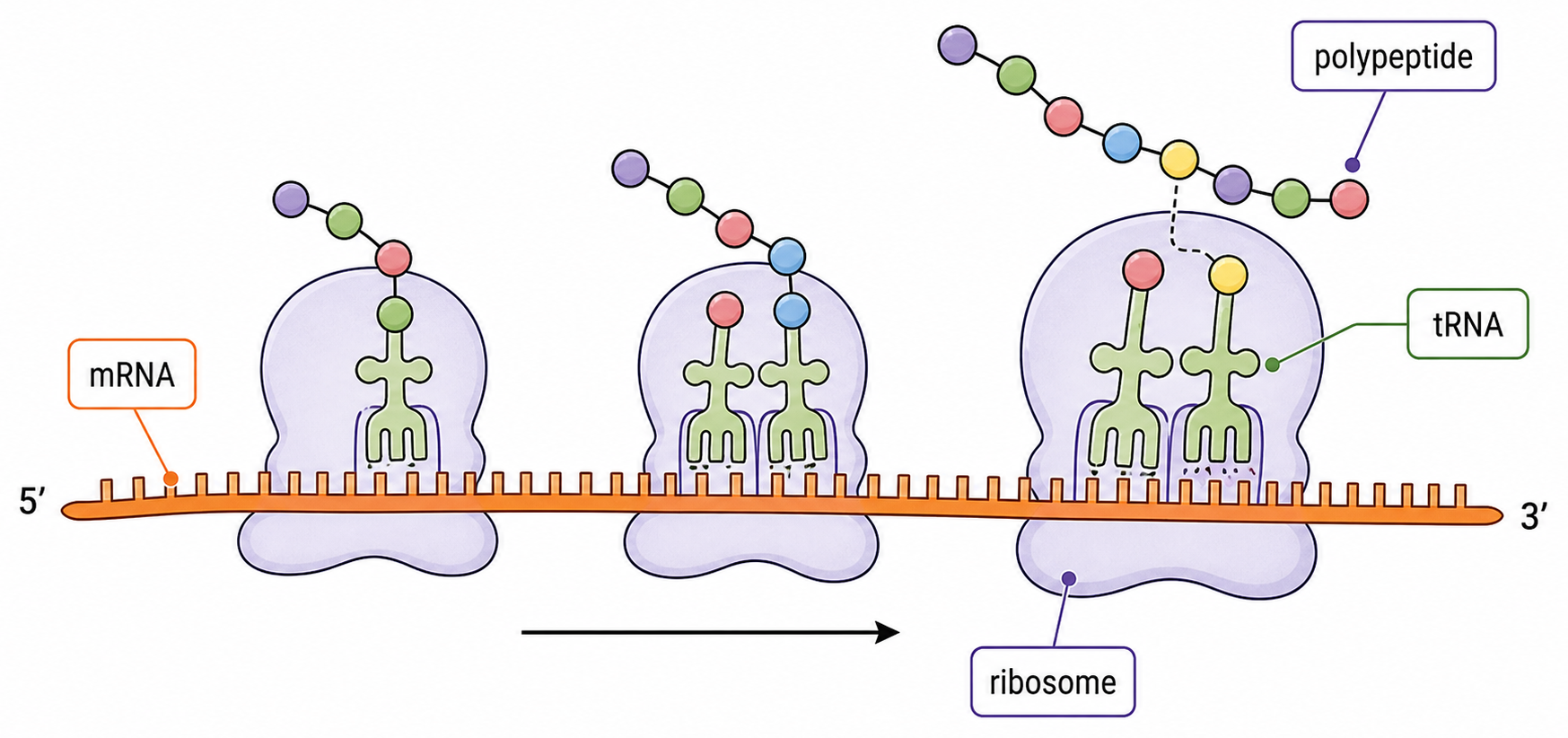
A polysome is one mRNA being translated simultaneously by several ribosomes. Each ribosome starts near the 5′ end and moves toward the 3′ end.

All ribosomes read the same codon sequence, so they produce polypeptides with the same amino-acid order. Simultaneous translation increases the rate of protein production from that mRNA.

The ribosomes do not cooperate to make one long polypeptide. Each ribosome makes a separate copy.

Several ribosomes move in the same 5′ to 3′ direction along one mRNA, each producing a polypeptide.

Trace Information—and the Places Where It Can Change

DNA template → complementary mRNA → codons read 5′→3′ → charged tRNAs selected → peptide bonds join amino acids → polypeptide primary structure

Checkpoint Question to ask
transcription Is the mRNA complementary to the template and written 5′→3′?
code table Are mRNA codons grouped from the correct start?
tRNA selection Does the anticodon pair and is the tRNA correctly charged?
elongation Has the ribosome advanced one codon while the chain remains on the peptidyl-tRNA?
mutation Did the codon, amino acid or reading frame actually change?

A sequence change matters biologically only through a causal path: altered primary structure → altered interactions or folding → altered protein activity → possible cellular or organism effect.

A, P and E Sites Track Each tRNA's State

HL only
Ribosomal site Typical tRNA state during elongation
A (aminoacyl) incoming charged tRNA paired with the next codon
P (peptidyl) tRNA carrying the growing polypeptide before peptide transfer
E (exit) uncharged tRNA leaving after translocation

Before peptide transfer: growing chain in P, new amino acid in A.

After peptide transfer and translocation: the chain-bearing tRNA occupies P, the empty tRNA moves to E, and A opens for the next charged tRNA.

The site letters describe functional positions in the ribosome, not permanent labels on a tRNA. A single tRNA can move A → P → E during one cycle.

Elongation of polypeptide

[ 2 ]

Six polypeptides are shown in the diagram. Explain the different lengths of these polypeptides.

Concept essentials

  • Elongation lengthens a polypeptide one amino acid at a time.
  • Ribosomes translocate along mRNA as translation proceeds.
  • A polysome consists of many ribosomes on one mRNA molecule.
  • Farther-moving ribosomes usually carry longer growing polypeptides.