D1.2.19 (HL)—Amino acid recycling by proteasomes

Proteasomes recycle amino acids by degrading damaged, misfolded or unneeded proteins into reusable components for new protein synthesis and quality control.

Syllabus
First assessment 2025
Objective
D1.2.19
Level
HL

Proteasomes Recycle Unneeded Proteins

HL only

Proteasomes break selected proteins into peptides, allowing amino acids to be recycled for new protein synthesis or metabolism.

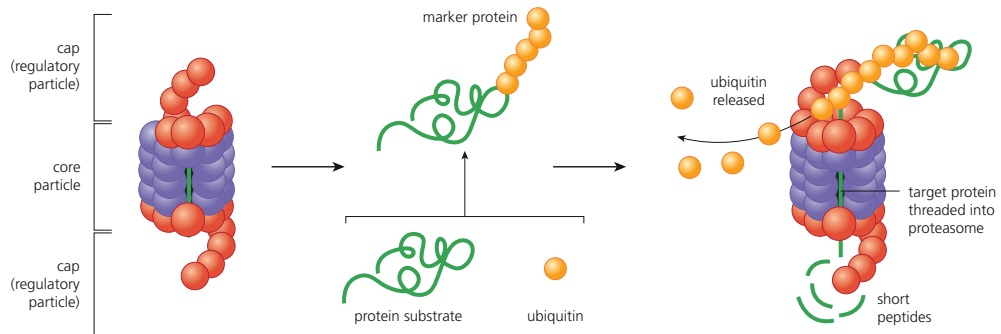
Damaged or short-lived proteins are tagged and fed into a proteasome, where peptide bonds are hydrolysed. Released amino acids return to the cellular pool.

Trace: protein tag; proteasome entry; peptide breakdown; amino-acid reuse or catabolism.

A misfolded protein can be removed and its amino acids reused to build a different protein.

Proteasomal degradation is controlled recycling, not random digestion of every protein. Proteasomes do not recycle every protein immediately; tagging and recognition determine which substrates are selected.

HL Protein Synthesis Details

HL only

RNA polymerase reads template DNA 3' to 5' and synthesizes RNA 5' to 3'; ribosomes translate mRNA codons in the 5' to 3' direction. Promoters mark transcription start regions and orientation; transcription factors help RNA polymerase bind and initiate in eukaryotes. Non-coding DNA does not code for polypeptide amino acid sequences and includes introns, regulatory sequences, telomeres, rRNA genes, and tRNA genes. Eukaryotic pre-mRNA is modified before export and translation by adding a 5' cap and poly-A tail and removing introns by splicing. Alternative splicing joins different exon combinations from one pre-mRNA, so one gene can produce multiple protein variants in different cells or stages. Translation initiation assembles ribosomal subunits at the start codon AUG; initiator tRNA enters the P site and A, P, and E sites organize tRNA movement. Newly made polypeptides may be folded, cleaved, or chemically modified; preproinsulin processing to active insulin is a key example. Proteasomes degrade tagged, damaged, or unneeded proteins; amino acid recycling supports new protein synthesis and proteome quality control.

Concept essentials

  • Proteasomes degrade selected proteins inside cells.
  • Ubiquitin tagging can target proteins for proteasome breakdown.
  • Protein degradation releases amino acids that can be reused.
  • Amino acid recycling supports new protein synthesis and quality control.