EduNinja
[Maximum number: 3]

Antibiotics are drugs which are very important in the treatment and cure of some diseases.

(a)

Some antibiotics act as competitive inhibitors of enzymes in pathogens.

[ 3 ]
(i)

Suggest the effect which penicillin will have on bacterial cells.

[ 3 ]
[Maximum number: 3]

The disease-causing bacterium, Pseudomonas aeruginosa, may occur in the form of a 'biofilm'. A biofilm consists of a layer of bacteria, growing on a surface and attached to one another. Such biofilms are difficult to control by antibiotics.

A mutant strain of P. aeruginosa has been found which produces biofilms that are indistinguishable from those of the wild-type bacteria. However, the mutant strain differs from the wild-type in its resistance to an antibiotic, A.

(a)

Antibiotic A belongs to a group of antibiotics known as anti-pseudomonal penicillins.

[ 3 ]
(i)

Describe the mode of action of penicillin on bacteria.

[ 3 ]
(a)

Folic acid is a molecule used by all cells for growth. Bacteria cannot absorb folic acid from their surroundings. Bacteria use an enzyme to make a molecule called PABA. PABA is used to make folic acid.

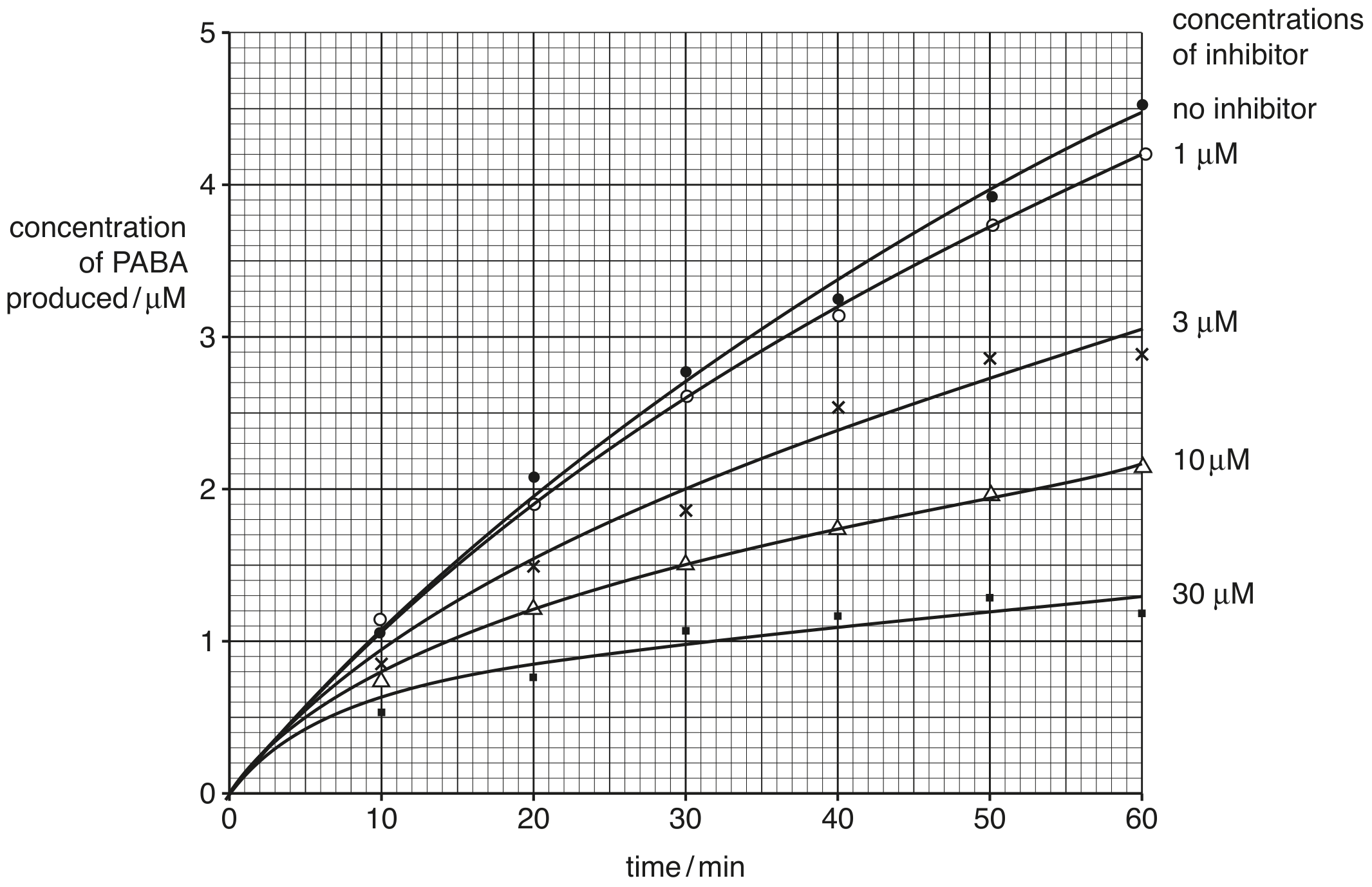
An investigation was carried out to determine the effect on the production of PABA when the concentration of an enzyme inhibitor is increased. Four different concentrations ( 1μM1 \mu \mathrm{M} to 30μM)30 \mu \mathrm{M}) of the inhibitor were used, together with a control with no inhibitor.

The concentration of PABA produced in each reaction mixture was determined at 10 minute intervals.

The results are shown in Fig. 2.1.

Fig. 2.1

Fig. 2.1

[ 1 ]
(i)

Folic acid from the diet is able to enter human cells, but is not able to cross bacterial cell walls. Human cells do not have an enzyme to make PABA.

Suggest why the inhibitor of this enzyme could be used as a drug to treat bacterial infections in humans.

[ 1 ]
(a)

Penicillin belongs to a group of antibiotics known as β\beta lactams, which all act in the same way on bacteria.

Describe how penicillin kills non-resistant bacteria.

[ 4 ]
(a)

Outline the role of antibiotics in the treatment of infectious diseases, such as TB.

Tobacco smoking is a risk factor for a number of diseases. This means that it increases the risk of developing disease. In 2009, the World Health Organization (WHO) published a factsheet stating that tobacco smoking:
- may be responsible for more than 20 % of the new cases of TB globally
- increases the risk of becoming infected and having active TB
- increases the risk of dying from TB
- is a risk factor for TB in all socioeconomic groups.

Projects have been set up in a number of different countries to tackle this health problem. One project involves health workers encouraging TB patients to give up smoking.

[ 4 ]
[Maximum number: 5]

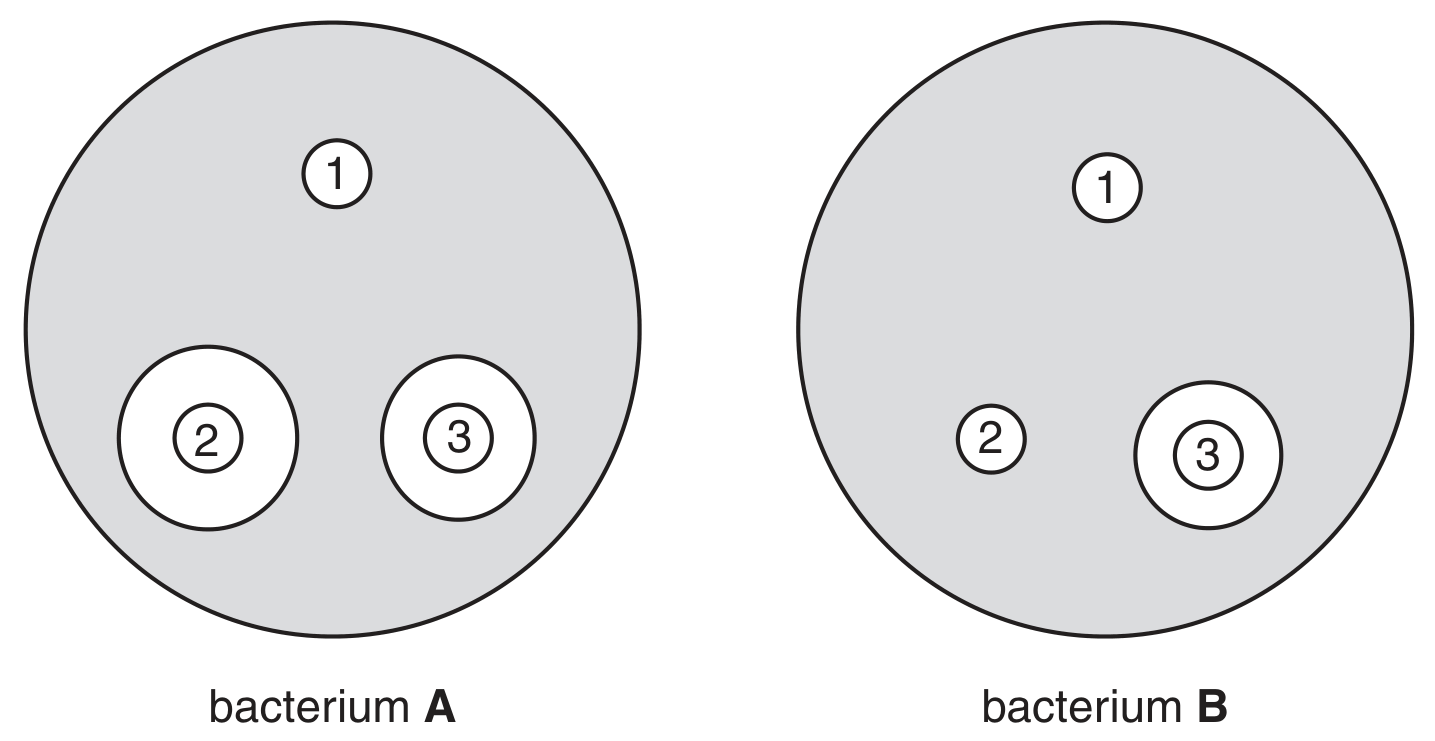
The sensitivity of bacteria to antibiotics can be tested using the disc diffusion method. An inoculum of the bacteria is spread onto agar culture plates and then filter paper discs impregnated with antibiotic are pressed onto the surface of the agar. The plates are incubated. Bacteria grow as a 'lawn' across the agar, but a circular zone (the zone of inhibition) appears around any disc where bacterial growth is inhibited.

Two species of bacteria, A and B, were grown on separate culture plates in the presence of three types of filter paper disc:

1 - no antibiotic (control)
2 - penicillin V, a natural penicillin
3 - carboxypenicillin, a synthetic penicillin.
The appearance of the incubated plates is shown in Fig. 3.1.

Fig. 3.1

Fig. 3.1

(a)

With reference to Fig. 3.1, explain the effect of penicillin V on bacterium A.

[ 3 ]
(b)

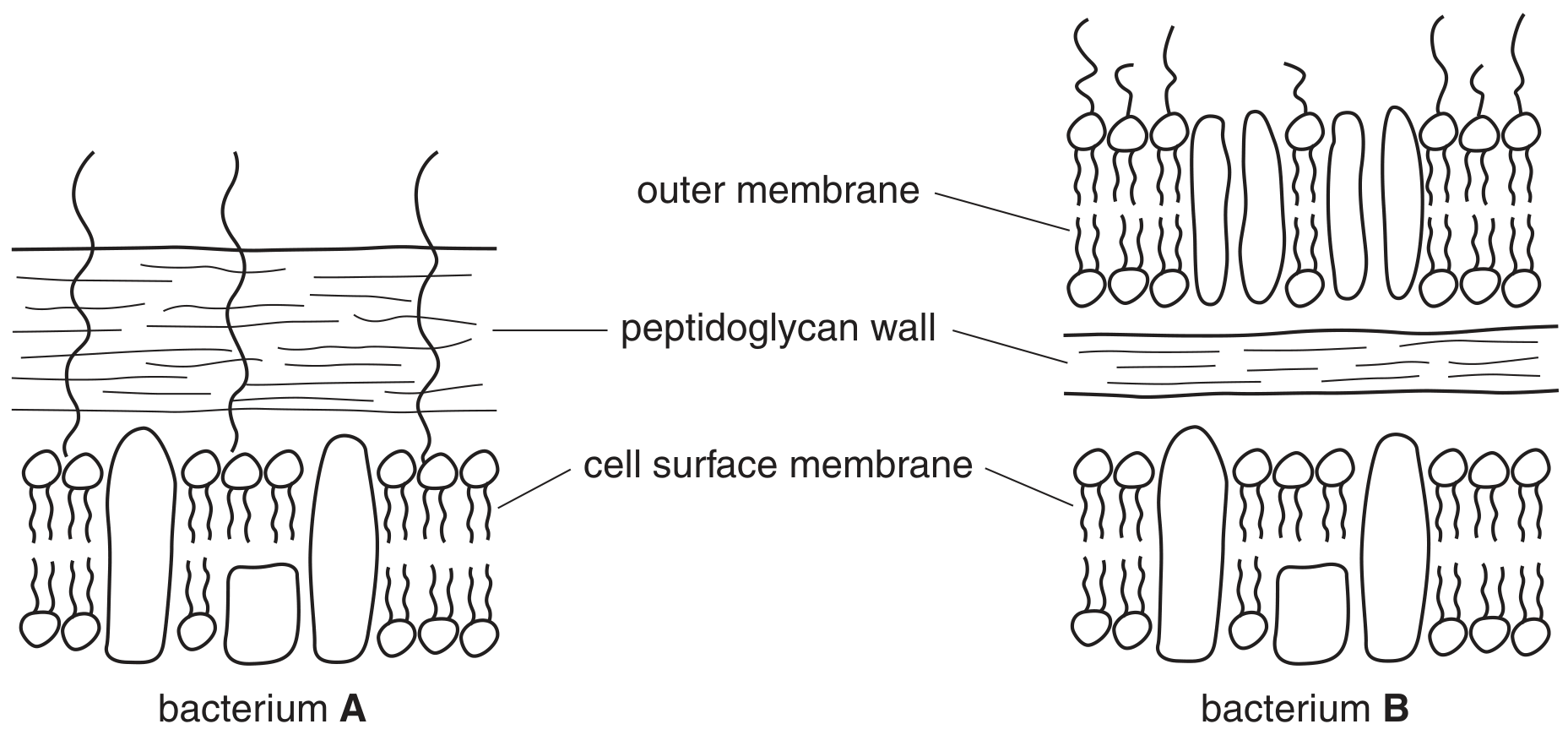
Bacteria A and B have different outer layers, as shown in Fig. 3.2.

Fig. 3.2

Fig. 3.2

With reference to Fig. 3.1 and Fig. 3.2

[ 2 ]
(i)

explain the different effects of penicillin V on bacteria A and B

[ 2 ]
[Maximum number: 3]

Penicillin-binding proteins (PBPs) are proteins found in the cell surface membranes of bacteria. PBPs catalyse the final steps in the production of a peptidoglycan cell wall.

(a)

Penicillin-resistant mutants of the bacterium, Staphylococcus aureus, produce a PBP, PBP2a, that does not bind well with penicillin.

Suggest how the presence of PBP2a in the cell surface membrane provides S. aureus with resistance to the effects of penicillin.

[ 3 ]
[Maximum number: 2]

Tuberculosis (TB) is an infectious disease that kills about three million people worldwide each year.

(a)

Streptomycin was the first antibiotic to be discovered that was effective against the pathogen that causes tuberculosis. Streptomycin causes the death of the pathogen by binding to ribosomes and inhibiting protein synthesis.

[ 2 ]
(i)

Suggest two ways in which streptomycin acts at ribosomes to inhibit protein synthesis.

1
2.

[ 2 ]
[Maximum number: 1]

Some antibiotics work by binding to ribosomes and preventing protein synthesis.
Which statement explains why these antibiotics kill bacterial cells but not human cells?

A

In bacterial cells mRNA is formed in the cytoplasm from naked DNA.

B

Ribosomes in human cells have a different structure from those in bacterial cells.

C

The antibiotics cannot pass through human cell surface membranes.

D

The tRNA molecules in bacterial cells are different from those in human cells.

0