EduNinja
[Maximum number: 1]

Haemoglobin is a complex protein molecule made of four separate subunits, as shown in Fig. 3.1.
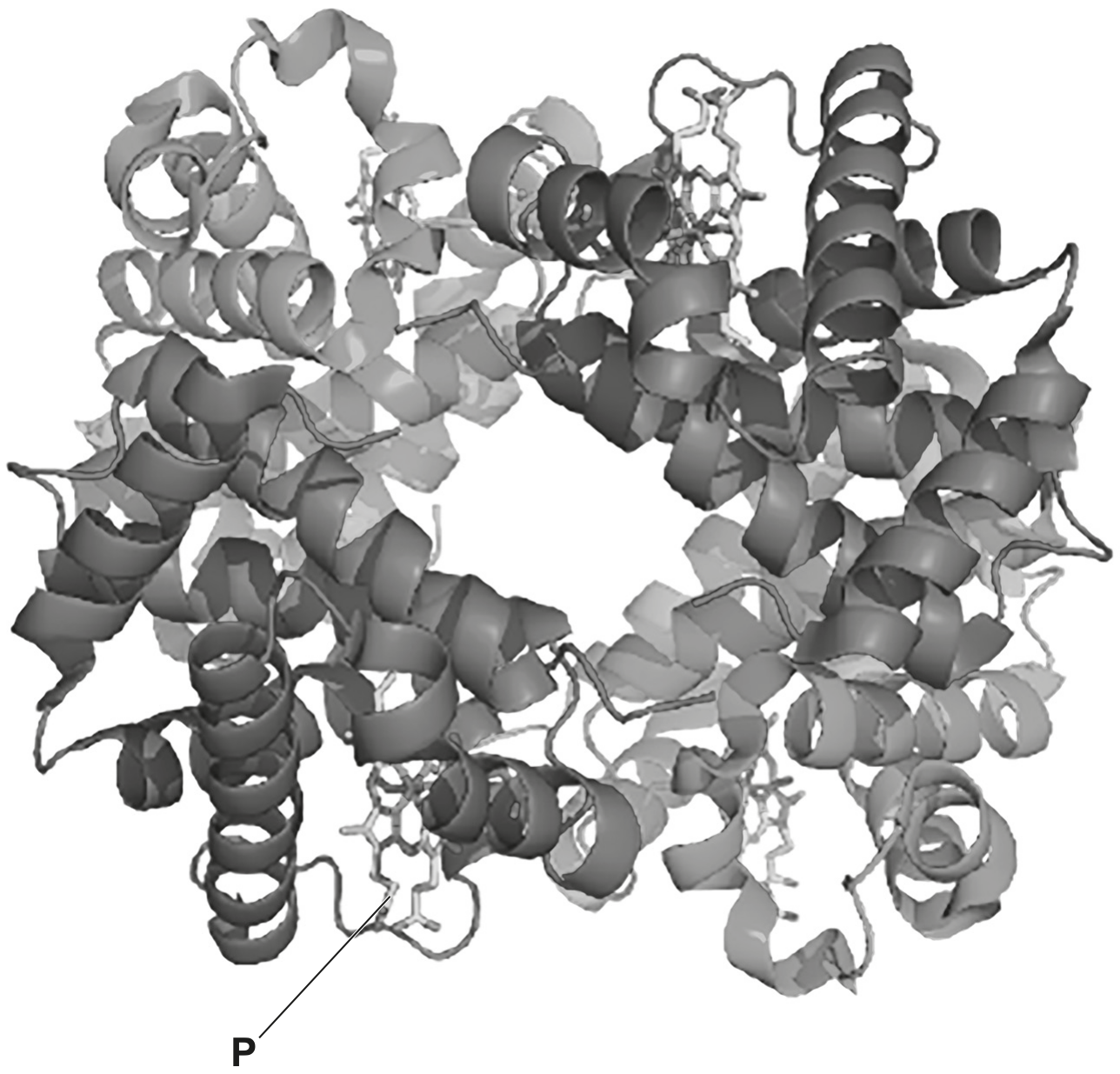
Fig. 3.1

Fig. 3.1

(a)

When haemoglobin associates (binds) with oxygen it forms oxyhaemoglobin.

State the precise site in the mammalian body where haemoglobin molecules bind with oxygen.

[ 1 ]
[Maximum number: 3]

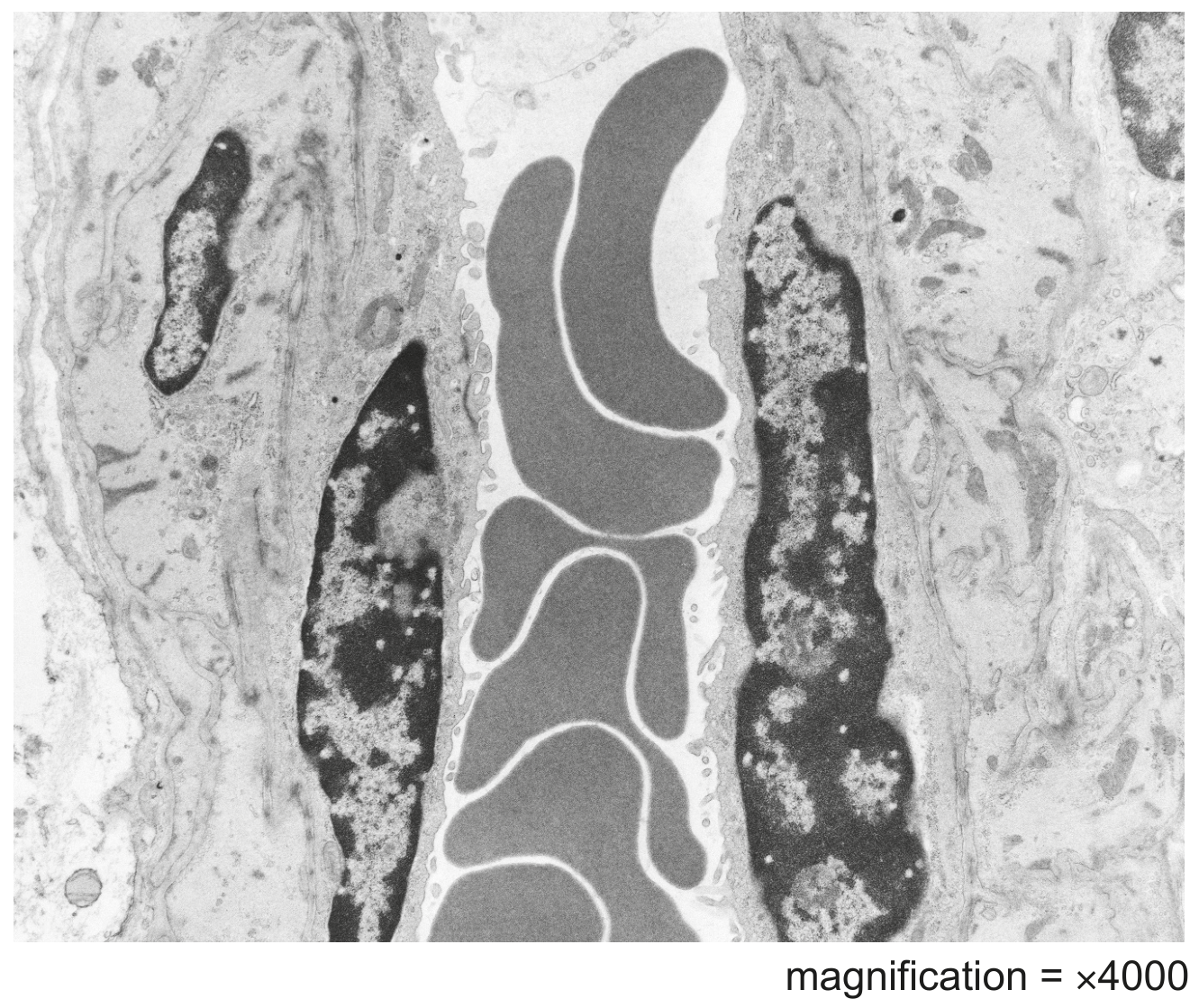
Fig. 3.1 is a transmission electron micrograph showing red blood cells in a capillary of a healthy adult.

Fig. 3.1

Fig. 3.1

(a)

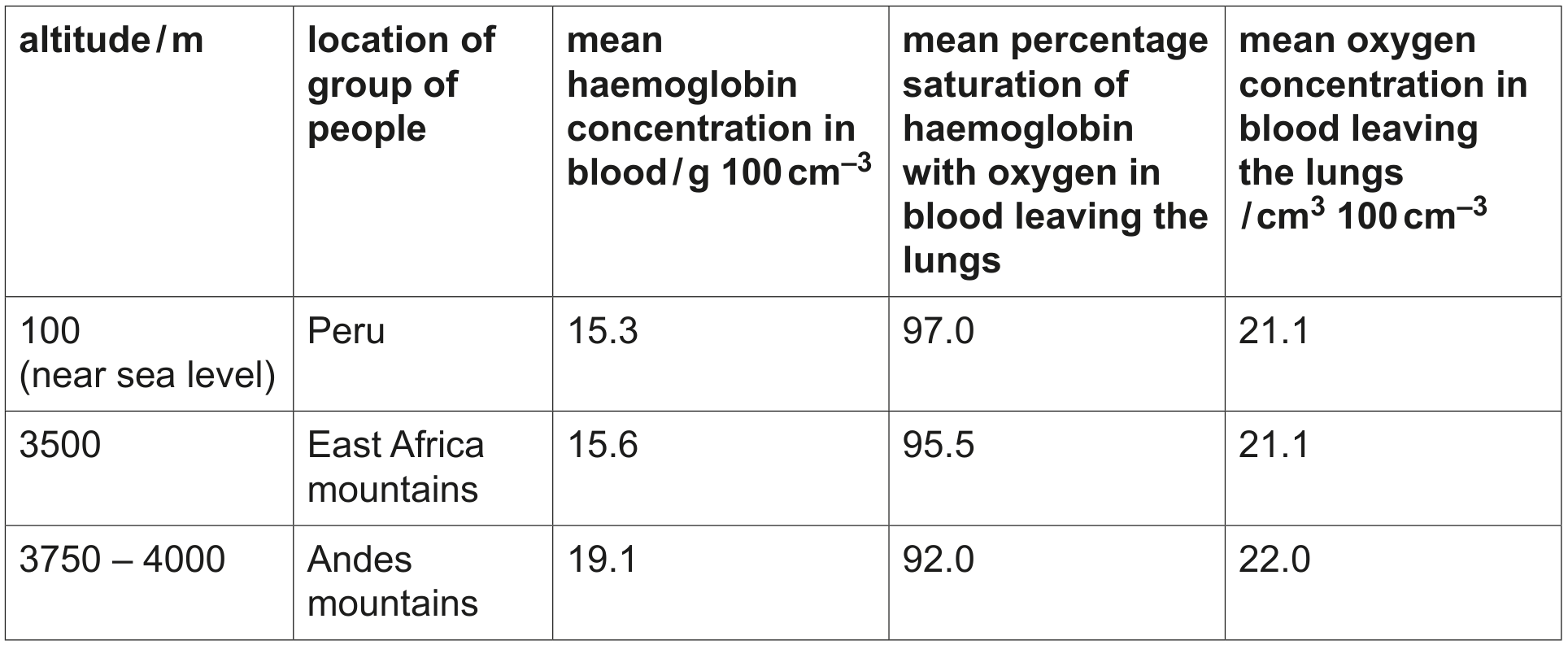
Scientists compared features of the physiology of three groups of people who live at different altitudes. These people were selected from populations that have lived at these altitudes for many thousands of years.

The scientists took blood samples from people in each location and measured:
- the concentration of haemoglobin in the blood
- the percentage saturation of haemoglobin with oxygen in blood leaving the lungs
- the oxygen concentration in the blood leaving the lungs.

The results are shown in Table 3.1.

Table 3.1

Table 3.1

[ 3 ]
(i)

With reference to Table 3.1, suggest how the people living at high altitude can have an oxygen concentration in blood leaving the lungs similar to that of the people living at sea level.

[ 3 ]
[Maximum number: 1]

There is a decreased partial pressure of oxygen at high altitude compared to sea level.
Which row is a correct description and reason for the response of the body to high altitude?

description

reason

more red blood cells

because haemoglobin breaks down more rapidly

red blood cells have genes switched on

so red blood cells produce more haemoglobin

oxygen dissociation curve shifts to the right

to compensate for an increase in oxygen unloading in tissues

percentage saturation of haemoglobin with oxygen in lungs decreases

so more red blood cells are produced to carry more haemoglobin

[Maximum number: 1]

Why does the red blood cell count of humans increase when they remain at high altitudes?

A

Haemoglobin is not saturated with oxygen in the lungs.

B

The partial pressure of oxygen is higher.

C

The percentage of oxygen in the air has decreased.

D

There is more carbon dioxide, increasing the Bohr effect.

[Maximum number: 1]

Some babies are born with a hole between the right and left atria. These newly born babies are found to have an increased number of red blood cells.

What is the reason for this increase?

A

More blood is needed because it is pumped faster.

B

Newly born babies' haemoglobin has a higher affinity for oxygen.

C

Newly born babies' haemoglobin molecules only have one haem group.

D

There is less oxygen available to the newly born baby.

[Maximum number: 1]

A person moves from sea level to live at a high altitude.
After three months living at high altitude, which change would be found in this person when at rest?

A

increased volume of blood per heartbeat

B

increased breathing rate

C

increased heart rate

D

increased mass of red blood cells

[Maximum number: 1]

At high altitudes, the oxygen content of the air may be a third of that at sea level.
As a person climbs a mountain, their body gradually adjusts to the high altitude.
What is increased during this period of adjustment?

A

the concentration of haemoglobin in the red blood cells

B

the oxygen-carrying capacity of the haemoglobin

C

the number of red blood cells per mm3\mathrm{mm}^{3} of blood

D

the rate at which haemoglobin releases oxygen to the tissues

[Maximum number: 1]

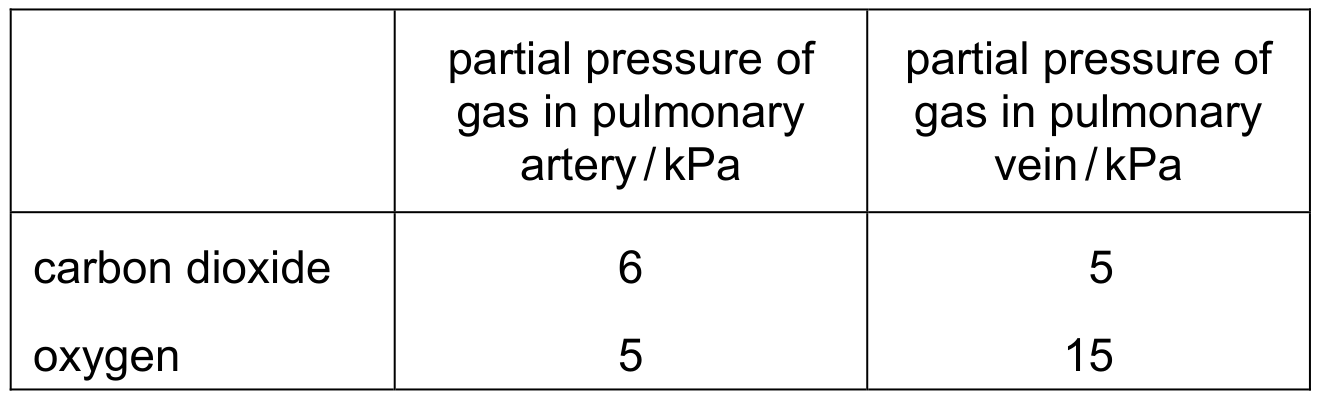
The table shows the partial pressure of carbon dioxide and oxygen in two blood vessels.

Table

What explains the difference in the partial pressures of oxygen in the pulmonary artery and pulmonary vein?

A

Oxygen diffuses from the alveoli into the blood in the capillaries.

B

Carbon dioxide diffuses into the alveoli from the blood in the capillaries.

C

Oxygen diffuses from the body cells into the blood in the capillaries.

D

Carbon dioxide diffuses into the body cells from the blood in the capillaries.

[Maximum number: 1]

What explains why the red blood cell count of humans increases when they remain at high altitudes?

A

Haemoglobin is not saturated with oxygen in the lungs.

B

The partial pressure of oxygen in the air is higher.

C

The percentage of oxygen in the air has decreased.

D

There is more carbon dioxide, increasing the Bohr effect.

0