EduNinja

Erythropoietin, also known as EPO, is a large glycoprotein synthesised by specialised cells in the kidney. These cells are very sensitive to changes in oxygen concentration in the blood passing through the kidney and respond to a low oxygen concentration by increasing the synthesis of EPO.

EPO acts at the surface of particular target cells, such as cells in the bone marrow. These bone marrow cells are stimulated to produce red blood cells.

(a)

Red blood cells originate from undifferentiated cells in the bone marrow that are capable of continuous mitotic cell division.

State the name of this type of undifferentiated cell.
[Maximum number: 3]

Hakea spp. are xerophytic plants native to Australia. The leaves of Hakea have adaptations for a xerophytic mode of life.

(a)

When the availability of phosphate ions and other soil nutrients is limited, a number of changes occur in the roots of Hakea spp.:
- Regions of meristematic tissue are active for a few days.
- Root clusters are formed. A root cluster is a dense arrangement of tiny side roots known as rootlets.
- Most of the epidermal cells of the rootlets are root hair cells.
- Rootlets release compounds into the soil that make phosphates and other mineral ions more soluble for uptake.
- Uptake of phosphate ions and the absorption of water from the soil increases.

[ 3 ]
(i)

Meristem cells have a similar role to stem cells in animals.

Suggest how meristematic tissue activity leads to the formation of root clusters.

[ 3 ]
[Maximum number: 2]

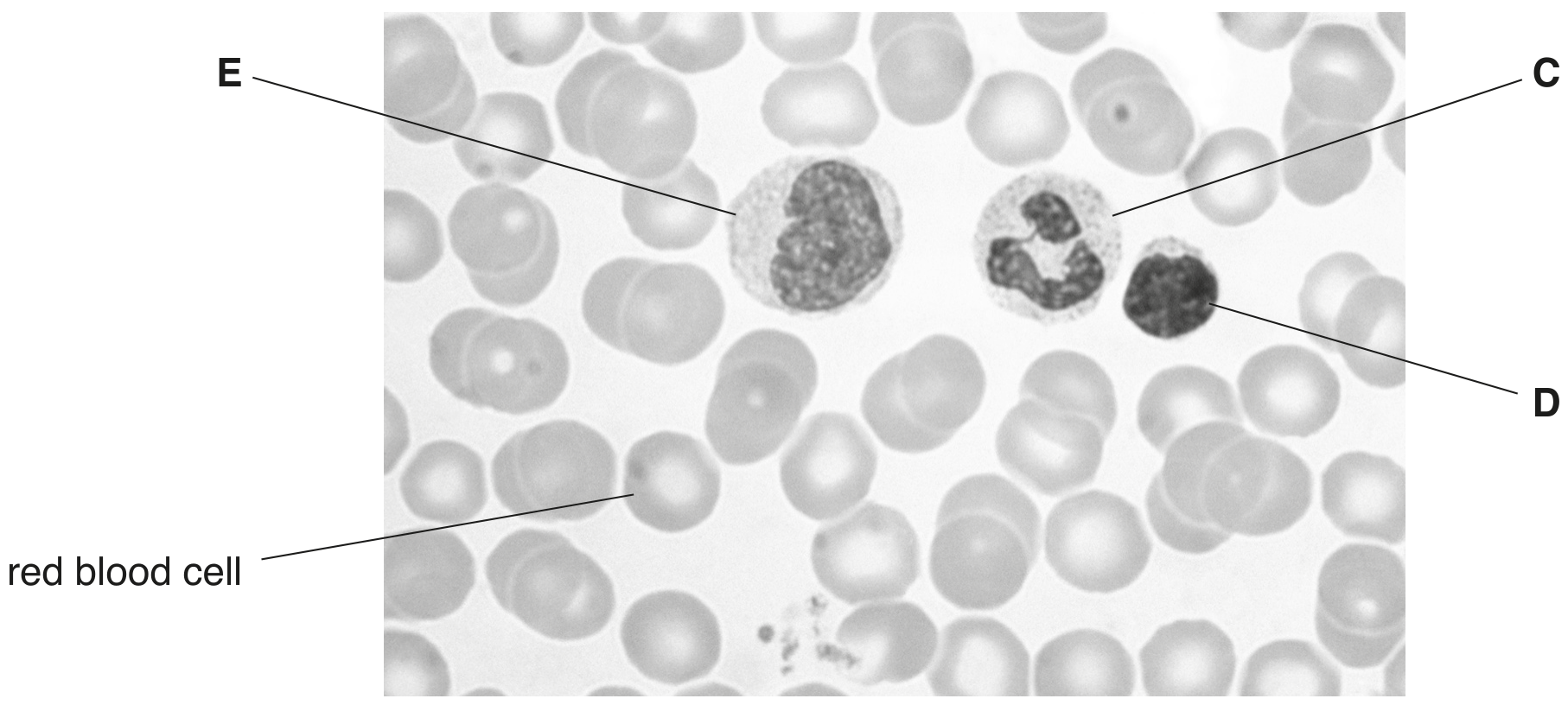
Fig. 3.1 is a photomicrograph of human blood cells from a healthy individual who lives at sea level. The cells labelled C, D and E are white blood cells.

Fig. 3.1

Fig. 3.1

(a)

In humans, an increase in the white blood cell count can be associated with leukaemias and with infectious diseases, such as measles.

Chronic lymphocytic leukaemia (CLL) is a type of cancer that starts in the bone marrow. In the early stages, many people with CLL feel well. The disease is sometimes diagnosed by chance during a routine blood analysis, when a high white blood cell count is noticed. Many of these white blood cells are only partially mature.

[ 2 ]
(i)

Suggest why CLL starts in the bone marrow and not in any other location in the body.

[ 2 ]
[Maximum number: 1]

Which feature of stem cells enables them to replace cells in tissues such as the skin?

A

They are undifferentiated cells that are present at birth.

B

They differentiate to form skin cells.

C

They divide by mitosis to supply some cells that can differentiate.

D

They have the full number of chromosomes.

[Maximum number: 2]

The response of the human body to tissue damage depends on the types of tissues involved. Epithelial tissue, liver tissue and cardiac muscle tissue each respond differently to damage.
- Epithelial tissue of the gas exchange system contains stem cells.
- Liver tissue contains cells in a non-dividing state that can enter a cell cycle when stimulated.
- Cardiac muscle tissue contains cells that cannot divide at all. Damage is permanent and is associated with scar tissue formation.

(a)

Explain why stem cells are important in tissue repair.

[ 2 ]
[Maximum number: 3]

Meristematic tissue is found in the growing regions of plants, such as root tips.

(a)

Meristematic cells have a similar role to stem cells found in animals.

Suggest the role of a meristematic cell and explain the features that help it to carry out its role.

[ 3 ]
[Maximum number: 1]

Some processes are listed.
- cytokinesis
- differentiation
- DNA replication
- mitosis

How many of the listed processes occur during tissue repair by stem cells?

A

1

B

2

C

3

D

4

[Maximum number: 1]

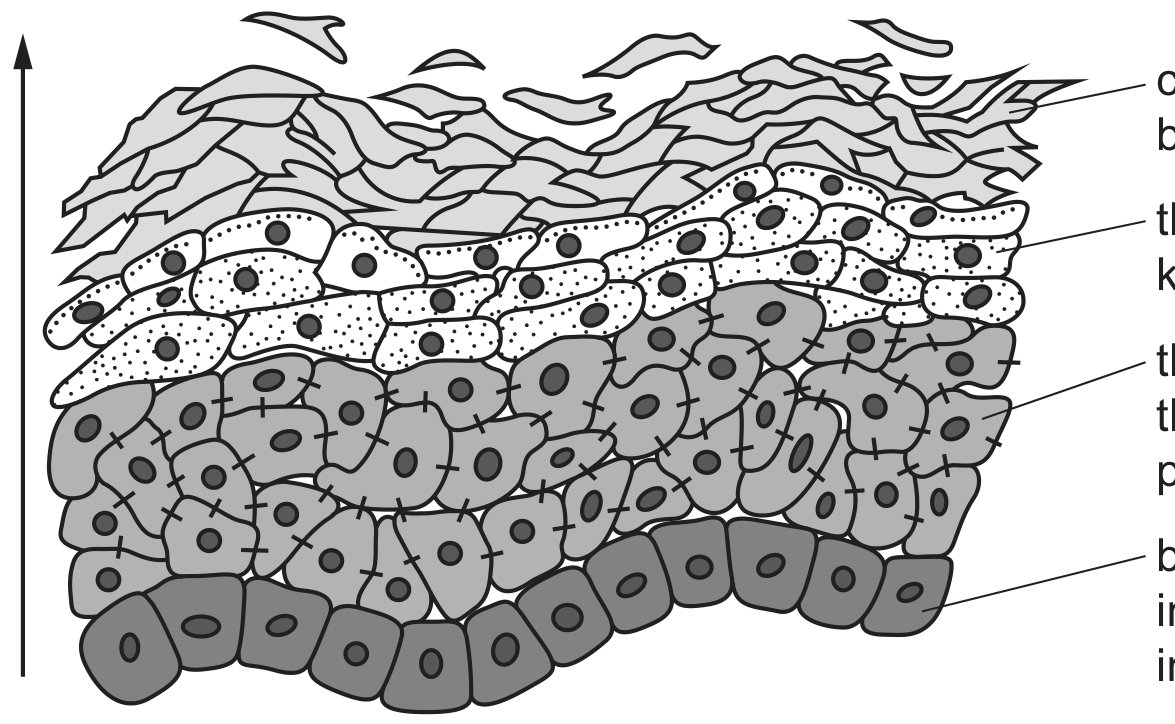
The diagram shows the epidermis of human skin. This is formed of four layers of cells.
Cells in each layer have specific functions which are outlined on the diagram. As the cells are produced, they move upwards as shown by the arrow.

Question image

cells in this layer are dead and eventually break away from the skin
the keratinocyte cells continue to synthesise keratin and glycolipids to waterproof the skin
the keratinocyte cells begin the synthesis of the protein keratin and a glycolipid that prevent water loss from the skin
basal cells divide by mitosis and differentiate into the keratinocyte cells which move up into the layer above as they are produced

Which row shows cells that are acting as stem cells in the skin epidermis and an organelle needed by the keratinocytes?

cells that are acting as stem cells

organelle needed by the keratinocytes

basal cells only

centrioles

basal cells only

Golgi body

basal cells and keratinocytes

centrioles

basal cells and keratinocytes

Golgi body

0