EduNinja
[Maximum number: 1]

Steps 1-4 are used to test for a non-reducing sugar.
1 Put 5 cm35 \mathrm{~cm}^{3} of solution into a test-tube.
2 Add a few drops of acid.
3 Neutralise with alkali.
4 Add 6 cm36 \mathrm{~cm}^{3} Benedict's solution.
When is the solution boiled?

A

between steps 1 and 2

B

between steps 2 and 3 and after step 4

C

between steps 2 and 3 only

D

after step 4 only
[Maximum number: 1]

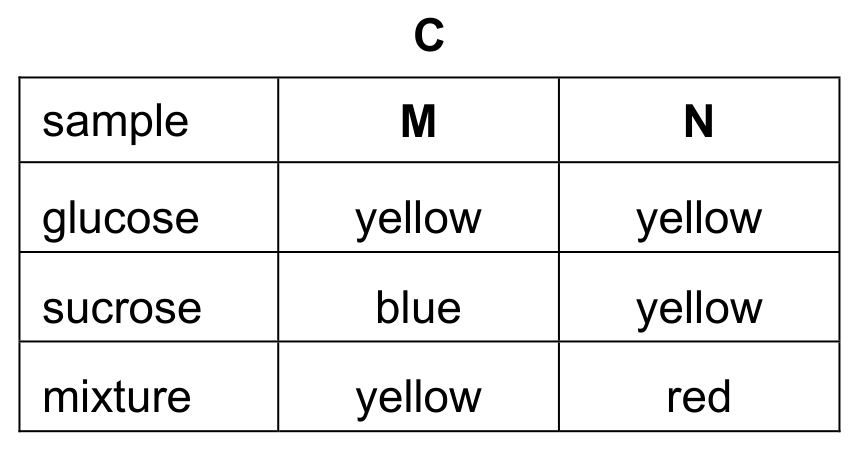
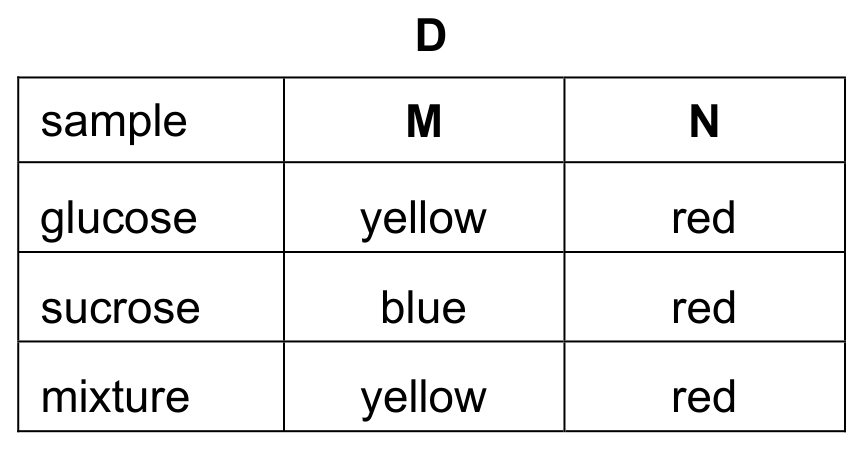
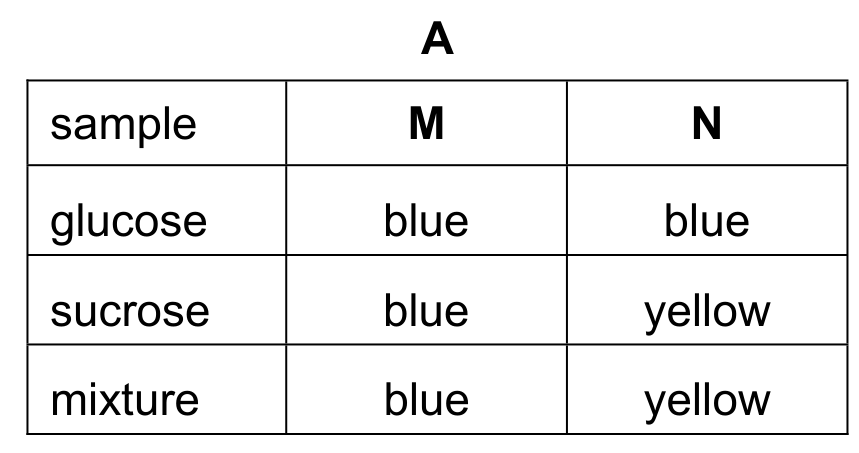
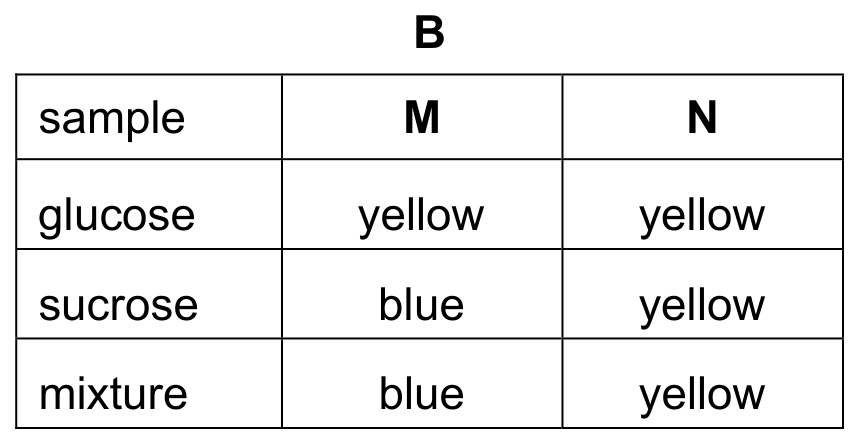
Samples of glucose, sucrose, and a mixture of glucose and sucrose were divided into two halves M and N.

M was then tested with Benedict's solution.
N was boiled with dilute hydrochloric acid, neutralised and then tested with Benedict's solution.
The colour of the solution was compared to colour standards.
Which table identifies the correct colour changes for these samples?

Table
Table
Table
Table
[Maximum number: 1]

Which flow chart outlining the test for non-reducing sugars is correct?

A
Question image
B
Question image
C
Question image
D
Question image
[Maximum number: 1]

Steps 1, 2, 3 and 4 are used to test for a non-reducing sugar.
1 Put 5 cm35 \mathrm{~cm}^{3} of solution into a test-tube.
2 Add a few drops of acid.
3 Neutralise with alkali.
4 Add 6 cm36 \mathrm{~cm}^{3} of Benedict's solution.
When is the solution heated or boiled?

A

between steps 1 and 2

B

between steps 2 and 3, and after step 4

C

between steps 2 and 3 only

D

after step 4 only
[Maximum number: 1]

A student carried out the Benedict's test on a sample and got a negative result.
What should the student do to confirm there are no sugars present in the sample?

A

boil the sample for 5 minutes then repeat the Benedict's test

B

boil with alkali, neutralise with hydrochloric acid and repeat the Benedict's test

C

boil with hydrochloric acid, neutralise with alkali and repeat the Benedict's test

D

repeat the Benedict's test but add more Benedict's reagent

[Maximum number: 1]

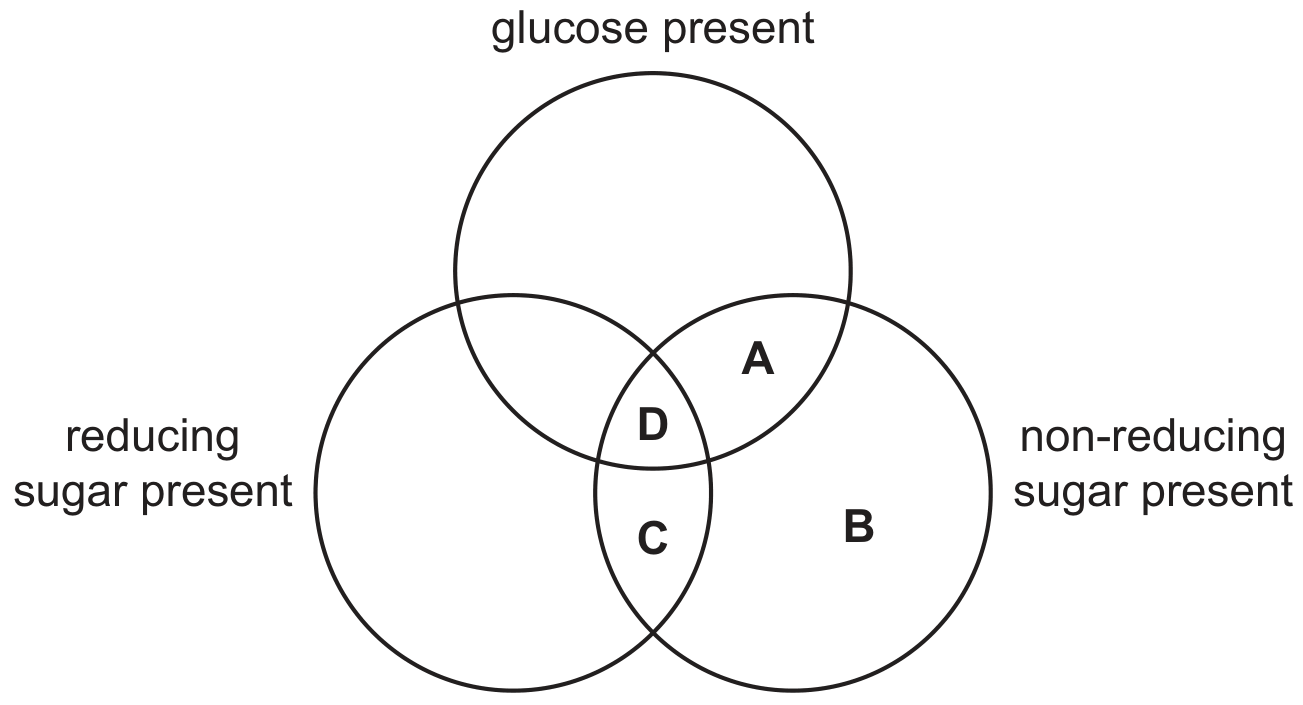
A sample of food was heated with Benedict's solution which changed colour to green.
A second sample of the same food was boiled with dilute hydrochloric acid and neutralised using sodium hydrogencarbonate. It was then heated with Benedict's solution which changed colour to red.

What did these results show?

Question image
[Maximum number: 1]

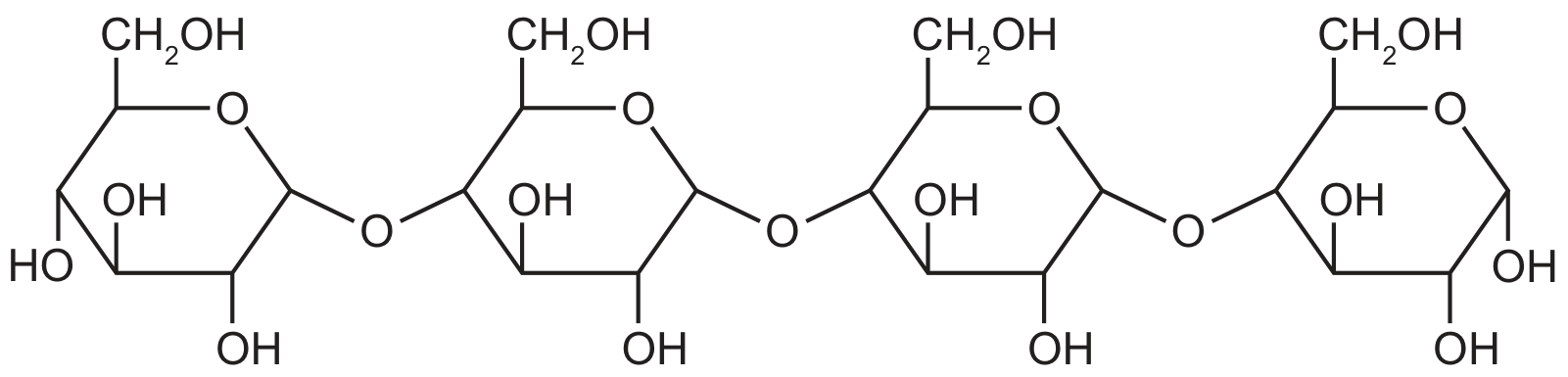
The molecule shown is a polymer of reducing sugars.

Question image

Which procedures could be carried out to show that this molecule is a polymer of reducing sugars?

1 Add hydrolytic enzyme and then heat with Benedict's solution.
2 Dissolve in water, neutralise and then heat with Benedict's solution.
3 Boil with hydrochloric acid, neutralise and then heat with Benedict's solution.

A

1, 2 and 3

B

1 and 2 only

C

1 and 3 only

D

2 and 3 only

[Maximum number: 1]

The colour of a positive Benedict's test is due to the formation of copper oxide. The mass of copper oxide is proportional to the mass of reducing sugar present.

Samples of fruit juice were tested for the presence of reducing sugars and non-reducing sugars using the Benedict's test. The results show the mass of copper oxide after boiling with Benedict's solution and after acid hydrolysis and boiling with Benedict's solution.

Which sample contained the most non-reducing sugar?

after boiling with Benedict's solution

after acid hydrolysis and boiling with Benedict's solution

20

20

30

45

50

55

65

75

0