EduNinja
[Maximum number: 1]

A student was asked to estimate the concentration of glucose in a solution using the Benedict's test. The student was provided with a 1.0 moldm31.0 \mathrm{~mol} \mathrm{dm}^{-3} glucose solution and was told to make a 0.6 moldm30.6 \mathrm{~mol} \mathrm{dm}^{-3} solution by proportional dilution.

Which row shows the correct volumes of both 1.0 moldm31.0 \mathrm{~mol} \mathrm{dm}^{-3} glucose solution and distilled water needed to make the 0.6 moldm30.6 \mathrm{~mol} \mathrm{dm}^{-3} solution?

volume of

1.0 moldm31.0 \mathrm{~mol} \mathrm{dm}^{-3}

glucose

solution /cm3/ \mathrm{cm}^{3}

volume of

distilled

water /cm3/ \mathrm{cm}^{3}

12

8

10

10

8

12

6

14

[Maximum number: 1]

A student carries out a semi-quantitative test with Benedict's solution.
Which statement about this procedure is correct?

A

It detects only the presence or absence of glucose.

B

It provides an indication of relative reducing sugar concentrations.

C

The precipitate needs to be filtered, dried and weighed to give the reducing sugar concentration.

D

A colorimeter needs to be used to determine the glucose concentration.

[Maximum number: 1]

In order to estimate the quantity of glucose in a solution, equal volumes of a range of known concentrations were mixed with equal excess volumes of Benedict's solution and placed in a thermostatically controlled water-bath at 90C90^{\circ} \mathrm{C} for the same length of time.

The unknown solution was then treated in the same way and the colours of the known and unknown solutions compared.

What is the independent variable in this procedure?

A

concentration of glucose

B

final colour of solutions

C

temperature of water-bath

D

volumes of glucose solutions

[Maximum number: 1]

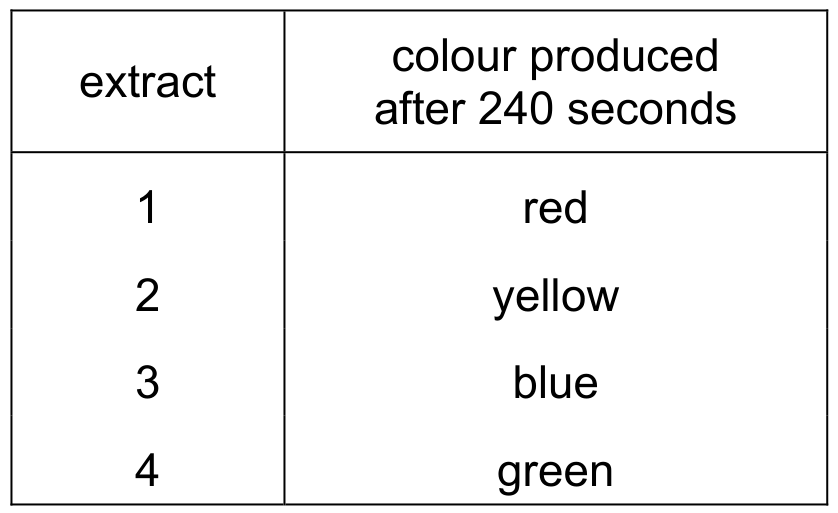
Four extracts from different plant materials were made and tested with Benedict's solution.
The extracts were boiled with Benedict's solution for 240 seconds and the final colour was recorded.

Table

Which sequence of plant extracts represents an increasing quantity of reducing sugar?

A

12431 \rightarrow 2 \rightarrow 4 \rightarrow 3

B

31243 \rightarrow 1 \rightarrow 2 \rightarrow 4

C

32143 \rightarrow 2 \rightarrow 1 \rightarrow 4

D

34213 \rightarrow 4 \rightarrow 2 \rightarrow 1

[Maximum number: 1]

To estimate the concentration of glucose in an unknown solution, equal volumes of a range of known concentrations of glucose were each mixed with the same excess volume of Benedict's solution. After mixing, the solutions were placed in a thermostatically controlled water-bath at 90C90^{\circ} \mathrm{C} for three minutes.

The unknown solution was then treated in the same way and the colours of the known and unknown solutions compared.

What is the independent variable in this procedure?

A

concentration of glucose

B

final colour of solutions

C

temperature of water-bath

D

volume of glucose solutions

[Maximum number: 1]

The concentration of reducing sugar in a solution can be found if an observational measurement is compared to a standard.

Which observational measurement could be used to estimate the concentration of reducing sugar in an unknown solution?

1 the colour of the solution after 20 minutes
2 the time for the first colour change to occur
3 the rate of formation of solid particles

A

1, 2 and 3

B

1 and 2 only

C

2 only

D

3 only

[Maximum number: 1]

The table shows some steps that can be made in carrying out the Benedict's test.
Which combination of steps is required to carry out a semi-quantitative test on a reducing sugar solution?

standardise volume of Benedict's solution and volume of test solution

boil with hydrochloric acid and then neutralise with alkali

standardise boiling time with Benedict's solution and compare final colour with numbered colour standards

key

✓ = step made

χ=\boldsymbol{\chi}= step not made

χ\chi

x

χ\chi

χ\chi

×

×

χ\chi

[Maximum number: 1]

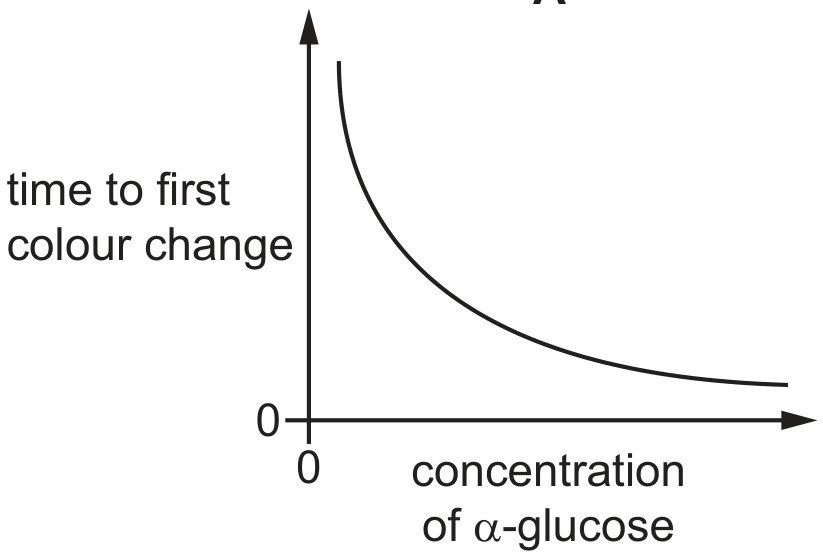
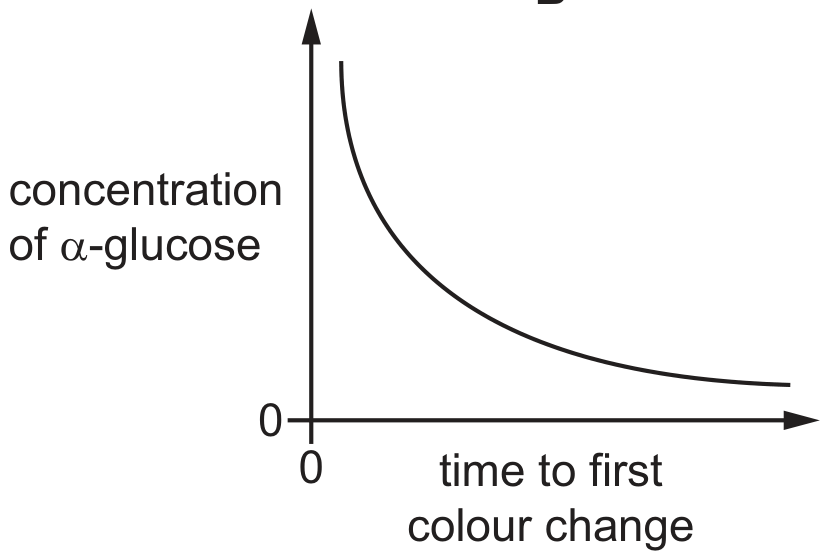
A student carried out a Benedict's test on several different known concentrations of α\alpha-glucose.
Which graph represents the results correctly?

A

A

B

B

colour change
concentration of α-glucose

[Maximum number: 1]

A student was asked to estimate the concentration of reducing sugar in an unknown solution using the Benedict's test. Five reducing sugar solutions with different concentrations were provided in order to produce a calibration curve.

The student added 2 cm32 \mathrm{~cm}^{3} of Benedict's solution to each of the reducing sugar solutions, heated them in a water-bath and recorded the time taken for the first appearance of a colour change.

Which variables should the student standardise, when carrying out the Benedict's test on each reducing sugar solution, to ensure the results are comparable?

1 volume of reducing sugar used
2 the temperature of the water-bath
3 the time the solutions are heated

A

1, 2 and 3

B

1 and 2 only

C

1 and 3 only

D

3 only

[Maximum number: 2]

Phloem and xylem are specialised tissues involved in the transport of water, ions and assimilates in plants.

(a)

A student was asked to carry out semi-quantitative Benedict's tests on two solutions.
- Solution A was extracted from the cytoplasm of cells in the mesophyll tissue of photosynthesising leaves.
- Solution B was extracted from the phloem sap in phloem sieve tubes.

The solutions were taken from the same plant, and other variables were standardised.
For each solution, the student measured the time taken for the first colour change to appear.
Suggest which of the two solutions, A or B, would change colour in the shortest time.
Explain your answer.

[ 2 ]
0