(a)
(i)
Suggest what information about the relative distance between the linked genes can be gained from crossover values.
[ 1 ]
 EduNinja
Suggest what information about the relative distance between the linked genes can be gained from crossover values.
The patty pan squash plant, Cucurbita pepo, produces edible fruits that vary in colour.
The colour of the fruits is controlled by two genes, A / a and B / b, that occur on different chromosomes.
- Allele A produces a white fruit colour.
- Allele a does not produce a colour by itself but allows the colours coded by gene B/b to show in the phenotype.
- Allele B produces a yellow fruit colour.
- Allele b produces a green fruit colour.
In a dihybrid cross, an AABB plant was crossed with an aabb plant. All the resulting F1 plants produced white fruits.
The F1 plants were then crossed with each other to obtain the F2 generation.
Plants P and Q show genetic variation with respect to fruit colour alleles.
Identify the process that occurred during meiosis in the F1 parents that produced this variation and the stage of meiosis at which it occurred.
process
stage of meiosis
The results of the test crosses described in (a)(ii) are shown in Table 2.2.
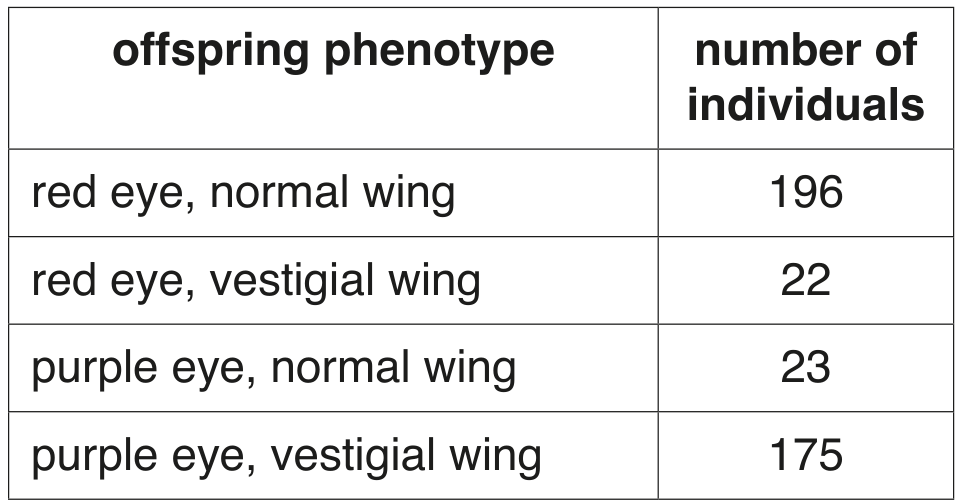
Table 2.2
Flies with red eye, vestigial wing and flies with purple eye, normal wing phenotypes are described as recombinant.
Name the stage of meiosis when these recombinants are produced and state how this occurs.
Explain why the results in Table 2.2 are different from the expected ratio of 1: 1: 1: 1.
Russian scientists have discovered the fruits of a flowering plant, Silene stenophylla, in the food store in a burrow of a ground squirrel in frozen sediments in Siberia.
Dating techniques suggest that the fruits were stored by the ground squirrel about 32000 years ago, shortly before the ground became permanently frozen.
Tissue samples were taken from the fruits and grown in a nutrient culture medium. After treatment with plant hormones to stimulate the growth of roots and shoots, 36 complete plants were produced.
These 'regenerated' plants, which looked identical to one another, flowered and after cross-pollination, produced seeds that were able to germinate.
Explain why cross-pollination produces more genetic variation among the offspring than self-pollination.
Phenotypic variation exists in many forms.
Other than the event named in (b), describe the features of sexual reproduction that contribute to the production of genetically different offspring.
Meiosis is one process that contributes to genetic variation.
Describe how crossing over during meiosis leads to genetic variation.
Mutation also causes genetic variation. Some populations of water hemp, Amaranthus tuberculatus, have evolved herbicide resistance as a result of a mutation. This is a problem for farmers as water hemp grows in crop fields, lowering productivity.
Two populations of water hemp were tested for resistance to the herbicide mesotrione. One was a population known to be resistant (control) and the other was a test population, whose resistance was unknown.
- Leaves were removed and immersed in a radioactively labelled solution of mesotrione.
- The leaves absorbed some mesotrione and became radioactive.
- Resistant leaves are able to degrade mesotrione by metabolism.
- The time for 50 % of absorbed mesotrione to degrade was calculated by measuring the radioactivity of the leaves.
The results are shown in Table 3.1.
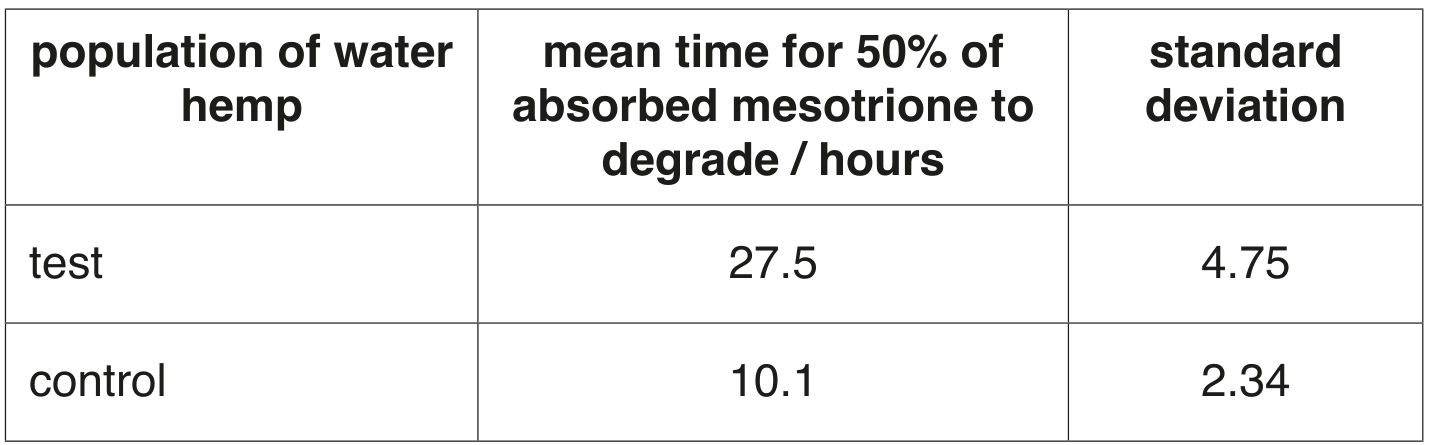
Table 3.1
Meiosis is one process that contributes to genetic variation.
Describe how crossing over during meiosis leads to genetic variation.
Mutation also causes genetic variation. Some populations of water hemp, Amaranthus tuberculatus, have evolved herbicide resistance as a result of a mutation. This is a problem for farmers as water hemp grows in crop fields, lowering productivity.
Two populations of water hemp were tested for resistance to the herbicide mesotrione. One was a population known to be resistant (control) and the other was a test population, whose resistance was unknown.
- Leaves were removed and immersed in a radioactively labelled solution of mesotrione.
- The leaves absorbed some mesotrione and became radioactive.
- Resistant leaves are able to degrade mesotrione by metabolism.
- The time for 50 % of absorbed mesotrione to degrade was calculated by measuring the radioactivity of the leaves.
The results are shown in Table 3.1.
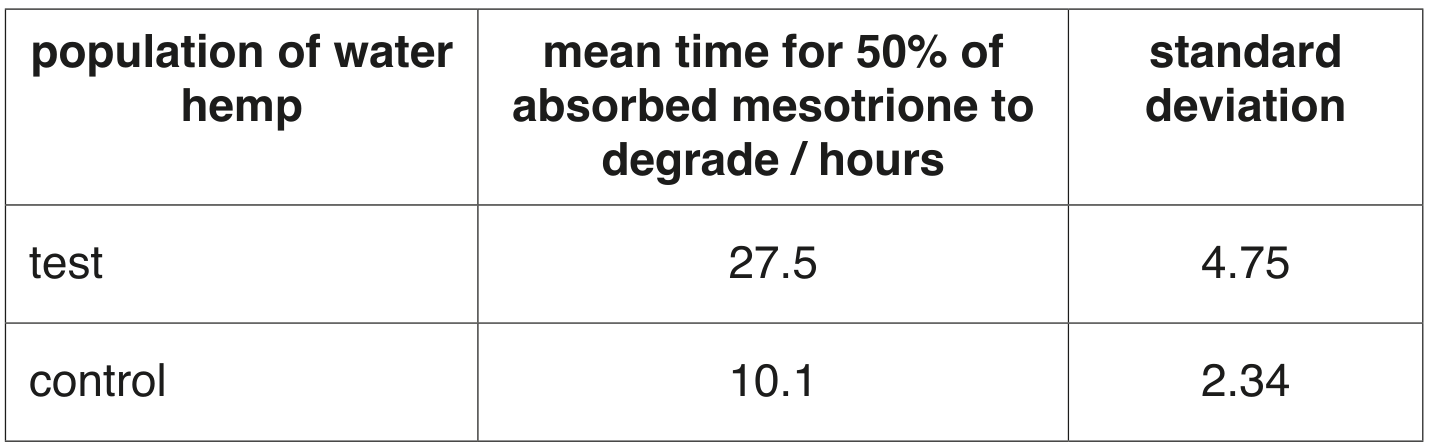
Table 3.1
Within a population, the variation for one characteristic is usually the result of genetic and environmental causes.
Meiosis is one source of genetic variation.
Explain how independent assortment of homologous chromosomes leads to genetic variation during meiosis I.
The monkey flower, Mimulus guttatus, is cross-pollinated by bumblebees. It does not normally self-pollinate.
Since the number of bumblebees in many parts of the world is falling, an experiment was carried out in Kansas to investigate the effects on these plants of the loss of pollinators.
- 1600 Mimulus plants were grown in a field.
- 1600 Mimulus plants were grown in a glasshouse which bumblebees could not enter.
Seeds were repeatedly collected and sown for several generations at each site.
At first, the plants in the glasshouse produced few seeds, but after five generations the plants were able to self-pollinate and the number of seeds produced was almost the same as that of the plants in the field.
After five generations, the flowers of the plants in the glasshouse were significantly smaller than those of the plants in the field.
Explain why offspring produced by cross-pollination and self-pollination differ in their genetic variation.
The monkey flower, Mimulus guttatus, is cross-pollinated by bumblebees. It does not normally self-pollinate.
Since the number of bumblebees in many parts of the world is falling, an experiment was carried out in Kansas to investigate the effects on these plants of the loss of pollinators.
- 1600 Mimulus plants were grown in a field.
- 1600 Mimulus plants were grown in a glasshouse which bumblebees could not enter.
Seeds were repeatedly collected and sown for several generations at each site.
At first, the plants in the glasshouse produced few seeds, but after five generations the plants were able to self-pollinate and the number of seeds produced was almost the same as that of the plants in the field.
After five generations, the flowers of the plants in the glasshouse were significantly smaller than those of the plants in the field.
Explain why offspring produced by cross-pollination and self-pollination differ in their genetic variation.