EduNinja
(a)

Wheat, Triticum aestivum, owes its origin to hybridisation involving three different, but related, species of grass, A, B and C.

Each of these species had seven pairs of chromosomes ( 2 n=14 ).
The hybridisation process is shown in Fig. 3.1.
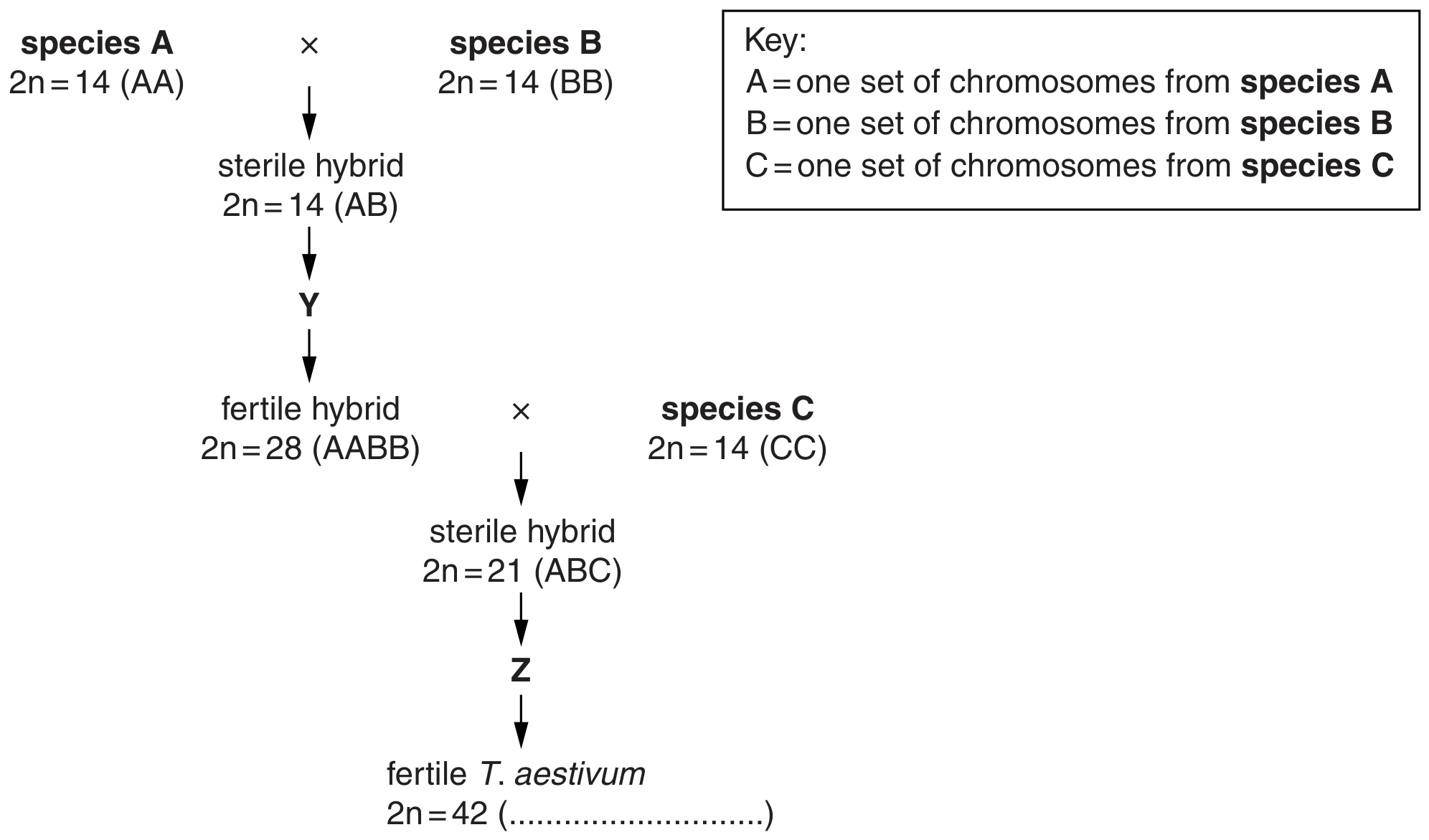
Fig. 3.1

Fig. 3.1

[ 4 ]
(i)

At the points labelled Y and Z in the hybridisation process, a fertile hybrid was produced from a sterile hybrid.

Explain why the hybrid (AB) is sterile and what occurred at the point labelled Y in Fig. 3.1.

Question 3 continues on page 8

[ 4 ]
(a)

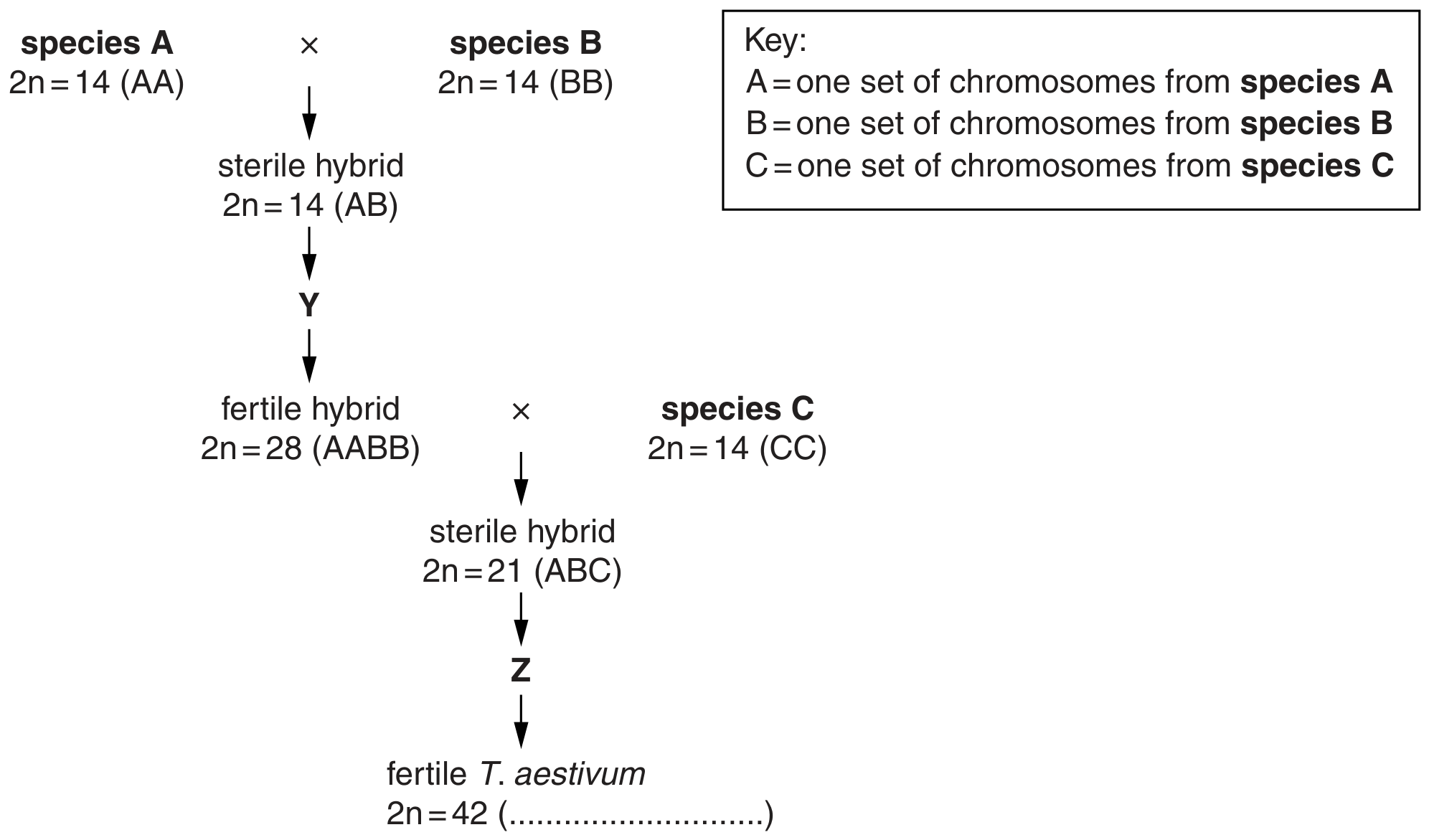
Wheat, Triticum aestivum, owes its origin to hybridisation involving three different, but related, species of grass, A, B and C.

Each of these species had seven pairs of chromosomes ( 2 n=14 ).
The hybridisation process is shown in Fig. 3.1.

Fig. 3.1

Fig. 3.1

[ 4 ]
(i)

At the points labelled Y and Z in the hybridisation process, a fertile hybrid was produced from a sterile hybrid.

Explain why the hybrid (AB) is sterile and what occurred at the point labelled Y in Fig. 3.1.

Question 3 continues on page 8

[ 4 ]
[Maximum number: 2]

Malaria is a serious and often fatal disease that is transmitted by the mosquito Anopheles gambiae. One method of reducing the incidence of malaria is to control the numbers of these mosquitoes.

In mosquitoes, as in humans, males have an X chromosome and a Y chromosome, while females have two X chromosomes. Researchers investigated the possibility of producing genetically modified (GM), fertile male mosquitoes in which most of the sperm contained a Y chromosome and not an X chromosome.

They predicted that introducing these males into a population of A. gambiae could greatly reduce the number of females in each generation and therefore reduce the numbers of eggs laid.

(a)

The researchers found that I-Ppol destroyed the X chromosome during meiosis in the GM male mosquitoes. This prevented these males from producing sperm containing an X chromosome.

However, I-Ppol was still active in zygotes produced by the fusion of female gametes with sperm containing a Y chromosome.

Explain why this meant that the GM males produced no offspring at all.

[ 2 ]
(a)

Outline the differences in the process of gametogenesis in a man compared with that in a woman.

[ 3 ]
[Maximum number: 1]

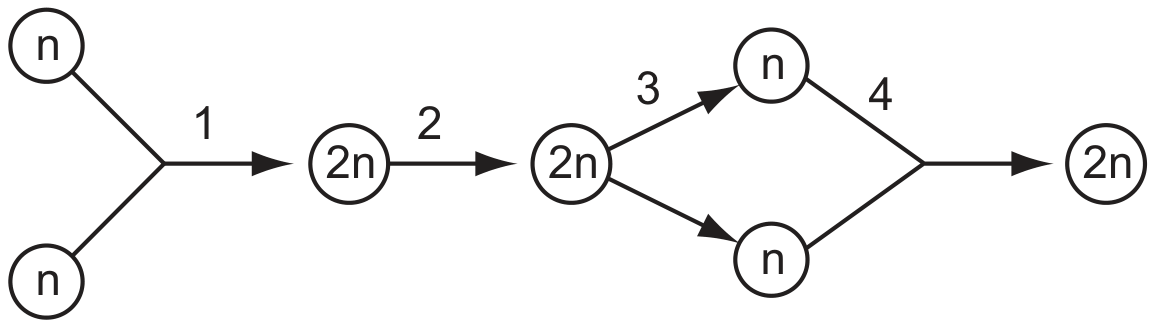
The diagram represents the life cycle of a sexually reproducing animal.

Question image

Which row correctly identifies meiosis and mitosis?

meiosis

mitosis

1

4

2

1

3

2

4

3

[Maximum number: 1]

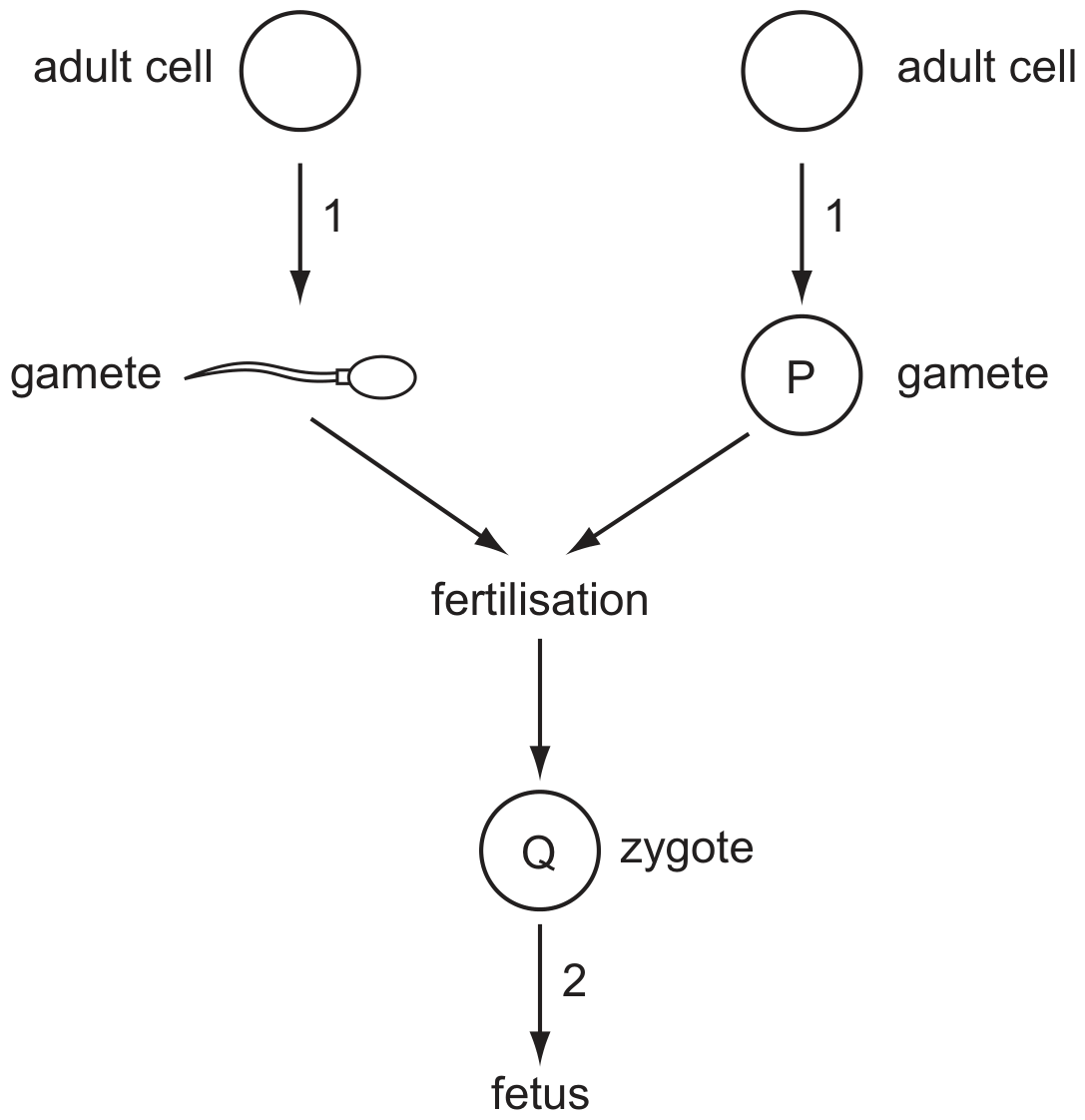
The diagram shows an outline of the process of sexual reproduction.

Question image

Which row identifies the type of cell division occurring during stages 1 and 2 and the number of chromosomes in cells P and Q ?

1

2

P

Q

meiosis

meiosis

diploid

haploid

meiosis

mitosis

haploid

diploid

mitosis

meiosis

haploid

diploid

mitosis

mitosis

diploid

haploid

(a)

Mothers with the X1\mathrm{X}_{1} form of Turner's syndrome can pass on the chromosome mutation to their daughters but not to their sons.
Complete the genetic diagram below to show how the chromosome mutation X1\mathrm{X}_{1} may be passed on to daughters from a mother with Turner's syndrome.
parental
parental genotypes
gametes
genotypes of daughters
phenotypes \\ phenotypes

gametes "
female with
Turner's syndrome

XX1\mathrm{XX}_{1}

normal male

\square
D
\square
\square
D

phenotypes of daughters

[ 4 ]
(a)

Outline the behaviour of chromosomes during meiosis.

[ 9 ]
0