(a)
Fig. 2.2 shows the banding pattern of chromosome pair 11 of M. musculus. The banding pattern is obtained by staining.
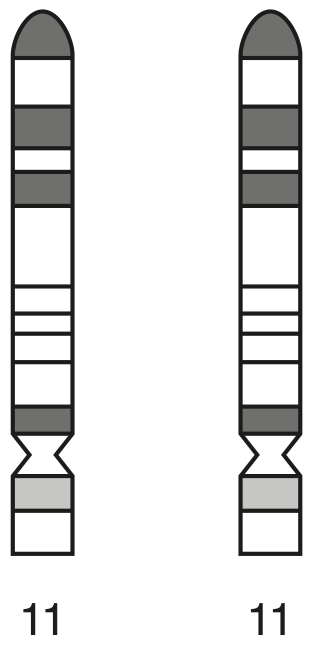
Fig. 2.2
[ 1 ]
(i)
State the number of chromosomes that are present in M. musculus spermatozoa.
[ 1 ]
 EduNinja
Fig. 2.2 shows the banding pattern of chromosome pair 11 of M. musculus. The banding pattern is obtained by staining.
Fig. 2.2
State the number of chromosomes that are present in M. musculus spermatozoa.
Oil seed rape (canola), Brassica napus, has been genetically modified to be resistant to herbicides containing glufosinate ammonium. The genetically modified (GM) oil seed rape contains the bar gene, obtained from a soil bacterium. This gene codes for an enzyme that converts glufosinate ammonium into a non-toxic compound.
The pollen of oil seed rape is transferred from one flower to another by insects. After pollination, fertilisation and seed formation can occur. One of the potential problems of growing glufosinate-resistant oil seed rape is that pollen from these plants could be transferred to the flowers of wild relatives, such as wild radish, Raphanus raphanistrum. This could result in genetic changes in these wild species.
An experiment was carried out to investigate whether glufosinate-resistant hybrids between GM oil seed rape and wild radish plants are likely to compete successfully with non-hybrid or non-resistant plants in the natural environment.
- Type 1 hybrids were produced by transferring pollen from wild radish (diploid number 18) to glufosinate-resistant oil seed rape (diploid number 38).
- Type 2 hybrids were produced by transferring pollen from glufosinate-resistant oil seed rape to wild radish.
- Each hybrid was then crossed with wild radish over several generations.
- The resulting offspring were then grown in field trials, together with normal wild radish.
- The height of the plants and number of seeds each produced were measured. Then the plants were tested for the bar gene.
Table 3.1 shows the results.
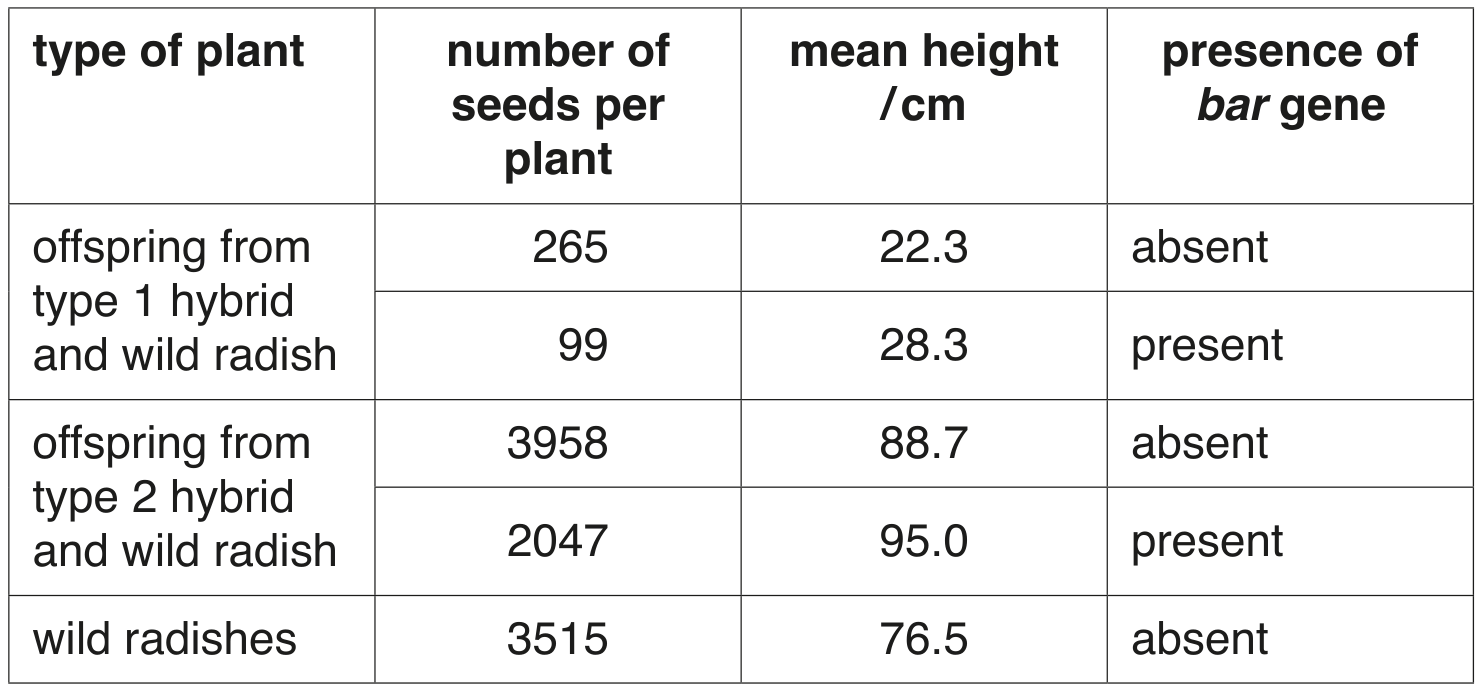
Table 3.1
Predict the diploid number of chromosomes in a hybrid between oil seed rape and wild radish.
Wheat, Triticum aestivum, owes its origin to hybridisation involving three different, but related, species of grass, A, B and C.
Each of these species had seven pairs of chromosomes ( 2 n=14 ).
The hybridisation process is shown in Fig. 3.1.
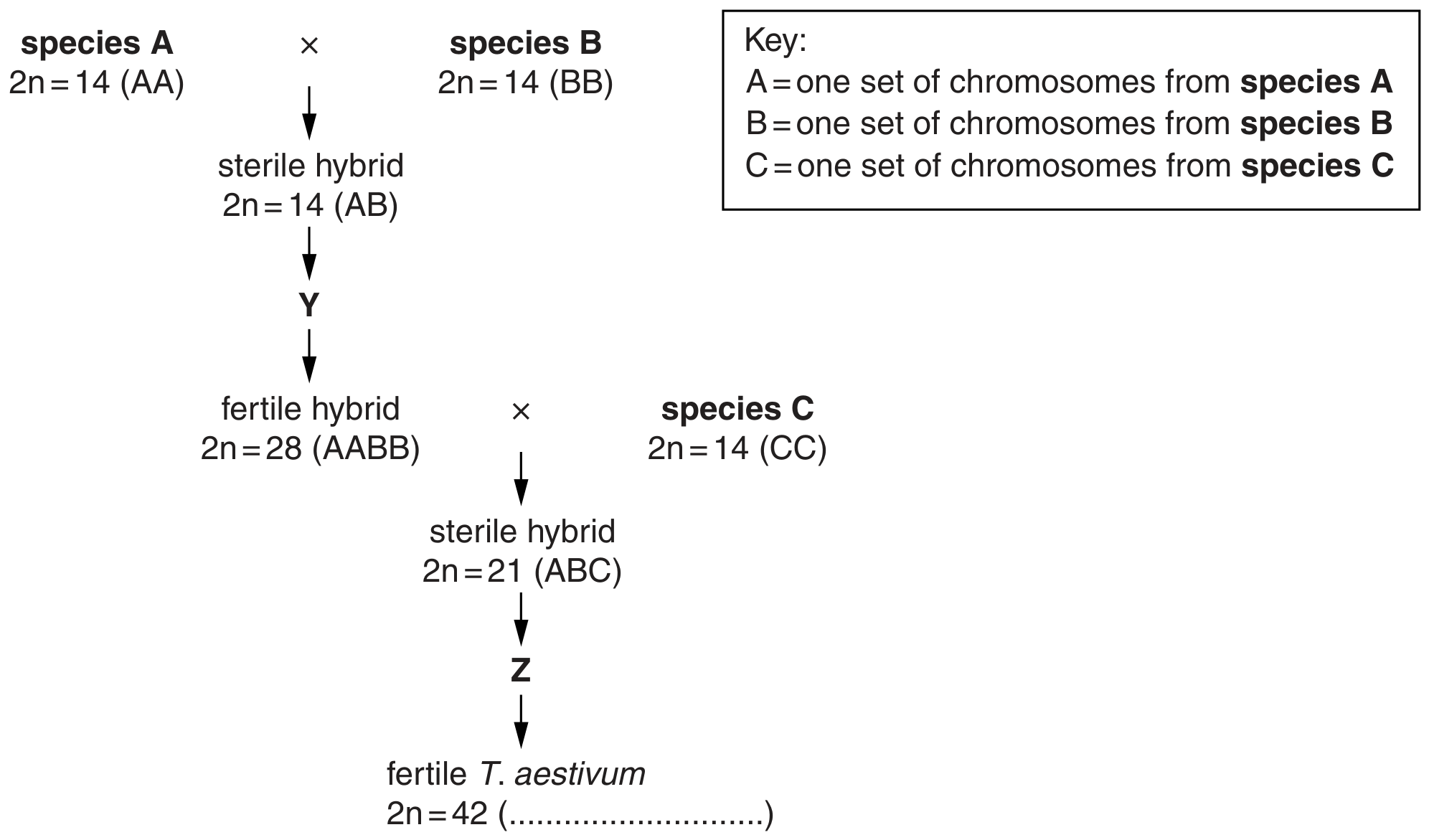
Fig. 3.1
Using the symbols in the key, complete Fig. 3.1 by writing in the chromosome sets of T. aestivum.
Fig. 3.1 shows a drawing of a section through an ovarian follicle.
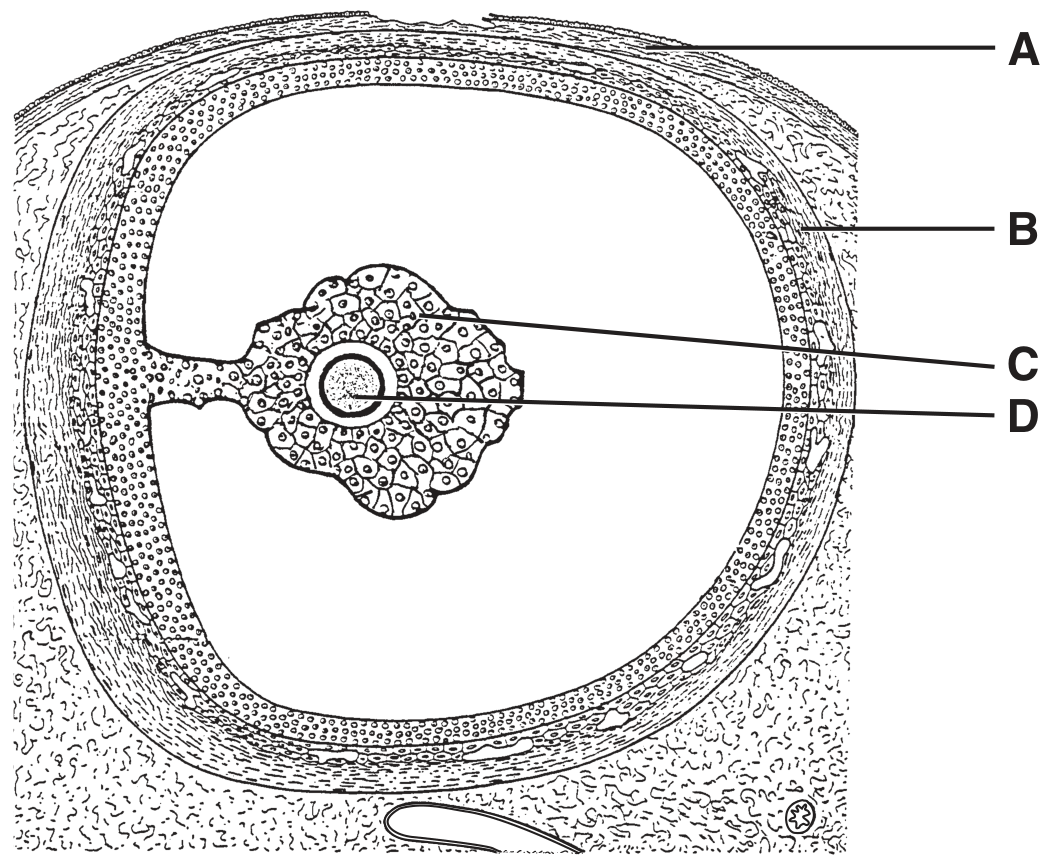
Fig. 3.1
State the names of the parts labelled A-D in Fig. 3.1.
A
B
C
D
Fig. 3.1 is a light micrograph of cells in the root tip of the garlic plant Allium sativum. It has a diploid number (2 n) of 16.
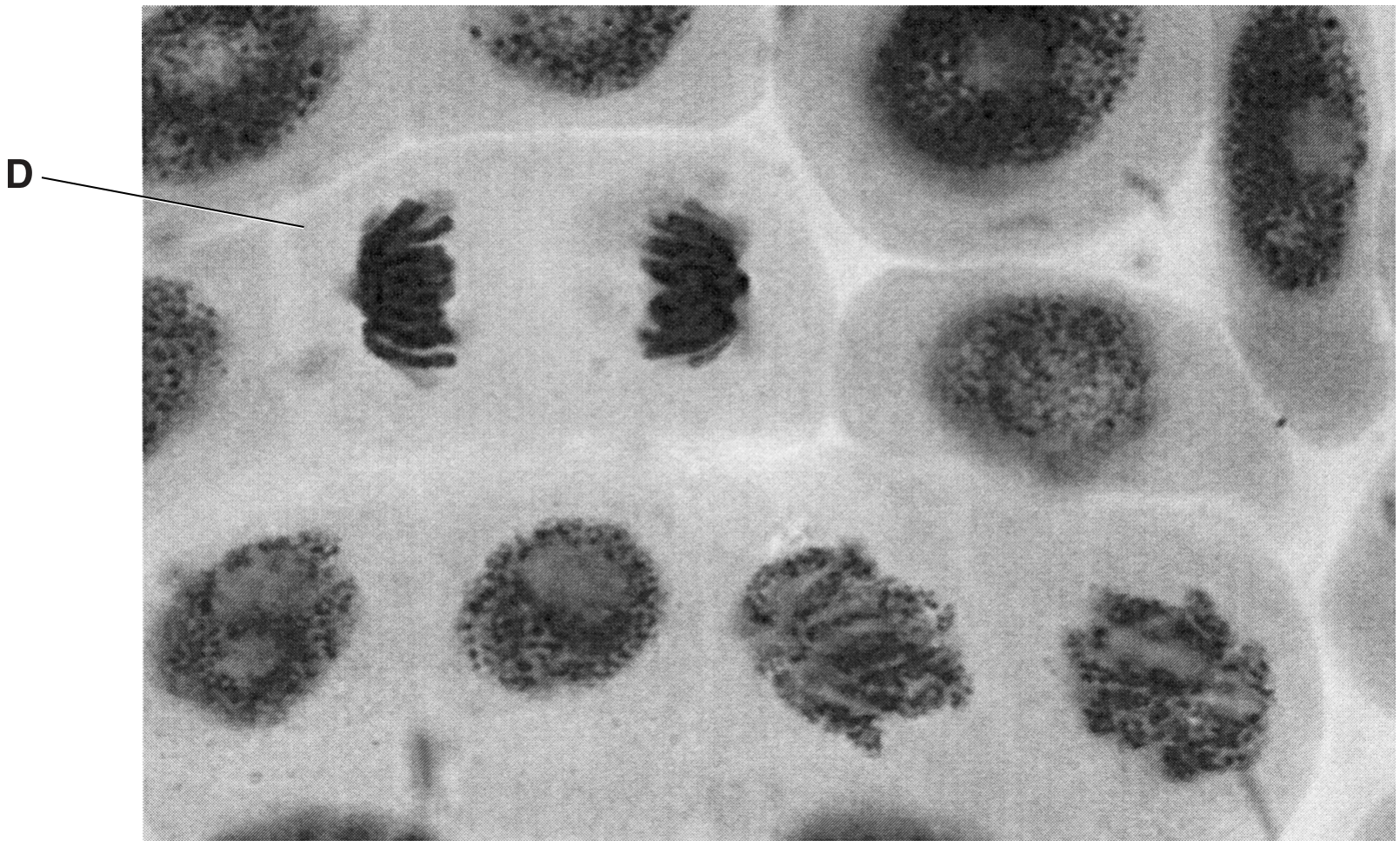
Fig. 3.1
State the haploid number of A. sativum.
Mammals such as sheep, Ovis aries, and goats, Capra hircus, are important agricultural animals that are sometimes kept together in mixed flocks. Very occasionally, live offspring are born from a mating between a male sheep and a female goat.
In sheep 2 n=54 and in goats 2 n=60.
Calculate the diploid chromosome number of the hybrid offspring of a sheep and a goat.
The diagram shows crosses between wild wheat and two types of grass.
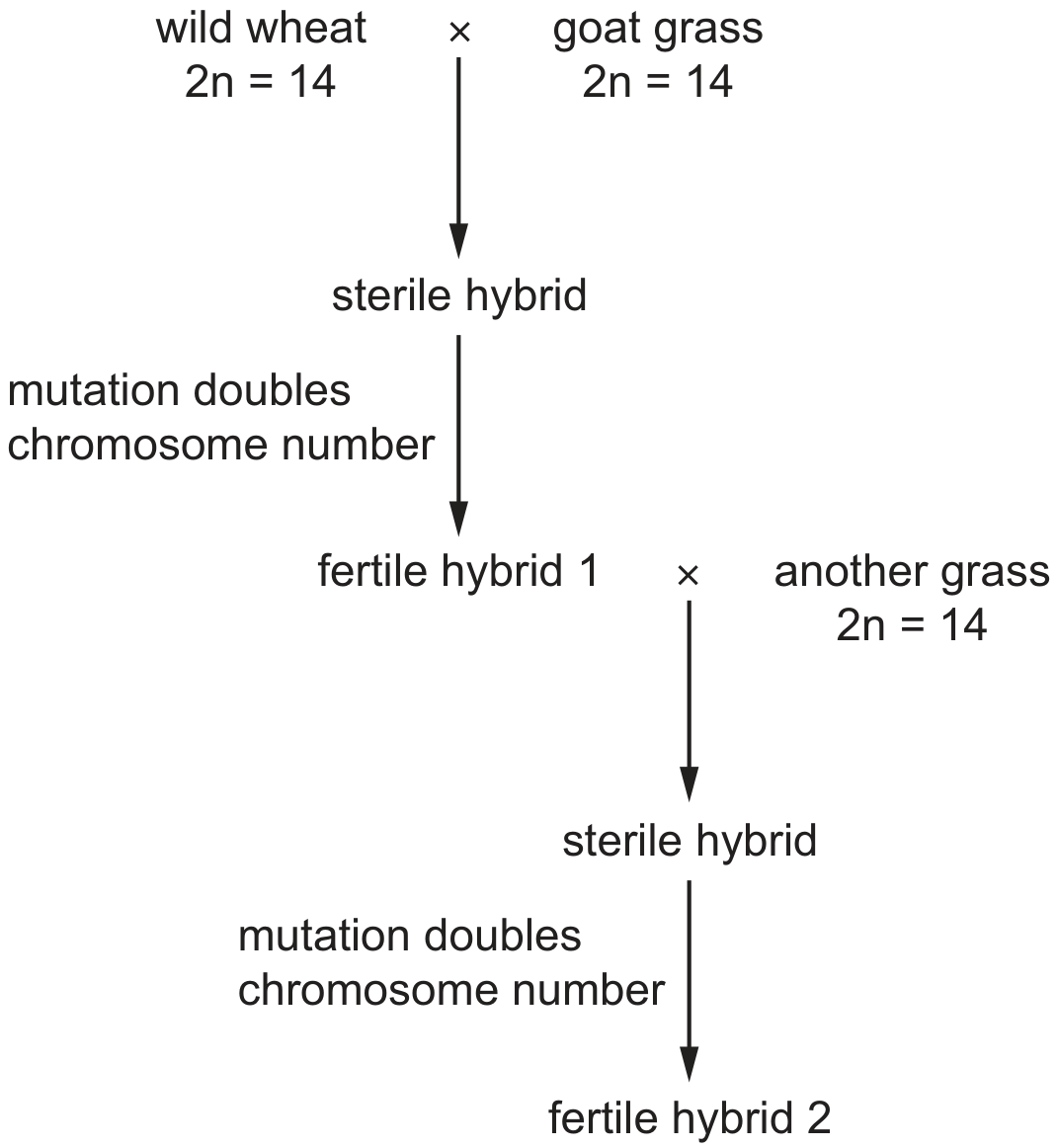
What is the chromosome number of the fertile hybrid 2?
28
42
56
140
Which statement describes a cell belonging to a haploid organism that is capable of reproduction?
It has chromosomes that contain one polynucleotide chain.
It is capable of carrying out a reduction division to form gametes.
It possesses two copies of each gene as a result of fertilisation.
It will undergo cell division by mitosis during asexual reproduction.
Mole rats, Spalax ehrenbergi, are mammals that live in groups in underground burrows. They are blind, and communicate with each other through sound and scent. Males make a purring call when they are attempting to persuade females to mate with them.
In Israel, the mole rats found in different parts of the country all look identical. However, there are actually four different populations with different chromosome numbers, which live in different climatic regions.
These are shown in Table 5.1.
This table also shows information about the purring calls used by the males in each population. The calls of the males were analysed by measuring the number of sound pulses per second, and also the frequencies of the sounds that they made.
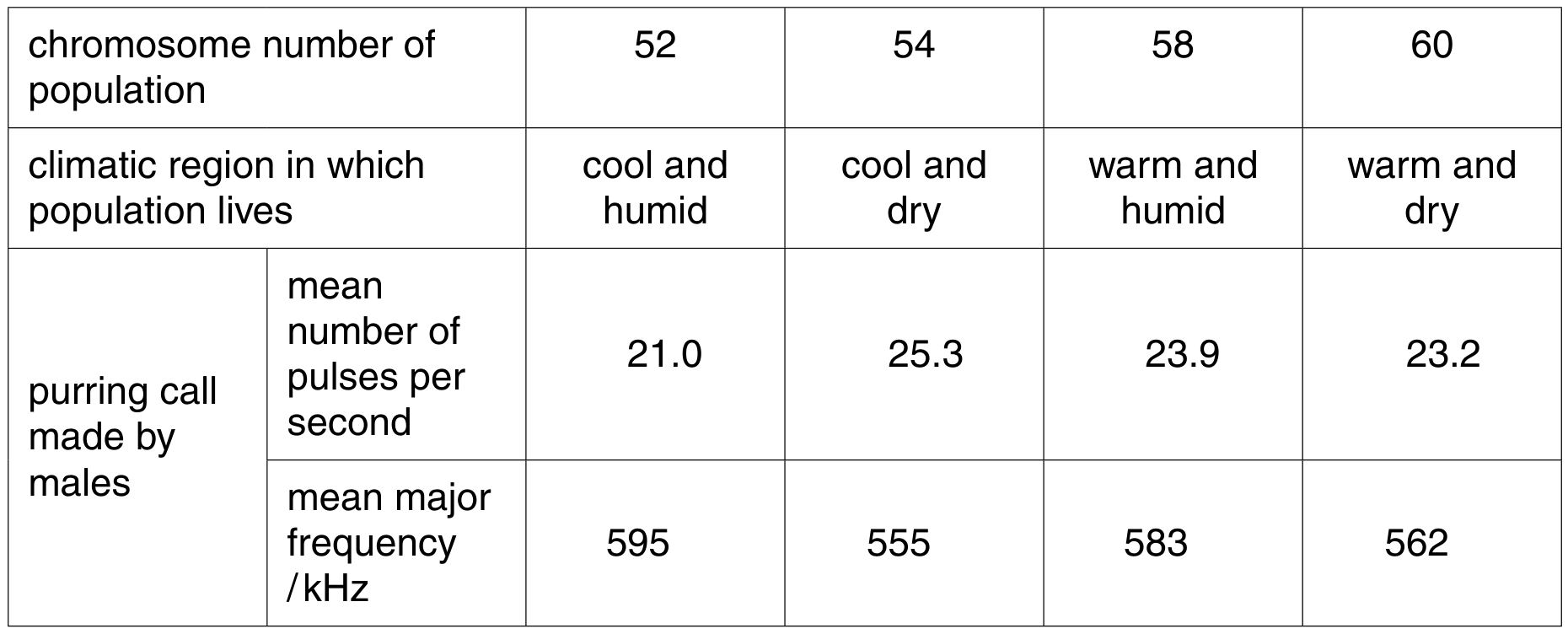
Table 5.1
Explain why the chromosome number of each of the four populations of mole rats is an even number.
State the term that applies to each of the descriptions (a) to (e).
Any cell containing one complete set of chromosomes.