EduNinja
[Maximum number: 2]

The patty pan squash plant, Cucurbita pepo, produces edible fruits that vary in colour.

(a)

In 1994, two new varieties of squash were grown in the USA. Both varieties showed resistance to two viral diseases of squash plants.
- The variety 'Tigress' was developed by selective breeding.
- The variety 'Freedom II' was developed by adding genes for viral coat proteins to the squash genome.

[ 2 ]
(i)

Outline one social advantage and one social disadvantage of the recombinant squash variety compared to non-resistant squash varieties.
advantage
disadvantage

[ 2 ]
[Maximum number: 3]

Oil seed rape (canola), Brassica napus, has been genetically modified to be resistant to herbicides containing glufosinate ammonium. The genetically modified (GM) oil seed rape contains the bar gene, obtained from a soil bacterium. This gene codes for an enzyme that converts glufosinate ammonium into a non-toxic compound.

(a)

The pollen of oil seed rape is transferred from one flower to another by insects. After pollination, fertilisation and seed formation can occur. One of the potential problems of growing glufosinate-resistant oil seed rape is that pollen from these plants could be transferred to the flowers of wild relatives, such as wild radish, Raphanus raphanistrum. This could result in genetic changes in these wild species.

An experiment was carried out to investigate whether glufosinate-resistant hybrids between GM oil seed rape and wild radish plants are likely to compete successfully with non-hybrid or non-resistant plants in the natural environment.
- Type 1 hybrids were produced by transferring pollen from wild radish (diploid number 18) to glufosinate-resistant oil seed rape (diploid number 38).
- Type 2 hybrids were produced by transferring pollen from glufosinate-resistant oil seed rape to wild radish.
- Each hybrid was then crossed with wild radish over several generations.
- The resulting offspring were then grown in field trials, together with normal wild radish.
- The height of the plants and number of seeds each produced were measured. Then the plants were tested for the bar gene.

Table 3.1 shows the results.

Table 3.1

Table 3.1

[ 3 ]
(i)

Many varieties of GM oil seed rape are male sterile, meaning that they do not produce pollen.

With reference to Table 3.1, suggest the advantages to the environment of growing male sterile varieties of GM oil seed rape, rather than GM varieties that produce pollen.

[ 3 ]
(a)

In 2012, permission was granted for a field trial in the UK of genetically modified T. aestivum. The wheat carries a gene, taken from peppermint plants, that results in the wheat leaves releasing a volatile, non-toxic chemical, (E)- β\beta-farnesene (E βf\beta \mathrm{f} ), into the atmosphere.
Eβf\mathrm{E} \beta \mathrm{f} is not only produced by various species of plants. It is also secreted by aphids when they are disturbed by a predator.
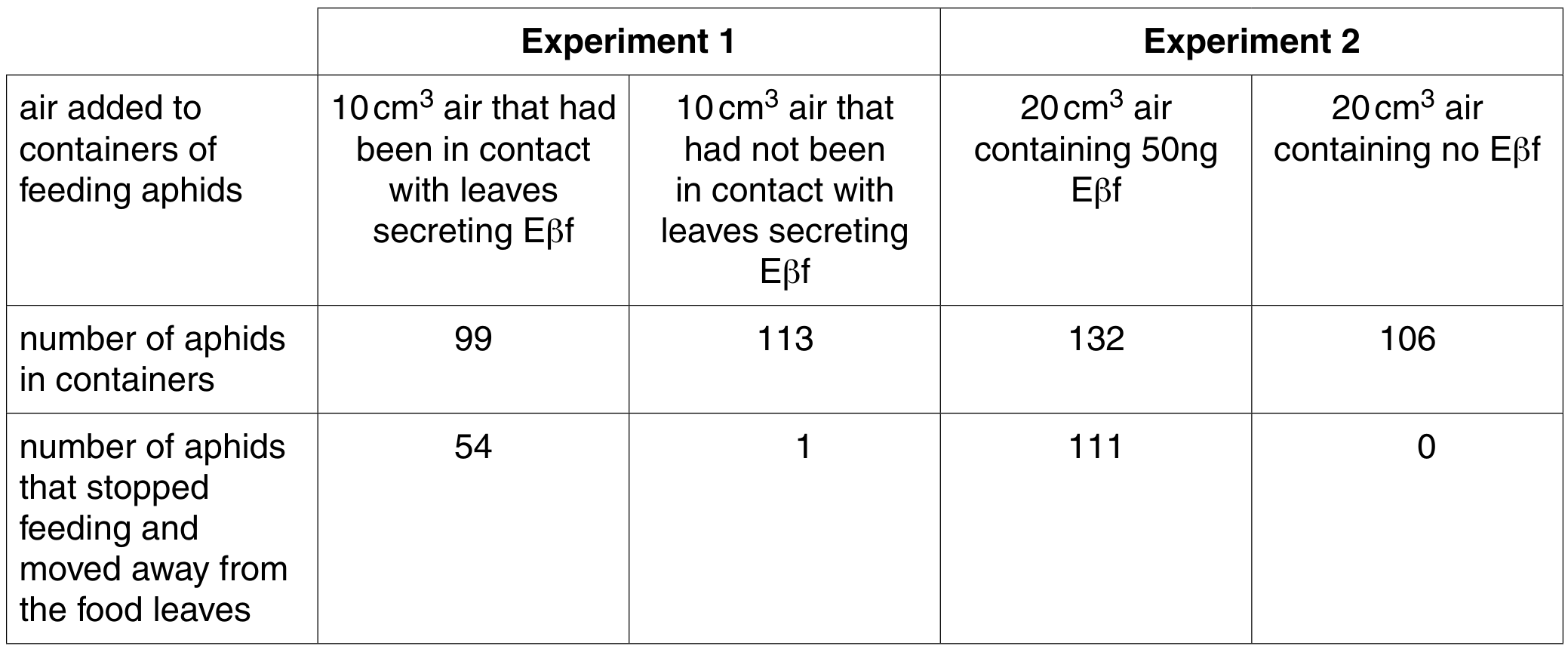
Two experiments have been performed into the effect of Eβf\mathrm{E} \beta \mathrm{f} on the behaviour of aphids feeding on leaves in closed containers.
Experiment 1
Either 10 cm310 \mathrm{~cm}^{3} of air from a syringe that contained plant leaves that secrete Eβf\mathrm{E} \beta \mathrm{f} or 10 cm3\quad 10 \mathrm{~cm}^{3} of air from a syringe with no such leaves
was added to the containers of feeding aphids.
Experiment 2
Either 20 cm320 \mathrm{~cm}^{3} of air containing 50 ng of Eβf\mathrm{E} \beta \mathrm{f}
or 20 cm320 \mathrm{~cm}^{3} of air containing no Eβf\mathrm{E} \beta \mathrm{f}
was added to the containers of feeding aphids.
In both experiments, the number of aphids that stopped feeding and moved away from the food leaves was counted. The results are shown in Table 3.1.

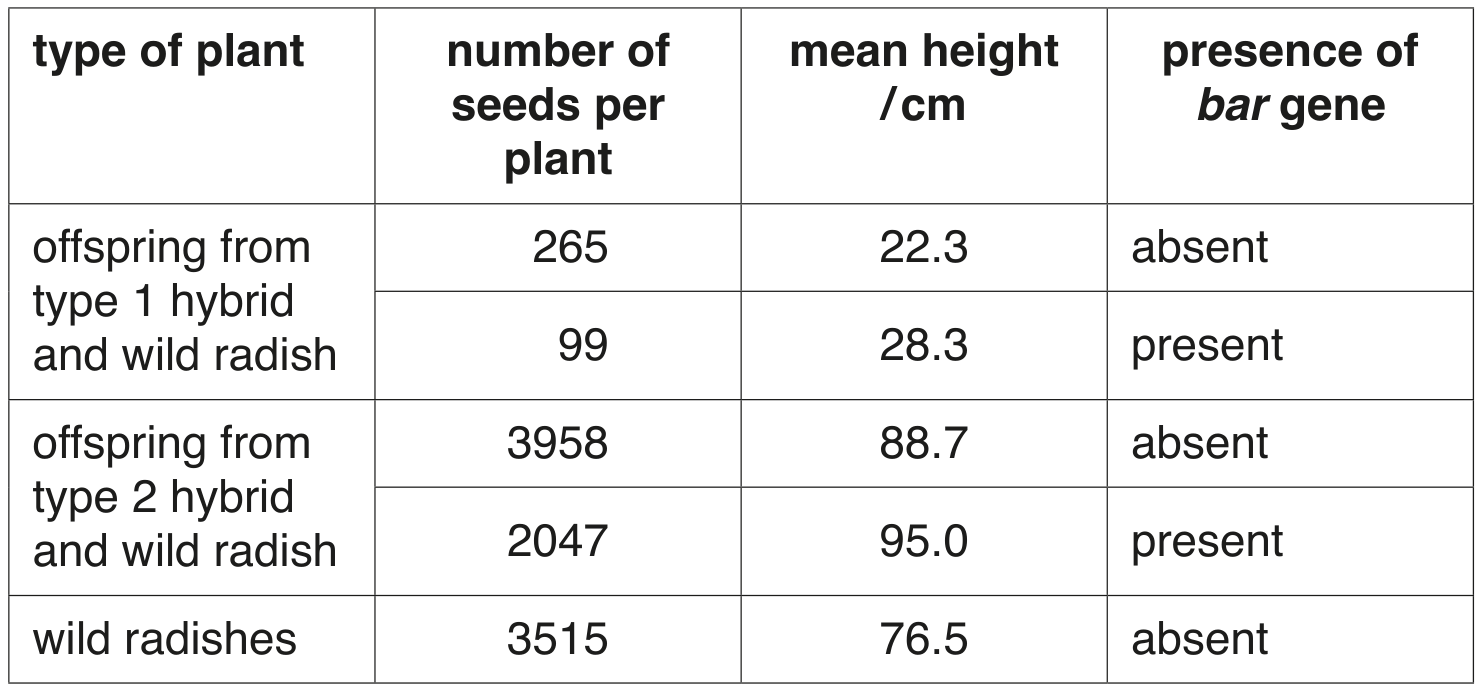
Table 3.1

Table 3.1

[ 7 ]
(i)

Suggest why growing this genetically modified wheat might be acceptable to people who object to the growth of genetically modified insect-resistant maize or cotton.

(a)

In 2012, permission was granted for a field trial in the UK of genetically modified T. aestivum. The wheat carries a gene, taken from peppermint plants, that results in the wheat leaves releasing a volatile, non-toxic chemical, (E)- β\beta-farnesene (E βf\beta \mathrm{f} ), into the atmosphere.
Eβf\mathrm{E} \beta \mathrm{f} is not only produced by various species of plants. It is also secreted by aphids when they are disturbed by a predator.
Two experiments have been performed into the effect of Eβf\mathrm{E} \beta \mathrm{f} on the behaviour of aphids feeding on leaves in closed containers.
Experiment 1
Either 10 cm310 \mathrm{~cm}^{3} of air from a syringe that contained plant leaves that secrete Eβf\mathrm{E} \beta \mathrm{f} or 10 cm3\quad 10 \mathrm{~cm}^{3} of air from a syringe with no such leaves
was added to the containers of feeding aphids.
Experiment 2
Either 20 cm320 \mathrm{~cm}^{3} of air containing 50 ng of Eβf\mathrm{E} \beta \mathrm{f}
or 20 cm320 \mathrm{~cm}^{3} of air containing no Eβf\mathrm{E} \beta \mathrm{f}
was added to the containers of feeding aphids.
In both experiments, the number of aphids that stopped feeding and moved away from the food leaves was counted. The results are shown in Table 3.1.
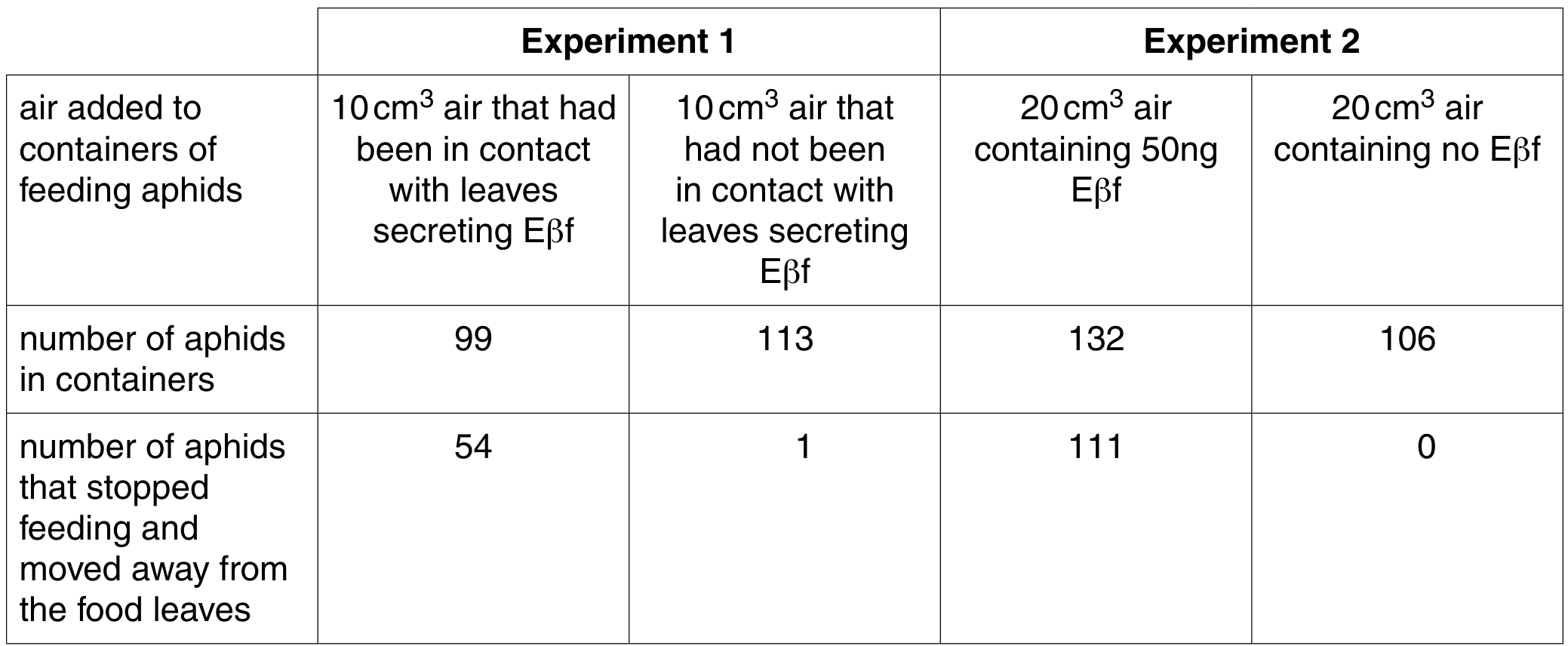
Table 3.1

Table 3.1

[ 7 ]
(i)

Suggest why growing this genetically modified wheat might be acceptable to people who object to the growth of genetically modified insect-resistant maize or cotton.

[Maximum number: 5]

Soybean, Glycine max, is an important food crop for human consumption and for feeding to animals.

Two varieties of soybean are Vinton 81 and GTS 40-3-2.
Vinton 81 has been developed in the traditional way by selective breeding (artificial selection) and GTS 40-3-2 is an example of a genetically modified (GM) organism.

(a)

Countries vary in the extent to which they grow GM varieties, such as GTS 40-3-2, instead of traditional varieties such as Vinton 81.
- In the USA, 94 % of soybeans grown are GM.
- In Europe, 0 % of soybeans grown are GM.

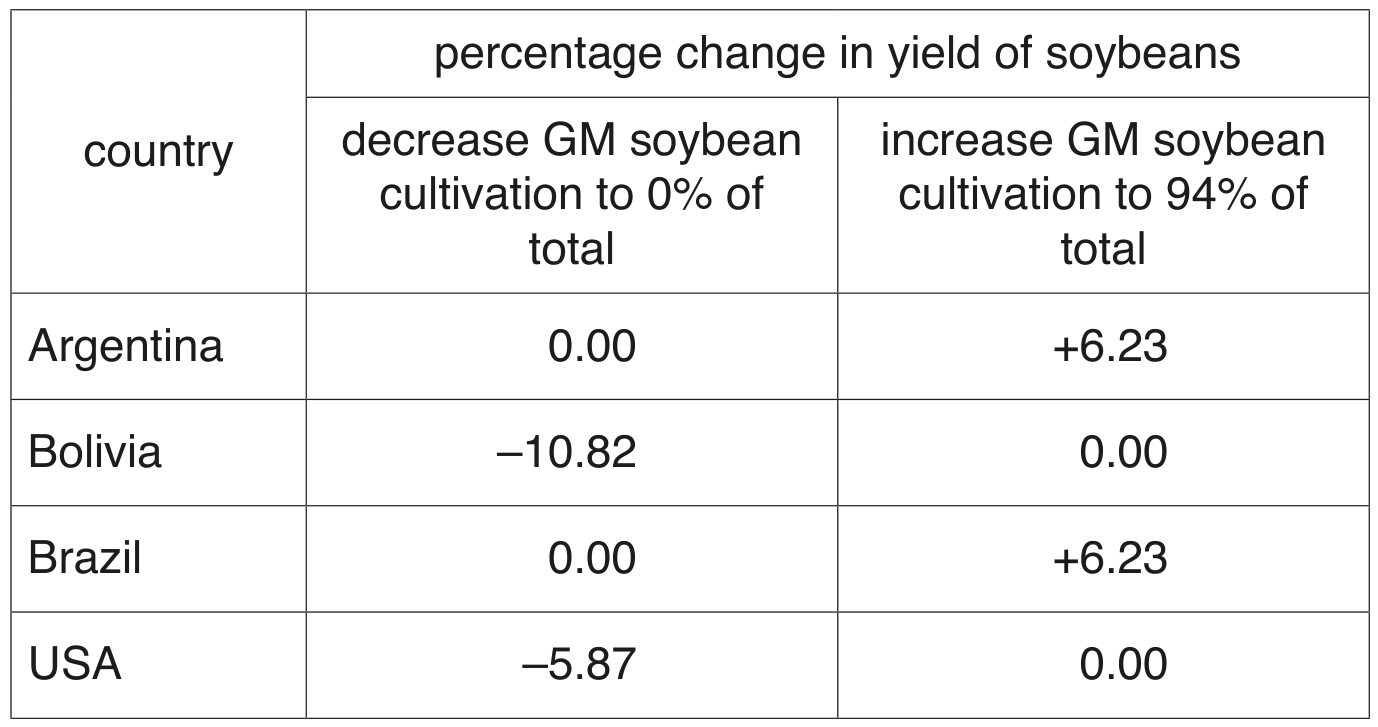
Scientists used computer models to predict the effect of two different changes in agricultural practice on soybean crop yields:
- a global ban that reduces the cultivation of GM soybeans to 0 % everywhere
- all countries increasing the cultivation of GM soybeans to the 94 % level of the USA.

Table 3.1 shows the results of this modelling for four countries.

Table 3.1

Table 3.1

Explain what the data in Table 3.1 suggests about the social and ethical implications of growing GM soybeans.

[ 5 ]
[Maximum number: 4]

Rice, Oryza sativa, is an important food crop for human consumption.
Two varieties of rice are T2A-1 and Shanyou 2.
Shanyou 2 has been developed in the traditional way by selective breeding (artificial selection) and T2A-1 is an example of a genetically modified (GM) organism.

(a)

Countries vary in the extent to which they grow GM varieties instead of traditional crop varieties.
- The USA, Canada and countries in South America plant GM varieties on a large proportion of their crop-growing land, reaching 94 % for soybeans in the USA.
- In most European countries, 0 % of the crop-growing land is planted with GM varieties.

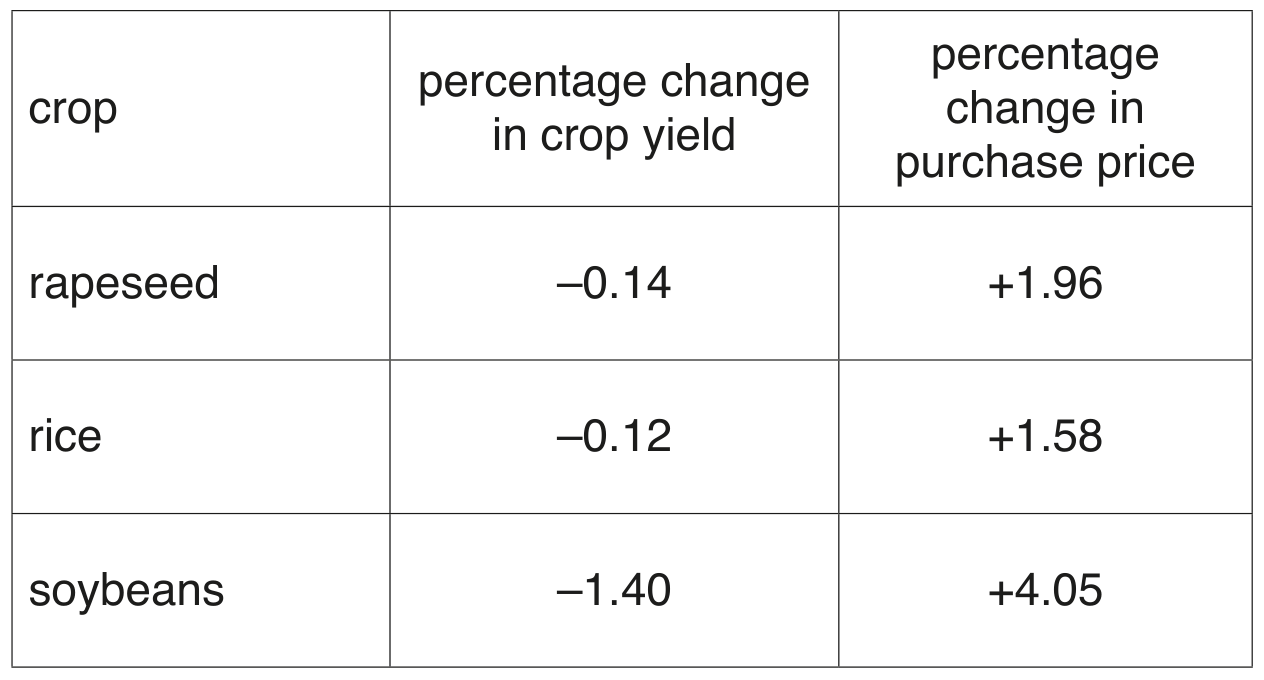
Scientists used computer models to predict the effects of a global ban that reduced the cultivation of GM crops to 0 % everywhere.

Table 4.1 shows the results of this modelling on world crop yields and the purchase price of each crop.

Table 4.1

Table 4.1

[ 4 ]
(i)

Explain what the data in Table 4.1 show about the social implications of growing GM crops.

[ 2 ]
(ii)

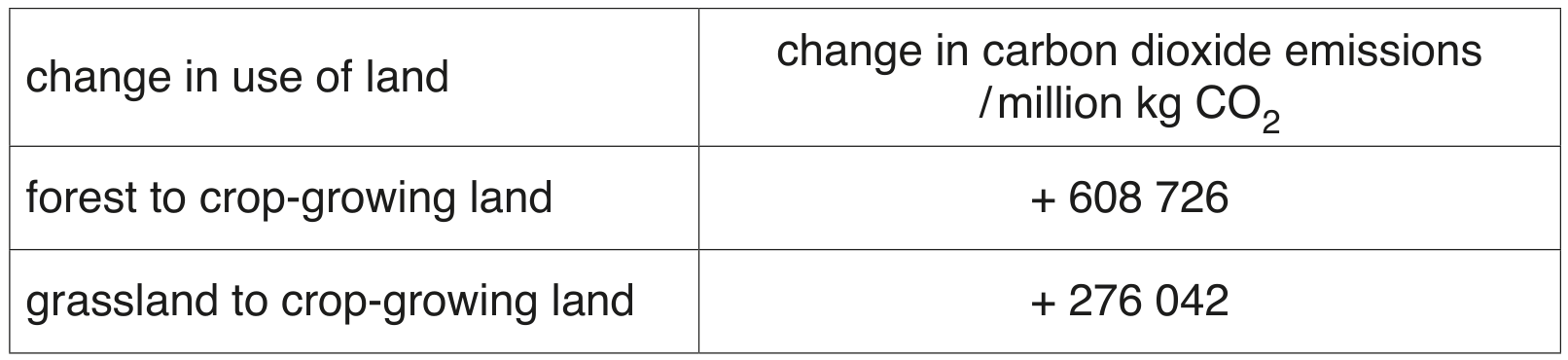
A worldwide ban on growing GM crop varieties would mean that more land would be needed to grow traditional crops, such as Shanyou 2. This would involve converting forest and grassland to crop-growing land.

Table 4.2 shows the predicted changes in carbon dioxide emissions associated with this change in use of land.

Table 4.2

Table 4.2

Discuss what the data in Table 4.2 indicate about the environmental implications of growing GM crops.

[ 2 ]
[Maximum number: 3]

Golden Rice TM { }^{\text {TM }} is a genetically modified form of rice that produces relatively large amounts of β\beta carotene in the endosperm. β\beta carotene is metabolised in the human body to produce vitamin A.

(a)

Describe the possible disadvantages of growing Golden Rice™.

[ 3 ]
(a)
(i)

Discuss whether these transgenic pigs have long term economic value.

[ 3 ]
[Maximum number: 3]

In the USA, about 35 % of all maize that is grown has been genetically modified to produce a toxin, called Bt toxin, derived from the bacterium Bacillus thuringiensis. The genetically modified plants are known as Bt maize.

(a)

In a second laboratory-based experiment, three groups of larvae of a different species of caddis fly, Helicopsyche borealis, were fed on pollen containing:

A

no Bt toxin

B

Bt toxin at concentrations found in streams in maize-growing areas

C

Bt toxin at concentrations twice as high as found in those streams. The researchers measured the mortality rates of the caddis fly larvae. Their results are summarised in Table 5.1.

Table 5.1

Table 5.1

The researchers were careful to state that their results showed the 'potential ecological effects' on the caddis fly larvae of growing Bt maize.

Suggest two reasons why 'potential ecological effects' is a suitable description of any conclusions that could be drawn from the results of this experiment.

[ 2 ]
(b)

When the results of the experiments described in (b) and (c) were published, many other scientists criticised the research very strongly.

Suggest why some scientists might wish to suppress results such as these, even if there is no fault with the investigation itself.

[ 1 ]
0