One goal of genetic engineering is to make crops that are heat tolerant. This means that crops can grow and produce a good yield at high environmental temperatures.
Use the information given in Question 2 to suggest and explain a way to improve the tolerance of a crop to high temperatures.
The patty pan squash plant, Cucurbita pepo, produces edible fruits that vary in colour.
In 1994, two new varieties of squash were grown in the USA. Both varieties showed resistance to two viral diseases of squash plants.
- The variety 'Tigress' was developed by selective breeding.
- The variety 'Freedom II' was developed by adding genes for viral coat proteins to the squash genome.
Identify, with reasons, the variety of squash that can be described as recombinant.
Oil seed rape (canola), Brassica napus, has been genetically modified to be resistant to herbicides containing glufosinate ammonium. The genetically modified (GM) oil seed rape contains the bar gene, obtained from a soil bacterium. This gene codes for an enzyme that converts glufosinate ammonium into a non-toxic compound.
Outline the advantages to farmers of growing glufosinate-resistant oil seed rape.
In 2012, permission was granted for a field trial in the UK of genetically modified T. aestivum. The wheat carries a gene, taken from peppermint plants, that results in the wheat leaves releasing a volatile, non-toxic chemical, (E)- β-farnesene (E βf ), into the atmosphere.
Eβf is not only produced by various species of plants. It is also secreted by aphids when they are disturbed by a predator.
Two experiments have been performed into the effect of Eβf on the behaviour of aphids feeding on leaves in closed containers.
Experiment 1
Either 10 cm3 of air from a syringe that contained plant leaves that secrete Eβf or 10 cm3 of air from a syringe with no such leaves
was added to the containers of feeding aphids.
Experiment 2
Either 20 cm3 of air containing 50 ng of Eβf
or 20 cm3 of air containing no Eβf
was added to the containers of feeding aphids.
In both experiments, the number of aphids that stopped feeding and moved away from the food leaves was counted. The results are shown in Table 3.1.

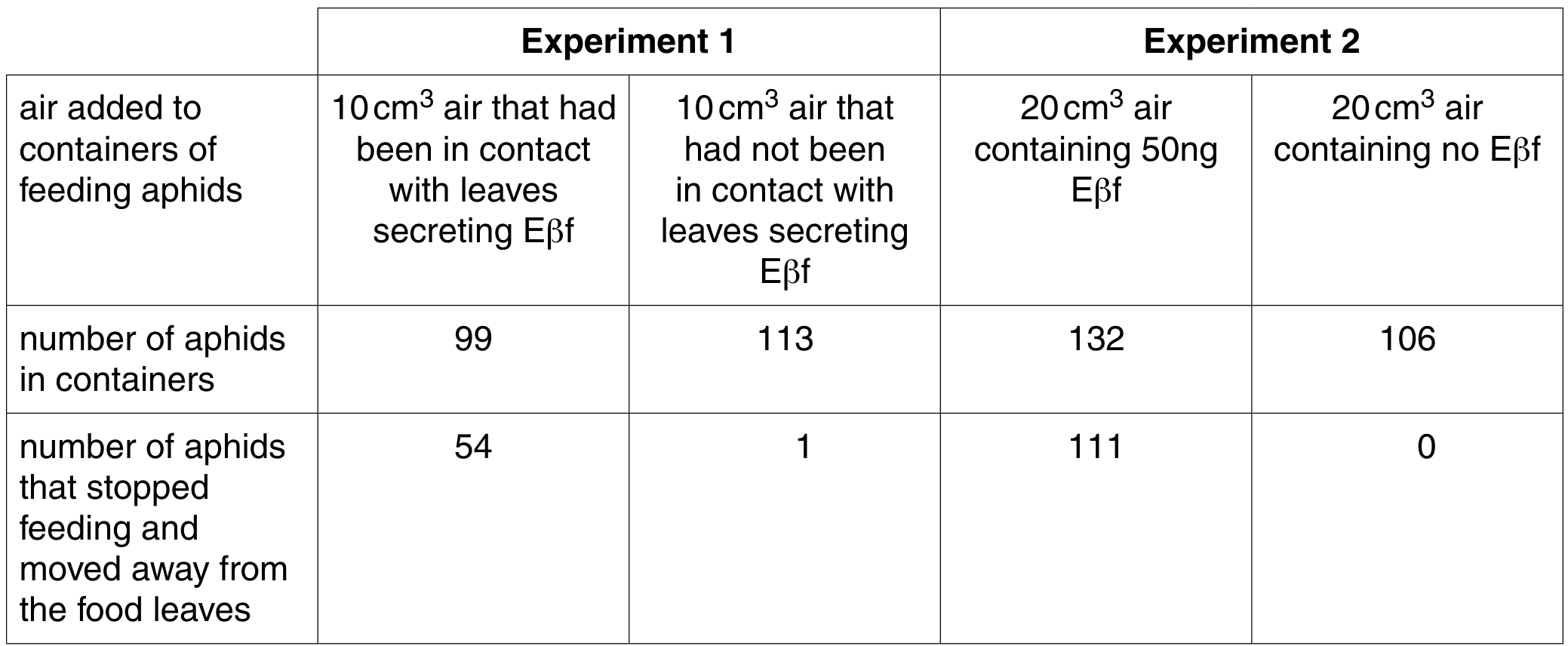
Table 3.1
Other experiments show that Eβf attracts predators of aphids, such as ladybirds.
Explain how growing genetically modified wheat secreting Eβf could increase the yield of wheat.
Salmon can be genetically modified (GM) to produce increased quantities of growth hormone, which is a protein. GM salmon modified in this way have a faster growth rate and reach their maximum body mass at a younger age than non-GM salmon.
Scientists investigated whether injection of very young non-GM salmon with recombinant growth hormone could cause an increase in the growth rate of the salmon.
The scientists used two groups of non-GM salmon:
- a control group of salmon that were not injected with recombinant growth hormone
- an experimental group of salmon that were injected with 1.0μ g of recombinant growth hormone at the start of the experiment and once a week for the next six weeks.
The mean body mass of the salmon in the two groups at the start of the experiment was the same ( 5.3 g ).
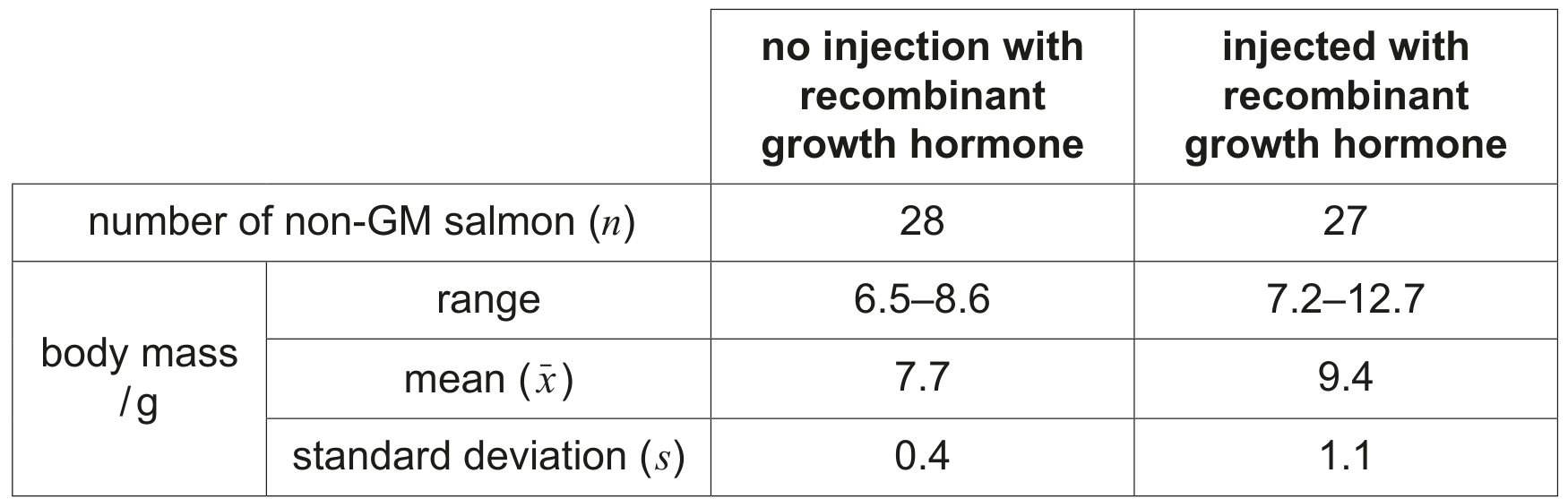
After six weeks, the body mass of every salmon was measured again. The results are summarised in Table 3.1.

Table 3.1
A student decided that a t-test should be performed on the results shown in Table 3.1.
Suggest one advantage, other than cost, of farming GM salmon that produce increased quantities of growth hormone instead of farming non-GM salmon that are injected with recombinant growth hormone each week.
Give two advantages of genetically engineering herbicide resistance in crop plants such as soybean.
An analysis in 2019 concluded that twice as many insect species have populations that are decreasing in size compared with chordate species. This analysis focused on developed countries that have large human populations.
Explain how the introduction of crops that are genetically modified to express the Bt toxin can benefit biodiversity.
Rice, Oryza sativa, is an important food crop for human consumption.
Two varieties of rice are T2A-1 and Shanyou 2.
Shanyou 2 has been developed in the traditional way by selective breeding (artificial selection) and T2A-1 is an example of a genetically modified (GM) organism.
T2A-1 rice is described as insect-resistant as it produces a chemical that is toxic to insect pests.
Outline how genetic engineering gave T2A-1 rice the trait of insect resistance.
Golden Rice TM is a genetically modified form of rice that produces relatively large amounts of β carotene in the endosperm. β carotene is metabolised in the human body to produce vitamin A.
Explain why rice has been genetically modified to produce extra β carotene.
Scientists tried to create an improved virus vector for gene therapy.
step 1 - The scientists used a special form of the polymerase chain reaction (PCR). This form of PCR causes mutations in the DNA sequence of AAV by base substitution.
step 2 - The viruses containing different base substitutions were tested. This was done by using the different viruses to deliver a new gene, the gene for green fluorescent protein (GFP), into the photoreceptor cells of mice, using the retinal injection method.
step 3 - The best virus, known as 7 m 8 , caused the photoreceptor cells in the retina of the mouse to fluoresce brightly, even when the recombinant virus was injected into the fluid inside the eye instead of into the retina itself.
step 4 - The 7 m 8 virus was used to cure a mouse with LCA by injecting this virus containing the therapeutic allele into the fluid inside the eye of the mouse.
Predict the impact of the 7 m 8 AAV on treatment for age-related retinal diseases.