EduNinja
(a)

In 2012, permission was granted for a field trial in the UK of genetically modified T. aestivum. The wheat carries a gene, taken from peppermint plants, that results in the wheat leaves releasing a volatile, non-toxic chemical, (E)- β\beta-farnesene (E βf\beta \mathrm{f} ), into the atmosphere.
Eβf\mathrm{E} \beta \mathrm{f} is not only produced by various species of plants. It is also secreted by aphids when they are disturbed by a predator.
Two experiments have been performed into the effect of Eβf\mathrm{E} \beta \mathrm{f} on the behaviour of aphids feeding on leaves in closed containers.
Experiment 1
Either 10 cm310 \mathrm{~cm}^{3} of air from a syringe that contained plant leaves that secrete Eβf\mathrm{E} \beta \mathrm{f} or 10 cm3\quad 10 \mathrm{~cm}^{3} of air from a syringe with no such leaves
was added to the containers of feeding aphids.
Experiment 2
Either 20 cm320 \mathrm{~cm}^{3} of air containing 50 ng of Eβf\mathrm{E} \beta \mathrm{f}
or 20 cm320 \mathrm{~cm}^{3} of air containing no Eβf\mathrm{E} \beta \mathrm{f}
was added to the containers of feeding aphids.
In both experiments, the number of aphids that stopped feeding and moved away from the food leaves was counted. The results are shown in Table 3.1.
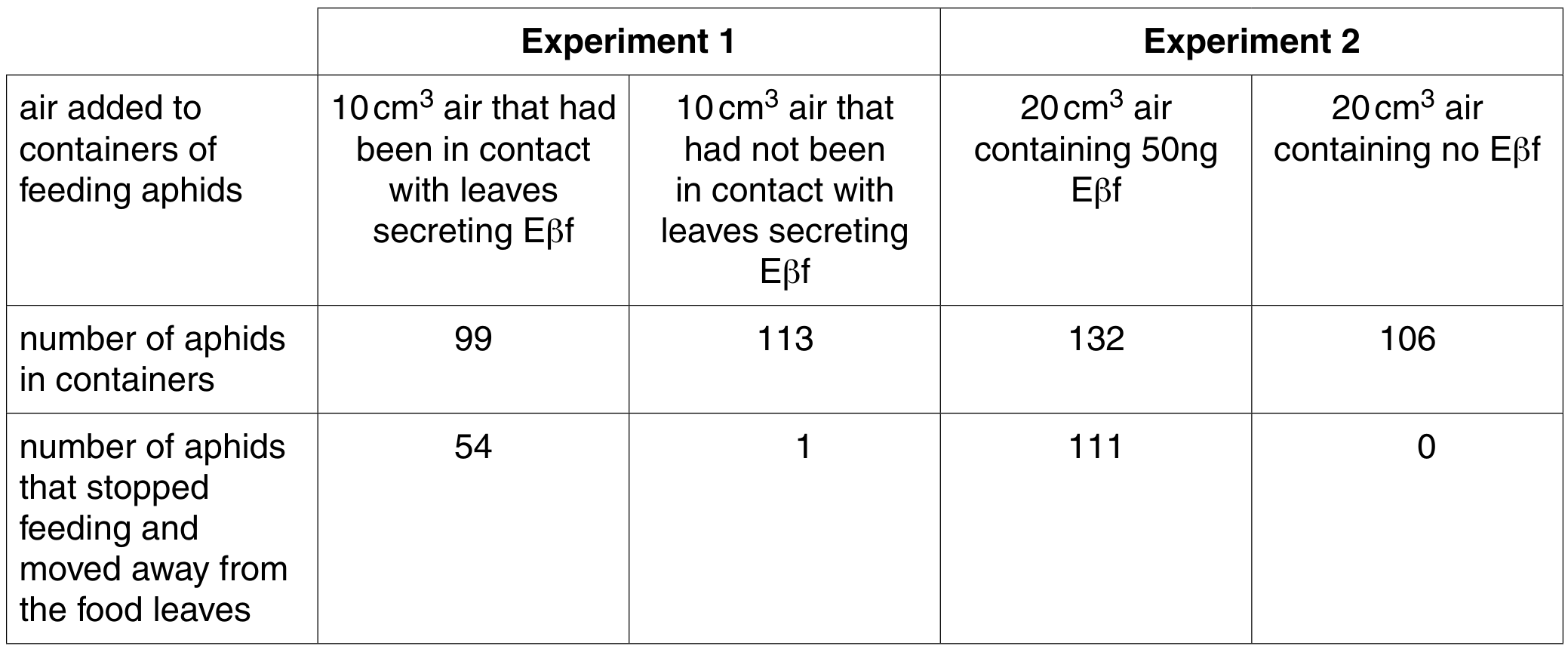
Table 3.1

Table 3.1

[ 3 ]
(i)

Other experiments show that Eβf\mathrm{E} \beta \mathrm{f} attracts predators of aphids, such as ladybirds.

Explain how growing genetically modified wheat secreting Eβf\mathrm{E} \beta \mathrm{f} could increase the yield of wheat.

[ 3 ]
[Maximum number: 2]

In the USA, about 35 % of all maize that is grown has been genetically modified to produce a toxin, called Bt toxin, derived from the bacterium Bacillus thuringiensis. The genetically modified plants are known as Bt maize.

(a)

An investigation was carried out into the potential effects of dead leaves from Bt maize on organisms living in streams that flow through areas where the maize is grown.

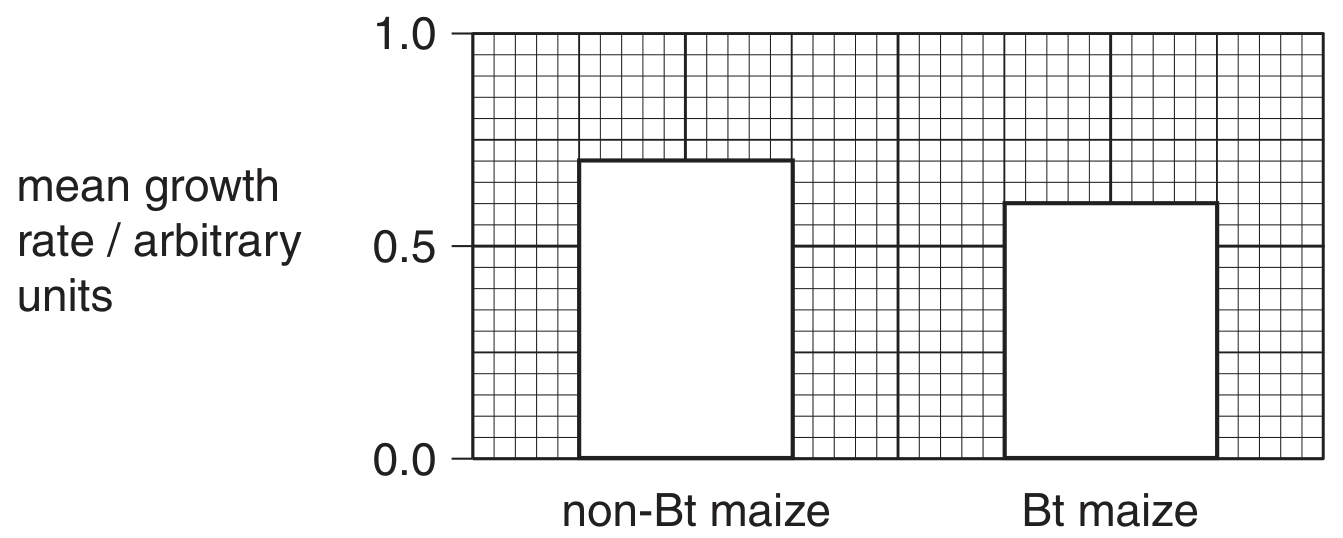
The researchers conducted a laboratory-based experiment in which larvae of one species of aquatic caddis fly, Lepidostoma liba, were fed on non-Bt maize leaves, or on leaves from Bt maize. The growth rates of the larvae were measured.

The results are summarised in Fig. 5.1.

Fig. 5.1

Fig. 5.1

Describe the effect of eating leaves from Bt maize on the growth rate of L. liba larvae.

[ 2 ]
[Maximum number: 3]

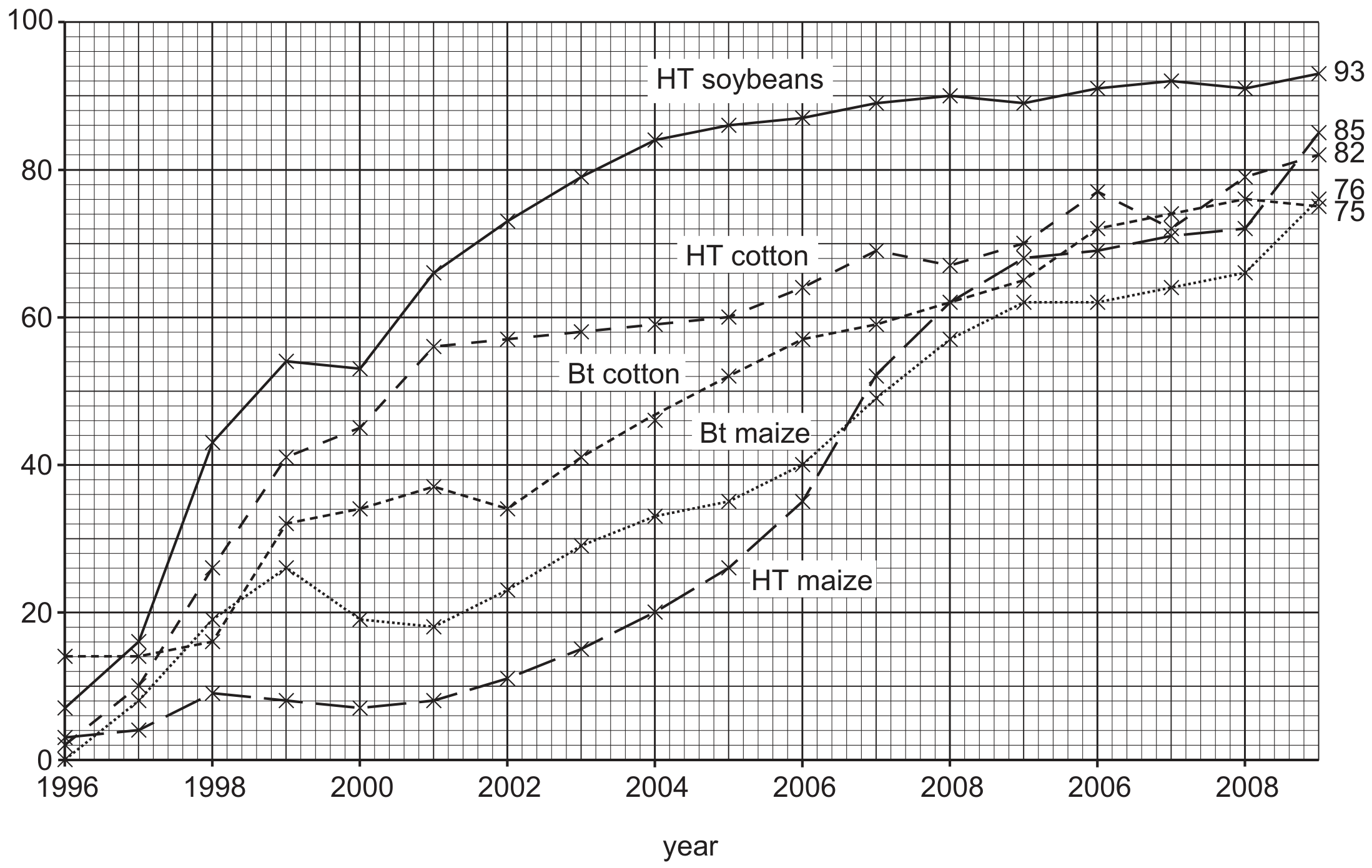
Fig. 8.1 shows the proportion of cotton, maize and soybeans grown in the USA that are genetically modified in two different ways:
- HT crops are modified to be resistant to the herbicide glyphosate
- Bt crops are modified to express the Bt toxin which kills insect pests.
percentage of total crop grown that is genetically modified

Fig. 8.1

Fig. 8.1

(a)
(i)

With reference to Fig. 8.1, describe the change in the percentage of genetically modified cotton grown in the USA since 1996.

[ 3 ]
0