EduNinja
[Maximum number: 3]

The natural ecosystem on Hawadax Island in Alaska was disrupted in the 1780s when brown rats, Rattus norvegicus, swam to the island from a sinking ship and then rapidly increased their population size.

The rats occupied a new niche on the island as predators. The rats ate the eggs and chicks of birds such as the black oystercatcher, Haematopus bachmani, and the glaucous-winged gull, Larus glaucescens. These birds make nests, lay eggs and rear their chicks on the beaches of the island.

(a)

Define the terms ecosystem and niche.

[ 3 ]
(i)

ecosystem

[ 2 ]
(ii)

niche

Conservation ecologists carried out a project to try to restore the natural ecosystem of Hawadax Island. In 2008, they removed all rats from the island.

Before removing the rats, the ecologists measured the abundance of birds, invertebrates and seaweeds on eight of the island's beaches. Seaweeds are large algae that grow attached to rocks on the beach. The ecologists repeated these measurements in 2013 and in 2019, so that they could calculate the percentage change in abundance from 2008.
[ 1 ]
[Maximum number: 4]

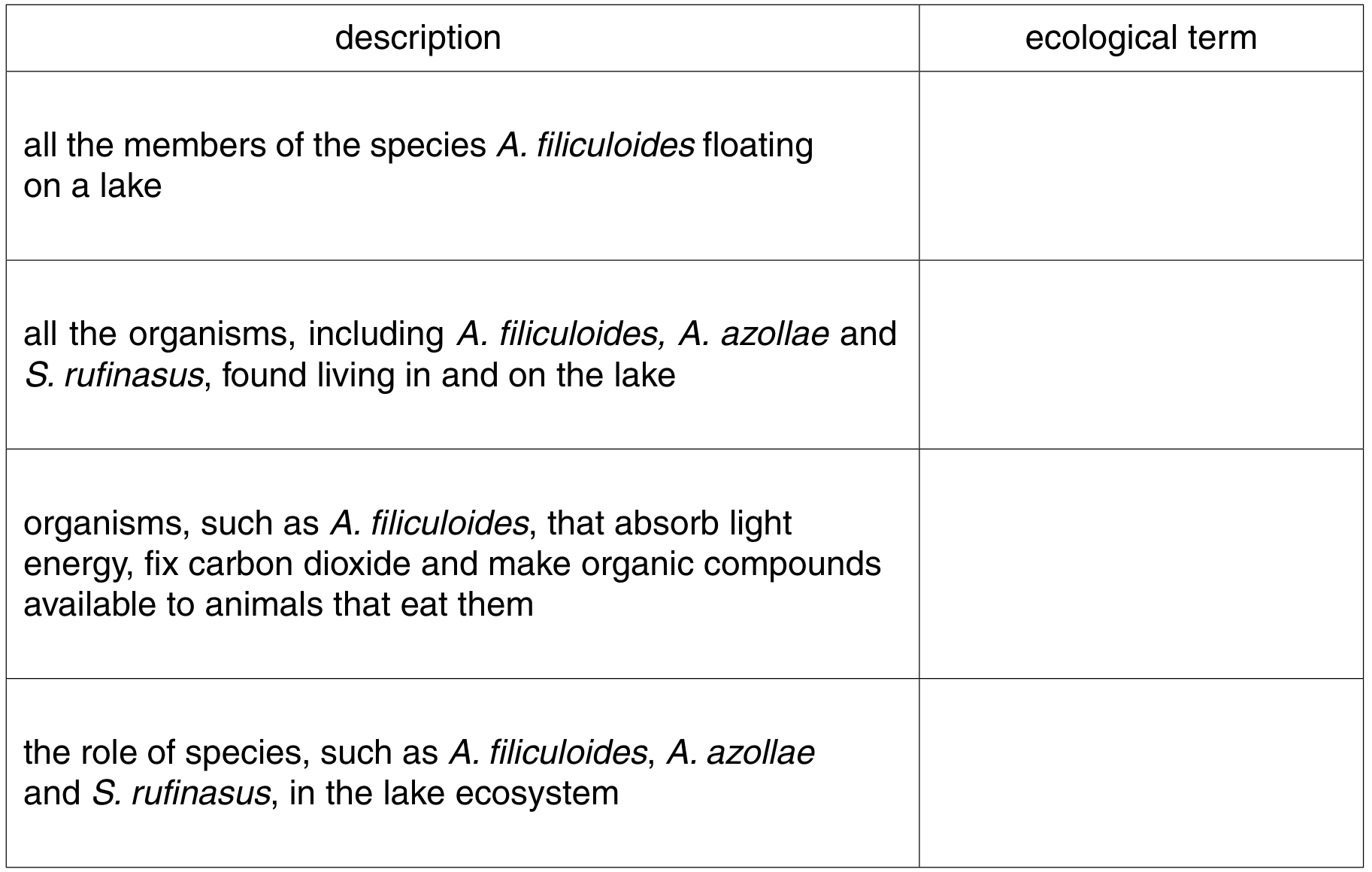
Azolla filiculoides is an aquatic fern that floats on the surface of lakes.
The nitrogen-fixing microorganism, Anabaena azollae, lives within the leaves of the fern. The beetle, Stenopelmus rufinasus, feeds on A.filiculoides.

(a)

State the ecological terms applied to each of the following descriptions of these species.

Table
[ 4 ]
[Maximum number: 1]

Two species of animal are found in the same area of forest and grassland. In the spring and summer they eat the same plant food. However, in the autumn and winter one eats nuts in the forest and the other eats roots on the grassland.

Both species are preyed upon by the same predator. Numbers of root-eating animals are reduced most by this, but they recover faster since they reproduce faster.

What can be concluded about these two species of animals?

1 They are part of the same community.
2 They are at different trophic levels.
3 They occupy different habitats.
4 They have different niches.

A

1 and 2 only

B

1 and 4 only

C

2, 3 and 4 only

D

1, 3 and 4 only

[Maximum number: 7]

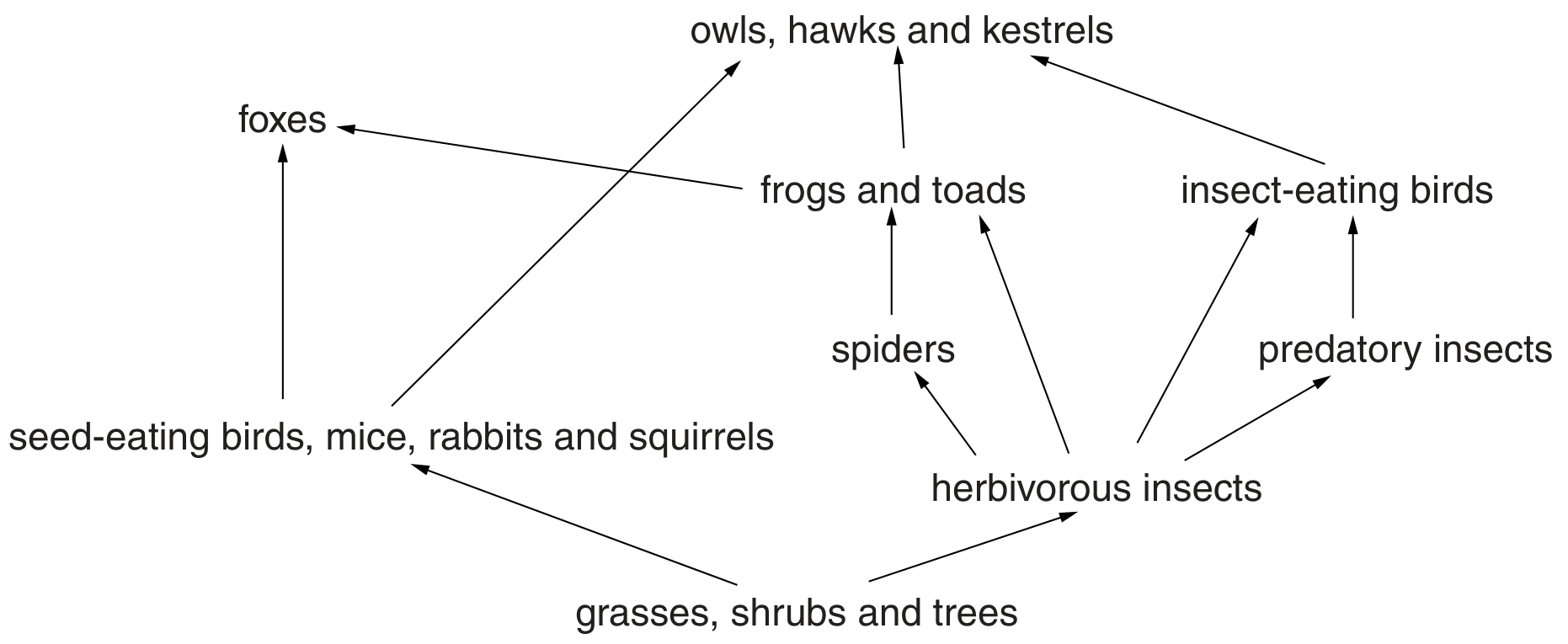
A woodland ecosystem was investigated and a food web was constructed. This food web is shown in Fig. 6.1.

Fig. 6.1

Fig. 6.1

(a)

State the meaning of the term ecosystem.

[ 2 ]
(b)

Name one group of organisms from Fig. 6.1 that are:

[ 2 ]
(i)

producers

[ 1 ]
(ii)

only secondary consumers.

[ 1 ]
(c)

Fig. 6.1 shows the flow of energy but not the cycling of nutrients in the ecosystem.

Outline what happens to the nitrogen-containing compounds in the organisms at the top of the food web.

[ 3 ]
[Maximum number: 2]

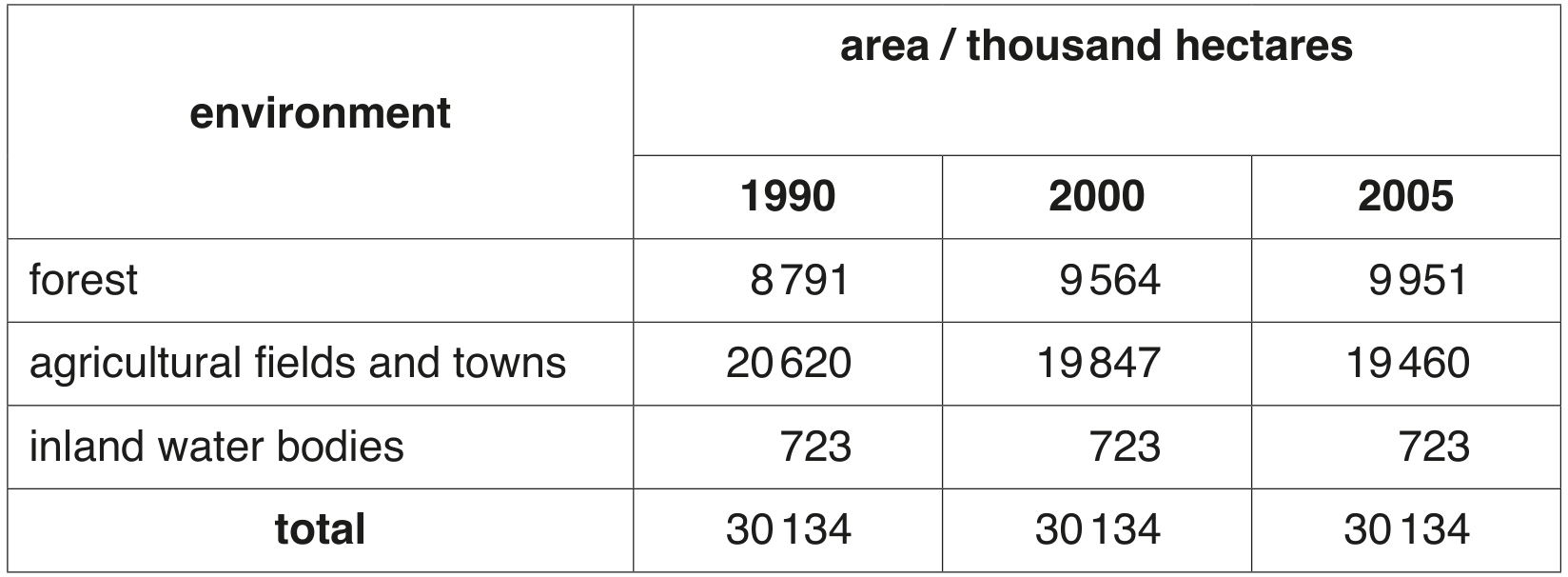
The land area of Italy is composed of forest, grasslands (including agricultural fields), built-up areas (for example towns and cities) and inland water bodies like lakes and rivers.

Table 5.1 shows changes in the area covered by these environments over a fifteen year period.

Table 5.1

Table 5.1

(a)
(i)

Explain why none of the three environments listed in Table 5.1 can be referred to as an ecosystem.

[ 2 ]
(a)

Sentences (i) and (ii) are extracted from longer definitions of ecological terms. Each has one or more missing words.

Complete (i) and (ii) using the correct terms chosen from the list below.

Table

(i) is the particular location and type of local environment occupied by or organism, characterised by its physical features or by its dominant .
(ii) is the functional role or place of a species of organism within

[ 3 ]
[Maximum number: 2]

State the term that applies to each of the descriptions (a) to (e).

(a)

The name of the trophic level to which photosynthetic organisms belong.

[ 1 ]
(b)

A process carried out by bacteria that involves the conversion of atmospheric nitrogen into nitrogenous compounds that can be used directly by plants.

[ 1 ]
[Maximum number: 7]

Read the following passage.

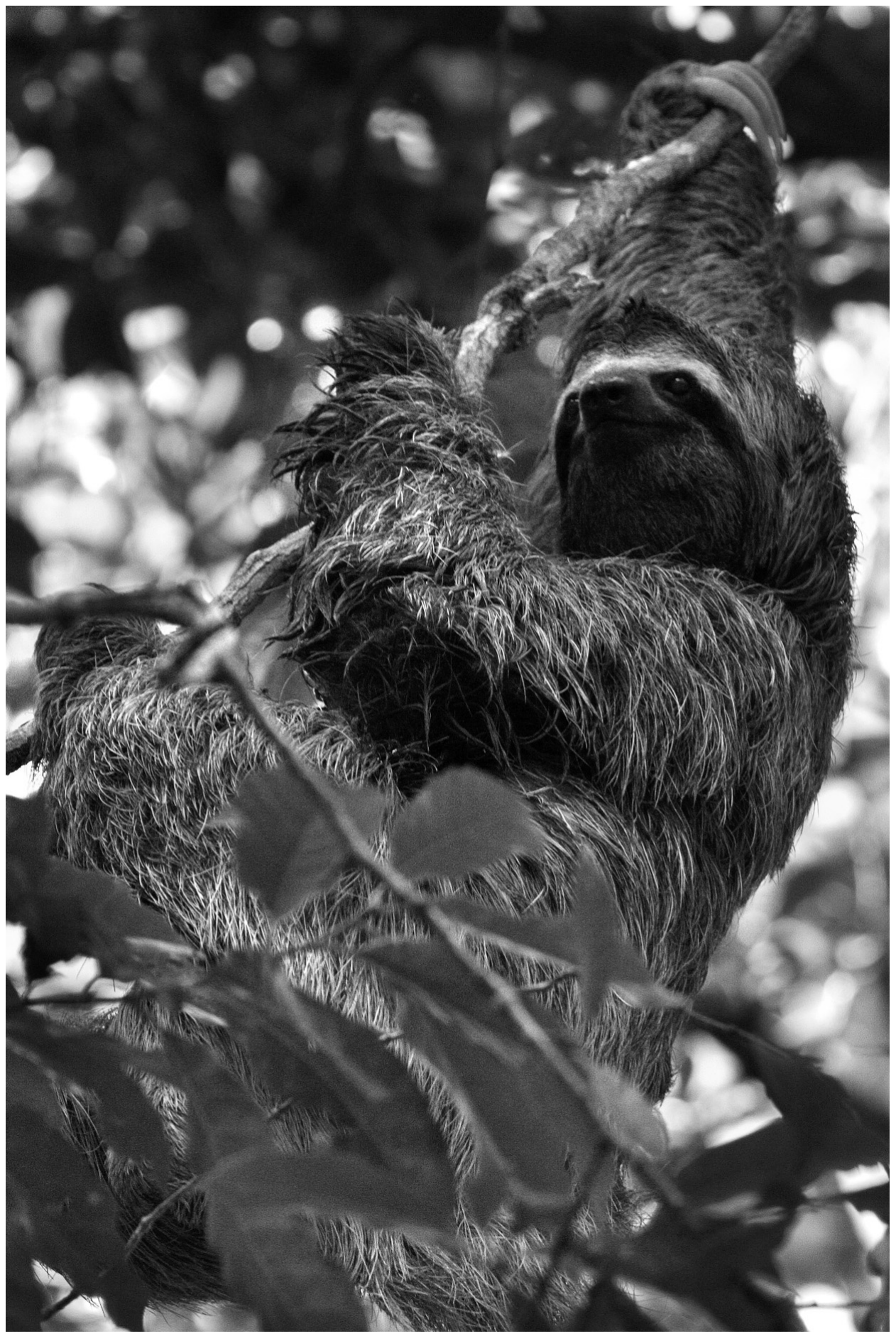
The three-toed sloth, Bradypus variegatus, is a very slow-moving mammal found in Central and South America that spends most of its life living in trees.

The thick, long grey fur of the sloth in Fig. 5.1 has a green appearance. Individual hairs of the sloth have grooves in them where water can collect.

Fig. 5.1

Fig. 5.1

Research has shown that the green colour is due to the presence of algae living on the sloth's fur, the most common species being Trichophilus welckeri. Algae are eukaryotic, photosynthetic organisms.

Many other species of non-photosynthetic eukaryotes, both unicellular and multicellular, have been found living on the sloth's fur. These include different species of roundworms, insects and saprotrophic fungi.

(a)

Explain the ecological terms population and community, using examples given in the passage.
population
community

[ 4 ]
(b)

Suggest why the sloth and its fur can be described as a small ecosystem.

[ 3 ]
[Maximum number: 4]

When investigating ecosystems, food chains and food webs are constructed.

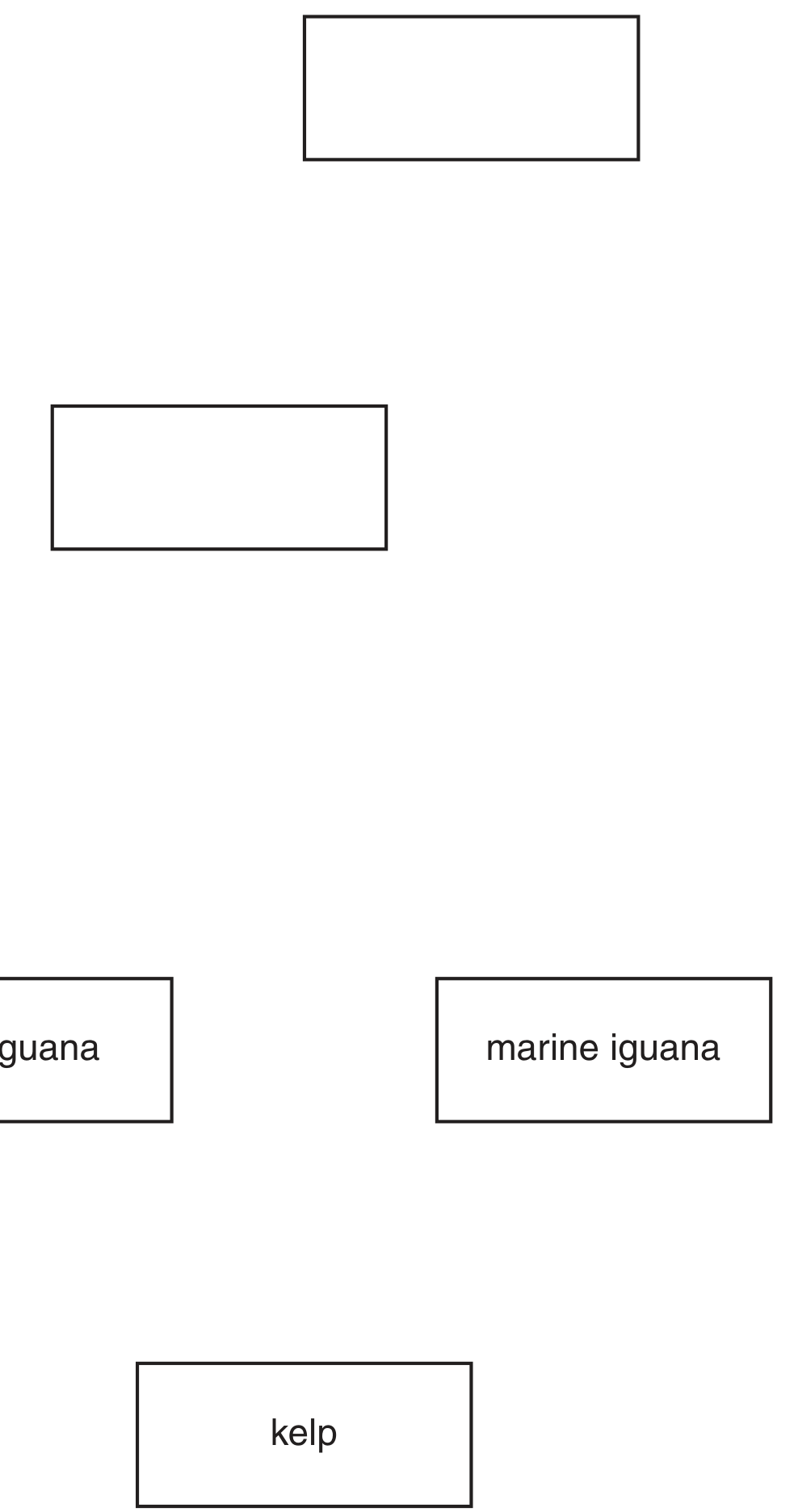
Read the passage below about trophic relationships on one of the Galapagos Islands.

Marine iguanas feed on kelp, which grows attached to rocks in shallow waters. Kelp is a photosynthetic organism. Further inland, xerophytes are grazed upon by land iguanas. A great diversity of herbivorous insects, including many species of short-horned grasshoppers, feed on the xerophytes. An analysis of the gut contents of lava lizards reveals that these insects are prey for the lizards. The lizards are preyed upon by Galapagos snakes. The snakes also hunt grasshoppers and newly hatched iguanas. The Galapagos hawk has a varied diet and catches animals such as Galapagos snakes, short-horned grasshoppers, small lava lizards and newly hatched iguanas.

(a)

Complete Fig. 6.1 to make a food web by:
- filling in the blank boxes with the names of the organisms
- adding arrows to show the direction of energy flow between all the different links in the food web.
galapagos hawk

Question image
[ 4 ]
(b)

State which of the organisms in Fig. 6.1 are the producers. Explain your choice.

[Maximum number: 10]

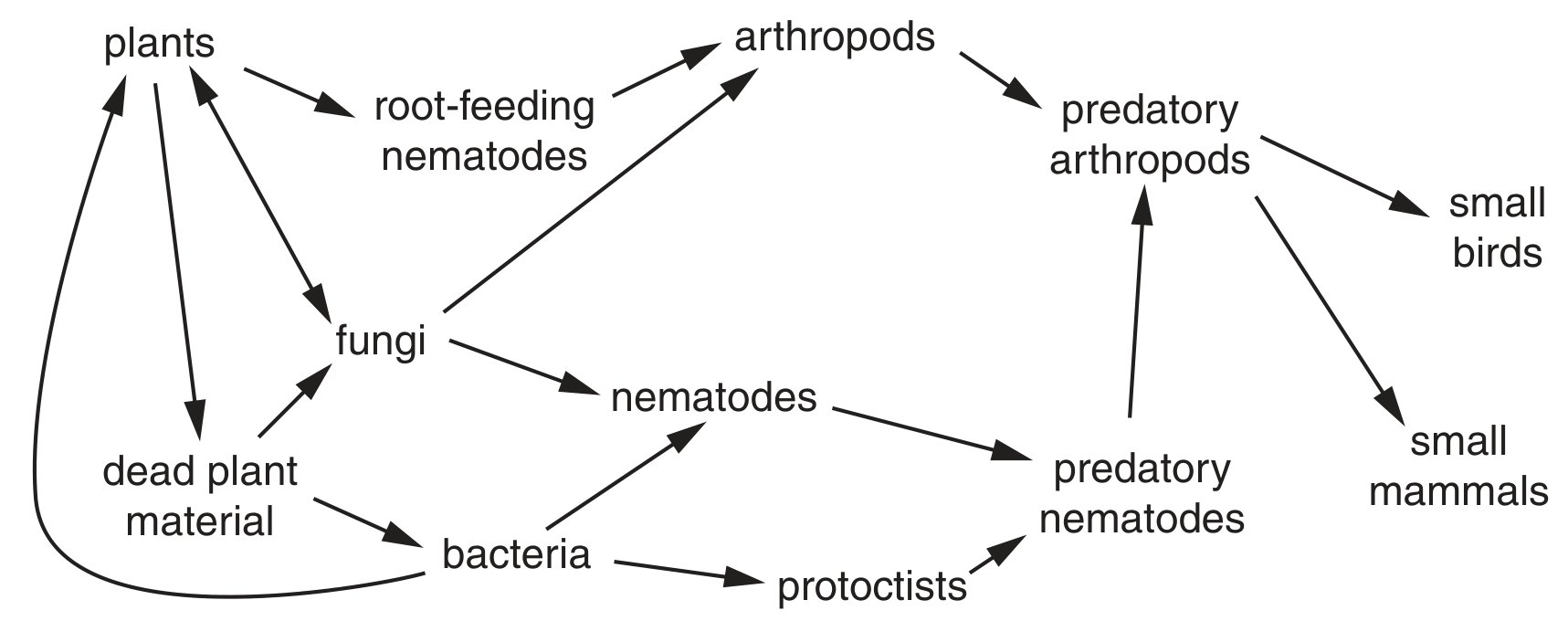
Fig. 6.1 shows the directions of nutrient flow in a soil food web.

Fig. 6.1

Fig. 6.1

(a)
(i)

State, in terms of nutrient flow, the significance of the double-headed arrow between plants and fungi.

[ 2 ]
(b)

The small birds shown in Fig. 6.1 are preyed upon by larger birds.

[ 3 ]
(i)

State which trophic level these larger birds occupy.

[ 1 ]
(ii)

Some large animals feed on more than one trophic level. Suggest why this is so.

[ 2 ]
(c)

Communities of organisms, in soil habitats, have been described by biologists as "the driving force for the environment".

[ 5 ]
(i)

Define the terms
community
habitat

[ 2 ]
(ii)

Suggest what is meant by the term "driving force for the environment".

[ 3 ]
0