(a)
With reference to Fig. 1.1, outline the events that occur in a guard cell during times of water stress.
[ 5 ]
 EduNinja
With reference to Fig. 1.1, outline the events that occur in a guard cell during times of water stress.
The lower epidermis contains stomata.
Abscisic acid has an important role in the closure of a stoma. It promotes the loss of potassium ions from guard cells.
Outline how the loss of potassium ions from guard cells will lead to the closure of a stoma.
The lower epidermis contains stomata.
Abscisic acid has an important role in the closure of a stoma. It promotes the loss of potassium ions from guard cells.
Outline how the loss of potassium ions from guard cells will lead to the closure of a stoma.
There are more than 600 plant species in the genus Ipomoea. Many species are grown for their attractive flowers, and some species are used as crop plants.
Scientists investigated the response of stomata to changing carbon dioxide ( ) concentrations in the beach morning glory, I. pes-caprae.
The scientists placed I. pes-caprae plants in chambers. They measured the width of open stomata (stomatal apertures) after the plants had been exposed to different concentrations for 40 minutes. Light intensity and temperature were kept constant.
The relationship between concentration and the mean width of stomatal apertures is shown in Fig. 3.2.
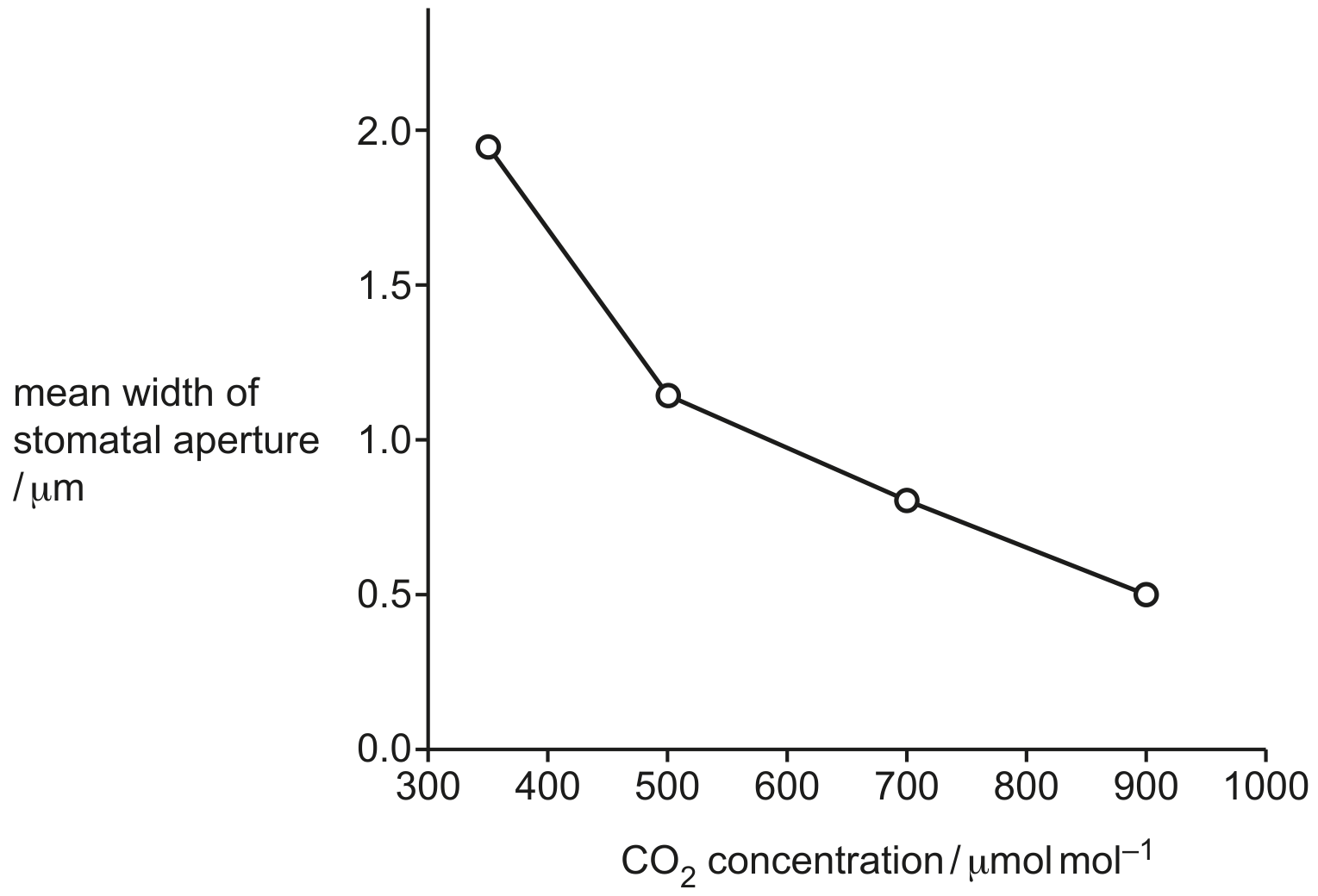
Fig. 3.2
Under certain conditions, the closure of stomata is controlled by abscisic acid.
Describe how abscisic acid causes the closure of stomata.
Scientists are researching whether abscisic acid can be used in crop treatment to increase yield. Evidence suggests that abscisic acid modifies the effect of auxin on elongation growth in plants.
Scientists investigated the effect of different concentrations of abscisic acid on root elongation in seedlings of thale cress, Arabidopsis thaliana.
The seedlings were divided into four groups:
- a control group ( abscisic acid)
- three experimental groups, each treated with a different concentration of abscisic acid: , or .
For each group of seedlings, root length was measured for six days during treatment. The rate of root elongation was calculated each day.
The results are shown in Fig. 3.3.
Key
- control (no abscisic acid)
- of abscisic acid
of abscisic acid
△ of abscisic acid
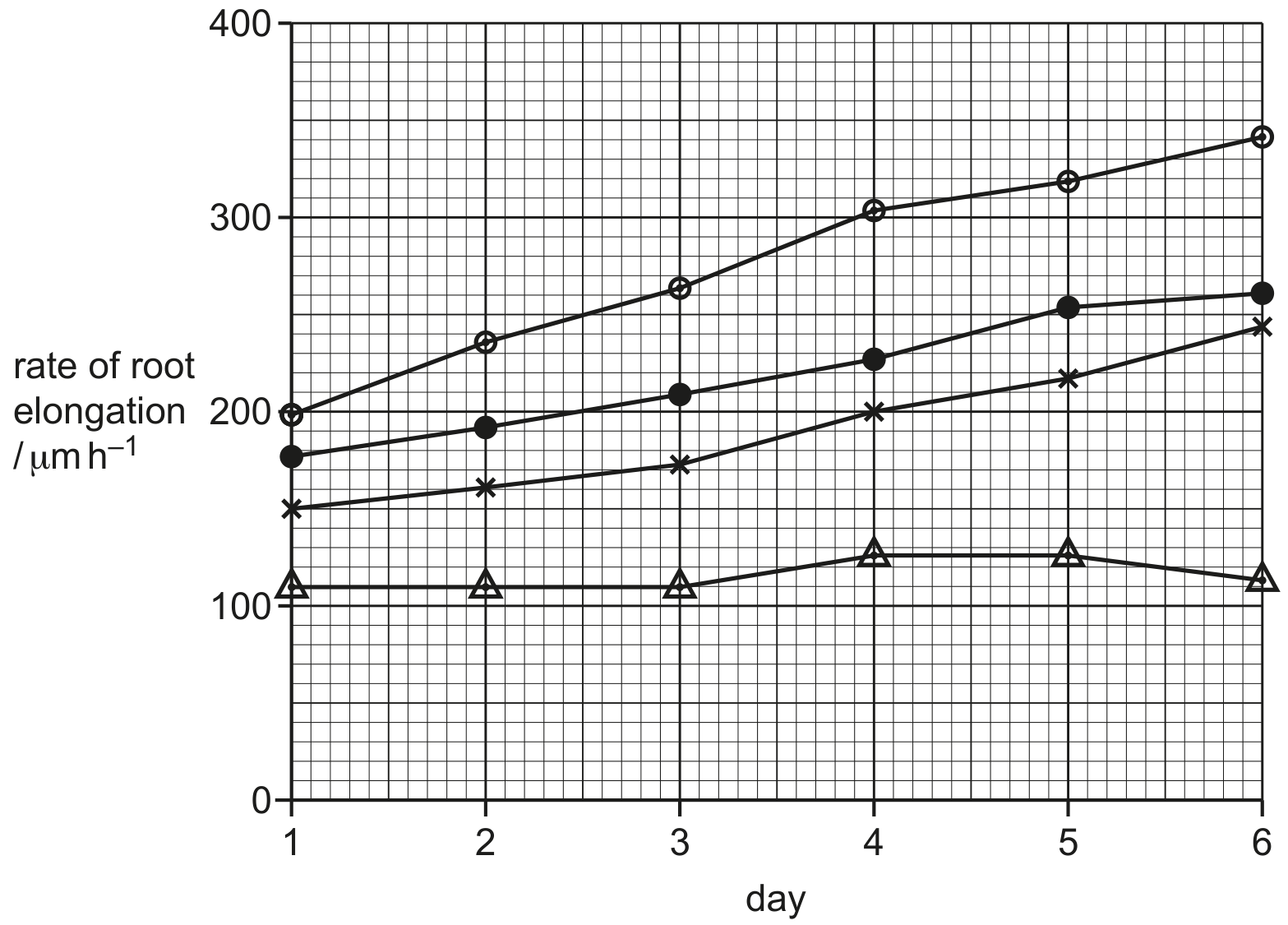
Fig. 3.3
With reference to Fig. 3.3, describe the effect of treatment with abscisic acid on the rate of root elongation.
Fig. 4.1 shows a diagram of a stoma, its guard cells and adjacent epidermal cells.
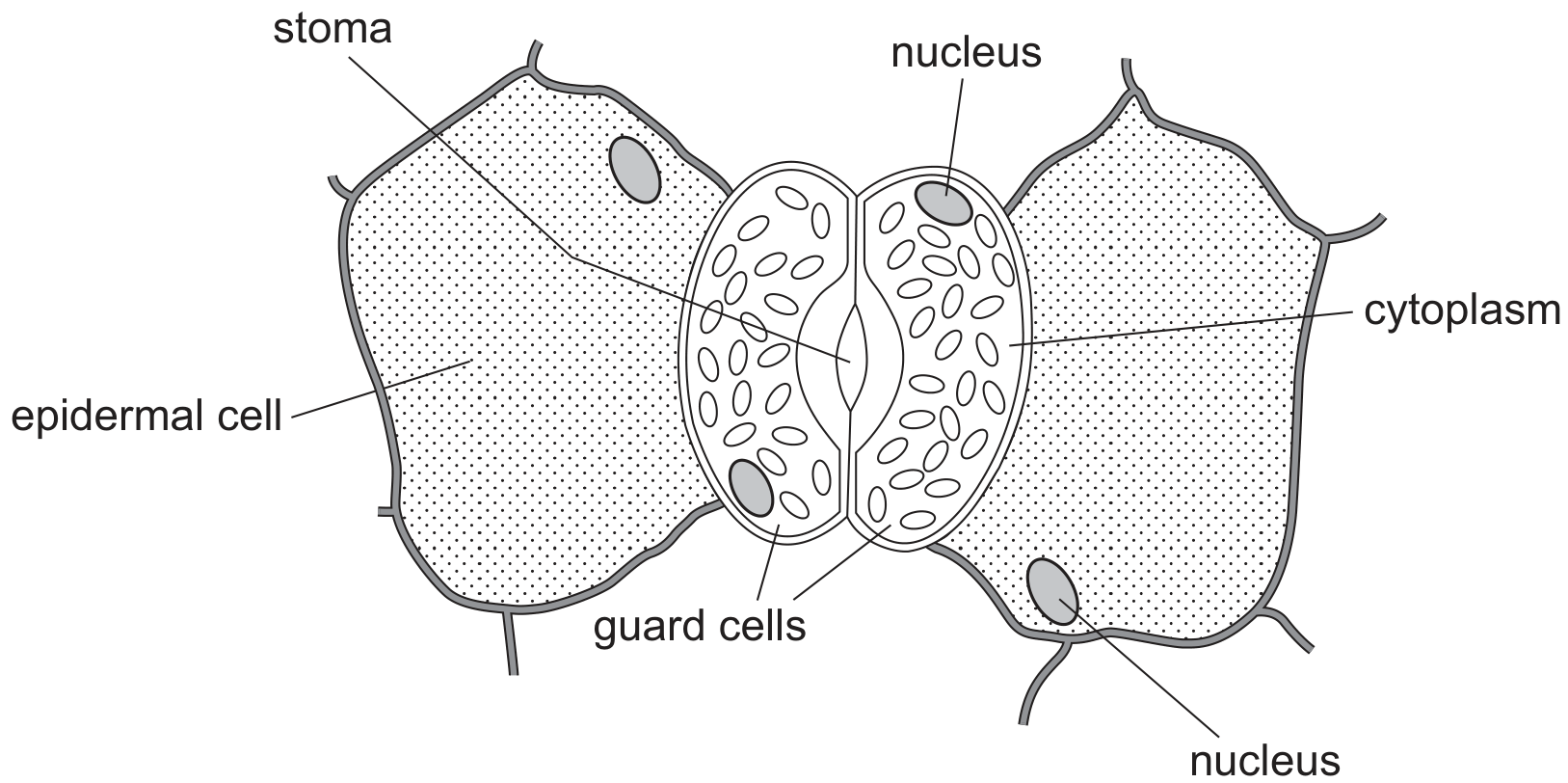
Fig. 4.1
During stomatal closure:
state precisely where abscisic acid (ABA) binds
identify the ion that diffuses from the guard cells to epidermal cells
compare the relative water potential of the guard cells with that of epidermal cells
The opening and closing of stomata are due to changes in environmental conditions. Hydrogen ions ( ) and potassium ions ( ) are involved in the opening of stomata.
Describe how hydrogen ions and potassium ions are involved in the opening of a stoma.
Fig. 8.1 shows a diagram of a stoma, its guard cells and adjacent epidermal cells.
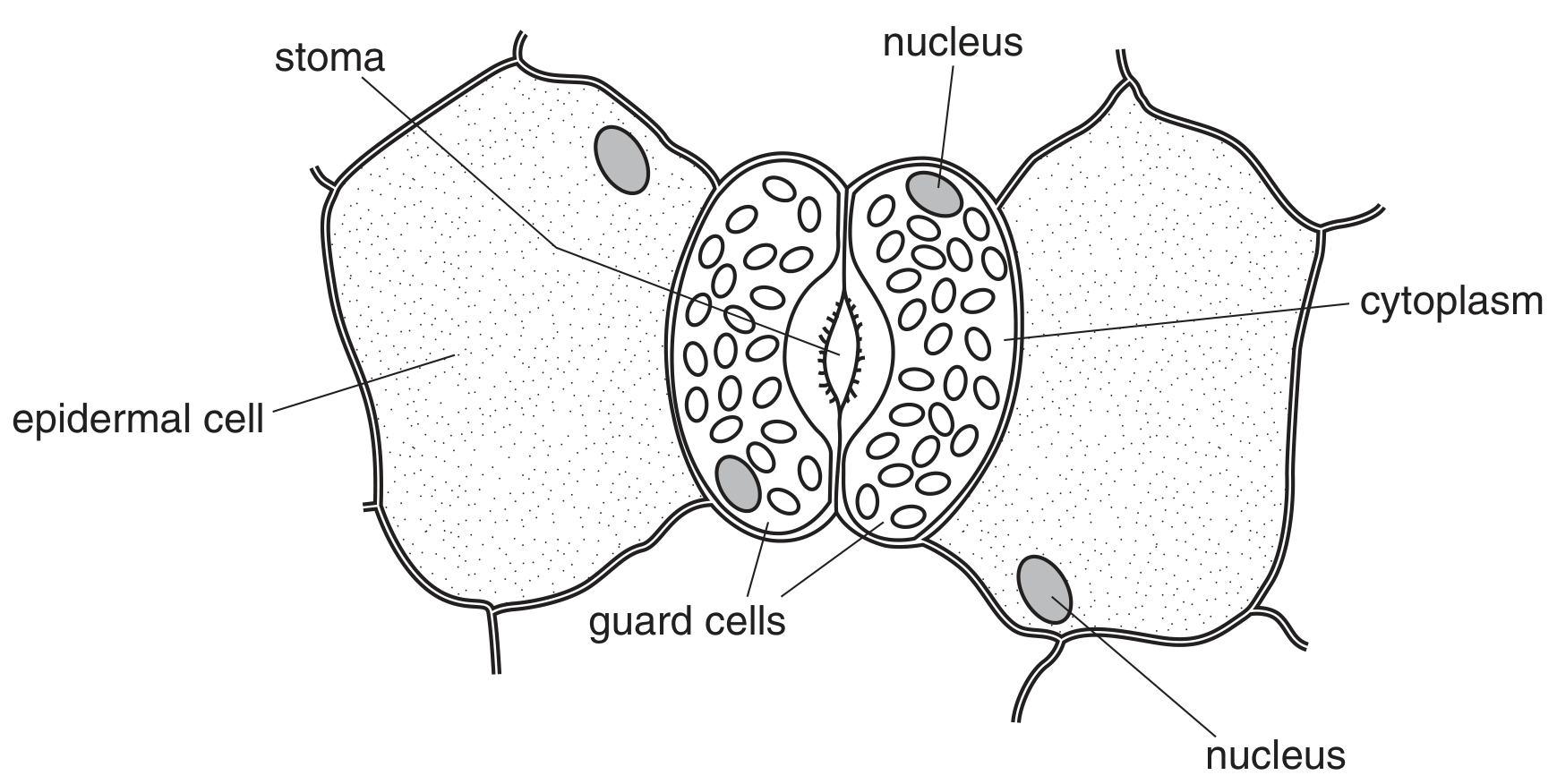
Fig. 8.1
During stomatal closure:
state precisely where abscisic acid ( ABA ) binds
identify the ion that diffuses from the guard cells to epidermal cells
compare the relative water potential of the guard cells with that of epidermal cells
describe the change in volume of the guard cells.
Describe the role of abscisic acid (ABA) in the closure of a stoma.