(a)
The leaves of C. sinensis have a large surface area and are thin.
Explain how each of these two features help the leaf to carry out photosynthesis.
[ 2 ]
 EduNinja
The leaves of C. sinensis have a large surface area and are thin.
Explain how each of these two features help the leaf to carry out photosynthesis.
The leaves of C. sinensis have a large surface area and are thin.
Explain how each of these two features help the leaf to carry out photosynthesis.
Photosynthesis is affected by many environmental factors.
In very dry conditions, concentration can become the main limiting factor of photosynthesis in plants.
Explain how very dry conditions cause concentration to become the main limiting factor of photosynthesis in plants.
The monkey flower, Mimulus guttatus, is cross-pollinated by bumblebees. It does not normally self-pollinate.
Since the number of bumblebees in many parts of the world is falling, an experiment was carried out in Kansas to investigate the effects on these plants of the loss of pollinators.
- 1600 Mimulus plants were grown in a field.
- 1600 Mimulus plants were grown in a glasshouse which bumblebees could not enter.
Seeds were repeatedly collected and sown for several generations at each site.
At first, the plants in the glasshouse produced few seeds, but after five generations the plants were able to self-pollinate and the number of seeds produced was almost the same as that of the plants in the field.
After five generations, the flowers of the plants in the glasshouse were significantly smaller than those of the plants in the field.
Suggest how smaller flowers could lead to an increase in self-pollination.
Maize, Zea mays, is a cereal crop that is adapted for growth at high temperatures. However, it does not cope with drought as well as some other crops, such as sorghum.
An investigation was carried out into the effect of low water availability on the activity of mitochondria taken from maize seedlings.
Young seedlings were uprooted and left in dry air for varying periods of time to reduce the water potential of their tissues.
In tissues where water potential is low, the mitochondria of sorghum are affected in a very similar way to those of maize.
Describe two ways in which sorghum plants are adapted to prevent the development of low water potentials in their tissues during drought conditions.
There are more than 600 plant species in the genus Ipomoea. Many species are grown for their attractive flowers, and some species are used as crop plants.
Scientists investigated the response of stomata to changing carbon dioxide ( ) concentrations in the beach morning glory, I. pes-caprae.
The scientists placed I. pes-caprae plants in chambers. They measured the width of open stomata (stomatal apertures) after the plants had been exposed to different concentrations for 40 minutes. Light intensity and temperature were kept constant.
The relationship between concentration and the mean width of stomatal apertures is shown in Fig. 3.2.
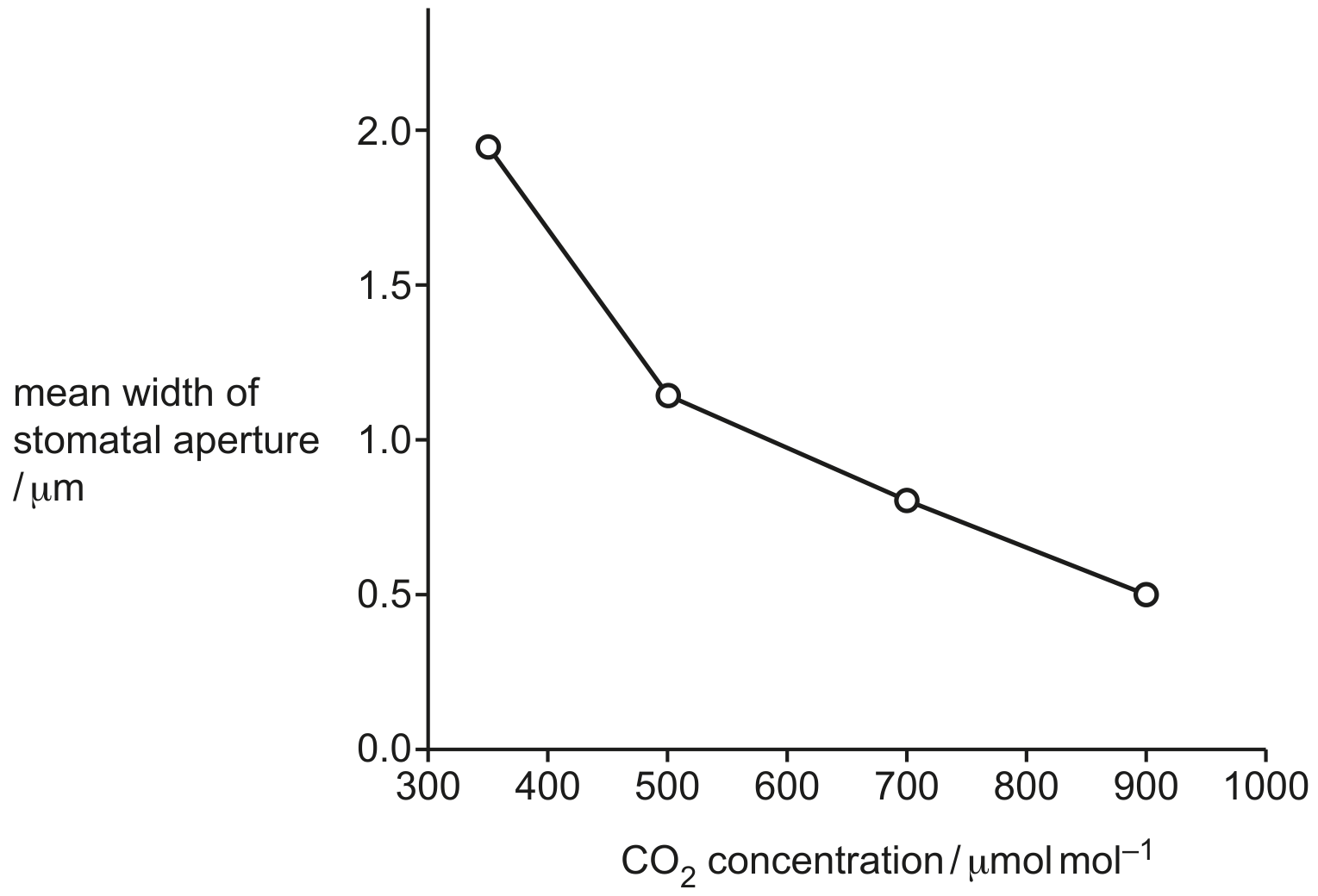
Fig. 3.2
In 2016, a study measured the atmospheric concentration as .
In the future, climate change may reduce water availability and increase atmospheric concentrations in some habitats.
Suggest how the stomatal response shown in Fig. 3.2 would allow I. pes-caprae to survive the effects of climate change.
In which combination of environmental conditions are the stomata of a plant most likely to close?
atmospheric
humidity
soil water
potential
wind
speed
high
low
high
high
low
low
low
high
high
low
low
high
The Venus fly trap is a plant that is able to capture and digest insects. It has modified leaves, which have sensory hairs that respond to touch. When an insect comes into contact with the hairs, receptor potentials are generated.
Suggest why Venus fly trap plants need to capture insects.
State the changes in the external environment that lead to stomatal opening and closure. Explain why these stomatal responses are necessary.