EduNinja
(a)

The number of mitochondria differs from cell to cell. Cells also vary in size and volume.

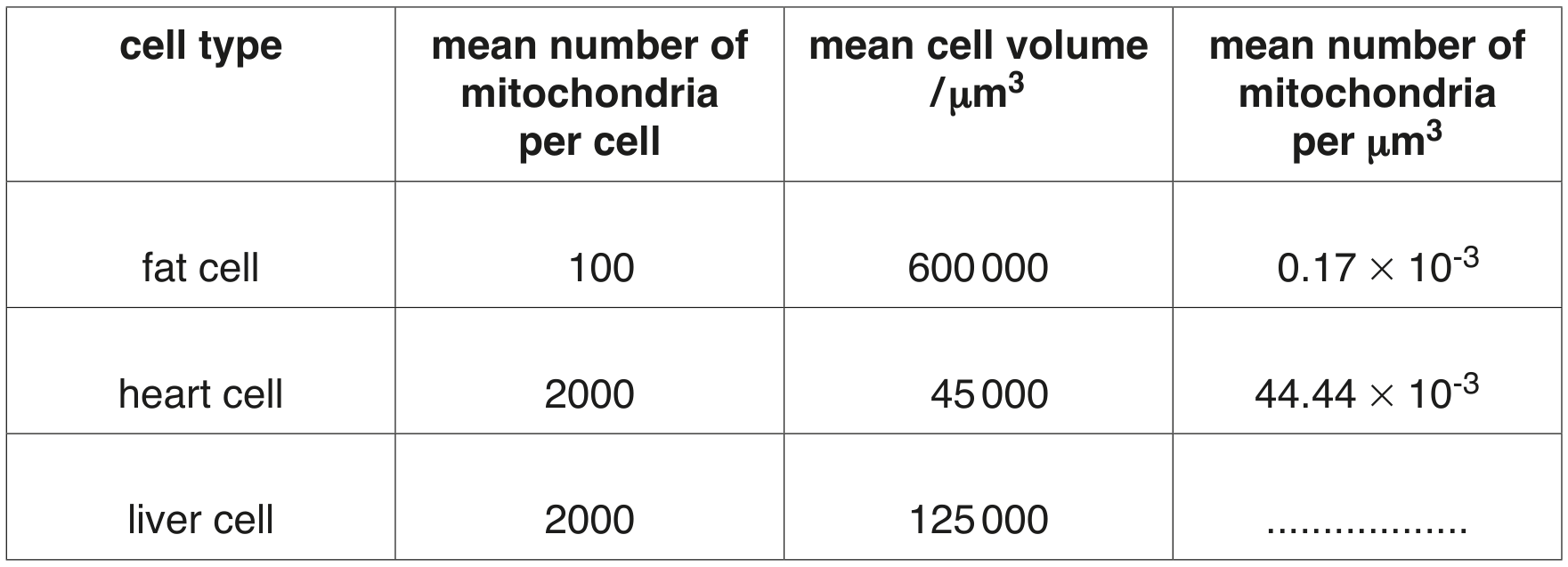
Table 6.2 shows the mean number of mitochondria per cell, the mean cell volume and the mean number of mitochondria per μm3\mu \mathrm{m}^{3} of three types of mammalian cells.

Table 6.2

Table 6.2

[ 1 ]
(i)

Calculate the mean number of mitochondria per μm3\mu \mathrm{m}^{3} for the liver cell.

Write your answer in Table 6.2.

[ 1 ]
(a)

Describe how you would carry out an investigation, using a simple respirometer, to measure the effect of temperature on the respiration rate of insect larvae.

[ 7 ]
(a)

A respirometer can be used to measure the respiration rate of small invertebrates such as the common woodlouse, Oniscus asellus.

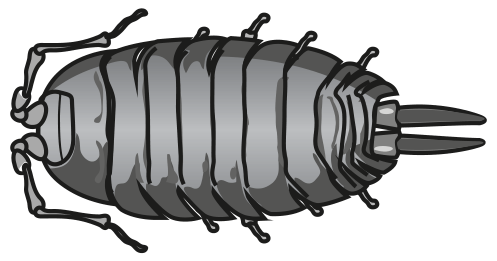
Fig. 8.1 shows a common woodlouse.

Fig. 8.1

Fig. 8.1

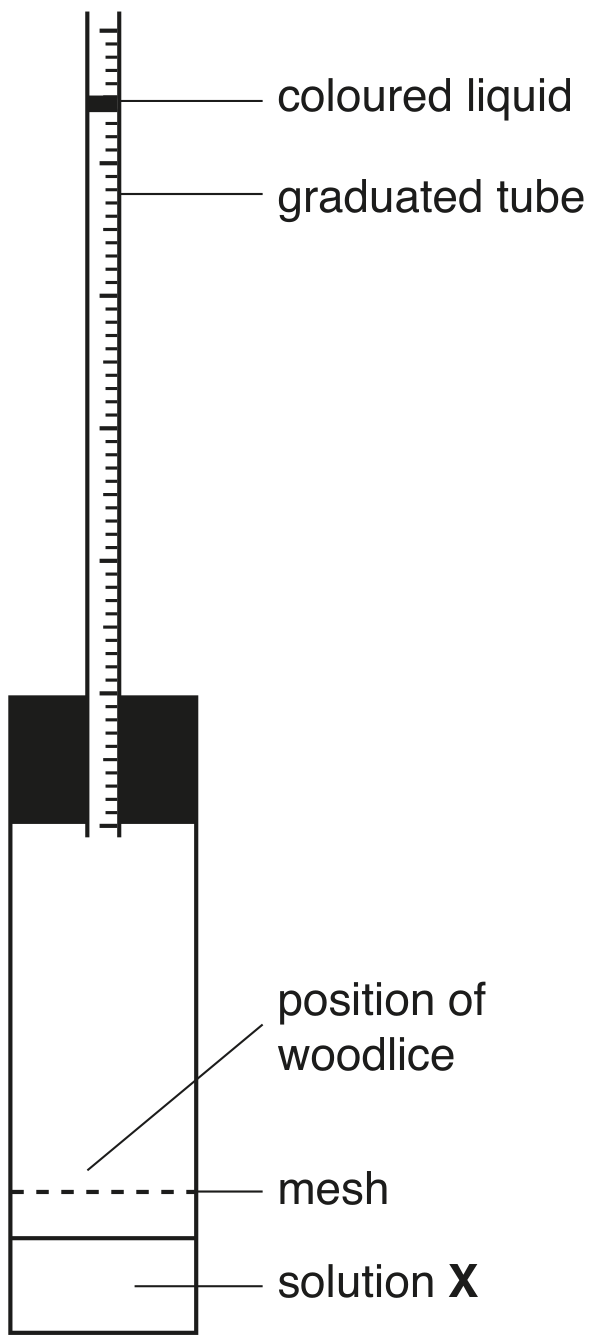
Fig. 8.2 shows a respirometer.

Fig. 8.2 shows a respirometer.

[ 2 ]
(i)

Name solution X .

[ 1 ]
(ii)

The respirometer can be used to measure the effect of temperature on the rate of respiration of organisms.

Suggest one factor that would need to be taken into account when using woodlice rather than germinating seeds.

[ 1 ]
(b)

A respirometer as shown in Fig. 8.2 was used to investigate the effect of temperature on the rate of respiration of woodlice.
- A student set up a respirometer containing 5 woodlice.
- The respirometer was placed in a water-bath maintained at 15C15^{\circ} \mathrm{C}.
- The respirometer was left for 10 minutes to equilibrate.
- After a further 15 minutes the distance moved by the coloured liquid was measured.
- The volume of oxygen used by the woodlice was then calculated.
- The experiment was repeated, using the same woodlice and respirometer, at 25C25^{\circ} \mathrm{C}.

[ 2 ]
(i)

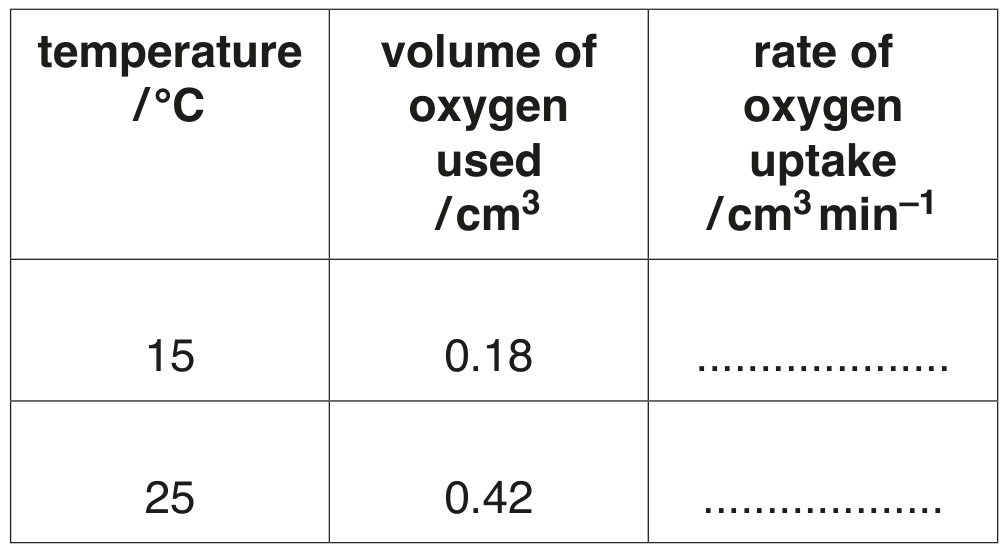
The results are shown in Table 8.1.

Table 8.1

Table 8.1

Complete Table 8.1 by calculating the rates of oxygen uptake at 15C15^{\circ} \mathrm{C} and 25C25^{\circ} \mathrm{C}.

[ 2 ]
(a)

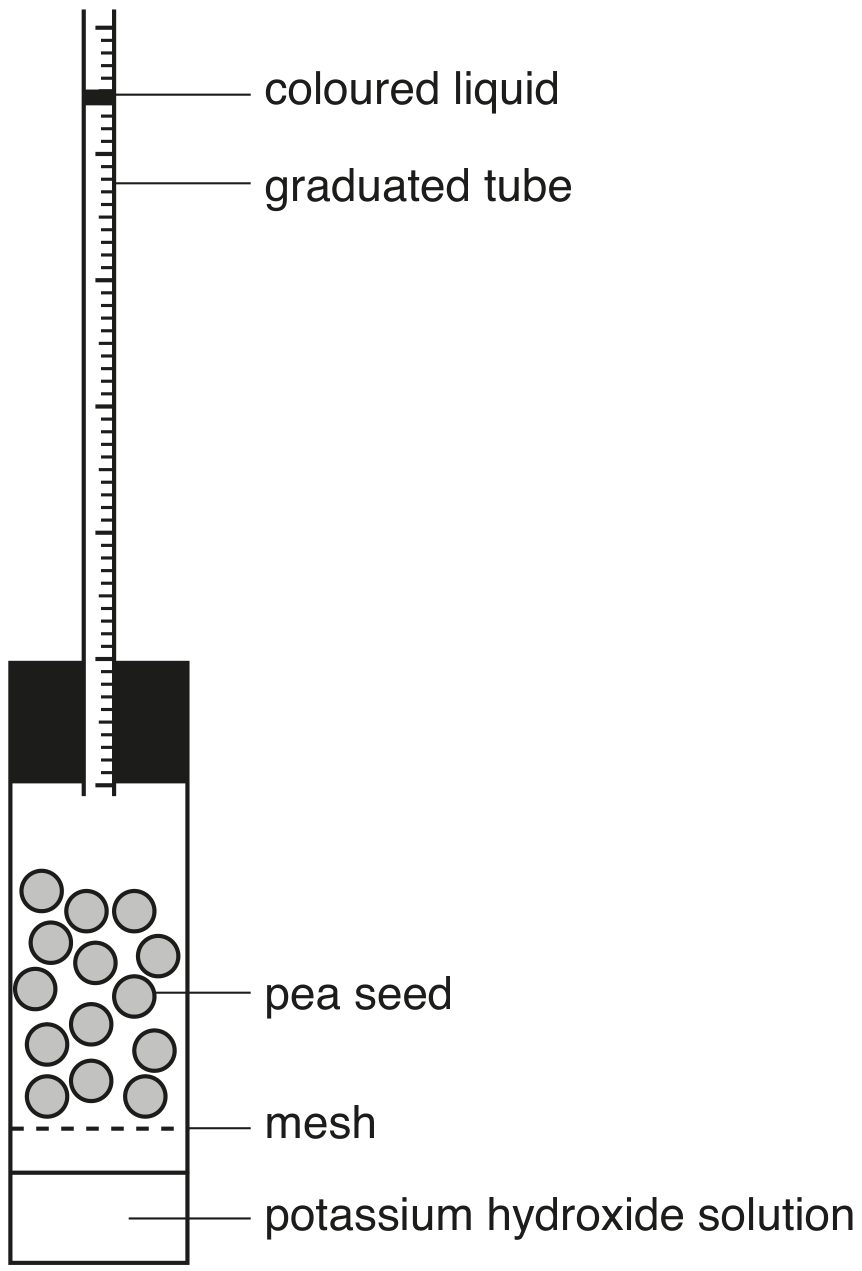
A respirometer can be used to measure the rate of respiration of germinating seeds.

Fig. 8.1 shows a respirometer.

Fig. 8.1 shows a respirometer.

[ 1 ]
(i)

State the role of potassium hydroxide solution in the use of a respirometer.

[ 1 ]
(b)

Respirometers, as shown in Fig. 8.1, were used to investigate the effect of temperature on the rate of respiration of germinating pea seeds.

Four respirometers, A, B, C and D were set up:
- A and B in a water-bath maintained at 10C10^{\circ} \mathrm{C}.
- C and D in a water-bath maintained at 25C25^{\circ} \mathrm{C}.
- A and C each contained 30 germinating pea seeds.
- B and D each contained glass beads with a total volume equivalent to 30 pea seeds.
- The respirometers were left in the water-baths for 10 minutes.
- In each respirometer the position of the coloured liquid in the graduated tube was then marked (time 0 minutes).
- After 5 minutes the distance moved by the coloured liquid was measured.
- The volume of oxygen taken up was calculated for each respirometer.
- This was repeated after 10,15 and 20 minutes.

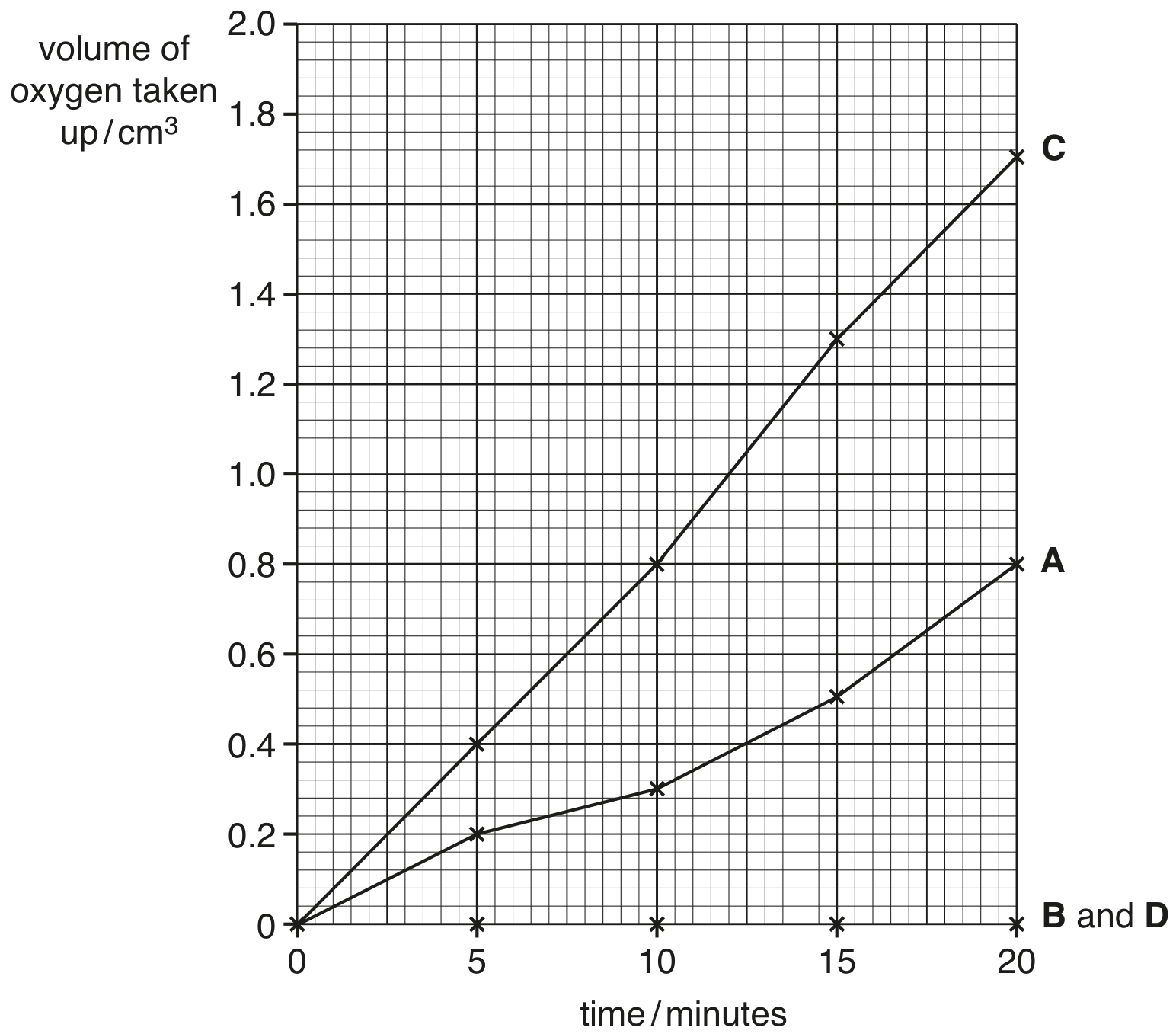
Fig. 8.2 shows the results of the experiment.

Fig. 8.2

Fig. 8.2

[ 3 ]
(i)

Suggest why the respirometers were left for 10 minutes before measurements were made.

[ 1 ]
(ii)

Suggest why respirometers B and D were used in this investigation.

[ 2 ]
(iii)

Calculate the rate of oxygen uptake in cm3\mathrm{cm}^{3} per minute for respirometer C between 5 and 20 minutes.

Give your answer to two significant figures.
Show your working.

\text { answer \mathrm{cm}^{3} \mathrm{~min}^{-1}
0