
EduNinja

5.3 Lean production and quality management Topic Practice

5.3 Lean production and quality management Topic Practice
IB Business Management syllabusBusiness Management SL/HLFirst assessment 2025

Students practise defining lean and quality terms while explaining how JIT, cradle-to-cradle, quality circles, and TQM affect operational efficiency and stakeholder outcomes.

Exam points

  • explain how cradle-to-cradle design at QS reduces waste and redefines material lifecycles using circular economy
  • evaluate TQM at Accord by linking reduced batch rejection and supply chain improvements to long-term cost

Question 4(a)

[Maximum number: 2]

M M uses just-in-time (JIT) production in its Oil Production Division.

The long-term demand for oil is usually predictable, and production is reliable unless major problems occur. In 2020, however, there was an unexpected decrease in demand for oil. Uncertainties in the world economy and responses to climate change now make predictions more difficult.
M M has prepared a sales forecast for its oil production for 2022 and 2023 (Table 2).
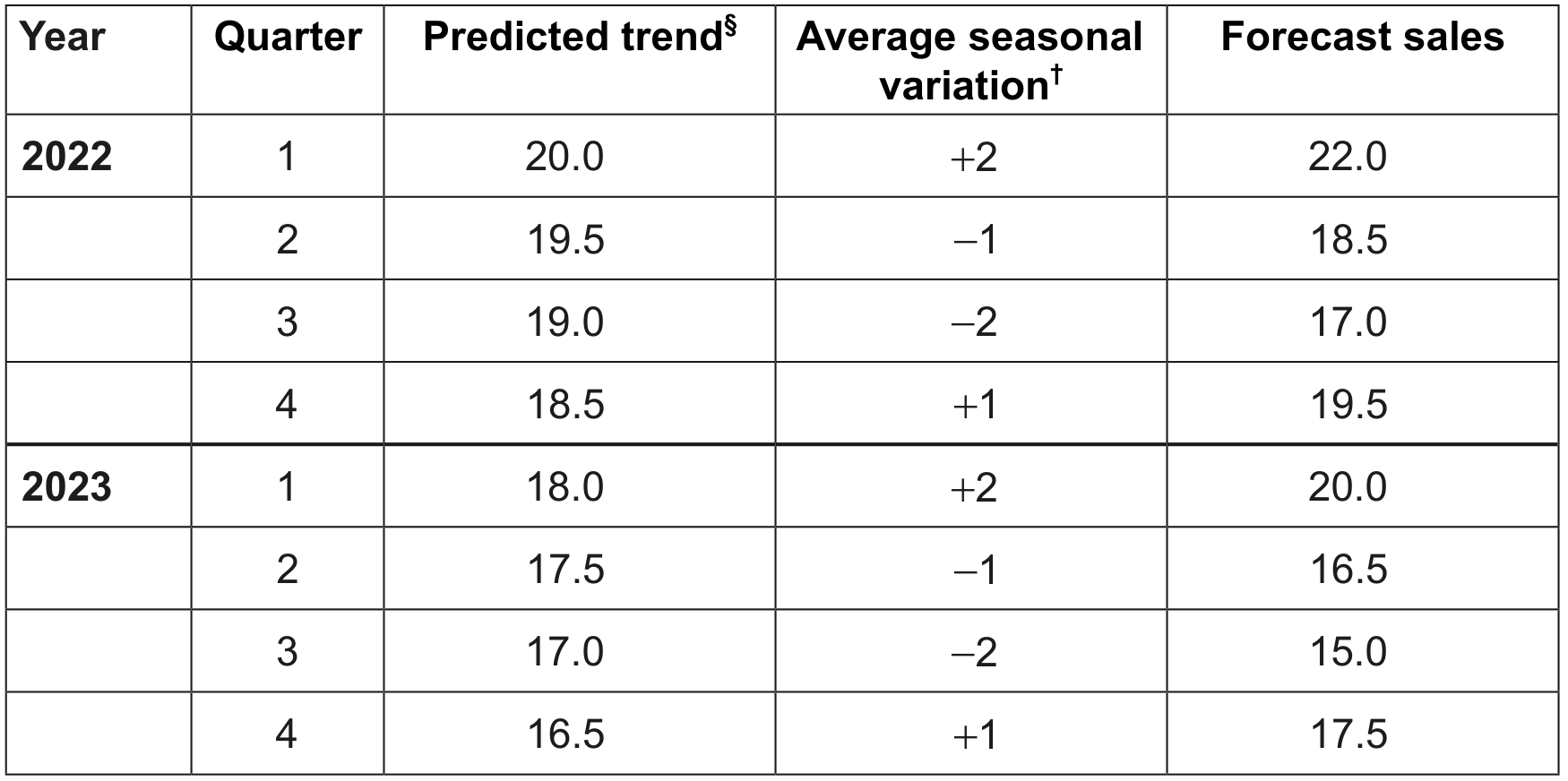
Table 2: Sales forecast for oil production for 2022 and 2023 (millions of barrels)

Table 2: Sales forecast for oil production for 2022 and 2023 (millions of barrels)

§ calculated using a four-quarter moving average based on six years of historic data
† calculated by comparing actual sales with a four-quarter moving average

In 2020, M M had some major problems:
- A catastrophic fire occurred at one of its oilfields.
- The gold mine in Egypt collapsed, trapping 23 miners.
- It experienced a cyber-attack on its computer network.
- An earthquake in Chile damaged the country's transport system.

In response to these problems, M M had to rely on its contingency planning and its crisis management procedures.

JG Mining (JG) wants to buy MM's tar sands mining operation for $50 million, but the board of directors are divided. MM recently invested $15 million in their tar sands operation in addition to the original $ 30 million set-up cost in 1986 . Production is at designed capacity, and, although the long-term average rate of return (ARR) for the tar sands operation is below those of most of MM's other investments, it provides a reliable source of income. However, M M has difficulty selling sulphur, a by-product of tar sands production.

Employees at the tar sands operation are against selling the operation to JG. However, the income from the sale would help M M finance other investments, such as lithium mining, and the sale could help improve MM's corporate image. MM's Finance Director, Ethan, estimates that the net present value (NPV) of the tar sands operation is $46 million.

Define the term just-in-time (JIT) production.
Question 4(c)

[Maximum number: 4]

Problems are continuing with Enrich drinks. Aran is becoming increasingly frustrated with the lack of growth of sales. He always wants to succeed and is driven by the need to get tasks completed. The Enrich part of his life is not a success. He blames the workforce. The workforce does not share his vision. Employees are mainly part-time workers and parents who value jobs that enable them to fit work around school hours. As Aran has become more autocratic in his leadership style, labour turnover has increased. Last month, from a workforce of twelve, one retired and two left for what they called "better jobs".
There are also increasing problems with the quality of Enrich drinks, as batches of Enrich are rejected by the quality control department. Elsie, the manager of the production department, blamed suppliers, saying that Aran had damaged business relations with them due to his impatience. Elsie also blamed Aran for poor stock management. She has proposed total quality management (TQM) as a solution to these problems.
Detox
Accord decided to start the production and marketing of Detox, the green tea drink that helps athletes to relax. Detox proved to be very successful. Encouraged by the success and boosted cash inflow, Kayla is considering producing a range of snack bars based on Enrich and Detox flavours and recipes. Accord would use the Enrich brand name for the snack bars. The market for healthy snack bars is very competitive and dominated by a few large companies who spend large amounts of money on advertising. The market is growing rapidly - some market researchers estimate by 34 % per annum. There are many examples of small businesses entering the market successfully on a small scale. Kayla estimates that the proposal would involve an investment of $ 100000, with forecast net returns of $ 80000 for four years. Aran thinks that the money could be better spent on marketing Enrich drinks.

With reference to Accord, explain one advantage and one disadvantage of using total quality management (TQM).

Question 4(d)

[Maximum number: 10]

Sam and Finn are having difficulties resolving their disagreements. Finn was convinced that the problems at AFA should be resolved by a change in the organizational structure. Sam, however, was convinced that he should strengthen the organizational culture. Sam reluctantly accepted the need for greater delegation but insisted that there should be more training for all employees on the culture and ethics of AFA.

As part of greater delegation, Kim was given responsibility for the relationship between AFA and its suppliers. Kim is concerned that she spends a lot of time chasing orders that do not arrive and dealing with the poor quality of orders. Some products have to be thrown away because they have passed their sell-by dates*. Others have to be returned to suppliers because the outlet managers do not accept the poor quality and therefore cannot be sold.

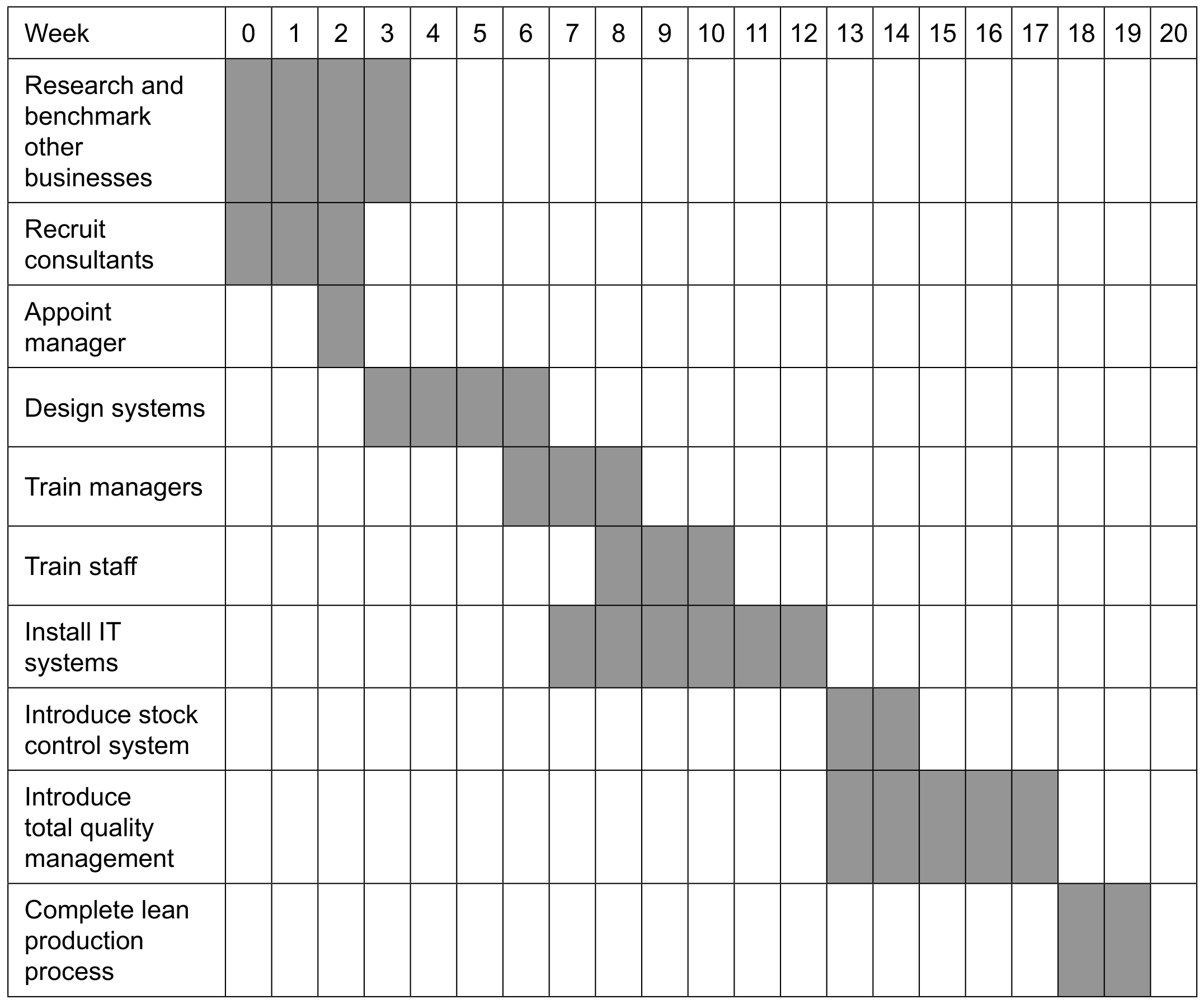
AFA's stock of fair trade woollen hats has now reached 500 , with an annual sales average of around 1250 for the whole business. Kim wants to introduce lean production including total quality management (TQM) throughout AFA's operations and has created a Gantt chart to show the stages in implementation.
* sell-by dates: dates printed on the packaging of products that state the date after which the product can no longer be sold.

Figure 1: Gantt chart for the implementation of lean production including TQM at AFA

Figure 1: Gantt chart for the implementation of lean production including TQM at AFA

Discuss the value to AFA of lean production methods.
Section C
Answer the following question.

Question 4(c)

[Maximum number: 4]

It is now mid-2019. Production of solar power systems has been going for over a year and sales have exceeded forecasts and reached 5000 systems for the year. Profits have been reinvested into developing new outlets and distribution channels for solar power systems in Afghanistan. Lean production techniques have enabled A S to keep costs low, but A S has had some quality issues: some cells produce lower quality systems than others. AS has found faults in components bought from suppliers. Some solar power systems have been damaged in the supply chain. Salima is thinking of instituting total quality management (TQM). She also needs to forecast sales for 2020 but has decided the situation is not suitable for a four-part moving average.

In a separate development, Doorway Foundation (DF), a multibillion-dollar charity established by the owners of one of the world's largest IT businesses, has approached Su. The foundation has a major IT initiative to bring IT to schools in Afghanistan, Myanmar and Bangladesh. By forming a joint venture, DF could use AS's expertise and local knowledge to help solve some of the electricity supply and IT problems in Afghanistan.

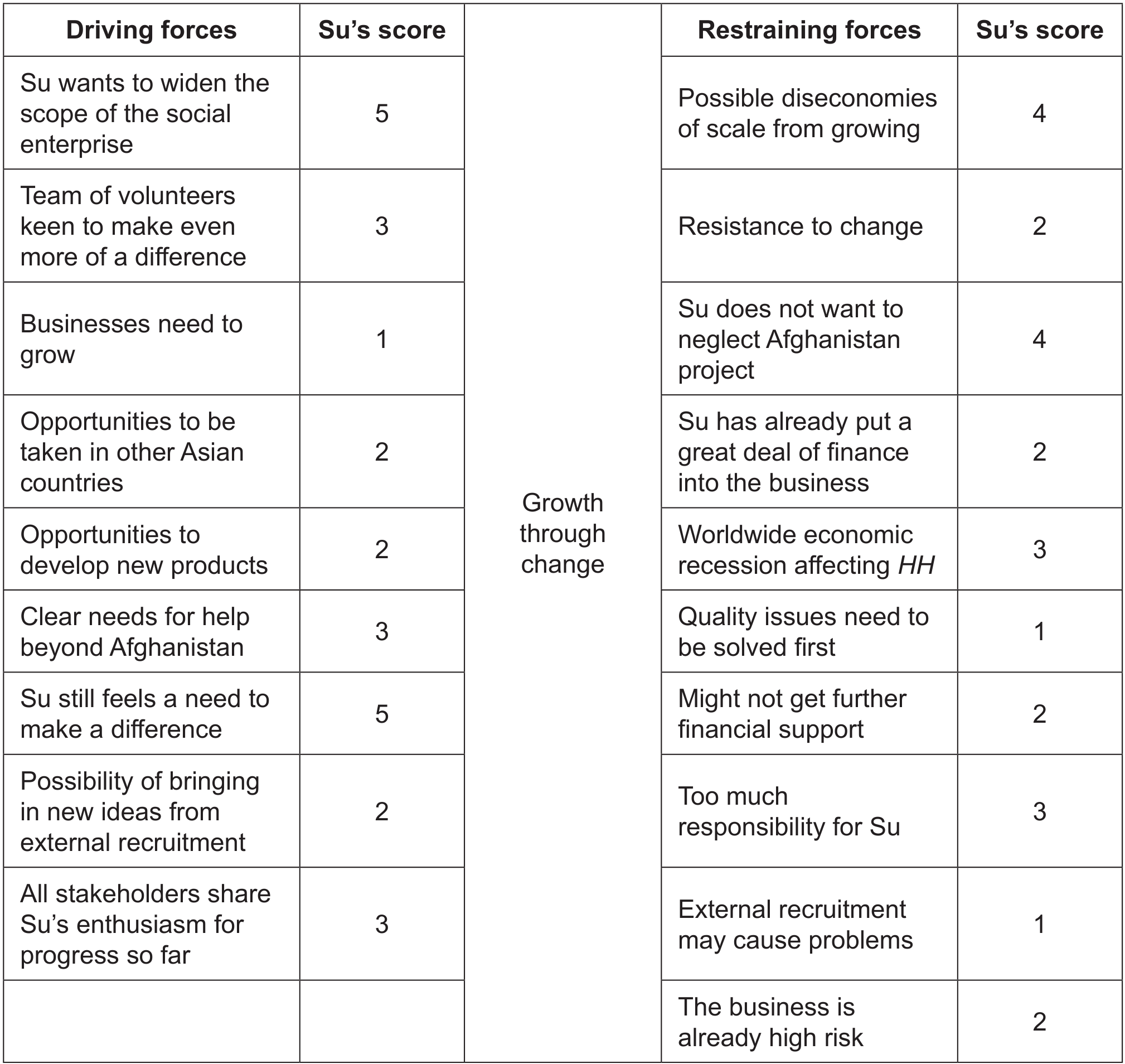
The possibility of a joint venture encouraged managers and investors to think about whether A S should grow. In response, Su decided to analyse the possibility of growth through change using a force field analysis of A S.

Table 3: Force field analysis for growth through change at AS

Table 3: Force field analysis for growth through change at AS

Explain how total quality management (TQM) could help AS improve the quality of its products.

Question 4(a)

[Maximum number: 2]

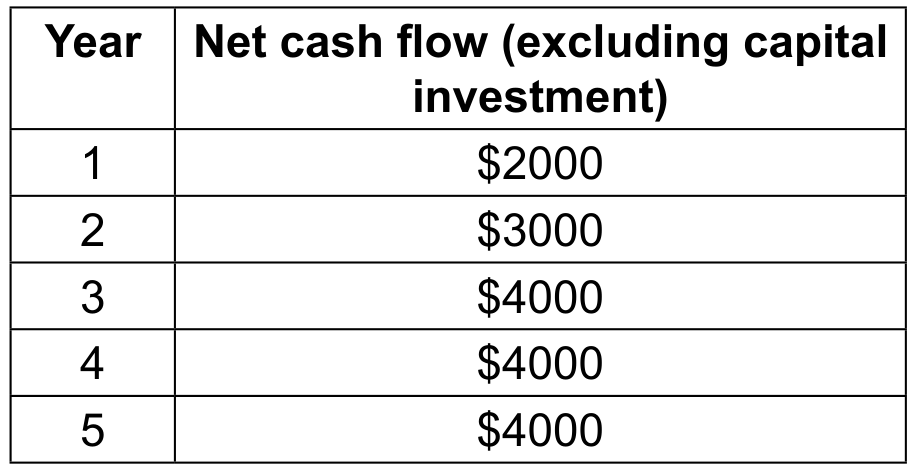
Paul's idea for 3D printing takes Utopia into a secondary sector activity that contrasts with its usual tertiary sector activities. In order to produce a sufficient number of souvenirs, Utopia would need to buy ten 3D printers at $ 1000 each. There would be material costs and significant operating costs, as well as time and additional labour. Paul has produced a net cash flow forecast for the project (Table 1) assuming a five year life for the printers. He likes the idea that each souvenir produced could be of a unique design and personalized. Some of the materials would be from recycled plastics obtained from waste at the resort. This example of lean production would be good for the resort's environment and for Utopia's caring image. The cost of recycling is uncertain.

Table 1: Net cash flow for the 3D printing project

Table 1: Net cash flow for the 3D printing project

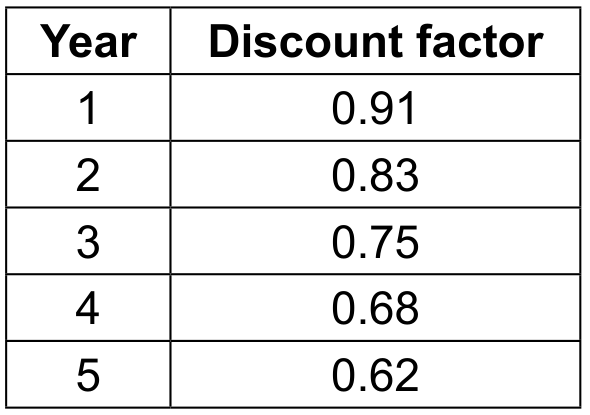
Table 2: Discount factors

Table 2: Discount factors

Liza does not like the idea of 3D printing. She is concerned that the souvenirs may damage Utopia's exclusive brand. She can see difficulties with recruiting someone with both the necessary IT skills and the ability to make decisions about which types of souvenirs to produce. She is particularly concerned about the impact on Utopia's current suppliers of souvenirs. She thinks that 3D printing is more suited to larger organizations.

John believes that the 3D printing technology will bring other benefits to his businesses. He can imagine decorations and other useful items being produced for the resort and its offices.

Describe one method of lean production other than recycling.

Question 3(c)

[Maximum number: 4]

3. JP
JP produces electric guitars. It is a cooperative owned by a committed workforce who share in the management and success (or failure) of the company and its profits. Workers enjoy having control over the workplace and are productive. However, JP's continued success is threatened by insufficient finance, which prevents them from spending more on traditional promotional methods.
J P 's guitars are expensive relative to the competition but are known for their quality. Its customers are very brand loyal. The use of social media marketing by many famous musicians influences JP's brand loyalty and awareness. Unfortunately for J P, one especially famous musician using a JP guitar on social media recently received negative publicity about his private life.
JP follows strict quality procedures that include quality circles. JP's management believe that teams of workers employed on the production line know the production process best and are in the best position to make any necessary improvements. Staff turnover at JP is very low.
XYZ, a large company known for its kitchen appliances, is considering moving into the musical instrument market as part of a growth strategy - they want the high gross profit margins on guitars (compared to the low profit margins on kitchen appliances). X Y Z wants to take over JP. XYZ has a strong balance sheet and large cash reserves and is an expert at marketing.
The cooperative has refused to consider the takeover bid from X Y Z. The cooperative has argued that the culture of X Y Z is too different to JP's. XYZ's management are viewed as too controlling. However, increased price competition has led to falling sales, forcing JP to make redundancies. Some cooperative members argue that unless JP accepts XYZ's bid, additional jobs will be lost.

Explain two benefits to JP of using quality circles.

Question 3(b)

[Maximum number: 4]

3. KA
K A is a public limited company that designs, manufactures and sells air conditioners. K A 's unionized employees are motivated and efficient despite not being involved in any decision making. However, they are resistant to change.
The market and competition for air conditioners are growing rapidly. K A operates at full capacity but stock turnover has slowed.
Primary market research revealed that:
- consumers do not differentiate KA air conditioners from those of its competitors. All products are perceived as medium price and medium quality
- KA's customer service is rated as poor
- customers demand energy-efficient products using ecologically sustainable production methods.
To exploit opportunities and overcome weaknesses and threats, KA's management has decided to redesign its products so that they are energy efficient. K A is considering two options:
- Option1: Implement lean production methods, which includes investing in ecologically sustainable machines that will increase capacity by 10 %. Total quality management (TQM) will also be implemented. However, the financial manager is worried about K A 's ability to meet high initial costs. The forecasted payback period is three years and average rate of return (ARR) is 4 %.
- Option 2: Outsource the production to QS, a company known for its reliability and high capacity to produce excellent quality air conditioners using cradle to cradle manufacturing principles. However, QS refuses to sign an exclusive long-term contract with KA, insisting instead on renegotiating the contract every two years. KA will have to close its production facility and will use the cost savings to improve customer service and to reposition and differentiate its air conditioners.
Employees have heard rumours of both options and fear for their jobs. Strike action is being considered.

With reference to QS, explain two features of cradle to cradle manufacturing.

0 selected