EduNinja

IB Business Management HL3.8 Investment appraisalQuestion Bank

Question 1

[Maximum number: 9]

1. Las Rosas (LR)
Las Rosas (LR) is a large commercial dairy farm owned and managed by the D'Aremberg family since 1986. It has 3800 cows. L R sells milk, cheese and yoghurts. In 1996, L R started to export some of its dairy products. Profits and cash flow have been improving year on year. L R has no outstanding loans and therefore its current gearing ratio is zero.
LR's unique selling proposition (USP) comes from the organic quality of its products as they are made without chemical additives. The cows' diet does not include hormones and other supplements. The farm's products also meet national and international quality standards.
LR's corporate culture encourages innovation and the use of cell production. To stay ahead of the competition L R has increased its spending on research and development (R\&D) and workers are given the opportunity to create new products, or to add value to existing ones. L R 's financial manager, however, believes that the R\&D budget is too high and needs to be cut. He also argues that there are too many legal constraints limiting the development of new products.
LR's management is considering buying El Remanzo, a large sheep farm located nearby. This acquisition will cost $ 24 million and L R will need to cut its R\&D budget to zero and organize a new loan to finance the takeover. A significant restructuring would need to occur at both L R and El Remanzo to allow both companies to combine resources and knowledge. However, the potential economies of scale experienced by L R could be substantial.
Total capital employed at L R is $ 45 million.
Table

Question 1(c)

(a)

Calculate the following for L R (show all your working):

[ 6 ]

Question 1(c)(i)

(i)

the payback period.

[ 2 ]

Question 1(c)(ii)

(ii)

the average rate of return (ARR).

[ 2 ]

Question 1(c)(iii)

(iii)

the net present value (NPV) using a discount rate of 8 %.

[ 2 ]

Question 1(d)

(b)

Comment on your results to parts (c)(iii) and (c)(iv).
[ 3 ]

Question 1

[Maximum number: 21]

1. Easy E Booking (EEB)
Easy E Booking ( E E B ) is a small, well-known, reputable and financially stable online hotel reservation service. E E B employees are highly motivated and take great pride in their work. E E B has received recognition for their high quality customer service. Due to an increase in global demand, greater competition and changes in technology, the finance director, Maia, has decided to upgrade E E B 's computers and/or software.
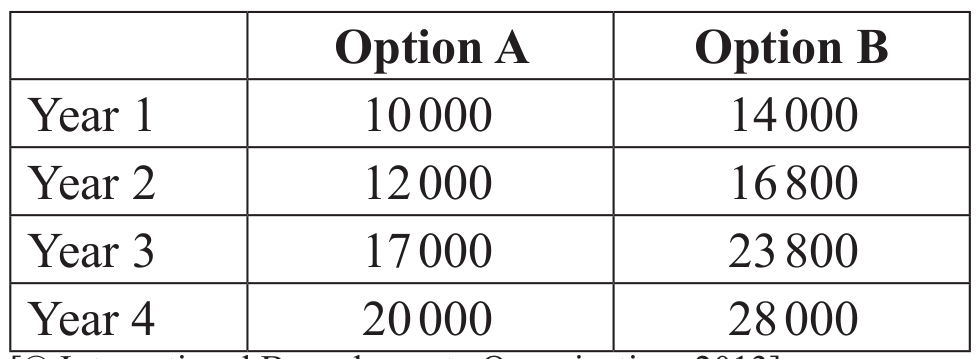
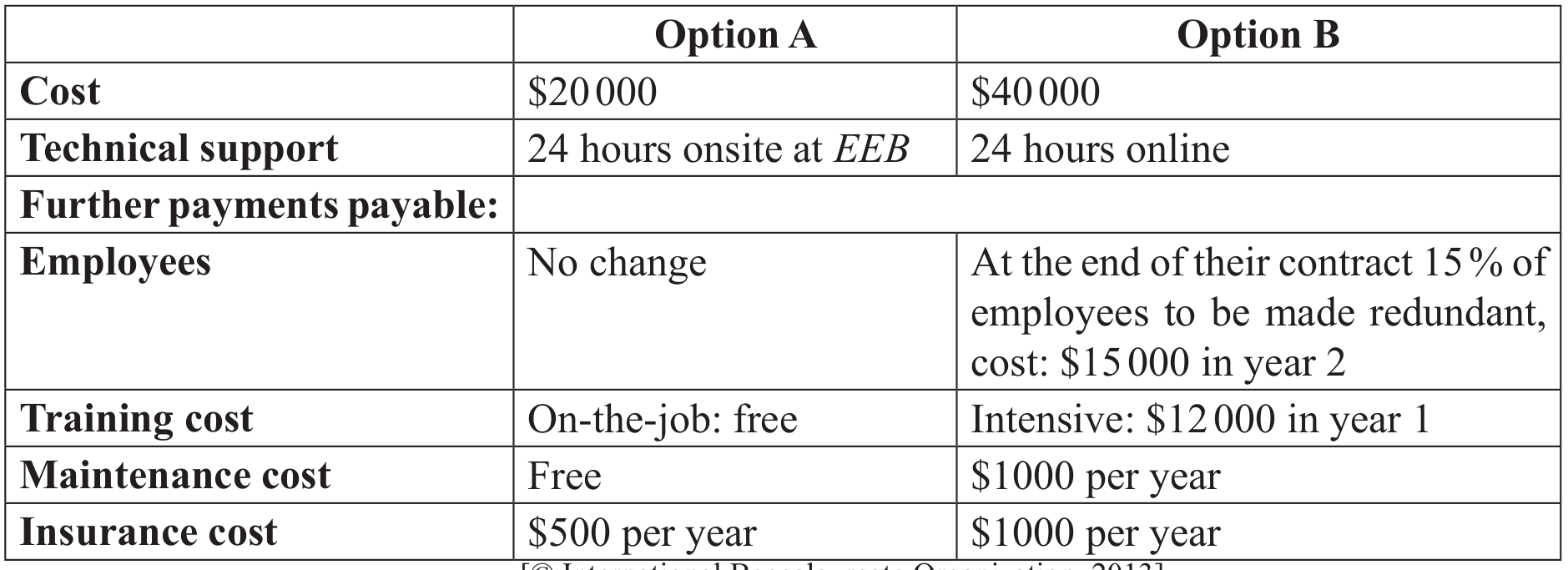
Maia has two options: manufacturer abroad.

Table

[C International Baccalaureate Organization, 2013]
The estimated return/total revenue in $ per year is shown below:

Table

The average rate of return (ARR) of Option A is 46.25 %.
Maia is considering using a straight line method of depreciation.
E E B employees favour Option A, even though some of their competitors using "Book-Fast" have reported problems with the software, including security issues. However, Maia has chosen Option B, which will provide more up-to-date, sophisticated and secure reservation system software. It will also give E E B a competitive advantage and an ability to handle a large global volume of hotel reservations.

Question 1(b)

(a)

Calculate the payback period for Option A (show all your working).

[ 2 ]

Question 1(c)

(b)

Calculate the average rate of return (ARR) for Option B (show all your working).

[ 4 ]

Question 1(d)

(c)

For both Option A and Option B, calculate the net present value (NPV) using a discount rate of 4 % (show all your working).

[ 5 ]

Question 1(e)

(d)

Explain one advantage and one disadvantage for E E B of using the NPV method of investment appraisal.

[ 4 ]

Question 1(f)

(e)

Examine Maia's choice of Option B.

[ 6 ]

Question 1

[Maximum number: 4]

1. Roscas
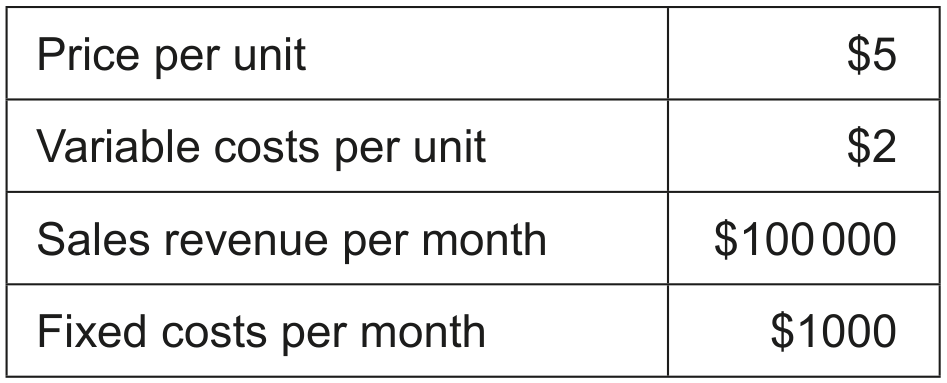
Roscas produces and sells sugar donuts. Monthly fixed costs are $15000, monthly sales revenue is $ 70000, and total variable costs per month are $ 25000. To increase its productivity rate, Roscas wants to buy a new high-efficiency machine that produces chocolate-filled donuts. The finance manager has forecasted the following information.

Table 1: Forecasted information for the production of chocolate-filled donuts

Table 1: Forecasted information for the production of chocolate-filled donuts

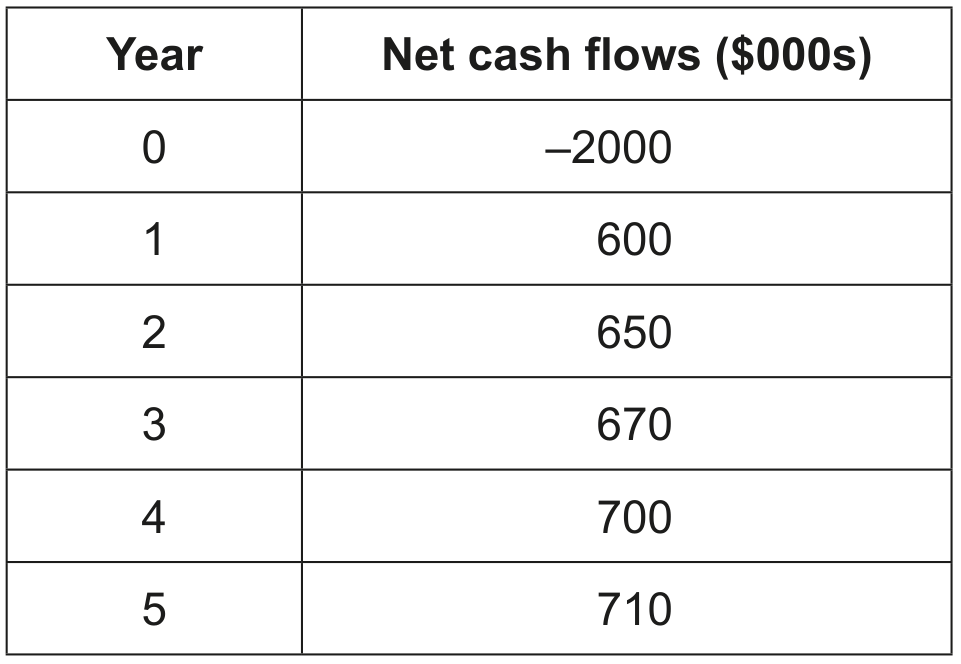
Table 2: Forecasted cash flow for the new machine

Table 2: Forecasted cash flow for the new machine

Question 1(c)

(a)

Using the information provided above and in Table 2, calculate:

[ 4 ]

Question 1(c)(i)

(i)

the payback period for the new machine (show all your working);

[ 2 ]

Question 1(c)(ii)

(ii)

the average rate of return (ARR) for the new machine (show all your working).

[ 2 ]

Question 1

[Maximum number: 8]

S4U

S4U is a private limited company that provides a storage facility to households and small businesses. S4U is considering constructing an additional new warehouse.

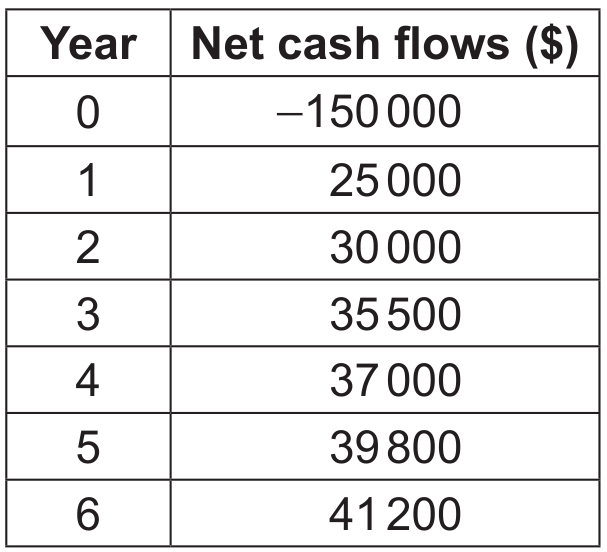
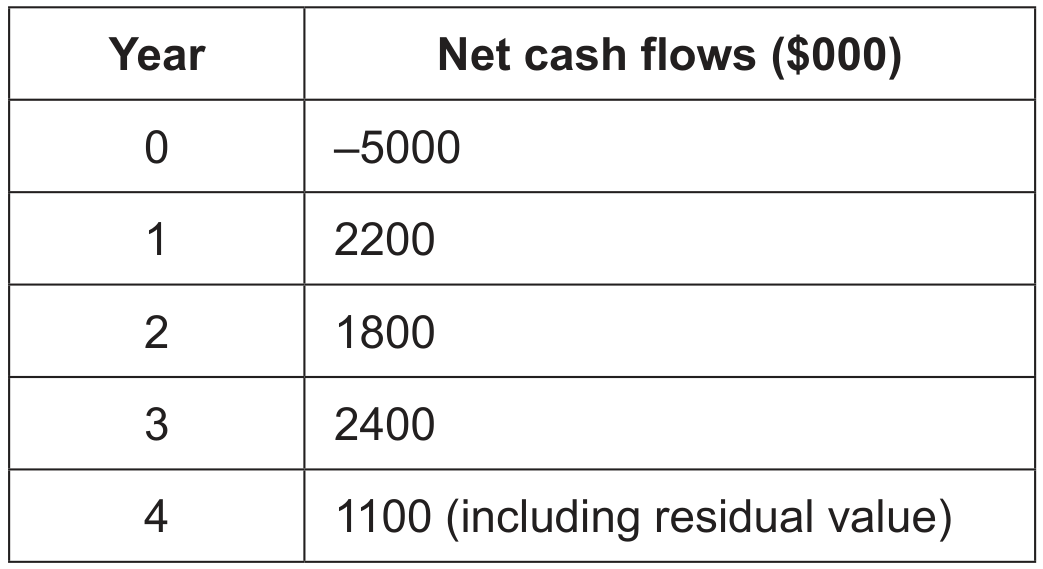
S4U's management has forecasted the following annual net cash flows for the new warehouse:

Table

Question 1(b)

(a)

For the new warehouse:

[ 6 ]

Question 1(b)(i)

(i)

using information from the table above, calculate the average rate of return (ARR) (show all your working);

[ 2 ]

Question 1(b)(ii)

(ii)

using information from the table above, calculate the payback period (show all your working);

[ 2 ]

Question 1(b)(iii)

(iii)

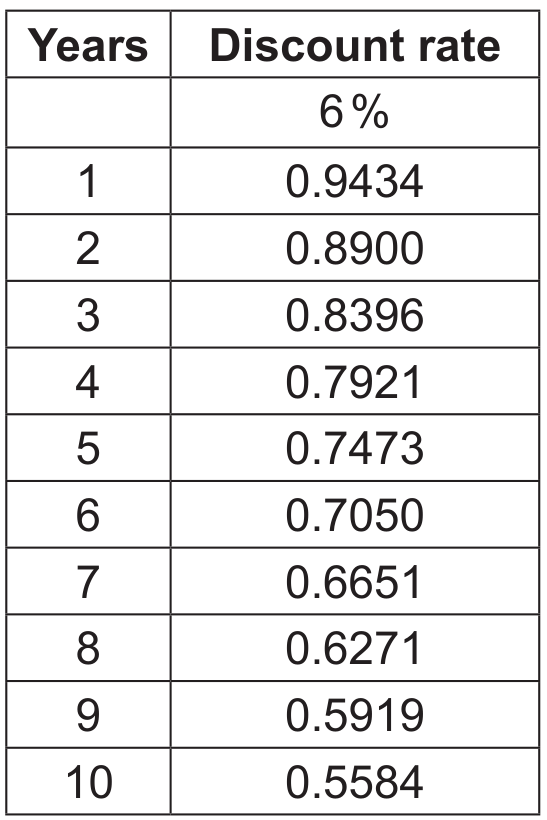
using information from the table below, calculate the net present value (NPV) at a discount rate of 6 % (show all your working).

Table
[ 2 ]

Question 1(c)

(b)

Explain one disadvantage for S4U of using the NPV method of investment appraisal.

[ 2 ]

Question 1

[Maximum number: 8]

1. Solar Soccer Academy Ltd. (SSA)
Solar Soccer Academy Ltd. (SSA) is a private limited company set up five years ago by Stephen Murdock. It provides top-quality soccer (football) skills and technique coaching. So far, SSA has been a success, and Stephen is deciding whether to open another academy in a neighbouring city.
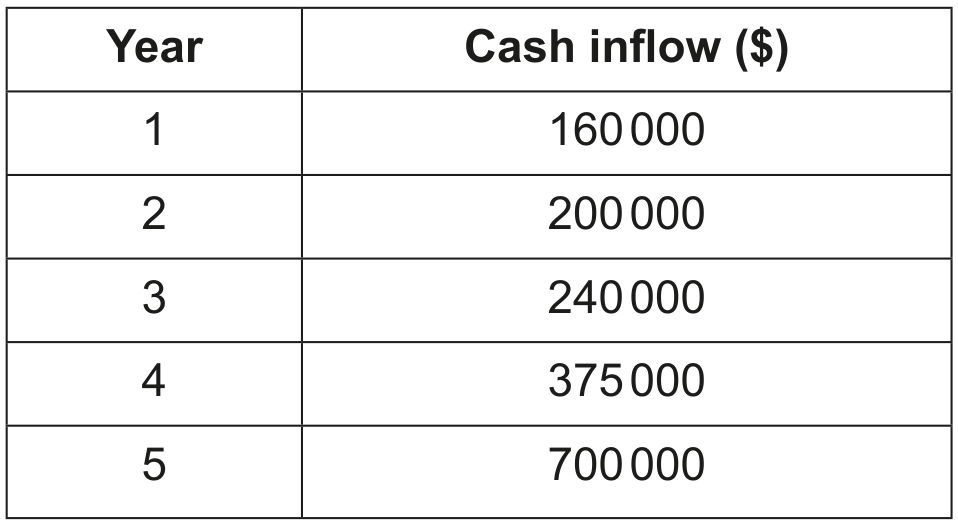
The cost of building a second academy is $ 500000. Stephen has produced forecasted financial information for the second academy's first five years of operation (see Table 1).

Table 1: Forecasted financial information for a second academy

Table 1: Forecasted financial information for a second academy

Stephen estimates cash outflow to be 25 % of the total cash inflow in years 1,2 and 3 and 20 % of the total cash inflow in years 4 and 5.

Question 1(b)

(a)

Using Table 1 and other information provided, calculate for SSA's second academy:

[ 6 ]

Question 1(b)(i)

(i)

the payback period (show all your working);

[ 2 ]

Question 1(b)(ii)

(ii)

the average rate of return (ARR) for the first five years of operation (show all your working);

[ 2 ]

Question 1(b)(iii)

(iii)

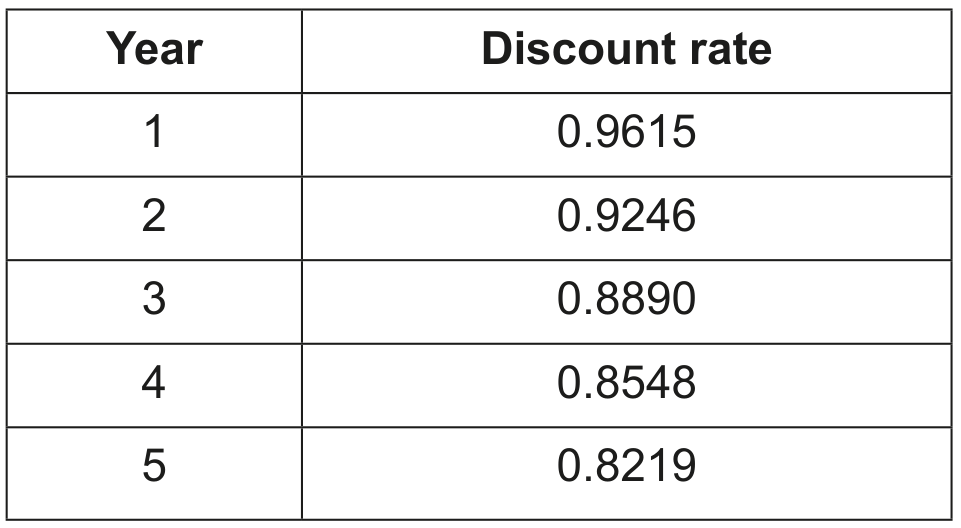
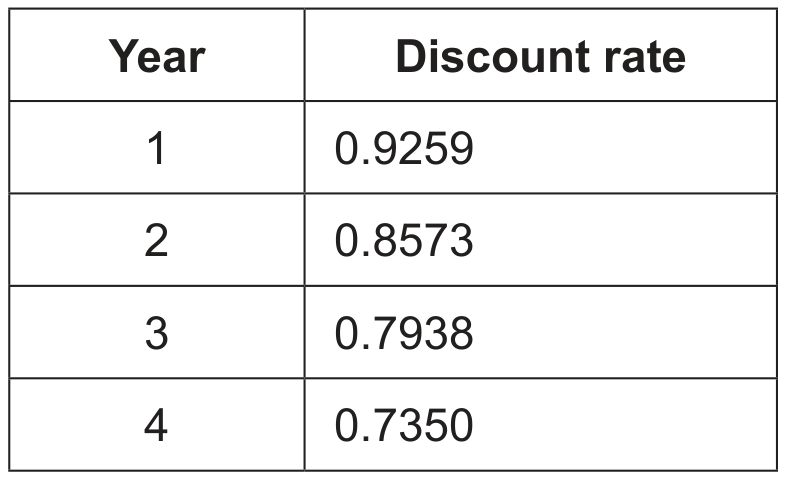
the net present value (NPV) at a discount rate of 4 % (see Table 2) (show all your working).

Table 2: Discount rates

Table 2: Discount rates

[ 2 ]

Question 1(c)

(b)

Explain one disadvantage for SSA of only using the payback period method in making its decision to open a second academy.

[ 2 ]

Question 2

[Maximum number: 8]

2. Urban Express (UE)
Urban Express Ltd. (UE), a private limited company, owns and operates city buses in an economically unstable country. Interest rates are forecasted to increase in the next few years. The government of the country has approached U E to set up a public
private partnership (PPP) to purchase electric buses. UE has forecasted the following annual net cash flows for UE's first purchase of electric buses.

Table 2: Forecasted annual net cash flows for UE's first purchase of electric buses

Table 2: Forecasted annual net cash flows for UE's first purchase of electric buses

Table 3: Discount rates at 8\%

Table 3: Discount rates at 8\%

Question 2(b)

(a)

Using Table 2, for UE's first purchase of electric buses, calculate:

[ 4 ]

Question 2(b)(i)

(i)

the average rate of return (ARR) (show all your working);

[ 2 ]

Question 2(b)(ii)

(ii)

the payback period (show all your working).

[ 2 ]

Question 2(c)

(b)

Using Table 2 and Table 3, calculate the net present value (NPV) at a discount rate of 8 % (show all your working).

[ 2 ]

Question 2(d)

(c)

Explain one factor that may have influenced UE's choice of the discount rate of 8 %.

Answer two questions from this section.

[ 2 ]

Question 4

[Maximum number: 10]

M M uses just-in-time (JIT) production in its Oil Production Division.

The long-term demand for oil is usually predictable, and production is reliable unless major problems occur. In 2020, however, there was an unexpected decrease in demand for oil. Uncertainties in the world economy and responses to climate change now make predictions more difficult.
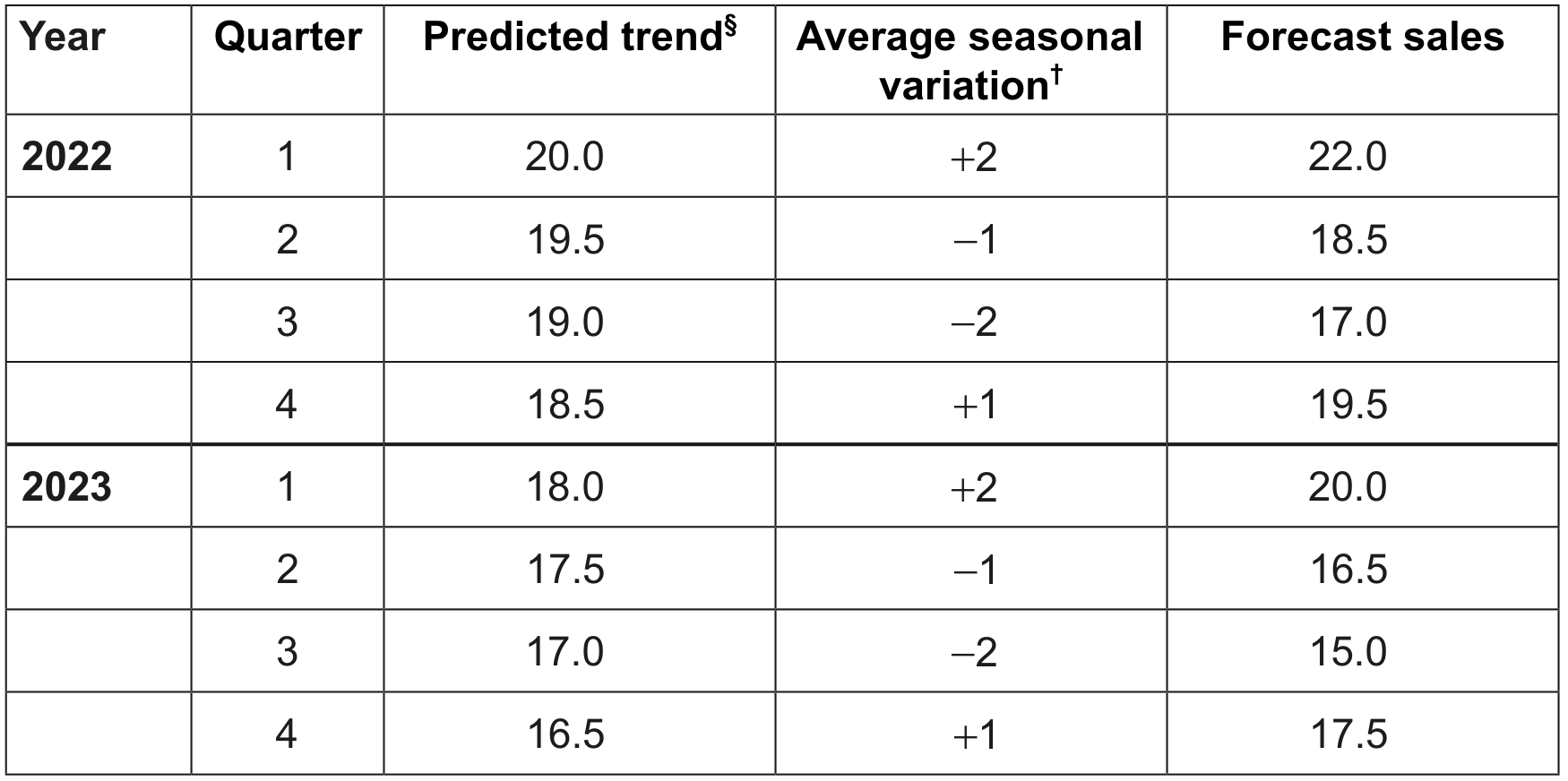
M M has prepared a sales forecast for its oil production for 2022 and 2023 (Table 2).

Table 2: Sales forecast for oil production for 2022 and 2023 (millions of barrels)

Table 2: Sales forecast for oil production for 2022 and 2023 (millions of barrels)

§ calculated using a four-quarter moving average based on six years of historic data
† calculated by comparing actual sales with a four-quarter moving average

In 2020, M M had some major problems:
- A catastrophic fire occurred at one of its oilfields.
- The gold mine in Egypt collapsed, trapping 23 miners.
- It experienced a cyber-attack on its computer network.
- An earthquake in Chile damaged the country's transport system.

In response to these problems, M M had to rely on its contingency planning and its crisis management procedures.

JG Mining (JG) wants to buy MM's tar sands mining operation for $50 million, but the board of directors are divided. MM recently invested $15 million in their tar sands operation in addition to the original $ 30 million set-up cost in 1986 . Production is at designed capacity, and, although the long-term average rate of return (ARR) for the tar sands operation is below those of most of MM's other investments, it provides a reliable source of income. However, M M has difficulty selling sulphur, a by-product of tar sands production.

Employees at the tar sands operation are against selling the operation to JG. However, the income from the sale would help M M finance other investments, such as lithium mining, and the sale could help improve MM's corporate image. MM's Finance Director, Ethan, estimates that the net present value (NPV) of the tar sands operation is $46 million.

Question 4(d)

(a)

Using information from the case study and additional information above, discuss whether M M should sell its tar sands mining operation to JG.

[ 10 ]

Question 4

[Maximum number: 4]

Problems are continuing with Enrich drinks. Aran is becoming increasingly frustrated with the lack of growth of sales. He always wants to succeed and is driven by the need to get tasks completed. The Enrich part of his life is not a success. He blames the workforce. The workforce does not share his vision. Employees are mainly part-time workers and parents who value jobs that enable them to fit work around school hours. As Aran has become more autocratic in his leadership style, labour turnover has increased. Last month, from a workforce of twelve, one retired and two left for what they called "better jobs".
There are also increasing problems with the quality of Enrich drinks, as batches of Enrich are rejected by the quality control department. Elsie, the manager of the production department, blamed suppliers, saying that Aran had damaged business relations with them due to his impatience. Elsie also blamed Aran for poor stock management. She has proposed total quality management (TQM) as a solution to these problems.
Detox
Accord decided to start the production and marketing of Detox, the green tea drink that helps athletes to relax. Detox proved to be very successful. Encouraged by the success and boosted cash inflow, Kayla is considering producing a range of snack bars based on Enrich and Detox flavours and recipes. Accord would use the Enrich brand name for the snack bars. The market for healthy snack bars is very competitive and dominated by a few large companies who spend large amounts of money on advertising. The market is growing rapidly - some market researchers estimate by 34 % per annum. There are many examples of small businesses entering the market successfully on a small scale. Kayla estimates that the proposal would involve an investment of $ 100000, with forecast net returns of $ 80000 for four years. Aran thinks that the money could be better spent on marketing Enrich drinks.

Question 4(b)

(a)

For Kayla's proposal calculate:

[ 4 ]

Question 4(b)(i)

(i)

the payback period;

[ 2 ]

Question 4(b)(ii)

(ii)

the net present value (NPV) using a discount rate of 6%6 \%^{*}.

[ 2 ]

Question 4

[Maximum number: 14]

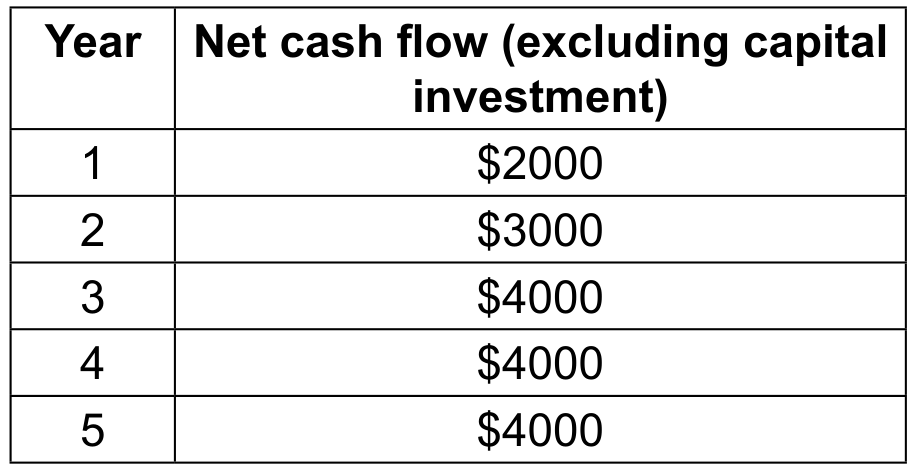
Paul's idea for 3D printing takes Utopia into a secondary sector activity that contrasts with its usual tertiary sector activities. In order to produce a sufficient number of souvenirs, Utopia would need to buy ten 3D printers at $ 1000 each. There would be material costs and significant operating costs, as well as time and additional labour. Paul has produced a net cash flow forecast for the project (Table 1) assuming a five year life for the printers. He likes the idea that each souvenir produced could be of a unique design and personalized. Some of the materials would be from recycled plastics obtained from waste at the resort. This example of lean production would be good for the resort's environment and for Utopia's caring image. The cost of recycling is uncertain.

Table 1: Net cash flow for the 3D printing project

Table 1: Net cash flow for the 3D printing project

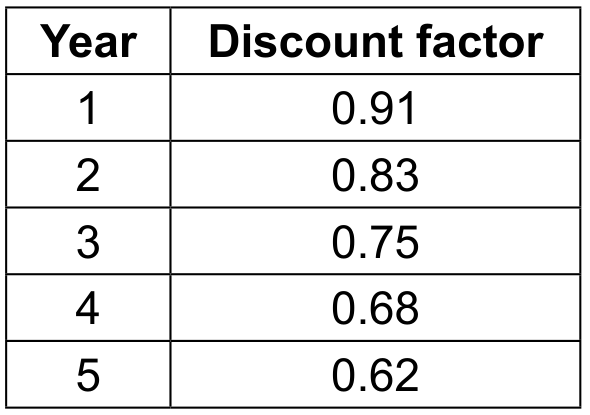
Table 2: Discount factors

Table 2: Discount factors

Liza does not like the idea of 3D printing. She is concerned that the souvenirs may damage Utopia's exclusive brand. She can see difficulties with recruiting someone with both the necessary IT skills and the ability to make decisions about which types of souvenirs to produce. She is particularly concerned about the impact on Utopia's current suppliers of souvenirs. She thinks that 3D printing is more suited to larger organizations.

John believes that the 3D printing technology will bring other benefits to his businesses. He can imagine decorations and other useful items being produced for the resort and its offices.

Question 4(c)

(a)

Using information from Table 1 and Table 2, calculate the net present value (NPV) for the 3D printing project.

[ 4 ]

Question 4(d)

(b)

Using information from the case study, additional information above and your results from part (c), discuss whether Utopia should proceed with the 3D printing project.
Section C
Answer the following question.

[ 10 ]

Question 5

[Maximum number: 20]

Su is considering two options.
Option 1: The joint venture
If A S goes ahead with the joint venture in 2019 , there will be consequences it will need to face. DF would have majority ownership in the joint venture, provide most of the senior managers, and is likely to expect changes in the way A S operates. AS would have to significantly increase the production of solar power systems and would have to restructure. Some managers may lose influence over decisions. Su is worried that her Afghanistan project (AS) would take second place.
Having a close working relationship with DF would reduce AS's risk of failure. Employees at AS have heard rumours about the joint venture and are unhappy with the idea. They fear a loss of identity, being overwhelmed by a much larger organization and possibly losing their jobs. Su is concerned that resistance to change, particularly by employees and managers, is going to be an important consideration in the decision. However she sees the situation as a huge opportunity to make a real change in young people's lives.
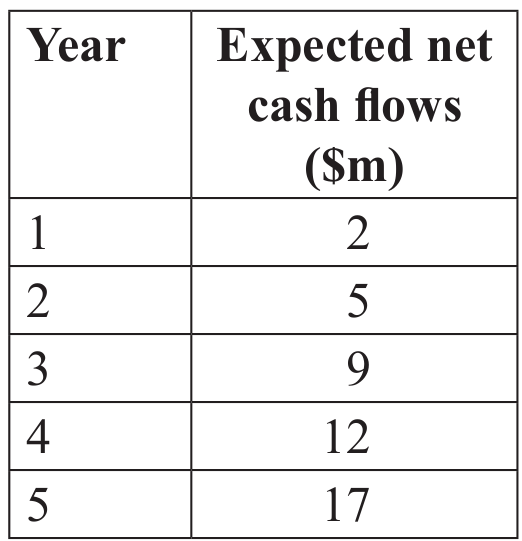
AS would invest $ 1 million. The net cash inflows to AS (ignoring inflows to DF and before deduction of the investment cost) are forecast to be $ 0.4 million per year, giving a net present value (NPV) at 6 % discount rate of $ 0.68 million and a payback of two years and six months. Su gives the project a life of five years.
Option 2: Diversification into biomass
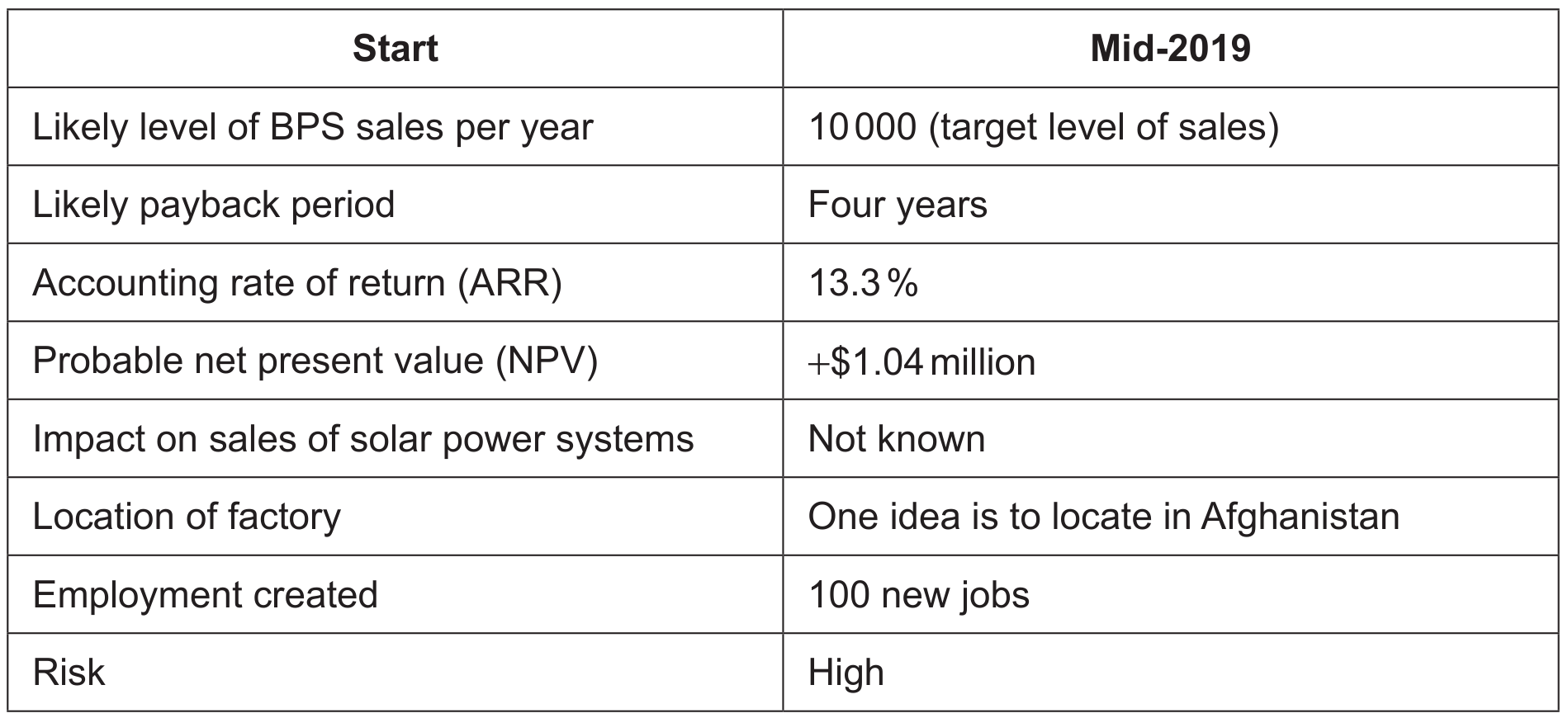
The research and development section of A S has developed a portable electricity generation system based on biomass, a biomas power system (BPS), as an alternative to solar power systems. A new factory costing $ 3 million will be needed. BPS will be particularly useful to those communities that keep cattle - the dung* produced provides the fuel for BPS. Su has assembled some relevant information.
\footnotetext{
* dung: animal waste from the cattle
}

Table 4: Information relevant to the BPS project

Table 4: Information relevant to the BPS project

Using the case study, additional information on pages 6 and 7 and appropriate planning tools, recommend whether Su should choose Option 1, Option 2, or neither. You will find it useful to calculate the ARR for Option 1.

0 selected