EduNinja

IB Business Management HL5.3 Lean production and quality managementQuestion Bank

Question 1

[Maximum number: 2]

1. Deep Sea Catch (DSC)
Deep Sea Catch (DSC) operates as a sole trader on an island popular with tourists. DSC specializes in supplying fresh fish to local hotels on a daily basis.
The local government has given D S C a permit to catch a maximum of 70 kilograms of fish per day. However, there has been an increase in illegal fishing (without permits), in addition to overfishing by DSC's other competitors (with permits), which has reduced fish stocks in the area. Given the increasing competition among fish suppliers on the island, hotels will only pay a fixed price of $ 10 per kilogram of fish.
DSC's cost of operation and the quantity of fish caught varies depending on factors such as weather conditions, the availability of fish, and the number of competitors.
Local hotels demand that:
- the fish they buy meet strict national health and safety standards, to ensure the quality of the fish for tourists
- fish are caught ethically without endangering other sea creatures, such as sea turtles or dolphins.
An environmental pressure group is also pressuring the government for:
- more strict regulations on the fishing industries, targeting suppliers without permits
- a reduction in the quantity of fish that each supplier can sell
- new legislation for a compulsory installation of new and sophisticated technological equipment for ethical fishing.
DSC is well known for fishing responsibly and within government legislation. However, the owner is worried about the possible high costs of some of the new legislation.
Unsold fish is stored and kept in a refrigerator for up to two days. After two days, the stored fish is sold to a processing factory for $ 4 per kilogram. For example, fish caught on Monday, but still not supplied to the hotels by Tuesday evening, will be sold on Wednesday to the processing factory.
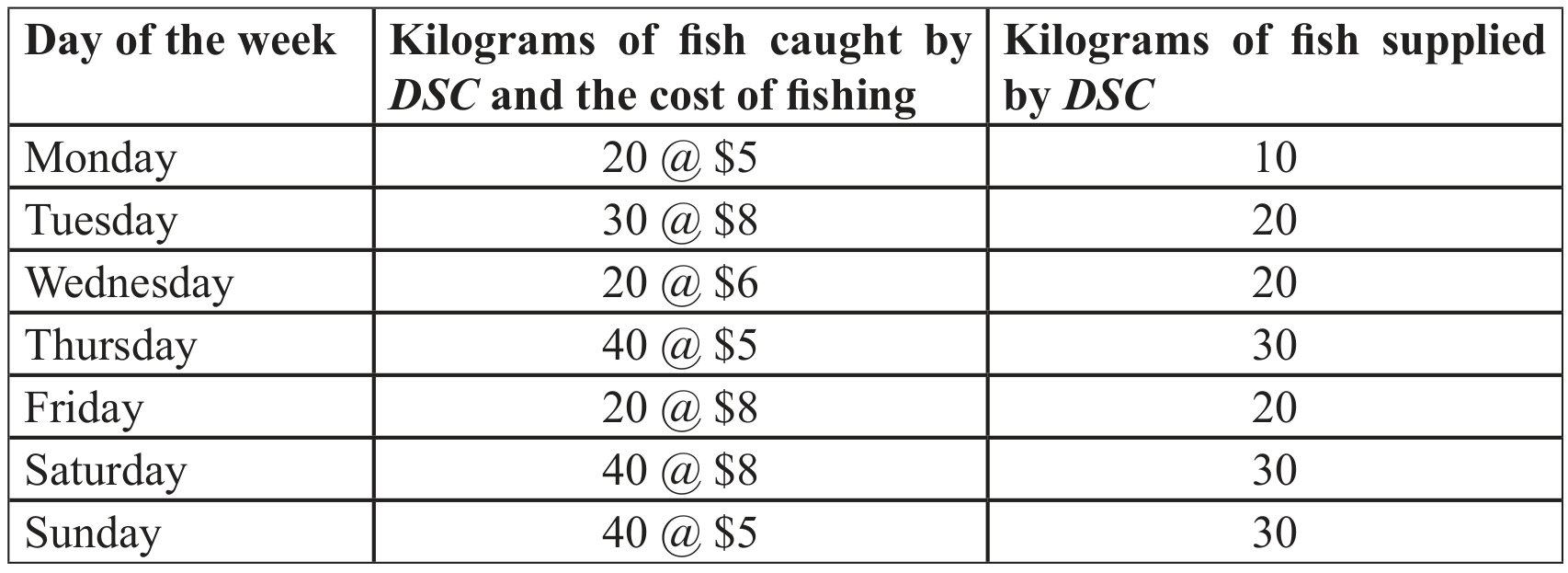
DSC uses the system of last-in-first-out (LIFO) for the stock valuation. The table below shows a typical week's supply of fish at DSC:
Table

Question 1(c)

(a)

Explain one advantage for DSC if they provide fish meeting national quality standards.
[ 2 ]

Question 1

[Maximum number: 4]

1. Las Rosas (LR)
Las Rosas (LR) is a large commercial dairy farm owned and managed by the D'Aremberg family since 1986. It has 3800 cows. L R sells milk, cheese and yoghurts. In 1996, L R started to export some of its dairy products. Profits and cash flow have been improving year on year. L R has no outstanding loans and therefore its current gearing ratio is zero.
LR's unique selling proposition (USP) comes from the organic quality of its products as they are made without chemical additives. The cows' diet does not include hormones and other supplements. The farm's products also meet national and international quality standards.
LR's corporate culture encourages innovation and the use of cell production. To stay ahead of the competition L R has increased its spending on research and development (R\&D) and workers are given the opportunity to create new products, or to add value to existing ones. L R 's financial manager, however, believes that the R\&D budget is too high and needs to be cut. He also argues that there are too many legal constraints limiting the development of new products.
LR's management is considering buying El Remanzo, a large sheep farm located nearby. This acquisition will cost $ 24 million and L R will need to cut its R\&D budget to zero and organize a new loan to finance the takeover. A significant restructuring would need to occur at both L R and El Remanzo to allow both companies to combine resources and knowledge. However, the potential economies of scale experienced by L R could be substantial.
Total capital employed at L R is $ 45 million.

Table

Question 1(b)

(a)

Explain two benefits for L R of meeting quality standards.

[ 4 ]

Question 2

[Maximum number: 12]

2. GF
Barbara Johnson manages a small business ( G F ) that produces and sells gluten-free* bread. G F has been recognized for meeting national quality standards for gluten-free bread which has helped increase sales. Local supermarkets sell their own label brands of gluten-free bread which do not meet national quality standards at a price 20 % cheaper than G F. Barbara aims to make national quality standard gluten-free bread more affordable and in larger batches.
G F has 21 employees. Four are gluten-sensitive (intolerant) testers who check the quality of the final bread. This traditional method of quality control is important, but takes significant time and resources.
Several hospitals have asked if G F can provide them with an additional 1200 loaves of gluten-free bread every day for the next year. Barbara is keen, however in a small market like this, becoming larger does not automatically result in economies of scale. GF's suppliers cannot provide larger quantities of gluten-free flour without increasing their prices and consequently G F 's costs.
Barbara has two options:
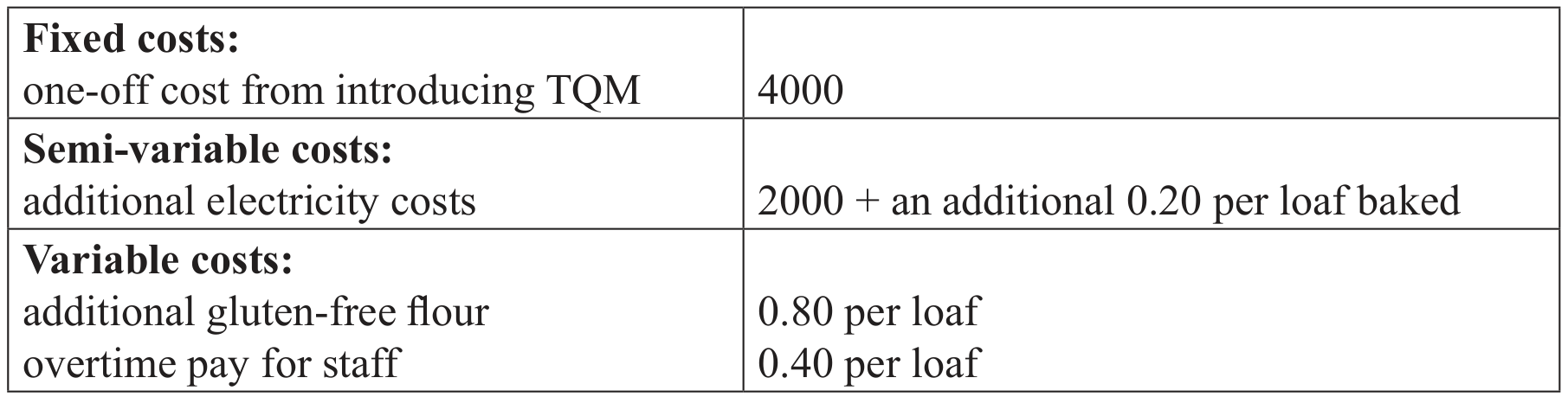
- Option 1: Increase G F 's production of gluten-free bread and maintain national quality standards by introducing total quality management (TQM) control at a one-off cost of $ 4000. This should also speed up the batch production process.
- Option 2: Buy-in the additional 1200 loaves from the company that supplies the local supermarkets and then sell this bread to the hospitals. However this supplier uses flow production and does not meet national quality standards.
The sales price per loaf of G F bread is $ 6.80 regardless of the option chosen.
Barbara prepared the following figures for each option (in $):
Option 1: Increase GF's production to make the additional 1200 loaves.

Table

Option 2: Buy-in the additional 1200 loaves.
Total variable cost of buying in 12007200 loaves from local supermarkets' supplier

\footnotetext{
* gluten: a protein found in wheat (flour) which causes health problems for those who are sensitive (intolerant) to it
}

Question 2(c)

(a)

Explain two benefits and one cost to G F of meeting national quality standards for its bread.

[ 6 ]

Question 2(e)

(b)

Analyse two reasons why G F should move from traditional quality control methods to a TQM approach.

Answer two questions from this section.

[ 6 ]

Question 2

[Maximum number: 2]

2. Crisis management and Mapa

Image removed for copyright reasons

The Portuguese company Mapa manufactures a handheld global positioning system (GPS)* device. In the winter of 2012, Mapa received reports that its GPS devices often failed in extremely cold weather. According to the media, the problem first appeared in 2011, when mountain climbers with the Mapa GPS devices discovered inaccuracies in the coordinates the devices provided. Rumours of the GPS failure began to circulate in the climbing community. Then, after several accidents in the mountains, including fatalities, television news programmes began to report the problem. Only then did Mapa begin to take action.

Engineers concluded that the problem resulted from where and when the quality testing was being performed. The production of a component part outsourced to a company in Iceland was being quality tested in Portugal in the summer. There was also poor communication between the producer of the component part and Mapa because of differences in language and culture.

Mapa's tall organizational structure, bureaucracy (and bureaucratic corporate culture) and centralized decision making meant that no manager acted until the Chief Executive Officer (CEO) formally apologized. As a result, Mapa had taken too long to admit that there was a problem and so consumer confidence fell and Mapa's reputation suffered.

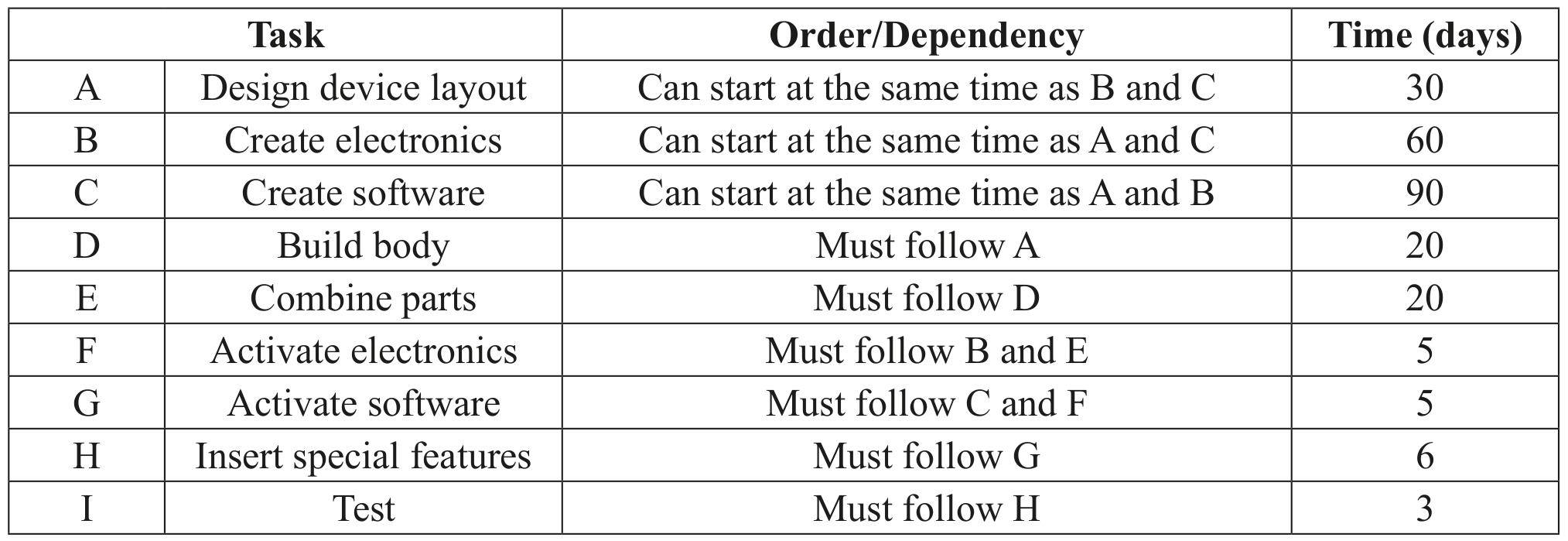
The production process of the GPS device is shown in the table below:

Table

\footnotetext{
* global positioning system (GPS): provides location, including geographic coordinates and time information to users anywhere on earth as long as their receivers (commonly a handheld device such as a smartphone with a GPS application) have unobstructed lines of wireless transmission to various GPS satellites
}

Question 2(a)

Question 2(a)(ii)

(a)
(i)

Identify two features of a quality control system.

[ 2 ]

Question 4

[Maximum number: 2]

M M uses just-in-time (JIT) production in its Oil Production Division.

The long-term demand for oil is usually predictable, and production is reliable unless major problems occur. In 2020, however, there was an unexpected decrease in demand for oil. Uncertainties in the world economy and responses to climate change now make predictions more difficult.
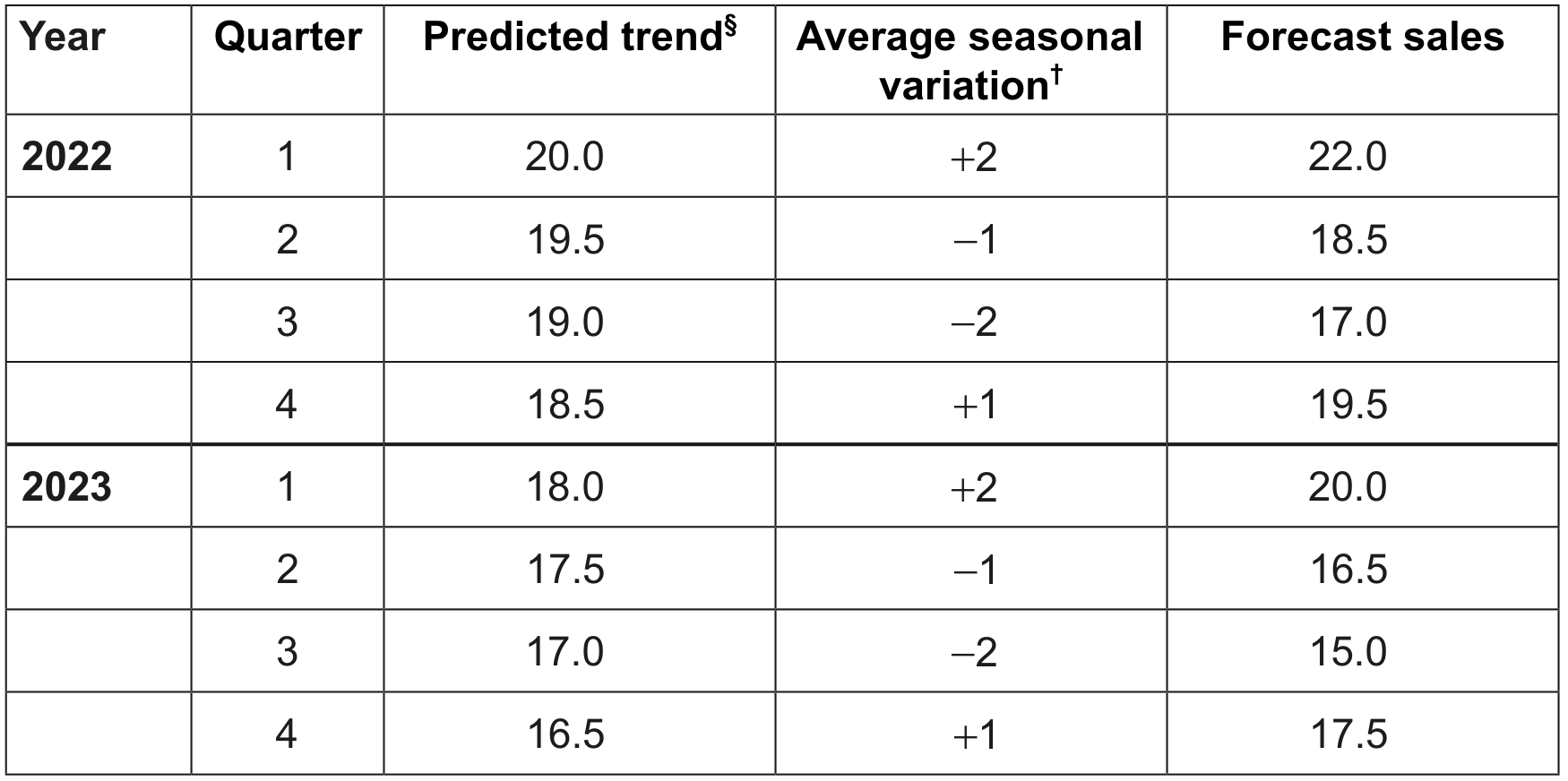
M M has prepared a sales forecast for its oil production for 2022 and 2023 (Table 2).

Table 2: Sales forecast for oil production for 2022 and 2023 (millions of barrels)

Table 2: Sales forecast for oil production for 2022 and 2023 (millions of barrels)

§ calculated using a four-quarter moving average based on six years of historic data
† calculated by comparing actual sales with a four-quarter moving average

In 2020, M M had some major problems:
- A catastrophic fire occurred at one of its oilfields.
- The gold mine in Egypt collapsed, trapping 23 miners.
- It experienced a cyber-attack on its computer network.
- An earthquake in Chile damaged the country's transport system.

In response to these problems, M M had to rely on its contingency planning and its crisis management procedures.

JG Mining (JG) wants to buy MM's tar sands mining operation for $50 million, but the board of directors are divided. MM recently invested $15 million in their tar sands operation in addition to the original $ 30 million set-up cost in 1986 . Production is at designed capacity, and, although the long-term average rate of return (ARR) for the tar sands operation is below those of most of MM's other investments, it provides a reliable source of income. However, M M has difficulty selling sulphur, a by-product of tar sands production.

Employees at the tar sands operation are against selling the operation to JG. However, the income from the sale would help M M finance other investments, such as lithium mining, and the sale could help improve MM's corporate image. MM's Finance Director, Ethan, estimates that the net present value (NPV) of the tar sands operation is $46 million.

Question 4(a)

(a)

Define the term just-in-time (JIT) production.

[ 2 ]

Question 4

[Maximum number: 10]

Sam and Finn are having difficulties resolving their disagreements. Finn was convinced that the problems at AFA should be resolved by a change in the organizational structure. Sam, however, was convinced that he should strengthen the organizational culture. Sam reluctantly accepted the need for greater delegation but insisted that there should be more training for all employees on the culture and ethics of AFA.

As part of greater delegation, Kim was given responsibility for the relationship between AFA and its suppliers. Kim is concerned that she spends a lot of time chasing orders that do not arrive and dealing with the poor quality of orders. Some products have to be thrown away because they have passed their sell-by dates*. Others have to be returned to suppliers because the outlet managers do not accept the poor quality and therefore cannot be sold.

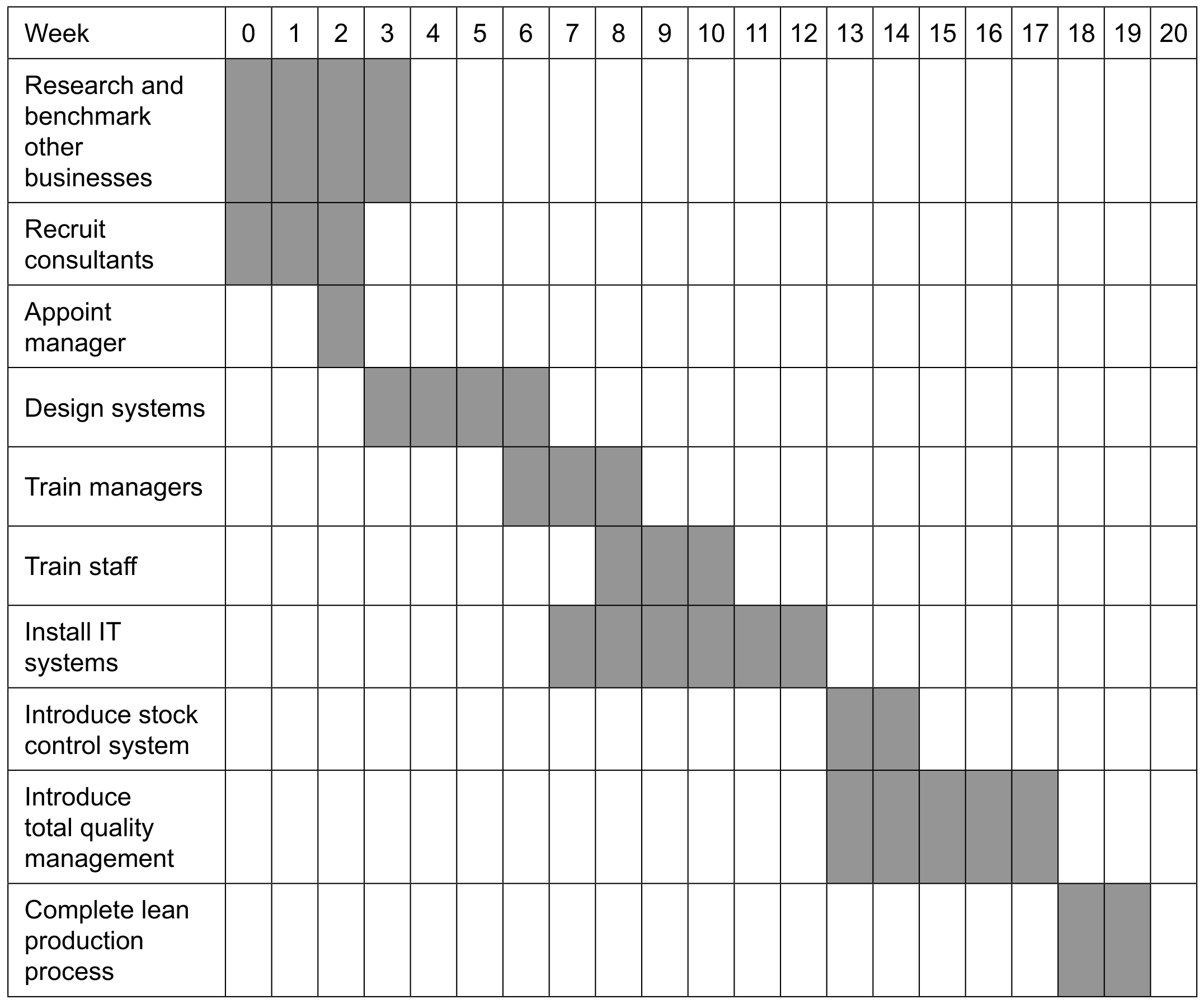
AFA's stock of fair trade woollen hats has now reached 500 , with an annual sales average of around 1250 for the whole business. Kim wants to introduce lean production including total quality management (TQM) throughout AFA's operations and has created a Gantt chart to show the stages in implementation.
* sell-by dates: dates printed on the packaging of products that state the date after which the product can no longer be sold.

Figure 1: Gantt chart for the implementation of lean production including TQM at AFA

Figure 1: Gantt chart for the implementation of lean production including TQM at AFA

Question 4(d)

(a)

Discuss the value to AFA of lean production methods.
Section C
Answer the following question.

[ 10 ]

Question 4

[Maximum number: 2]

Six months has passed and Medimatters is now ready to launch IBAT. Medimatters will recruit new staff to set up a customer services department. Ahmed has spent some time thinking about the people he would need to recruit. The staff would need to possess IT skills and an understanding of medical issues.

The manufacturer Falit found in India has produced the first batch of 1000 IBAT lenses. Unfortunately, the IBAT lenses were delivered later than expected and some were faulty. As a result, the group is considering whether to make or buy the IBAT lenses. Ahmed has suggested setting up a manufacturing facility using lean production. His calculations are as follows:
- Price paid to manufacturer in India per IBAT lens: $ 50.
- Current number of IBAT lenses purchased per month: 1000.
- Variable cost of making IBAT lenses: $25 (per lens).
- Additional fixed cost of making IBAT lenses per month: $ 20000.

Ahmed considered his role as leader.
- He has consulted widely on a draft business plan and has discussed and agreed the mission and vision statements because he wants to involve everyone.
- The group are all very enthusiastic about IBAT, although some are anxious about the risks involved and have asked for more guidance.
- He spends a lot of time keeping everyone informed of project developments in addition to coordinating all of their efforts.
- Emma has many ideas about expanding into new markets, however, Didi does not agree and has argued with Emma.
- He is prepared to make urgent decisions himself. For example, without consultation he decided that Medimatters should become a private limited company.

Question 4(a)

(a)

Define the term lean production.

[ 2 ]

Question 4

[Maximum number: 2]

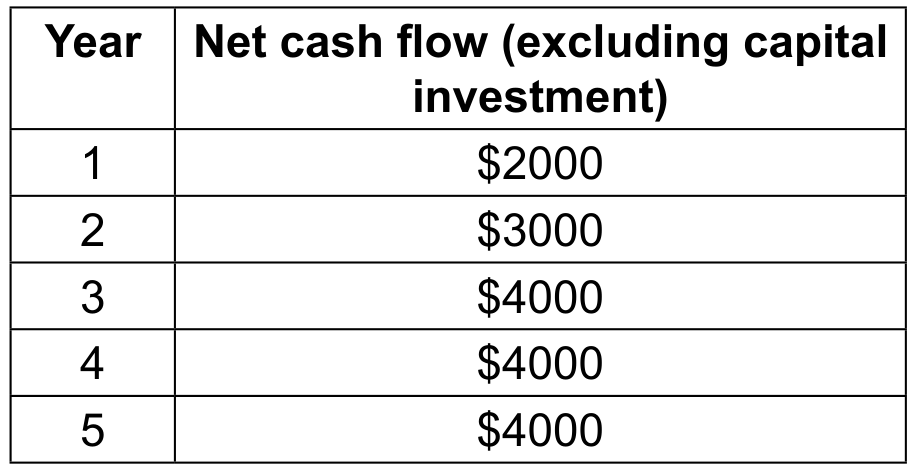
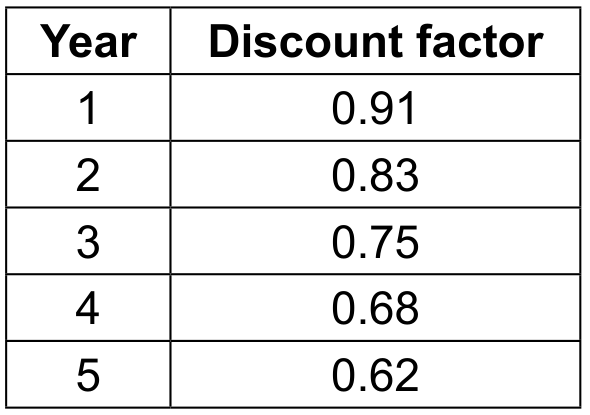
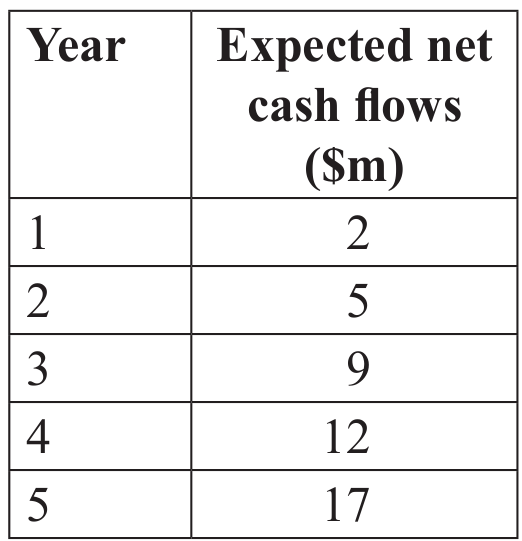
Paul's idea for 3D printing takes Utopia into a secondary sector activity that contrasts with its usual tertiary sector activities. In order to produce a sufficient number of souvenirs, Utopia would need to buy ten 3D printers at $ 1000 each. There would be material costs and significant operating costs, as well as time and additional labour. Paul has produced a net cash flow forecast for the project (Table 1) assuming a five year life for the printers. He likes the idea that each souvenir produced could be of a unique design and personalized. Some of the materials would be from recycled plastics obtained from waste at the resort. This example of lean production would be good for the resort's environment and for Utopia's caring image. The cost of recycling is uncertain.

Table 1: Net cash flow for the 3D printing project

Table 1: Net cash flow for the 3D printing project

Table 2: Discount factors

Table 2: Discount factors

Liza does not like the idea of 3D printing. She is concerned that the souvenirs may damage Utopia's exclusive brand. She can see difficulties with recruiting someone with both the necessary IT skills and the ability to make decisions about which types of souvenirs to produce. She is particularly concerned about the impact on Utopia's current suppliers of souvenirs. She thinks that 3D printing is more suited to larger organizations.

John believes that the 3D printing technology will bring other benefits to his businesses. He can imagine decorations and other useful items being produced for the resort and its offices.

Question 4(a)

(a)

Describe one method of lean production other than recycling.

[ 2 ]

Question 4

[Maximum number: 4]

It is now mid-2019. Production of solar power systems has been going for over a year and sales have exceeded forecasts and reached 5000 systems for the year. Profits have been reinvested into developing new outlets and distribution channels for solar power systems in Afghanistan. Lean production techniques have enabled A S to keep costs low, but A S has had some quality issues: some cells produce lower quality systems than others. AS has found faults in components bought from suppliers. Some solar power systems have been damaged in the supply chain. Salima is thinking of instituting total quality management (TQM). She also needs to forecast sales for 2020 but has decided the situation is not suitable for a four-part moving average.

In a separate development, Doorway Foundation (DF), a multibillion-dollar charity established by the owners of one of the world's largest IT businesses, has approached Su. The foundation has a major IT initiative to bring IT to schools in Afghanistan, Myanmar and Bangladesh. By forming a joint venture, DF could use AS's expertise and local knowledge to help solve some of the electricity supply and IT problems in Afghanistan.

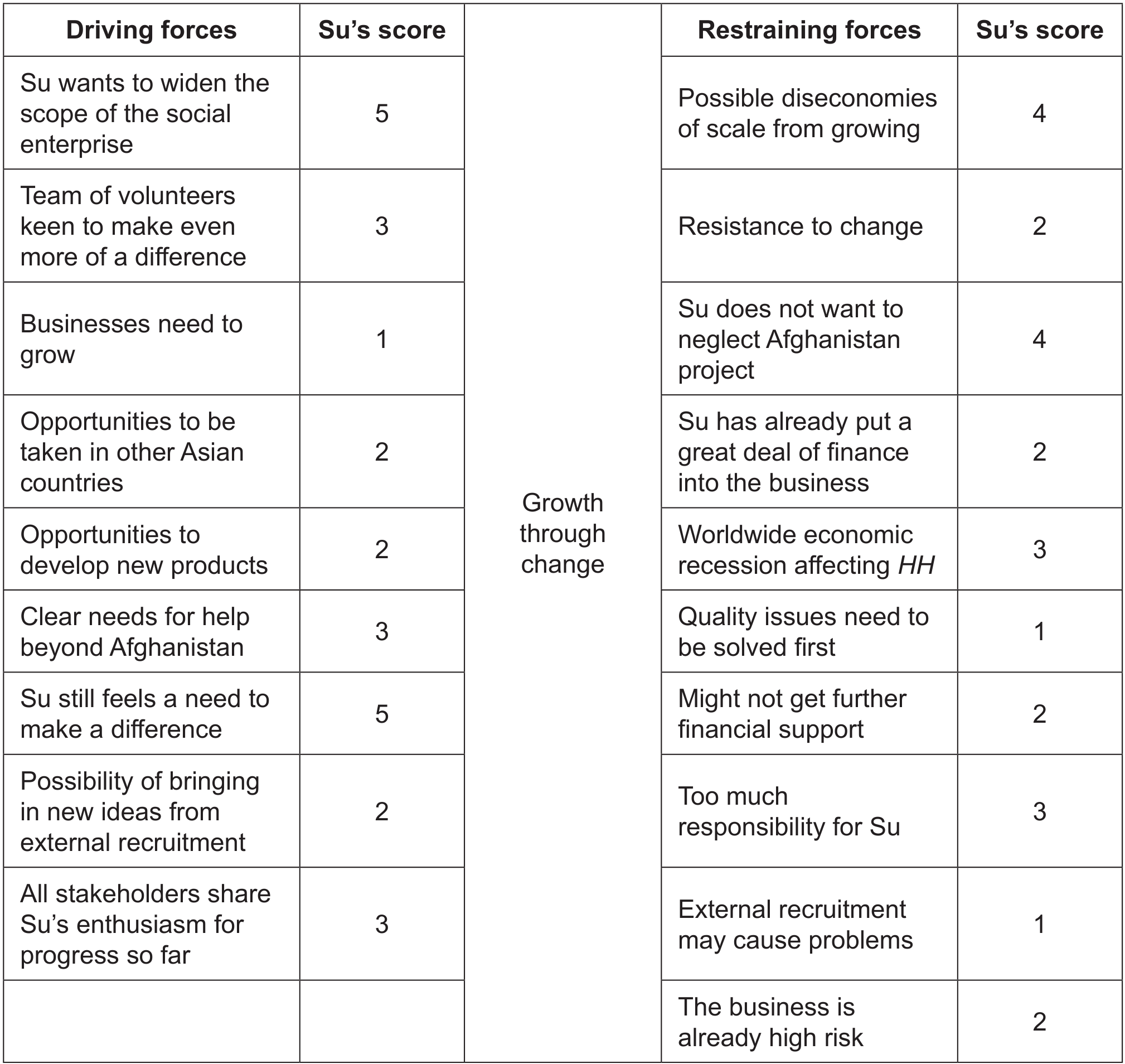
The possibility of a joint venture encouraged managers and investors to think about whether A S should grow. In response, Su decided to analyse the possibility of growth through change using a force field analysis of A S.

Table 3: Force field analysis for growth through change at AS

Table 3: Force field analysis for growth through change at AS

Question 4(c)

(a)

Explain how total quality management (TQM) could help AS improve the quality of its products.

[ 4 ]

Question 4

[Maximum number: 4]

Problems are continuing with Enrich drinks. Aran is becoming increasingly frustrated with the lack of growth of sales. He always wants to succeed and is driven by the need to get tasks completed. The Enrich part of his life is not a success. He blames the workforce. The workforce does not share his vision. Employees are mainly part-time workers and parents who value jobs that enable them to fit work around school hours. As Aran has become more autocratic in his leadership style, labour turnover has increased. Last month, from a workforce of twelve, one retired and two left for what they called "better jobs".
There are also increasing problems with the quality of Enrich drinks, as batches of Enrich are rejected by the quality control department. Elsie, the manager of the production department, blamed suppliers, saying that Aran had damaged business relations with them due to his impatience. Elsie also blamed Aran for poor stock management. She has proposed total quality management (TQM) as a solution to these problems.
Detox
Accord decided to start the production and marketing of Detox, the green tea drink that helps athletes to relax. Detox proved to be very successful. Encouraged by the success and boosted cash inflow, Kayla is considering producing a range of snack bars based on Enrich and Detox flavours and recipes. Accord would use the Enrich brand name for the snack bars. The market for healthy snack bars is very competitive and dominated by a few large companies who spend large amounts of money on advertising. The market is growing rapidly - some market researchers estimate by 34 % per annum. There are many examples of small businesses entering the market successfully on a small scale. Kayla estimates that the proposal would involve an investment of $ 100000, with forecast net returns of $ 80000 for four years. Aran thinks that the money could be better spent on marketing Enrich drinks.

Question 4(c)

(a)

With reference to Accord, explain one advantage and one disadvantage of using total quality management (TQM).

[ 4 ]
0 selected