
EduNinja

IB Business Management HL1.4 StakeholdersQuestion Bank

Question 2

[Maximum number: 2]

2. Himalayan Trekking
Himalayan Trekking (HT) is a trekking (mountain walking) agency based in Nepal. It has been operating guided treks for tourists in Nepal, Tibet and Bhutan for over 20 years. With a duration of between one and three weeks, H T offerings include treks to the Everest Base Camp, tours to Buddhist sites in Tibet, and treks even to the inaccessible Kingdom of Bhutan. Brand loyalty is very strong, with repeat bookings from many clients (trekkers).
The market for trekking has been growing very rapidly with many new businesses setting up to meet the increased demand for "adventure" holidays. In this competitive market, HT's unique selling proposition (USP) is to provide an unforgettable wilderness experience in a socially and ethically responsible manner. It only uses locally produced food and local guides and trekkers camp without wasting too many resources. All clients have to sign a contract to agree that they will act in a socially responsible manner throughout the trek. Though it always had a strong sense of social responsibility, HT had not promoted this aspect of the business until the management realized that changes in attitudes towards social responsibility could be used to gain competitive advantage.
HT's brochure states that:
- It is a market leader in adventure tourism for Nepal, Tibet and Bhutan. It caters to a wide range of clients from experienced to inexperienced trekkers.
- In recognition of protecting the fragile environment, economic systems and cultures it treks in, HT has been awarded a global quality standard.
- By employing local guides and using locally produced food, H T adds much value to the local region.
- It only employs staff that have previous social and environmental experience.
- It financially supports a non-governmental organization (NGO) for Nepali orphans by giving 5 % of its turnover to Child Environment Nepal (CEN).
Selected financial information for HT for 2013:
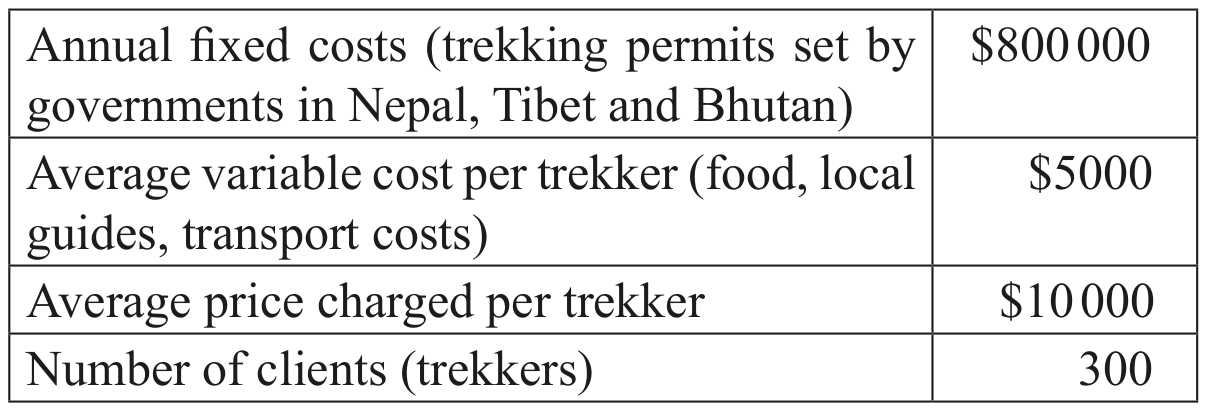
Table

Question 2(a)

Question 2(a)(ii)

(a)
(i)

Identify two external stakeholders of H T.

[ 2 ]

Question 3

Question 3(a)

(a)

Describe one consequence of the likely relocation of the factories (lines 96-99):

[ 4 ]

Question 3(a)(i)

(i)

for one internal stakeholder of R D B.

[ 2 ]

Question 3(a)(ii)

(ii)

for one external stakeholder of R D B.

[ 2 ]

Question 4

Question 4(d)

(a)

Evaluate the possible ways to overcome conflict between external stakeholders and the U W P Mission in Loyka.
Additional information
There is no additional information in this paper for Sections A and B.
SECTION C
Answer the compulsory question from this section.

[ 8 ]

Question 3

[Maximum number: 6]

3. The $ 1.99 toy shop
James Lai's toy shop is popular with no toy priced above $ 1.99. The toy shop uses psychological pricing at a level much lower than its competitors. James imports 90 % of his stock from China. It is located in a poor part of the city centre. Its target market is low-income families. The shop is very busy at weekends with a long queue (line) at the one cash register. Most employees are teenagers, who are very low paid.
Several stakeholder groups have complained:
- parents are concerned about the quality and safety of the toys and have set up an online social networking web site urging people to stop purchasing from the shop
- older customers have complained about the long queue at the one cash register
- one employee representative (union official) contacted James about employing teenagers on very low wages
- local toy manufacturers have questioned James' use of Chinese suppliers.
Competitors have argued that the $ 1.99 toy shop's psychological pricing method is unethical. James replied to stakeholder concerns, in a letter to a local newspaper, by stating that his shop allows young children to purchase affordable toys and provides job opportunities for teenagers. James has decided to create a social networking web site to respond to critics and to manage customers' perceptions.
James admits that the rate of stock turnover could be improved. He admits that the long queue is causing many customers to leave without buying anything. James is considering opening a second, larger toy shop called $ 4.99. He announced the opening on his social networking web site, informing stakeholders that he would stock higher quality products and have more cash registers. However, he immediately received negative online feedback from customers who saw the $ 4.99 toy shop as just a $ 3 price increase for the same toys.

Question 3(c)

(a)

Analyse two possible conflicts between stakeholders of the $ 1.99 toy shop.

[ 6 ]

Question 3

[Maximum number: 2]

3. Construir
Construir is a large construction company that uses empowerment, job enrichment and teamwork to motivate its workers. Commitment to quality is strong, and productivity is high.
The company makes substantial investment in the training and professional development of its workers, who may receive both external and internal training:
- External training takes place at a local university. However, university training fees are rising.
- Internal training is led by managers within each department. However, some managers do not feel comfortable in this role.
Managers also conduct worker appraisals in order to monitor performance and reward success. However, some managers feel that it takes too long to appraise workers appropriately; they also say that for some workers the appraisal process can be very stressful.
The government is considering the construction of a bridge, which would take three years to complete. This would be through a public-private partnership with Construir. The government would pay half of the cost of construction and would give Construir the right to charge a fee to drivers who use the bridge. Building the bridge, however, would represent financial and operational risks for Construir.
The company will not be able to accept other construction projects in order to build the bridge. Moreover, a general election is due next year and the current government is unpopular and not expected to win. If a new government is elected, Construir believes that the project may be cancelled. Some local environmental pressure groups are currently campaigning against the bridge project, arguing that government funds should be spent on health and education.

Question 3(a)

(a)

Define the following terms:

[ 2 ]

Question 3(a)(ii)

(i)

pressure groups.

[ 2 ]

Question 4

[Maximum number: 6]

4. Oktopus Air (OA)
Oktopus Air ( O A ) is an airline targeting both business and economy class passengers. Customers have praised O A for its ethical objectives, its commitment to below market prices for both market segments and its mission statement: "In the air, we care for everyone!".
Employees have praised O A 's Chief Executive Officer (CEO), Eythor Karlsson, for his situational leadership style. O A 's flights are usually full and customer feedback is excellent.
Two social changes are affecting O A :
- Obesity is increasing. Very obese passengers are finding difficulty fitting into seats. On full flights, some passengers sitting next to a very obese passenger have complained about a lack of space. O A has decided to charge very obese passengers for two seats. A refund of one seat will be given if the flight is not full. Pressure groups representing very obese people have argued that O A is acting unethically. Eythor defended the decision, arguing that competitors were already carrying out the same practices. He added that very obese passengers can create safety problems during an emergency evacuation of the airplane.
- The second change is the increasing number of families with young children travelling in business class. Business passengers are complaining that young children are too noisy and are threatening to fly with competitor airlines. Eythor has suggested to O A 's Board of Directors that a market gap could be filled if O A offered a family-only service, once a day, with additional play areas for young children and hence fewer passenger seats. Eythor has indicated that O A will need to raise prices for this service, change its promotional method for this service and create a new marketing mix. Some consumer groups recognize the good intentions of a family-only service; however they fear it could actually increase the hostility towards families with young children on other flights that O A offers.

Question 4(b)

(a)

Explain three stakeholder conflicts at O A.

[ 6 ]

Question 4

[Maximum number: 15]

4. Mergers in the airline industry
Recently, British Airways merged with Iberia, and Air France merged with KLM. Both mergers resulted in some significant benefits.
Ryanair plans a £ 560 million takeover of the Irish airline, Aer Lingus, which has failed to deliver shareholder dividends. One shareholder, the Irish government, owns 25 % of the shares of Aer Lingus.
Ryanair's chief executive officer (CEO) said that the proposed takeover could:
- create revenue and a positive return for the Irish government by selling its shares
- create a strong Irish airline capable of competing with major European airlines.
This form of external growth is also occurring in the United States (US). American Airlines and US Airways will merge, forming the nation's biggest airline, to be called American.
Airline analysts argue that mergers are necessary to reduce financial uncertainty and restore stability to a business that lost about $ 60 billion in 10 years. Large airlines with big networks can invest in new airplanes, new routes and better facilities, and provide passengers with more travel options. Mergers are likely to increase operational and financial efficiencies and create economies of scale. Airline analysts, favouring airline mergers, emphasize that each merger must be approved by appropriate national and international regulatory agencies to ensure that the competitive nature of the industry is maintained.
Other analysts, however, argue that:
- large airlines make it difficult for smaller rivals to compete, and in the long run reduce competition. This situation may lead to higher fares and a poorer service.
- being larger may not make airlines globally competitive. Some national governments restrict operation of foreign airlines within their countries, which allows a local airline monopoly* to exist.
- strategic decisions are difficult to implement as companies grow in size.
- larger is not always better. http://www.guardian.co.uk; http://www.nytimes.com]
* monopoly: an industry where there may be only one seller/producer of a particular good or service

Question 4(d)

(a)

Examine the Irish government's decision to own 25 % of the shares of Aer Lingus.

[ 6 ]

Question 4(e)

(b)

With reference to one internal stakeholder and one external stakeholder, discuss the statement that "larger is not always better" from the perspective of the airline industry.

[ 9 ]

Question 5

[Maximum number: 4]

5. Chips to Go (C2G)
Chips to Go (C2G) produce potato chips for the British market. C2G's Chief Executive Officer (CEO) is Charles Chip who is a dynamic entrepreneur famous for taking risks with chip flavours such as "banana and sour cream" and "chocolate fudge" and promoting them with humour especially appealing to British culture. C2G has created a number of successful snack products under the C2G family brand. Charles uses intuitive rather than scientific decision-making. He rarely consults with senior managers or considers financial data.
C2G's value as a company in terms of goodwill, brand value and other intangible assets is tied very closely to the personality and lifestyle of Charles. He is the company's most valuable intangible asset and is very popular among the younger generation. He is constantly in the news trying to travel around the world in a canoe, or taking risks by parachuting off high buildings to gain free publicity and word-of-mouth promotion. Current and potential investors have contacted the finance department as to what may happen to the value of these intangible assets if Charles were to have a serious accident.
C2G is looking for ways to increase market share in an increasingly competitive domestic snack market. One long-time aim for Charles has been the creation of a potato chip with all the taste of regular chips but without any fat. The marketing department of C 2 G is very excited with this idea but the Production Manager has indicated to Charles that it cannot be produced. Charles has been told and was furious.
A second strategic option could be to launch the potato chips into a new international market. One of Charles's closest advisers has argued that C2G would need to be careful with its product and promotion, as overseas customers may not share British tastes in potato chips, or British humour in promotion. He urges Charles to take time to carry out extensive market research of the new international market.

Question 5(a)

(a)

Describe two stakeholder conflicts at C2G.

[ 4 ]
0 selected