Question 3
Question 3(b)
(a)
Explain ways in which PU could achieve greater sustainability in the 2022/23 academic year (lines 118-131).
Answer the following question.
[ 6 ]
 EduNinja
Explain ways in which PU could achieve greater sustainability in the 2022/23 academic year (lines 118-131).
Answer the following question.
3. Cool Meals (CM)
Cool Meals (CM) produces frozen organic ready-made meals that are sold to food retailers throughout the country.
CM buys large quantities of organic ingredients from local farmers for its just-in-case (JIC) stock control management. It uses a cost-plus (mark-up) pricing strategy.
CM is known for its:
- good-quality organic frozen meals, which are perceived as good value for money
- flexibility with retailers in terms of quantity of meals supplied, credit given and efficient delivery at pre-arranged dates
- corporate social responsibility (CSR) based on a long-term commitment made to farmers to purchase large quantities of organic ingredients every four months and pay a fair price promptly
- CM has an excellent working relationship with farmers, who always prioritize CM's requests in terms of quantity and delivery.
Recently, an economic downturn and increased competition, especially from non-organic frozen meal suppliers, has decreased demand for frozen organic meals.
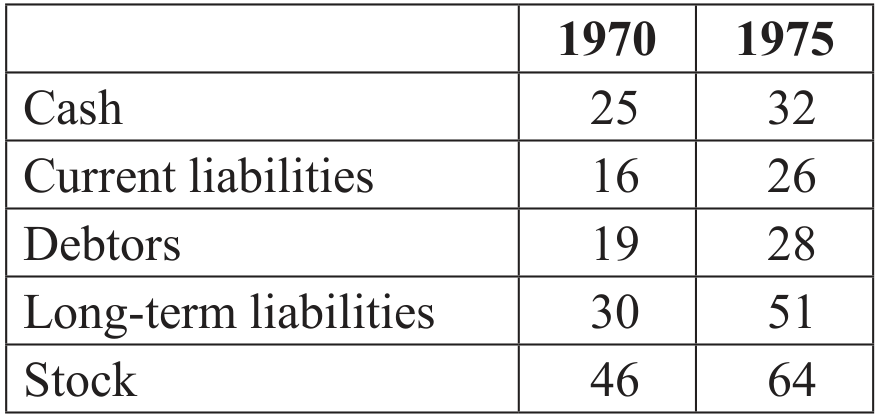
The finance manager of CM, Kayleigh, provided the following financial information.
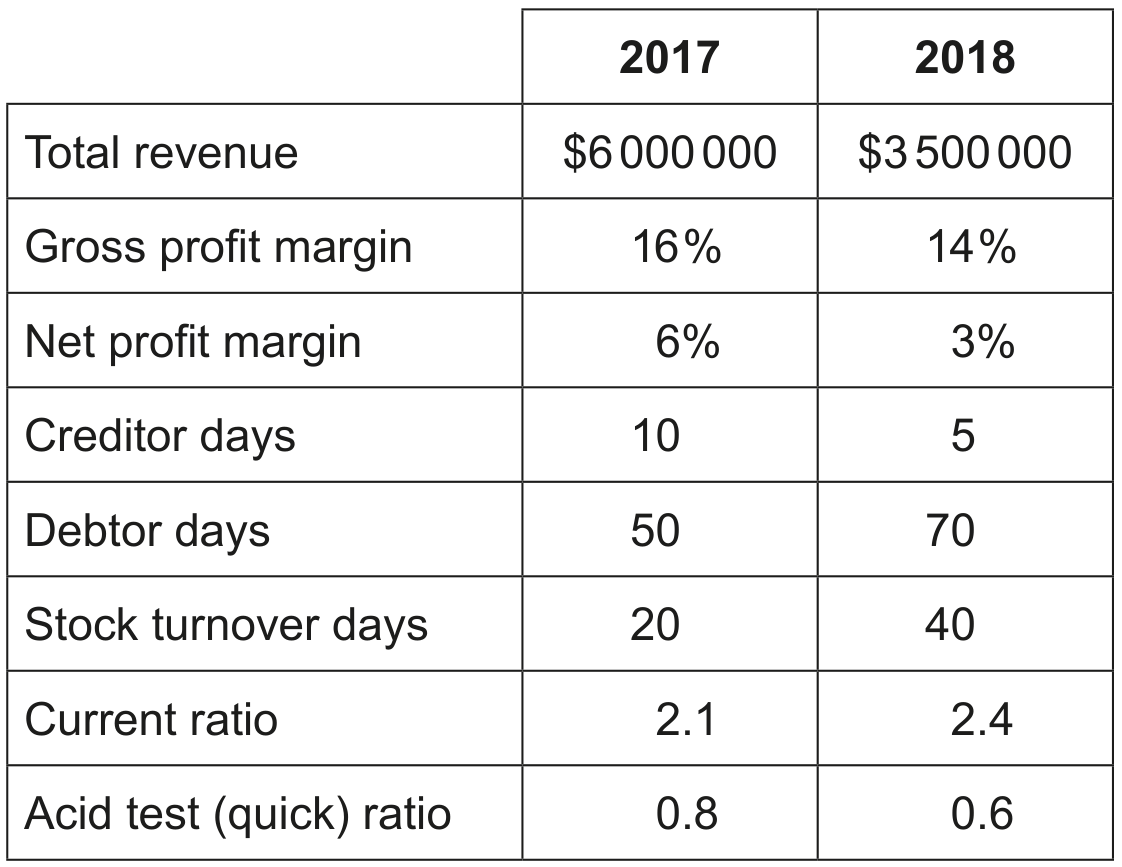
Table 1: Selected financial information for CM
Kayleigh is worried about the cash flow of CM and suggested the company changes the stock control method from just-in-case (JIC) to just-in-time (JIT). She is also looking at other strategies to improve CM's financial position.
Define the term corporate social responsibility (CSR).
2. Himalayan Trekking
Himalayan Trekking (HT) is a trekking (mountain walking) agency based in Nepal. It has been operating guided treks for tourists in Nepal, Tibet and Bhutan for over 20 years. With a duration of between one and three weeks, H T offerings include treks to the Everest Base Camp, tours to Buddhist sites in Tibet, and treks even to the inaccessible Kingdom of Bhutan. Brand loyalty is very strong, with repeat bookings from many clients (trekkers).
The market for trekking has been growing very rapidly with many new businesses setting up to meet the increased demand for "adventure" holidays. In this competitive market, HT's unique selling proposition (USP) is to provide an unforgettable wilderness experience in a socially and ethically responsible manner. It only uses locally produced food and local guides and trekkers camp without wasting too many resources. All clients have to sign a contract to agree that they will act in a socially responsible manner throughout the trek. Though it always had a strong sense of social responsibility, HT had not promoted this aspect of the business until the management realized that changes in attitudes towards social responsibility could be used to gain competitive advantage.
HT's brochure states that:
- It is a market leader in adventure tourism for Nepal, Tibet and Bhutan. It caters to a wide range of clients from experienced to inexperienced trekkers.
- In recognition of protecting the fragile environment, economic systems and cultures it treks in, HT has been awarded a global quality standard.
- By employing local guides and using locally produced food, H T adds much value to the local region.
- It only employs staff that have previous social and environmental experience.
- It financially supports a non-governmental organization (NGO) for Nepali orphans by giving 5 % of its turnover to Child Environment Nepal (CEN).
Selected financial information for HT for 2013:
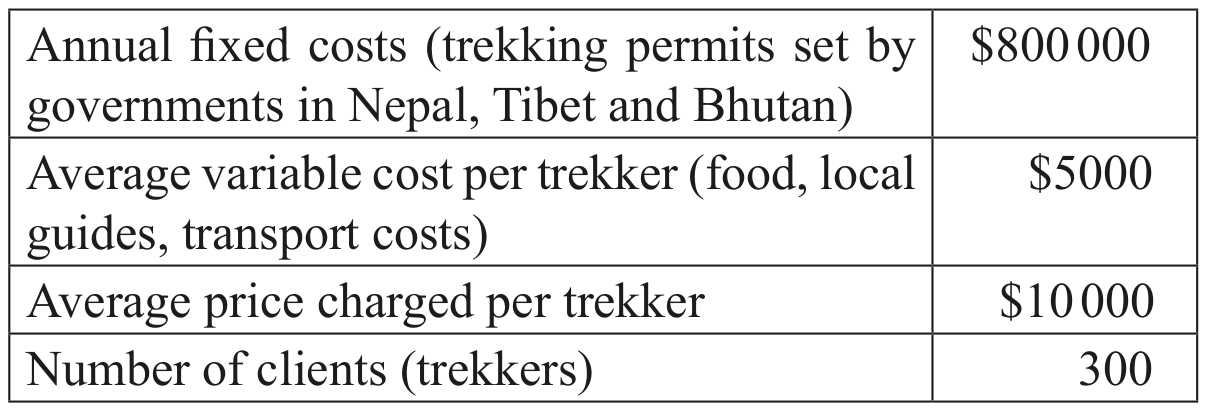
Examine why changing attitudes to social responsibility might be important for H T.
Answer two questions from this section.
3. Soft Skin Cosmetics (SSC)
Soft Skin Cosmetics (SSC) is a private limited company that produces a small range of face creams and soaps. Its products are designed and produced in the United States, and are made from safe, natural ingredients.
SSC has a product-orientated marketing approach. Tiffany Presley, one of the company's co-founders, believes that SSC's consumers value health above fashion. "The skincare market is full of toxic products, but ours are healthy even if they don't smell or look as nice," she says. Chelsea Presley, SSC's other co-founder, wants to develop the first sunscreen free of synthetic chemicals. However, product innovation is costly and risky. If the new sunscreen is a failure, several years of research and development costs will be wasted, which SSC cannot afford. SSC currently lacks the scale to innovate.
SSC does not pay for advertising. It relies on social media and word-of-mouth promotion. Its brand awareness is very high among young women, and customer reviews are very positive about SSC's quality and effectiveness. The company only sells online, not in retail outlets. To reach unsatisfied demand domestically and internationally, SSC would have to broaden its current distribution channels.
SSC practises corporate social responsibility (CSR). It does not test its products on animals, and supports several charities protecting endangered species. Pressure groups publicly recognize SSC's commitment to animal welfare.
Currently, multinational companies dominate the global skincare market. Small emerging companies rarely survive. Chelsea wants to convert SSC to a public limited company, but Tiffany disagrees: she argues that shareholder pressure toward profit maximization could jeopardize consumer and animal safety.
Explain one advantage and one disadvantage to SSC of practising corporate social responsibility (CSR).
4. The Warriors
The Warriors are a soccer* club who perform well but have not won any trophies. Recently, The Warriors have had above average turnover of managers, increasing time spent on recruitment. Player turnover has also been higher than that of other clubs.
Dave Atkinson, owner and former player, is an autocratic leader who denies blame for the high manager and player turnover. He publicly criticizes players. However, fans adore Dave. He was a successful player, supports the fans and is committed to corporate social responsibility (CSR). He has:
- reduced ticket prices to the lowest in the league
- provided free, healthy snacks for junior supporters
- donated 20 % of The Warriors' profits to local schools to encourage young people to play sport.
After a recent poor performance, Dave demanded that all players donate 50 % of their pay for that match to good causes. Two new players used social media to complain. In response, Dave threatened to cancel their contracts. The other players refused to turn up for training to show solidarity. Dave then locked the players out of the stadium.
This controversy comes at a critical time for The Warriors. With a dynamic new manager, they have their first chance to win an important final and with it significant financial gain, which is needed to support corporate social responsibility (CSR) and upgrade spectator facilities. On social media, the fans have asked Dave not to enforce the lock-out.
Dave wants to resolve the conflict and privately regrets the lock-out. He is angry with the team but wants to increase The Warriors' corporate social responsibility (CSR). Without wishing to appear as a weak leader, he asked another popular former player for advice.
\footnotetext{
* soccer: football
}
Explain one cost and one benefit to The Warriors of committing to corporate social responsibility (CSR).
Explain two reasons why Alejandra's objectives might have changed over time.
Evaluate Option 1 (lines 139-146) as a strategic option for LadyA.
Additional information
There is no additional information in this paper for Section B.
Section C
Answer the compulsory question from this section.
4. Adventures for All (A4A)
Tama Toki founded Adventures for All (A4A), which owns four adventure parks employing 342 people. The parks offer adventure activities such as high wire and mountain biking. A4A's target market is teenagers and adults. A4A's mission statement is "safety and affordability at A4A are the most important reasons for a great time for all".
A4A uses predatory pricing. Its competitors are theme parks and adventure centres. However, social trends are
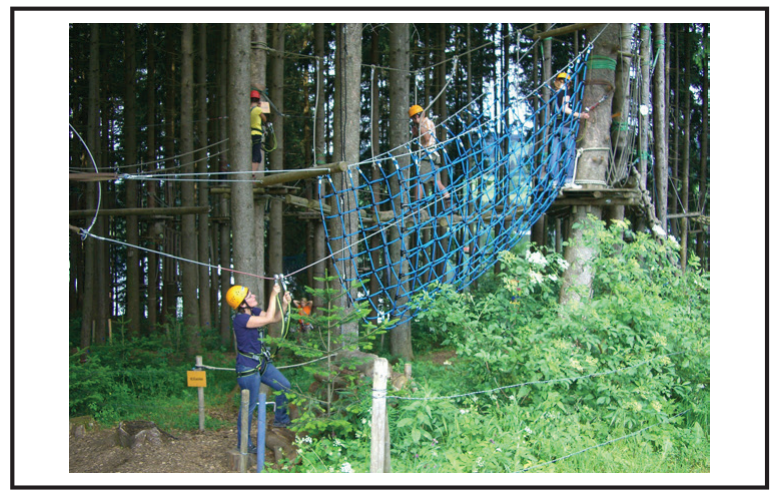
changing. Many teenagers prefer social networking rather than adventure activities. A4A's sales revenue and profits are falling.
Tama discussed with senior managers two possible growth strategies:
Option 1. Through extensive promotion, attract children and adults with disabilities and access requirements to the parks. This approach would require specialized training for existing staff. No modifications to the parks would be required.
Option 2. Offer corporate team-building activities. A4A would develop specially designed programmes for senior leadership teams to spend three days in newly built conference centres located at the parks. Corporate teams would engage in adventure activities together and then discuss strategic options for their organizations.
Option 2 could be highly profitable. A4A could charge high prices for these programmes. However, some of Tama's senior managers argued that A4A should continue to provide "adventures for all" and not just to a group of highly paid senior leadership teams.
The two options created major disagreements. Two senior managers, working with Tama since the creation of A 4 A, threatened to resign if Option 2 was implemented. Two other senior managers argued that without Option 2 many jobs at A4A were under threat.
Explain two roles of A4A's mission statement.
4. Bandit \& Max
Bandit \& Max (BM) is a partnership between Dr. Jones and Dr. Morris that produces specialist food for dogs with health problems. BM's unique selling point/proposition (USP) is food for dogs with diabetes and digestive or kidney problems. BM's mission statement is, "To help strengthen the bond between people and their dogs."
BM uses a cost-plus (mark-up) pricing strategy; however, the costs of raw materials are rising. B M has an excellent brand image and sells its products only through veterinarians and large pet shops that provide advice to customers. Veterinarians recommend BM's dog food because of its high quality and nutritional value. However, potential customers in some areas lack access to BM's food. BM's sales are not growing.
Dr. Morris wants to diversify into specialist cat food, as more people are buying or adopting cats. B M has experience in developing new products. In the past, B M outsourced its research and development. Now, Dr. Morris wants BM to build its own research facilities, but building costs are high. BM's warehouse will need refurbishing to stock more food. BM could become a private limited company to raise the necessary finance.
Dr. Jones disagrees. He believes BM should not diversify. BM's current distribution costs are high. He has suggested introducing a new distribution channel for the dog food that includes a large supermarket chain, a wholesaler, and many small pet shops.
Describe one feature of a mission statement.
To what extent is Anna Holstein's "RDB 2020" strategic plan consistent with a focus on corporate social responsibility?
Additional information for question 2(b) and 2(c)
Selected financial data from R D B 's end of year profit and loss accounts (all figures in € 000000 )
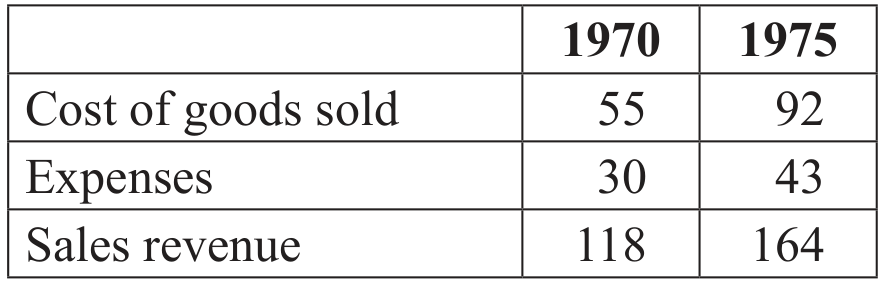
Selected financial data from R D B 's end of year balance sheets (all figures in € 000000 )
SECTION C
Answer the compulsory question from this section.
5. Green Clean (GC)
Green Clean (GC) is a private limited company. Its unique selling point (USP) is offering high-quality and reliable cleaning services by teams of professional cleaners who clean offices and houses.
GC has strong ethical objectives. They only use eco-friendly cleaning products and pay their employees fair wages. Labour turnover is low and many cleaners have worked for the company for over two decades.
However, the cleaning market has become very competitive. GC has been slow to react. Other cleaning companies are beginning to offer a wider range of services. GC's management has decided to introduce a new gardening service to create new revenue streams. GC will have to recruit professionally trained gardeners from wide geographical areas, as they are difficult to find. GC will have to pay these new gardeners at least 20 % more than cleaners to attract them. GC has limited experience in recruiting employees other than cleaners.
The cleaners are becoming demotivated because they are unhappy about the difference in pay between cleaners and future gardeners. They believe that gardeners are not more skilled than cleaners but just have a different skill set. Human resource managers are concerned about the potential impact of demotivated cleaners and are looking for ways to improve morale. One option they are considering is to offer cleaners an employee-share ownership scheme. Shareholders, however, are opposed to this proposal.
Define the term ethical objective.