EduNinja

IB Business Management HL3.3 Costs and revenuesQuestion Bank

Question 2

[Maximum number: 3]

2. Jill Anderson
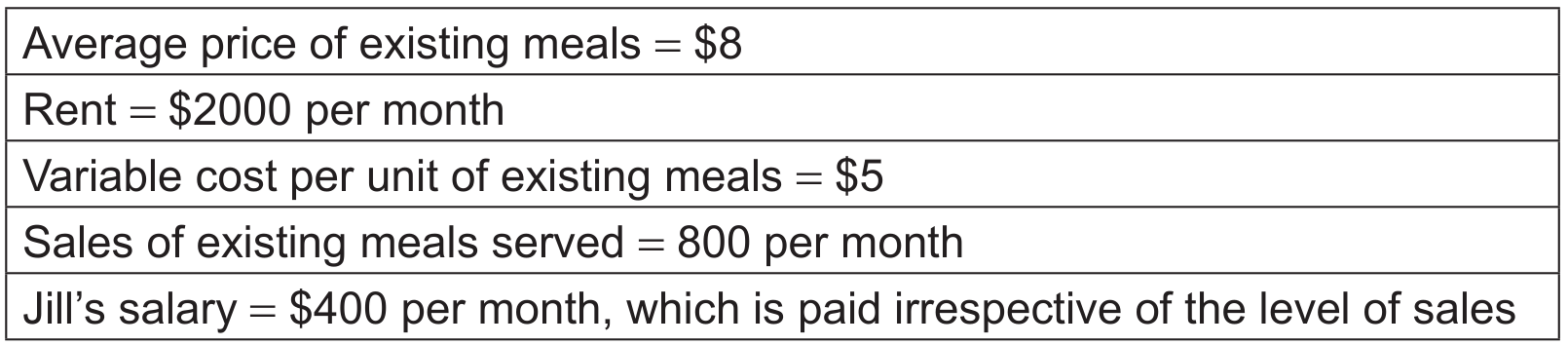
Jill Anderson operates a restaurant. Although Jill's meals are viewed as being excellent quality, sales are slowing. Jill is considering replacing existing meals with gluten-free meals. The following financial and forecast information is for the month of May 2018. Jill's restaurant can only produce either existing or gluten-free meals.

Table 1: Existing meals

Table 1: Existing meals

Table 2: Estimated costs and price if Jill produces the gluten-free meals

Table 2: Estimated costs and price if Jill produces the gluten-free meals

A local gluten-free manufacturer, which is not part of Jill's existing supply chain, has offered to supply already prepared gluten-free meals at $ 8 per meal. Jill is unsure whether to make or buy the gluten-free meals.

Question 2(b)

(a)

Calculate:

[ 3 ]

Question 2(b)(ii)

(i)

the total profit or loss on existing meals for May 2018 (show all your working);

[ 1 ]

Question 2(b)(iii)

(ii)

the forecast profit or loss if Jill decides to make and sell gluten-free meals (show all your working);

[ 2 ]

Question 2

[Maximum number: 2]

2. Café Lucchini (CL)
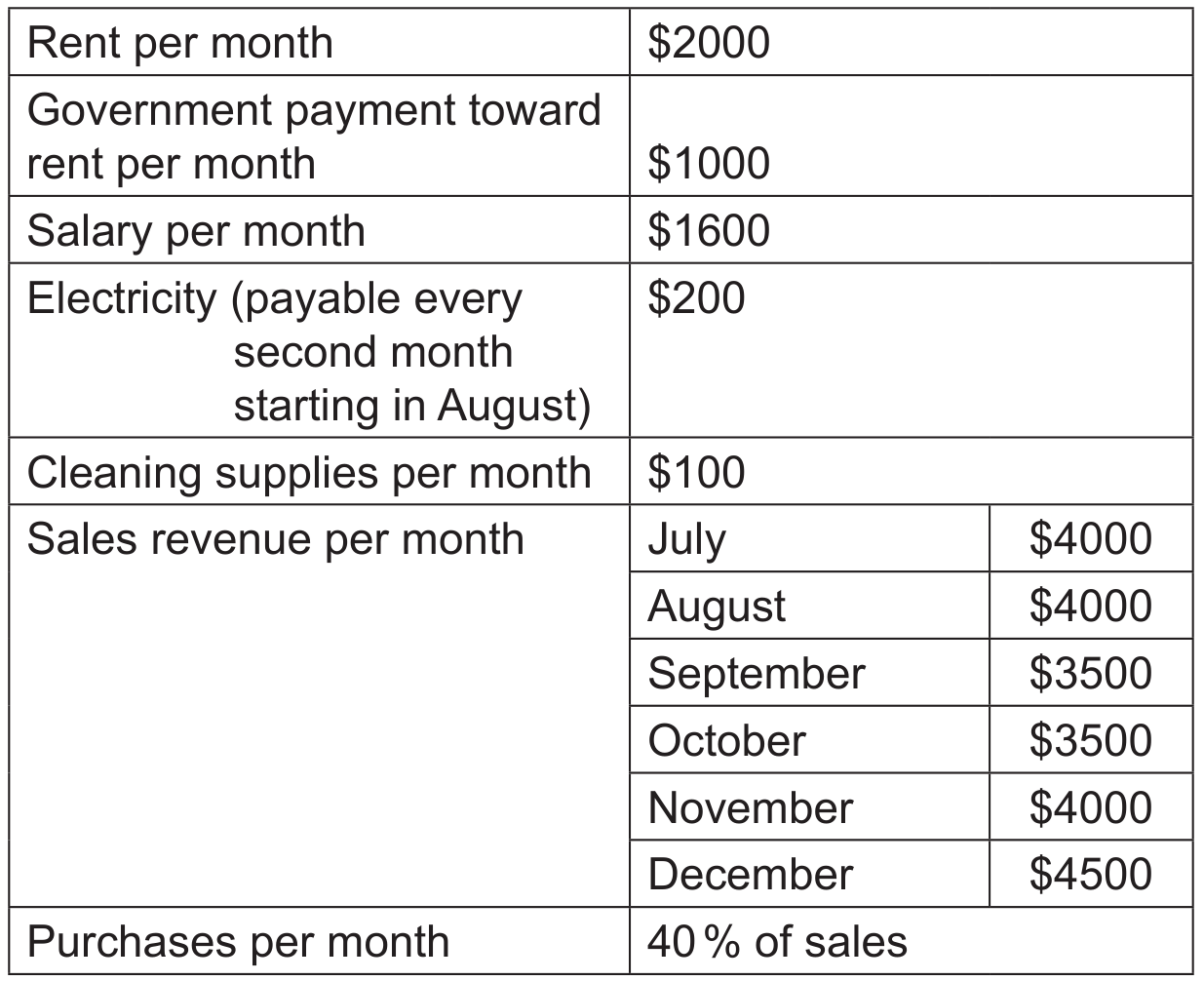
Fabi Lucchini will open the only café, selling hot and cold drinks only, in her small village. The economy is weak so the local government will pay 50 % of the rent for the premises in which C L will operate.
Fabi has forecasted the following figures for the first six months of operation, beginning on 1 July 2016:

Table

An option is to install cooking facilities and serve meals to increase CL's sales revenue. Fabi estimates that she could sell 40 meals per day at an average variable cost of $ 5 and at an average sales price of $ 10. Serving meals would increase her fixed costs by $ 3000 per month.

Question 2(a)

(a)

Define the term fixed cost.

[ 2 ]

Question 3

[Maximum number: 2]

3. Carol's Designs (CD)
Carol Rodríguez is passionate about design. She runs Carol's Designs (CD) with two assistants, making and selling party dresses directly to consumers through her website. Customers provide their style preferences and measurements. Then, Carol emails a computer-designed drawing for the customer's approval. CD uses job/customized production.
An emerging talent in dress design, Carol decided to use e-commerce because she could not afford the fixed costs of an expensive physical location and traditional promotional techniques. Through her website, she promotes and sells her designs to a large audience and collects valuable information and opinions from her customers. The business-to-consumer (B2C) approach, essential for her business growth, requires regular website updates.
E-commerce sales have steadily increased worldwide, and Carol's dress orders have increased too. However, CD regularly misses delivery deadlines and is often short of cash. Carol's bank suggested that she find a partner. She approached Juan Pérez, an engineer and business angel, about becoming a 50 % partner in CD. Juan thinks Carol needs to delegate design and focus on the operation of the business.
CD uses social media marketing. Alexia Bros, a famous actress, ordered a dress for this season's cinema festival, and Carol uploaded pictures of Alexia wearing her newly designed dress. Recently, however, some negative comments, including customer complaints about delays in delivery times, have appeared on social media. Carol did not have time to reply to these complaints. She is planning to hire a social media marketing manager.

Question 3(a)

(a)

Define the term fixed cost.

[ 2 ]

Question 3

[Maximum number: 6]

3. Cheap4U (C4U)
Cheap4U (C4U), a public limited company (plc), operates a successful low-price airline service. C4U offers a basic service targeting low-income families and students. It is positioned as offering the lowest price for a flight. Staff training for flights is on-the-job and C4U uses non-financial motivation such as job enlargement. C4U has recently experienced difficulty in recruiting enough flight staff. As a result, flight staff are overworked and there have been complaints by some passengers about poor service.
In 2013, C4U suffered its first loss in 11 years. C4U carried out a review and the following three issues were identified:
- given the staff shortages, C4U flights are often delayed or cancelled.
- some advertising for popular flights is considered to be unethical. For example, cheap one-way flights are promoted without stating that the return flight is twice as expensive.
- new low-price competitors are emerging, using newer and more fuel-efficient aircrafts.
C 4 U is considering offering a new international flight service, Quality4U ( Q 4 U ). This service will only be offered at certain times. Q4U will target higher-income consumers by offering excellent aircraft facilities, free internet access and more comfortable seats. Four new fully equipped aircrafts will need to be purchased. C4U's gearing ratio is rising at over 80 %. New sources of finance will be required.
C 4 U is also considering new methods of staff training for the new Q4U service:
- One new method of off-the-job training could be conducted by a hotel which is famous for its high quality of customer service. This new training method will increase C4U's costs at a time when its working capital is limited.
- Secondly, all flight staff will have to study for and pass an examination to meet international quality standards of customer service. C4U's senior management is insisting that staff study in their own free time. Flight staff have complained and have consulted their representatives about possible industrial action, as they feel that they are already overworked.

Question 3(b)

(a)

Explain how each of the three issues identified, could have impacted on C4U's revenue, leading to its first loss in 11 years.

[ 6 ]

Question 5

[Maximum number: 2]

5. Moving back to the US
Reducing costs has been a significant driving force in pushing multinational companies to offshore manufacturing. However, as emerging economies develop, labour costs are rising.
Between 2005 and 2010, wages of factory workers in China rose by 69 %. An analyst for Boston Consulting Group said that "the cost advantages from offshoring are falling to such an extent that some American multinationals with manufacturing offshore are returning home to supply their American customers". By 2015, the cost advantage of offshoring manufacturing for the United States (US) market will disappear. The analyst has forecasted, based on the same time series technique as sales forecasting, that wages will continue to grow at around 17\% a year in China, but remain stable in the US.
Gary Pisano, of Harvard Business School, said that some American companies that had considered offshoring parts of their business are choosing to expand within the US. General Motors, for example, will invest US $ 2 billion to create 4000 jobs at 17 manufacturing plants in the US.
A growing number of multinational companies, especially from high-income countries, are starting to see the benefits of keeping their manufacturing "at home". For many producers, labour costs are a small proportion of the total cost. Also, long and complex supply chains have become unreliable due to changes in external factors such as the increase of oil prices, political instability and natural disasters such as earthquakes.
However, Gary Pisano also argues that:
- in some industries, such as consumer electronics, the US no longer has the necessary supply chain
- some multinational companies will continue to build most of their new factories in emerging economies, where the demand is growing fastest
- some of the new factories in the US have been financed by government subsidies, which will soon stop
- in India, despite rising wages, its innovative software development and call-centre offshoring industries are likely to retain its cost advantages because of increasing productivity.

Question 5(a)

Question 5(a)(i)

(a)
(i)

Identify one possible variable cost of production, other than wages, that a manufacturing company may face.

[ 1 ]

Question 5(a)(ii)

(ii)

Identify one possible fixed cost of production that a manufacturing company may face.

[ 1 ]
0 selected