EduNinja

IB Business Management HL5.2 Operations methodsQuestion Bank

5.2 Operations methods

Question 1

[Maximum number: 4]

1. Las Rosas (LR)
Las Rosas (LR) is a large commercial dairy farm owned and managed by the D'Aremberg family since 1986. It has 3800 cows. L R sells milk, cheese and yoghurts. In 1996, L R started to export some of its dairy products. Profits and cash flow have been improving year on year. L R has no outstanding loans and therefore its current gearing ratio is zero.
LR's unique selling proposition (USP) comes from the organic quality of its products as they are made without chemical additives. The cows' diet does not include hormones and other supplements. The farm's products also meet national and international quality standards.
LR's corporate culture encourages innovation and the use of cell production. To stay ahead of the competition L R has increased its spending on research and development (R\&D) and workers are given the opportunity to create new products, or to add value to existing ones. L R 's financial manager, however, believes that the R\&D budget is too high and needs to be cut. He also argues that there are too many legal constraints limiting the development of new products.
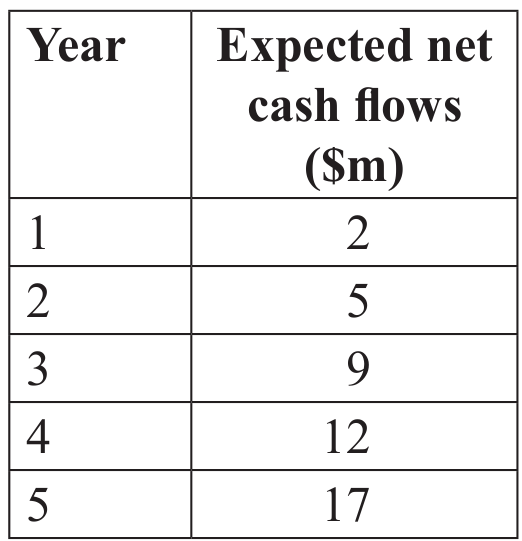
LR's management is considering buying El Remanzo, a large sheep farm located nearby. This acquisition will cost $ 24 million and L R will need to cut its R\&D budget to zero and organize a new loan to finance the takeover. A significant restructuring would need to occur at both L R and El Remanzo to allow both companies to combine resources and knowledge. However, the potential economies of scale experienced by L R could be substantial.
Total capital employed at L R is $ 45 million.
Table

Question 1(a)

(a)

Describe two benefits for L R of using cell production.
[ 4 ]

Question 1

Question 1(a)

(a)

Outline two advantages for Accord of using job/customized production.

[ 4 ]

Question 2

Question 2(a)

(a)

Outline one advantage and one disadvantage for ELE of changing to cellular manufacturing in the Zeat factory (line 34).

[ 4 ]

Question 3

Question 3(a)

(a)

Describe two advantages for AS of using cellular manufacturing in the production of its solar power systems.

[ 4 ]

Question 2

[Maximum number: 6]

2. Stay Float (SF)
Stay Float ( S F ) is a family-owned private limited company that produces rowing boats. Dan is the Marketing Director and Ori, his brother, is the Finance Director. Together they own 75 % of S F 's shares. The main target market is university boat clubs that require custom-made rowing boats. S F produces two models of boat, "The Single" and "The Quad", using a job production method. Each model of boat is treated as separate profit centres.
S F is market-orientated and highly responsive to customer needs. Customers are willing to wait a long time for the completion of a boat because of its high quality and flexible design. Employees are highly skilled and motivated. S F uses a price skimming strategy.
Increasing overseas competition of cheaper mass-produced rowing boats and a cut in university activity budgets has caused a fall in demand for S F 's boats. As a result, S F is experiencing cash flow difficulties. Dan and Ori are considering two different strategic options to reduce costs and find new market segments for both boats:
- (Option 1) change the production method to flow production to improve the working capital cycle. However, Ori is concerned about how this will be financed.
- (Option 2) subcontract the production of the "The Quad" overseas and continue producing "The Single" at the current location.
Sales price for "The Single": $ 15000.
Sales price for "The Quad": $25 000.
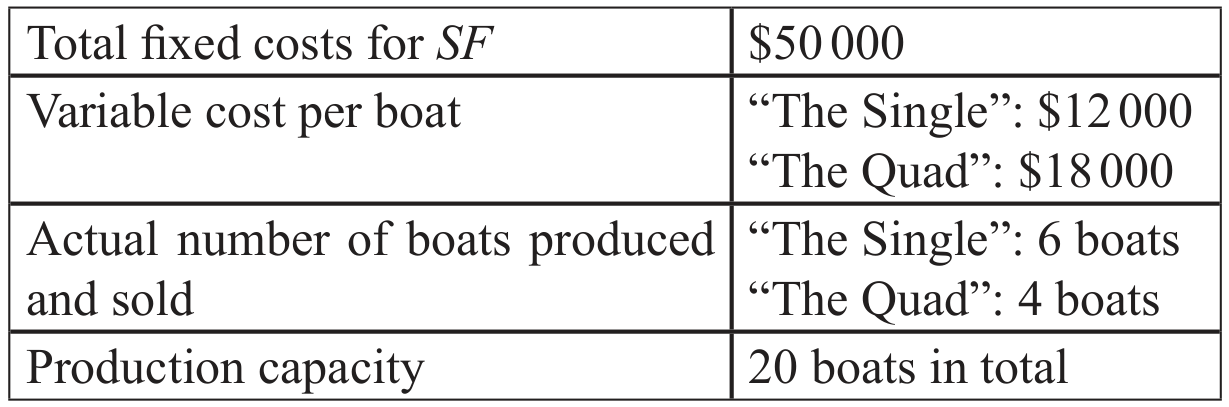
Current financial data for 2014:

Table

Financial data if S F subcontracts "The Quad" overseas (Option 2):
- production capacity for the subcontractor: 40 boats.
- the total fixed cost will be reduced by $ 14000.
- S F will pay a variable cost of $ 14000 per boat to the subcontractor.
- S F will reduce the price of the mass-produced "The Quad" by 20 % and double the quantity sold in the first year.
- the quantity of "The Single" (6 boats) sold will remain unchanged.

Question 2(d)

(a)

Analyse the suggestion that S F should change from job production to flow production (Option 1).

Answer two questions from this section.

[ 6 ]

Question 3

[Maximum number: 4]

3. Carol's Designs (CD)
Carol Rodríguez is passionate about design. She runs Carol's Designs (CD) with two assistants, making and selling party dresses directly to consumers through her website. Customers provide their style preferences and measurements. Then, Carol emails a computer-designed drawing for the customer's approval. CD uses job/customized production.
An emerging talent in dress design, Carol decided to use e-commerce because she could not afford the fixed costs of an expensive physical location and traditional promotional techniques. Through her website, she promotes and sells her designs to a large audience and collects valuable information and opinions from her customers. The business-to-consumer (B2C) approach, essential for her business growth, requires regular website updates.
E-commerce sales have steadily increased worldwide, and Carol's dress orders have increased too. However, CD regularly misses delivery deadlines and is often short of cash. Carol's bank suggested that she find a partner. She approached Juan Pérez, an engineer and business angel, about becoming a 50 % partner in CD. Juan thinks Carol needs to delegate design and focus on the operation of the business.
CD uses social media marketing. Alexia Bros, a famous actress, ordered a dress for this season's cinema festival, and Carol uploaded pictures of Alexia wearing her newly designed dress. Recently, however, some negative comments, including customer complaints about delays in delivery times, have appeared on social media. Carol did not have time to reply to these complaints. She is planning to hire a social media marketing manager.

Question 3(b)

(a)

Explain one advantage and one disadvantage for CD of using a job/customized production method.

[ 4 ]

Question 4

[Maximum number: 4]

4. Smith's Foods Ltd (SF)
Charles Smith and seven friends started a private limited company, Smith's Foods Ltd (SF), to produce ready-made healthy meals for people with diabetes*. Using a cost-plus (mark-up) pricing strategy, SF's mission is to make inexpensive, widely available meals that help diabetics manage their carbohydrate intake accurately.
Despite reliance on inexpensive social media marketing, S F grew rapidly. Due to this rapid growth, however, the quality of its products deteriorated, and a number of its meals were found to contain different quantities of carbohydrate than those stated on the packaging. Negative comments appeared on SF's Instagram page. Charles responded quickly to reassure customers and offered refunds. SF's response led to the company receiving an industry award for ethical behaviour.
Charles introduced flow production to reduce the cost of S F 's meals, which changed S F 's scale of operations and increased its gearing ratio. However, Charles had little business experience of using flow production and problems emerged.
External stakeholders began to look into SF's operations. One supermarket chain, Good Foods (GF), contacted Charles and offered to take over SF, keeping Charles on the board of directors. This takeover would allow SF's meals to be produced at a lower cost and reach a wider target market. GF would also finance research and development into new meals with more carefully controlled carbohydrate levels.
However, SF would close. Negative publicity would be considerable. The remaining shareholders have threatened to launch a new business, creating their own brand of meals for people with diabetes in direct competition with GF.
* diabetes: a medical condition that causes a person's blood sugar level to become too high. People with diabetes need to be mindful of the amount of carbohydrates (which includes sugar) they include in their diet.

Question 4(c)

(a)

Explain one benefit and one cost to S F of using a flow production method.

[ 4 ]

Question 4

[Maximum number: 2]

4. Easy Ride Ltd. (ER)
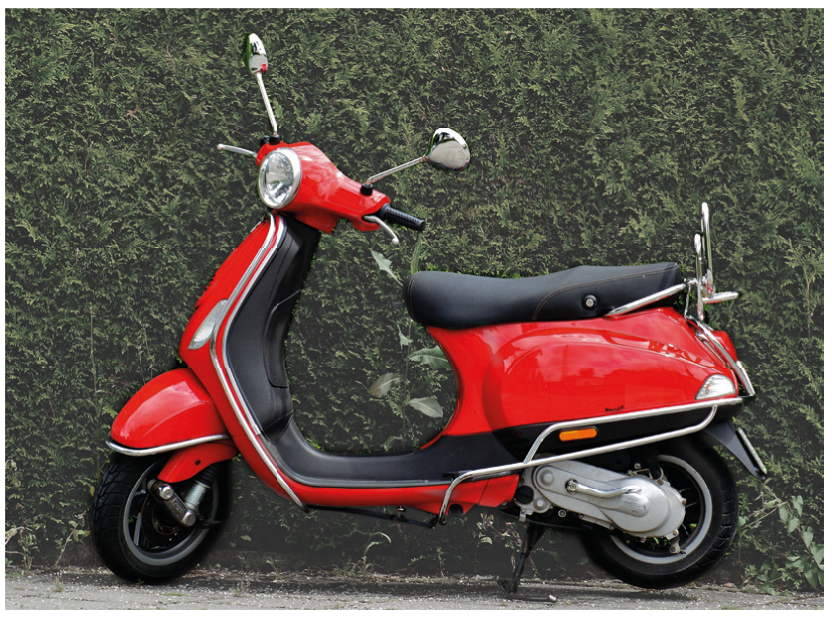
Easy Ride Ltd. (ER) is a medium-sized private limited company that manufactures gasoline (petrol)-powered scooters that are sold worldwide. Customers think that ER's scooters are good value for money. However, increased global competition in both the gasoline-powered and electric scooter markets, and a shift in customers' demands, has resulted in a significant drop in sales.
ER commissioned market research in the Middle East using focus groups. This research revealed that consumers:

Question image

- perceive competitors as medium-price/medium-quality providers
- have highly innovative products as their top priority
- want products and production methods to be environmentally friendly.
E R 's employees have expressed dissatisfaction with the use of flow production. E R is no longer profitable and is highly geared.
Given the pace of change in the scooter industry, ER's management wants to react quickly and is considering two options for research and development.
Option 1: Adaptive creativity
ER would design and produce different models of electric scooters only. Lacking finance and expertise in the electric scooter industry, ER would subcontract the production of batteries to a well-known designer and producer of environmentally friendly batteries. Cellular production would be used for each scooter model. Employees would need training.
Option 2: Innovative creativity
ER would gain a new competitive advantage by developing cutting-edge gasoline-powered scooters. ER would create its own research and development department and recruit highly skilled and innovative product designers. It would reposition the scooters into the high-
price/high-quality market, and flow production would be used. This option would be more expensive than Option 1 and would take longer to implement.
Loan capital from a bank with low interest rates, aimed at helping small to medium enterprises (SMEs), is being considered for financing either option.

Question 4(a)

(a)

State two characteristics of flow production.

[ 2 ]

Question 5

[Maximum number: 9]

General Diane Pierce concluded that building a hospital was a better option than building a university.

The situation around Beral was deteriorating (Item 1). Soon the city would be unable to obtain sufficient food supplies. Moreover, the loss of control of the area surrounding Beral would psychologically impact on the residents, perhaps causing greater resistance to the UWP Mission. General Pierce decided to increase the frequency of the UWP patrols in the UWP-protected area. This, however, would require several changes to the overall plan for the UWP Mission in Beral. With an increase in the frequency of patrols, fewer troops would be available for the construction project.

General Pierce instructed Colonel Michael Donovan to prepare a new critical path analysis. He developed two possible timetables and approaches to constructing the hospital (Items 2 and 3). Either way, completing the project would take longer than 30 weeks as originally planned. Colonel Donovan also recommended a change to the workforce planning scheme, shifting from a traditional construction approach where the construction team moves from one job to the next sequentially; to a cell production approach where smaller teams work simultaneously on different jobs (Item 5). He warned, however, that regardless of the approach taken, building the hospital under the new circumstances would put huge physical and mental pressure on the troops. In light of the deteriorating situation in Beral, Colonel Donovan's warnings, and of recent demographic data about Loyka (Item 6), General Pierce had to re-evaluate her strategy of building a hospital.

Question 5(c)

(a)

Analyse the use of a cell production approach for the construction of the hospital.

[ 9 ]

Question 5

[Maximum number: 4]

5. Musical Musings (MM)
Musical Musings (MM) manufactures musical keyboards, using batch production to produce a limited range.
MM's products are designed for use in schools and homes. M M sells directly to schools, and, for the home market, sells through shops specializing in technology. MM's costs are kept low by:
- limiting its product range

Question image

- focusing on a small target market, which enables M M to limit the features on its keyboards and keep the appearance functional.
M M provides free online "Teach yourself to play the keyboard" training courses for all customers.
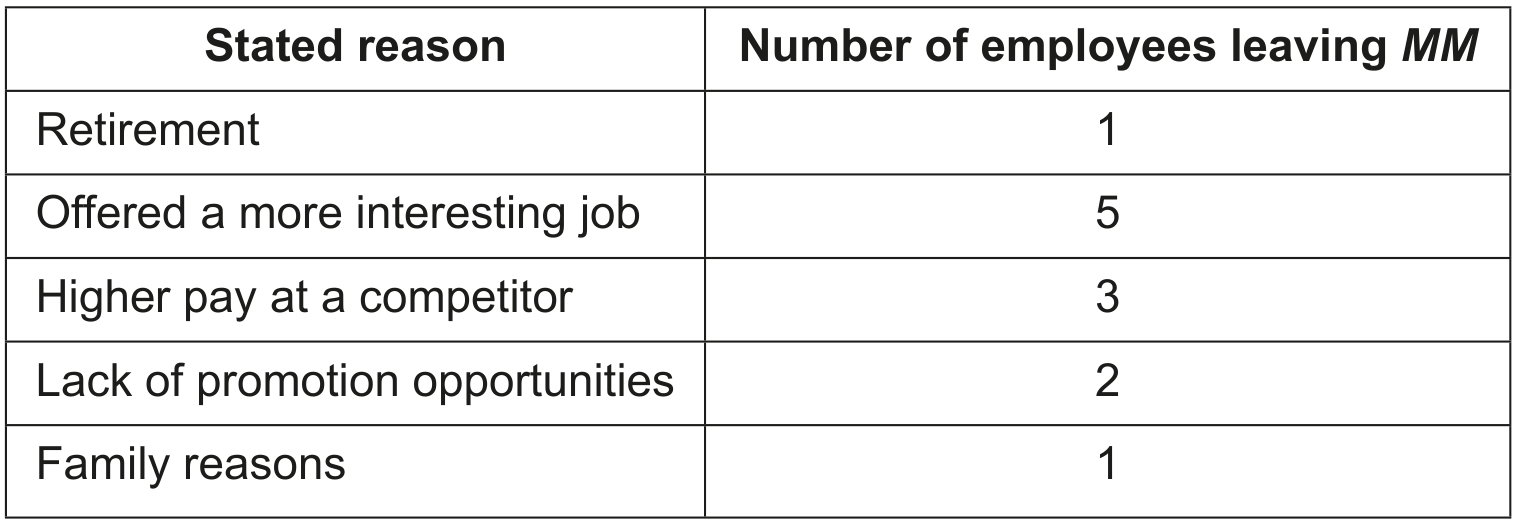
In 2021, MM employed an average of 50 people. During that year, however, 12 people left the company. Their reasons for leaving are shown in Table 5.

Table 5: Stated reasons for employees leaving \(\boldsymbol{M

Table 5: Stated reasons for employees leaving \(\boldsymbol{M

MM's labour turnover rate for 2021 was 24 %. The manufacturing industry average was 15 %.
In 2021, MM's sales declined. MM is now considering targeting the niche market of professional musicians. MM would change its product design by adding a range of different sound features and improving the appearance of its keyboards. To achieve this change, MM would eventually stop supplying its existing market. Professional musicians would pay a higher negotiated price for improved keyboards made to their individual specifications. Changing its production process to job/customized production would be expensive for M M, however, and it would have to invest in a new marketing strategy.

Question 5(c)

(a)

Explain two ways in which MM's profits could be affected by changing from batch production to job/customized production.

[ 4 ]
0 selected