EduNinja

IB Business Management HL6.1 Business management toolsQuestion Bank

Question 1

[Maximum number: 8]

1. Sassy
Sassy, a partnership between fashion designers, produces clothes for teenagers. Capacity utilization is very high.
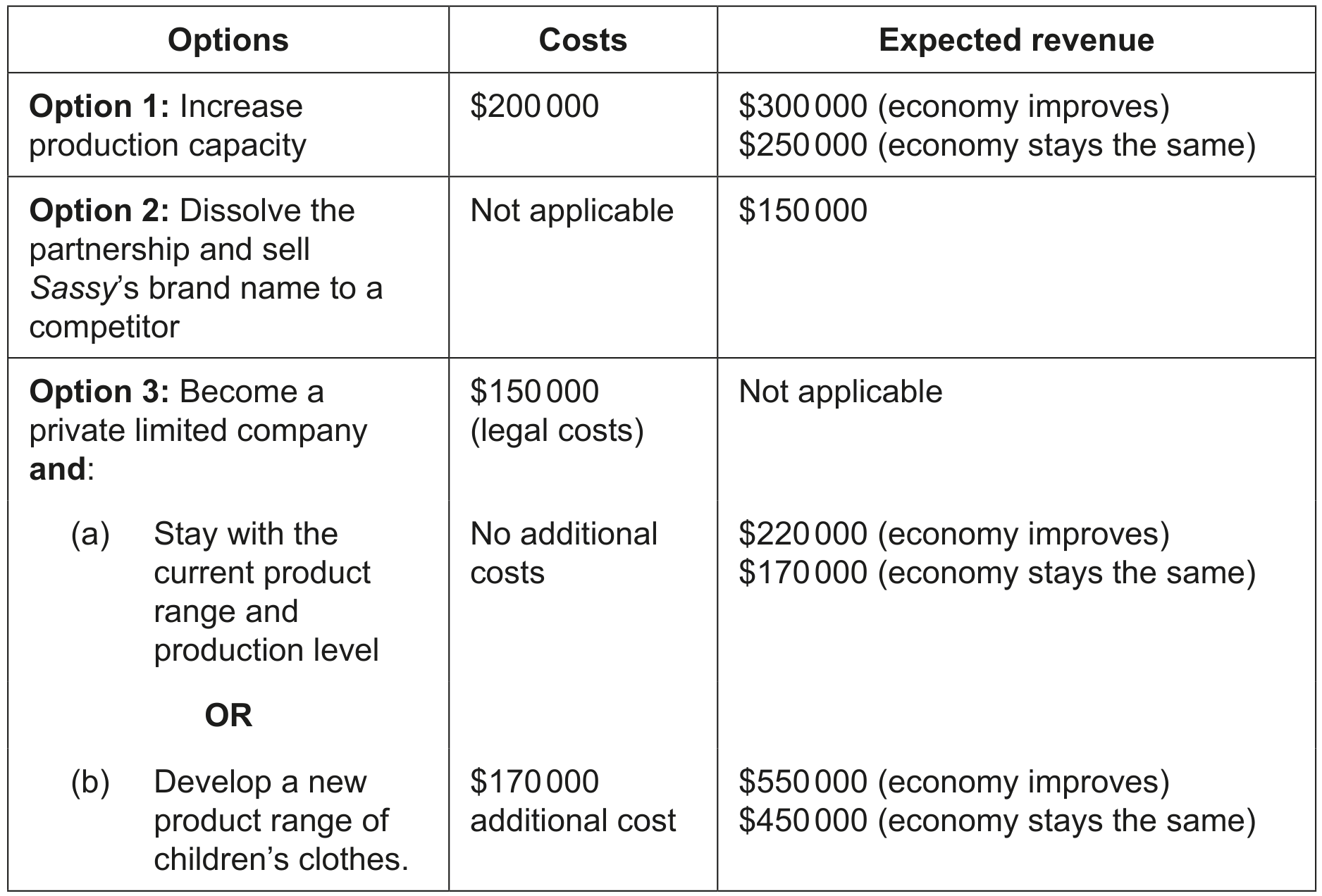
The partners are considering some strategic changes. After conducting research, they presented three options and outlined the costs and expected revenue. They also predicted that the economy would either improve or stay the same. The probability of the economy staying the same is 0.3 .
The options, costs and expected revenue are given below:

Table 1: Information relating to the three strategic options for change

Table 1: Information relating to the three strategic options for change

Question 1(b)

(a)

Construct a fully labelled decision tree and identify the best option for Sassy (show all your working).

[ 6 ]

Question 1(c)

(b)

Explain one limitation for Sassy of using a decision tree as a planning tool.

[ 2 ]

Question 1

[Maximum number: 2]

1. Las Migas
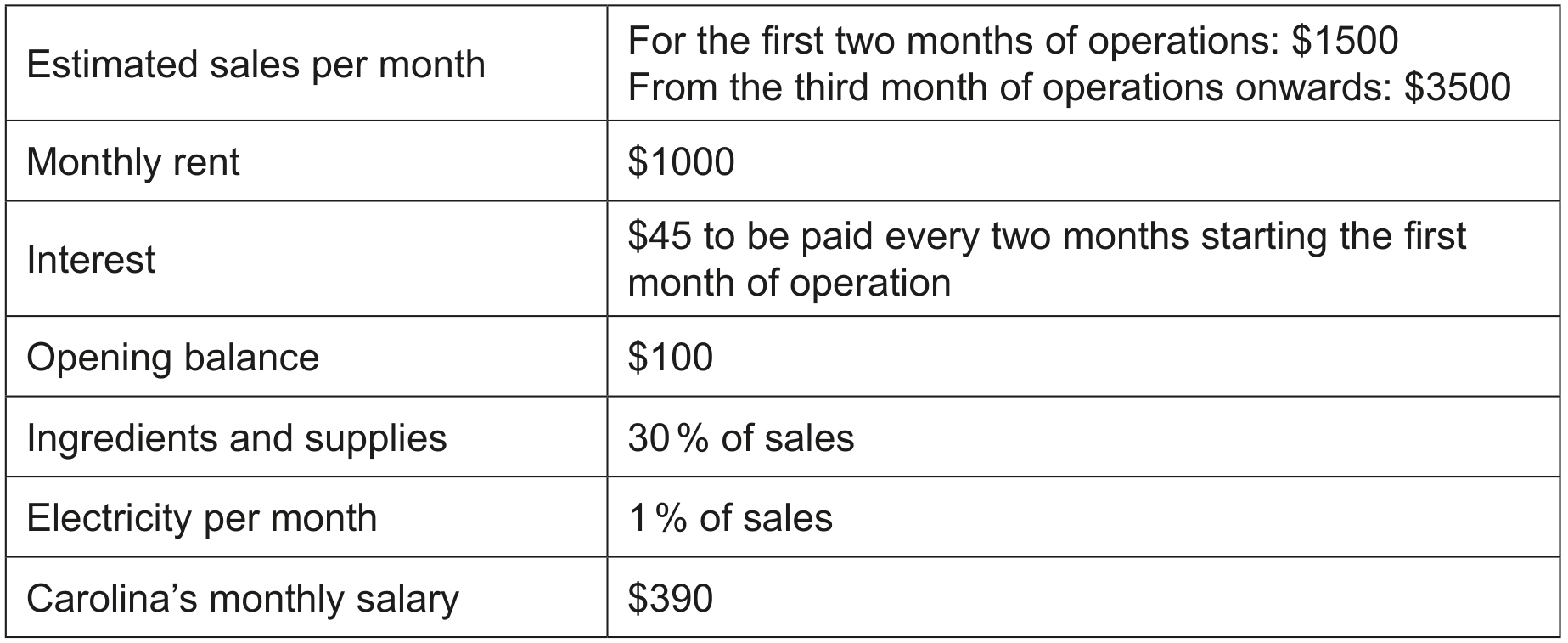
Carolina plans to set up a bakery, Las Migas, in a small town. Competition from established bakeries is strong. Carolina has asked for a bank loan because her personal savings are insufficient. The bank manager requested the following information:
- a business plan
- a cash flow forecast for the first four months of operations.
Carolina has no experience with financial forecasts but she estimated the figures for Las Migas for the first four months of operations. These figures are shown in Table 1.

Table 1: Estimated figures for Las Migas for the first four months of operations

Table 1: Estimated figures for Las Migas for the first four months of operations

Question 1(a)

(a)

State two elements, other than a cash flow forecast, of a business plan.

[ 2 ]

Question 1

[Maximum number: 6]

1. Deep Sea Catch (DSC)
Deep Sea Catch (DSC) operates as a sole trader on an island popular with tourists. DSC specializes in supplying fresh fish to local hotels on a daily basis.
The local government has given D S C a permit to catch a maximum of 70 kilograms of fish per day. However, there has been an increase in illegal fishing (without permits), in addition to overfishing by DSC's other competitors (with permits), which has reduced fish stocks in the area. Given the increasing competition among fish suppliers on the island, hotels will only pay a fixed price of $ 10 per kilogram of fish.
DSC's cost of operation and the quantity of fish caught varies depending on factors such as weather conditions, the availability of fish, and the number of competitors.
Local hotels demand that:
- the fish they buy meet strict national health and safety standards, to ensure the quality of the fish for tourists
- fish are caught ethically without endangering other sea creatures, such as sea turtles or dolphins.
An environmental pressure group is also pressuring the government for:
- more strict regulations on the fishing industries, targeting suppliers without permits
- a reduction in the quantity of fish that each supplier can sell
- new legislation for a compulsory installation of new and sophisticated technological equipment for ethical fishing.
DSC is well known for fishing responsibly and within government legislation. However, the owner is worried about the possible high costs of some of the new legislation.
Unsold fish is stored and kept in a refrigerator for up to two days. After two days, the stored fish is sold to a processing factory for $ 4 per kilogram. For example, fish caught on Monday, but still not supplied to the hotels by Tuesday evening, will be sold on Wednesday to the processing factory.
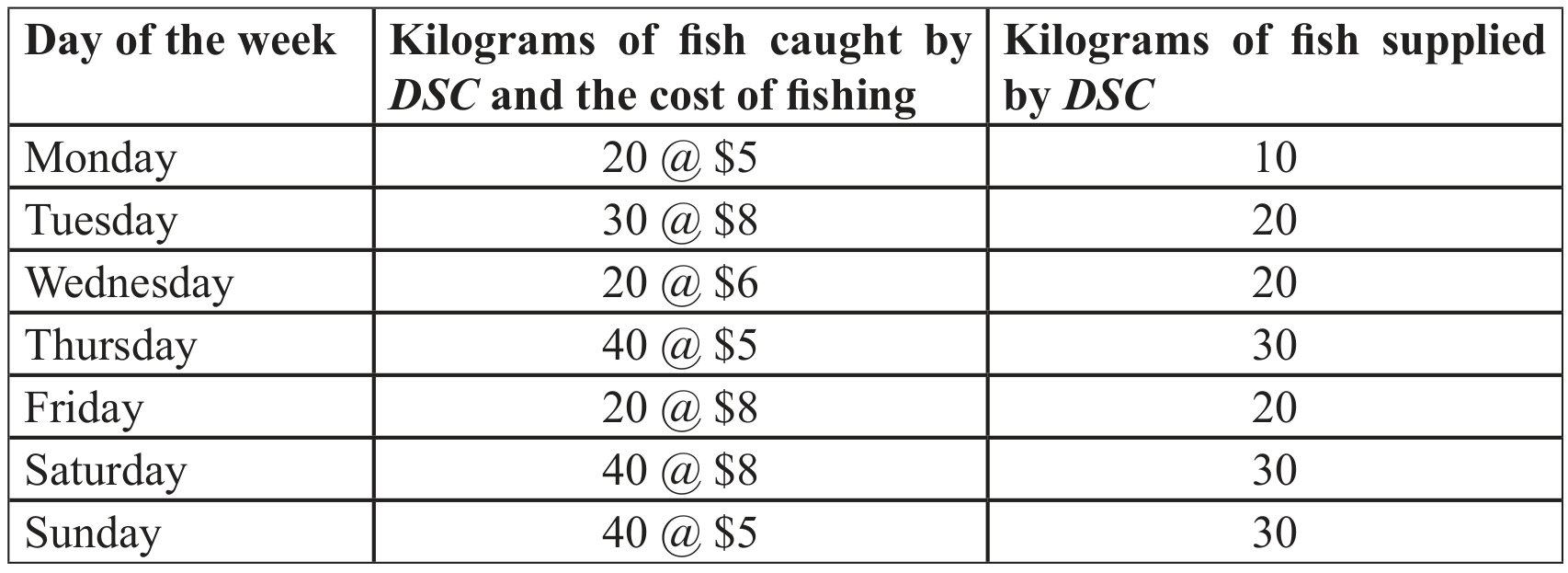
DSC uses the system of last-in-first-out (LIFO) for the stock valuation. The table below shows a typical week's supply of fish at DSC:

Table

Question 1(d)

(a)

Using the PEST model, examine the impact of the external environment on DSC.

[ 6 ]

Question 1

[Maximum number: 12]

1. Safe Passage (SP)
Trent Peters is one of seven partners at Safe Passage (SP). It provides bodyguard* services to film stars, politicians and other important people in Europe and the Americas. Trent would like to satisfy a growing demand from Asia but has to choose from two options for the recruitment and training of bodyguards. These are:
- offshoring by setting up it's own overseas branch in Asian country X or Y or Z
- subcontracting by using an external agency in Asian country X or Y or Z .
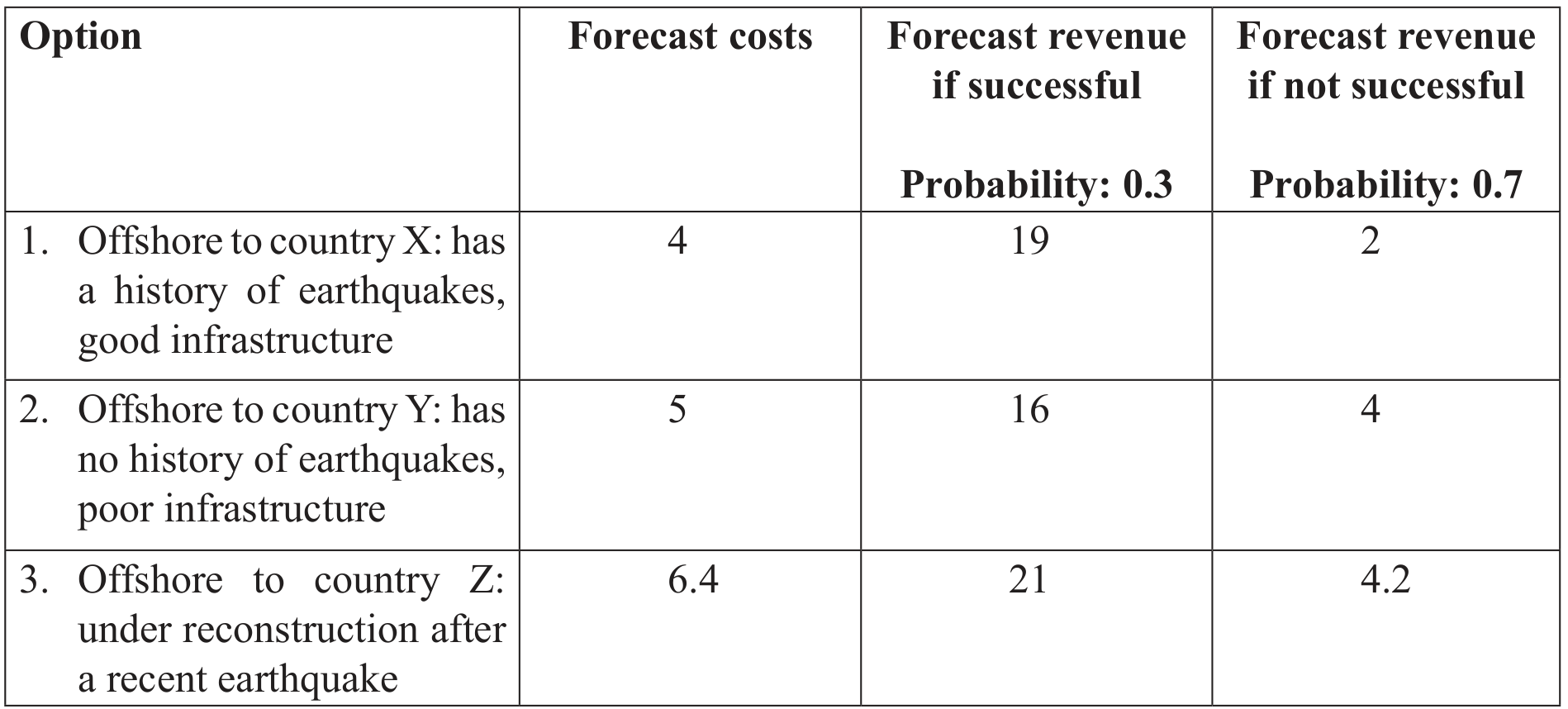
The forecast costs and revenues of offshoring are given below (all figures in US$ millions):

Table

The forecast costs of subcontracting to the same Asian countries are given below:

Country X: US$1.5 million.
Country Y: US$2.8 million.
Country Z: US$4.2 million.

\footnotetext{
* bodyguard: a person who is responsible for protecting a person from harm
}
The three suitable Asian countries are located in earthquake zones. An earthquake expert assured Trent that all three areas are safe. Trent is concerned and decides to prepare a contingency plan for each possible location in Asia.

Control over recruitment and training of bodyguards is vital to S P. Customer service and trust are their unique selling propositions (USP). Clients will pay high fees to ensure their safe transport to concerts, meetings and important events. However, Trent is refusing valuable contracts in Asia due to a lack of suitably trained bodyguards. As a result S P is missing out on large profits.

Trent has mentioned to a previous customer of his plans to subcontract the recruitment and training of bodyguards. She has threatened not to use S P again and would tell her friends if the plans went ahead. Trent is concerned as word-of-mouth promotion is crucial to S P.

He calls a meeting of all the partners. Three partners prefer subcontracting the recruitment and training as it is cheaper, quicker and less risky. The three other partners prefer offshoring. They believe that subcontracting will damage SP's USP. They argue that the higher costs of offshoring will be covered by the forecast high revenue.

Question 1(c)

Question 1(c)(i)

(a)
(i)

Construct a fully labelled decision tree and calculate the predicted outcome of each offshoring option (show all your working).

[ 6 ]

Question 1(c)(ii)

(ii)

Comment on the value for S P of using a decision tree as a decision-making tool.

[ 6 ]

Question 2

Question 2(a)

(a)

Using a SWOT analysis framework, identify two weaknesses and two threats to R D B.

[ 4 ]

Question 2

[Maximum number: 8]

2. Aroma Corporation (AC)
Aroma Corporation (AC) is a mass-market cosmetics company that produces soaps. Concerned about falling market share and profit, AC conducted new market research.
The senior management team is considering two strategic options.
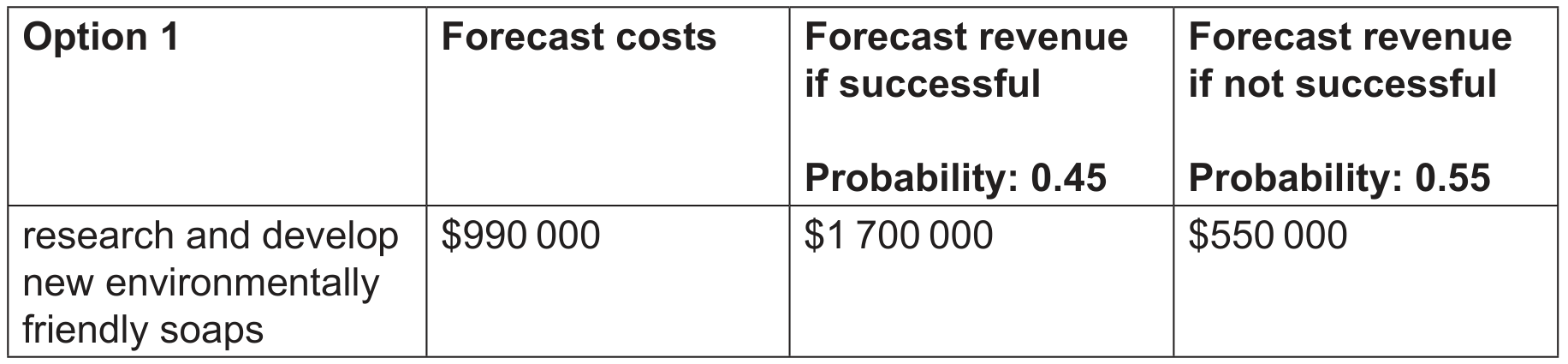
- Option 1: research and develop new environmentally friendly soaps
- Option 2: buy new machinery to produce more of the current products
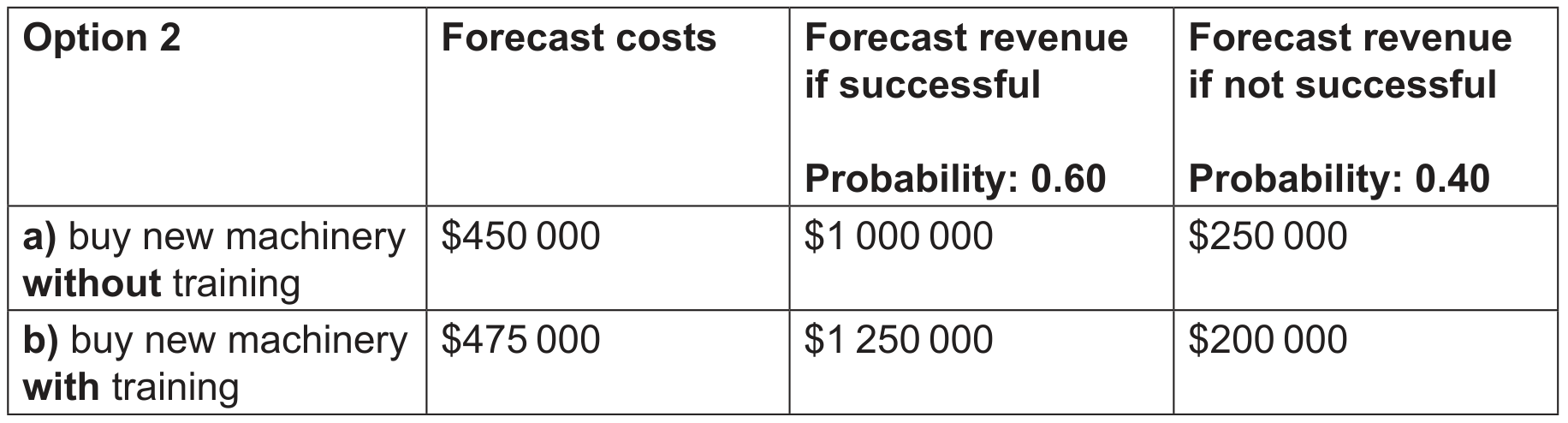
The probabilities, forecast costs and revenues of each option are given below:

Table
Table

Question 2(b)

(a)

Construct a fully labelled decision tree, calculate the predicted outcome for each option and identify the best option for AC (show all your working).

[ 6 ]

Question 2(c)

(b)

Explain one limitation of using a decision tree as a planning tool for A C.

Answer two questions from this section.

[ 2 ]

Question 3

Question 3(a)

(a)

Outline two STEEPLE factors that influence P U 's decisions.

[ 4 ]

Question 3

Question 3(a)

(a)

Describe two changes in the external environment that have affected RDM.

[ 4 ]

Question 2

[Maximum number: 9]

2. Crisis management and Mapa

Image removed for copyright reasons

The Portuguese company Mapa manufactures a handheld global positioning system (GPS)* device. In the winter of 2012, Mapa received reports that its GPS devices often failed in extremely cold weather. According to the media, the problem first appeared in 2011, when mountain climbers with the Mapa GPS devices discovered inaccuracies in the coordinates the devices provided. Rumours of the GPS failure began to circulate in the climbing community. Then, after several accidents in the mountains, including fatalities, television news programmes began to report the problem. Only then did Mapa begin to take action.

Engineers concluded that the problem resulted from where and when the quality testing was being performed. The production of a component part outsourced to a company in Iceland was being quality tested in Portugal in the summer. There was also poor communication between the producer of the component part and Mapa because of differences in language and culture.

Mapa's tall organizational structure, bureaucracy (and bureaucratic corporate culture) and centralized decision making meant that no manager acted until the Chief Executive Officer (CEO) formally apologized. As a result, Mapa had taken too long to admit that there was a problem and so consumer confidence fell and Mapa's reputation suffered.

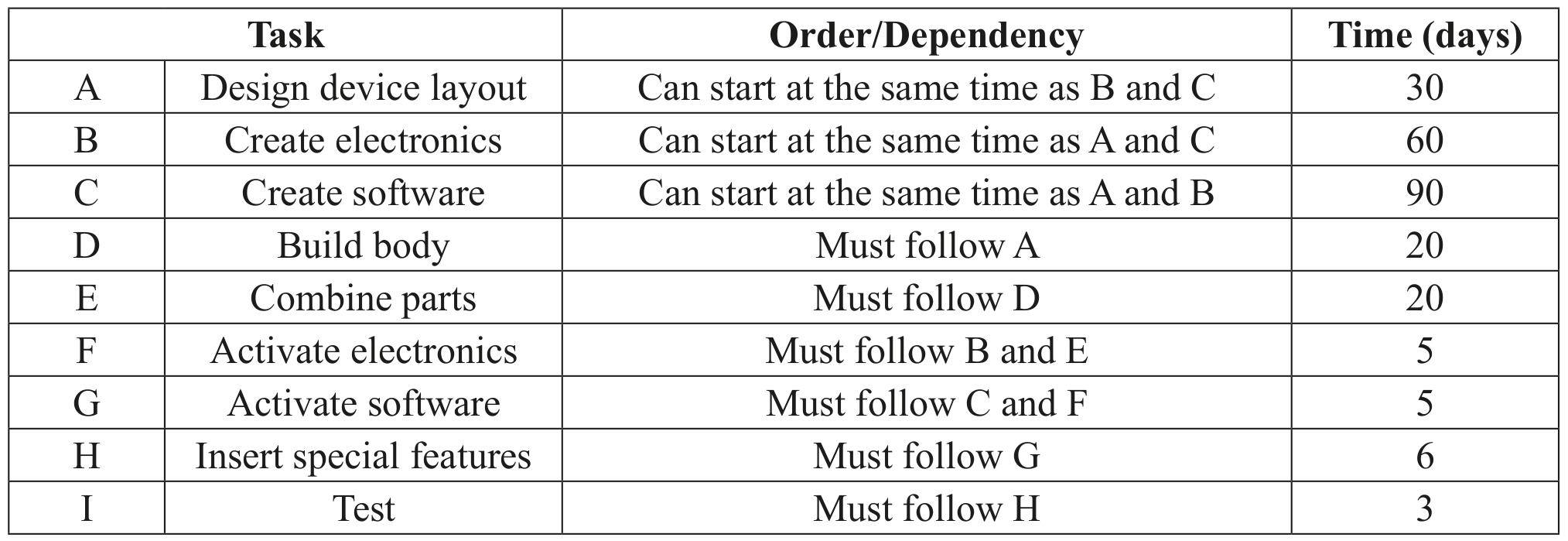
The production process of the GPS device is shown in the table below:

Table

\footnotetext{
* global positioning system (GPS): provides location, including geographic coordinates and time information to users anywhere on earth as long as their receivers (commonly a handheld device such as a smartphone with a GPS application) have unobstructed lines of wireless transmission to various GPS satellites
}

Question 2(b)

Question 2(b)(i)

(a)
(i)

Construct a fully labelled network diagram to represent the sequence of tasks in the table. Show the earliest starting time (EST) and the latest finishing time (LFT) for each task and identify the critical path.

[ 6 ]

Question 2(b)(ii)

(ii)

Calculate the total float and the free float for Task B and describe the impact of delaying Task B by 20 days.

[ 3 ]

Question 3

[Maximum number: 4]

3. Pedro
Pedro is a farmer who operates as a sole trader in a developing country. Like other farmers in his community, he grows oranges, which are sold to buyers in developed communities and large cities. Working in the primary sector often results in very low income and poverty for some of the farmers. Most children do not go to school, as they are needed in the fields for manual work. Cooperation between the farmers in this community is very limited due to linguistic and cultural differences.
Recently, farmers' incomes have fallen further. Pedro has conducted social, technological, economic, environmental, political, legal and ethical (STEEPLE) analysis and identified two main external threats that are impacting on farmers' incomes:
- competition from orange producers from developed communities and large cities with improved technology and higher productivity rates
- a severe and sustained drought affecting the level of orange production in all developing countries.
Pedro would like to improve productivity as an orange producer. Investing in new technology is risky and would require extensive research and development. The internet is unreliable and Pedro is unable to raise funds for this investment himself to change current production methods.
Pedro has arranged an emergency meeting of local farmers. He proposes that all farmers in his community create an agricultural cooperative and collectively raise funds to invest in new capital-intensive farming methods. The investment in technology could allow them to diversify into the manufacturing of bottled orange juice drinks.

Question 3(b)

(a)

Explain how each of the two external threats arising from the STEEPLE analysis would have impacted on farmers' incomes in the developing world.

[ 4 ]
0 selected