Question 2
Question 2(b)
(a)
Su is considering two possible locations for the production facility (lines 51-52). Explain the factors (reasons) that Su may consider when deciding between the two locations.
[ 6 ]
 EduNinja
Su is considering two possible locations for the production facility (lines 51-52). Explain the factors (reasons) that Su may consider when deciding between the two locations.
2. Crisis management and Mapa
The Portuguese company Mapa manufactures a handheld global positioning system (GPS)* device. In the winter of 2012, Mapa received reports that its GPS devices often failed in extremely cold weather. According to the media, the problem first appeared in 2011, when mountain climbers with the Mapa GPS devices discovered inaccuracies in the coordinates the devices provided. Rumours of the GPS failure began to circulate in the climbing community. Then, after several accidents in the mountains, including fatalities, television news programmes began to report the problem. Only then did Mapa begin to take action.
Engineers concluded that the problem resulted from where and when the quality testing was being performed. The production of a component part outsourced to a company in Iceland was being quality tested in Portugal in the summer. There was also poor communication between the producer of the component part and Mapa because of differences in language and culture.
Mapa's tall organizational structure, bureaucracy (and bureaucratic corporate culture) and centralized decision making meant that no manager acted until the Chief Executive Officer (CEO) formally apologized. As a result, Mapa had taken too long to admit that there was a problem and so consumer confidence fell and Mapa's reputation suffered.
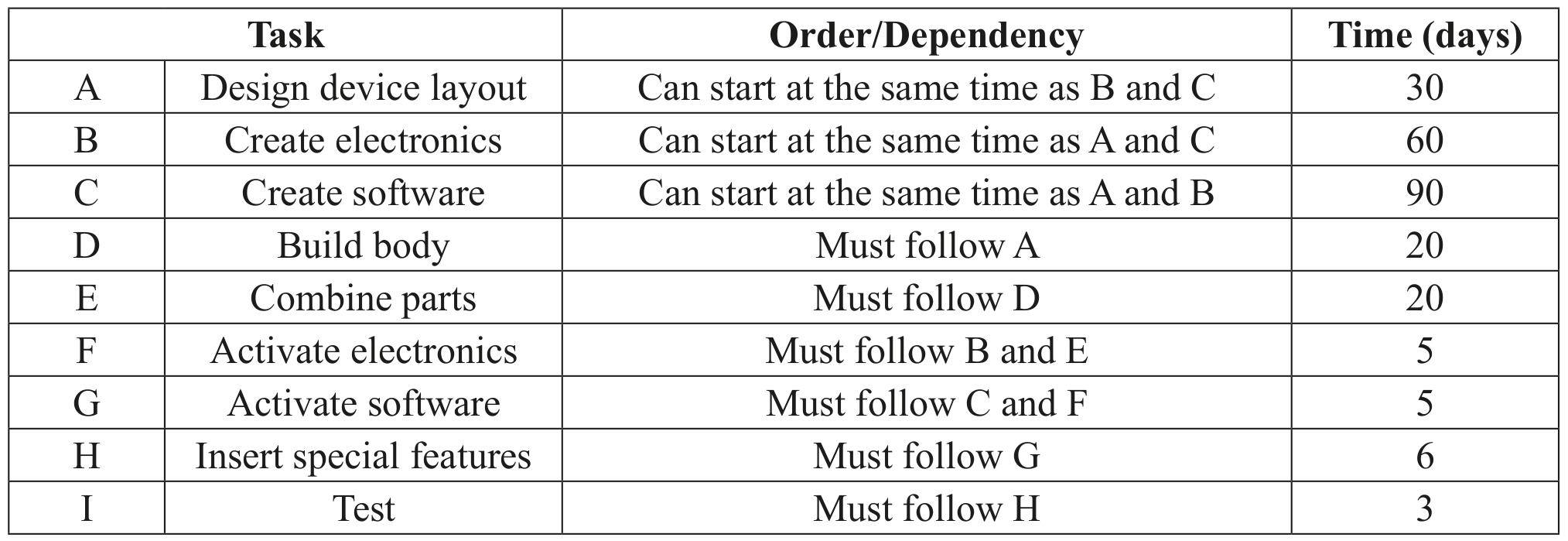
The production process of the GPS device is shown in the table below:
\footnotetext{
* global positioning system (GPS): provides location, including geographic coordinates and time information to users anywhere on earth as long as their receivers (commonly a handheld device such as a smartphone with a GPS application) have unobstructed lines of wireless transmission to various GPS satellites
}
Define the term outsourcing.
2. Stay Float (SF)
Stay Float ( S F ) is a family-owned private limited company that produces rowing boats. Dan is the Marketing Director and Ori, his brother, is the Finance Director. Together they own 75 % of S F 's shares. The main target market is university boat clubs that require custom-made rowing boats. S F produces two models of boat, "The Single" and "The Quad", using a job production method. Each model of boat is treated as separate profit centres.
S F is market-orientated and highly responsive to customer needs. Customers are willing to wait a long time for the completion of a boat because of its high quality and flexible design. Employees are highly skilled and motivated. S F uses a price skimming strategy.
Increasing overseas competition of cheaper mass-produced rowing boats and a cut in university activity budgets has caused a fall in demand for S F 's boats. As a result, S F is experiencing cash flow difficulties. Dan and Ori are considering two different strategic options to reduce costs and find new market segments for both boats:
- (Option 1) change the production method to flow production to improve the working capital cycle. However, Ori is concerned about how this will be financed.
- (Option 2) subcontract the production of the "The Quad" overseas and continue producing "The Single" at the current location.
Sales price for "The Single": $ 15000.
Sales price for "The Quad": $25 000.
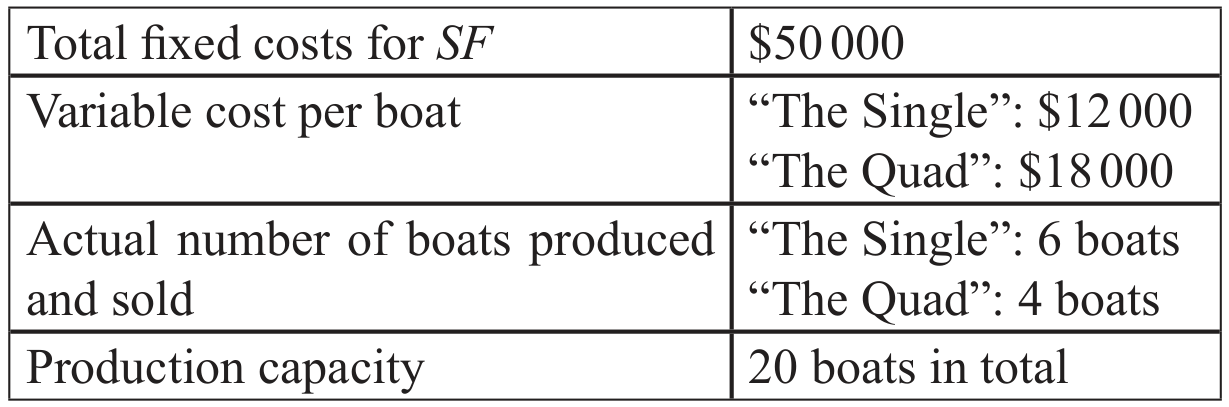
Current financial data for 2014:
Financial data if S F subcontracts "The Quad" overseas (Option 2):
- production capacity for the subcontractor: 40 boats.
- the total fixed cost will be reduced by $ 14000.
- S F will pay a variable cost of $ 14000 per boat to the subcontractor.
- S F will reduce the price of the mass-produced "The Quad" by 20 % and double the quantity sold in the first year.
- the quantity of "The Single" (6 boats) sold will remain unchanged.
Calculate for S F (show all your working):
whether the production of "The Quad" should be subcontracted overseas (Option 2), assuming that the sales of "The Single" stay the same as in 2014.
3. KA
K A is a public limited company that designs, manufactures and sells air conditioners. K A 's unionized employees are motivated and efficient despite not being involved in any decision making. However, they are resistant to change.
The market and competition for air conditioners are growing rapidly. K A operates at full capacity but stock turnover has slowed.
Primary market research revealed that:
- consumers do not differentiate KA air conditioners from those of its competitors. All products are perceived as medium price and medium quality
- KA's customer service is rated as poor
- customers demand energy-efficient products using ecologically sustainable production methods.
To exploit opportunities and overcome weaknesses and threats, KA's management has decided to redesign its products so that they are energy efficient. K A is considering two options:
- Option1: Implement lean production methods, which includes investing in ecologically sustainable machines that will increase capacity by 10 %. Total quality management (TQM) will also be implemented. However, the financial manager is worried about K A 's ability to meet high initial costs. The forecasted payback period is three years and average rate of return (ARR) is 4 %.
- Option 2: Outsource the production to QS, a company known for its reliability and high capacity to produce excellent quality air conditioners using cradle to cradle manufacturing principles. However, QS refuses to sign an exclusive long-term contract with KA, insisting instead on renegotiating the contract every two years. KA will have to close its production facility and will use the cost savings to improve customer service and to reposition and differentiate its air conditioners.
Employees have heard rumours of both options and fear for their jobs. Strike action is being considered.
Evaluate the two options that K A is considering.
3. Toyota
Toyota is one of the biggest car manufacturers in the world. For decades it was known for production efficiency and car quality. Its Kaizen approach to manufacturing transformed car-making worldwide resulting in years of growth in sales and profits. With rapid global growth, Toyota began outsourcing production activities of some car parts to overseas manufacturers, with whom it had not worked before, resulting in a loss of quality control. In addition to this, it ignored employees' concerns about car safety and quality and was also slow in responding to customers' complaints.
In 2009, Toyota recalled 11 million cars worldwide due to various defects in car parts. The financial loss to Toyota from the recall and lost sales was US $ 2 billion. The total market value of Toyota's shares fell by US $ 20 billion.
Following the recall, company President Akio Toyoda said that in expanding too rapidly Toyota:
- Lost sight of its long-established customer focus.
- No longer stopped to study every defect, or problem to determine the causes.
- Forgot its core values of safety first, quality second and volume third. Its main strategic objectives became "world biggest" and profit.
He added that the situation is urgent and to recover its reputation and core values:
- New quality control standards will be put in place.
- New procedures will pay closer attention to customers' feedback.
- A team will be set up to investigate every defect reported within 24 hours.
- Change will be implemented more rapidly than normal.
Other famous car brands have also experienced product recalls. Regarding Toyota, analysts commented that Akio Toyoda understands the problems and has personal interest in Toyota, his name is on every car. Financially, Toyota created a US $ 1.4 billion provision for the recall and it has US $ 23 billion in reserve. In America, Toyota's sales were up 6 % in 2010 over the previous year.
Examine Toyota's decision to outsource "production activities of some car parts to overseas manufacturers".
"The production of LadyA perfume and cosmetics was outsourced" (lines 113-114). Describe two advantages to LadyA of outsourcing.
Describe two benefits for LadyA of outsourcing the production of perfume and cosmetics to Malaysia (lines 113-114).
With reference to R D B, outline one advantage and one disadvantage of offshoring.
4. ReVolve Ltd (RV)
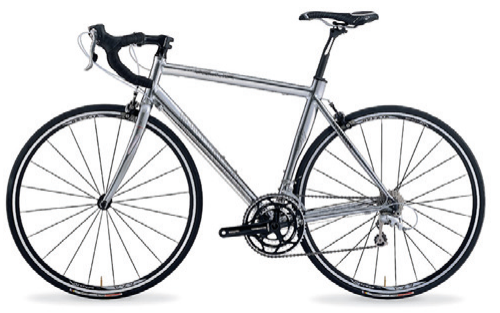
ReVolve L t d(R V) manufactures and sells high-quality, high-priced bicycles to high-income earners. Operating in a niche market, its advertising slogan and unique selling point/proposition (USP) is "hand made to order, in the USA, delivered within seven days". Brand loyalty is strong, but brand recognition outside of its customer base is weak. 98 % of its sales are to customers living within 50 miles of the business.
Prior to 2017, RV received an increasing number of customer complaints that phone lines were often engaged and calls not returned. As such, it adopted e-commerce. Its website now allows customers to:
- customize their choice of bicycle
- place orders
- pay for purchases
- have their questions answered.
R V employs 20 highly paid, skilled employees using job production. To retain these workers, R V has raised their wages significantly since 2016.
Increasing competition from imports of hand-made high-quality bikes has forced down prices in this niche market. RV has been making increasingly larger losses since 2017. In 2020, its sales fell by 15 %. Inflation is forecasted at between 2 % and 3 % for the next three years. As such, RV's directors are considering two options to enable it to lower the prices of its bicycles.
Option 1: Offshore production to China, where production costs are significantly lower. The bicycles would be manufactured using batch production. R V would focus only on the design and marketing of its bicycles.
Option 2: Invest in new job production techniques that enable parts to be glued rather than welded, which only requires unskilled labour. Investment would cost $ 3500000 and the forecasted annual net cash flow is $ 600000.
Recommend whether RV's directors should choose Option 1 or Option 2.
5. FrioAire Appliances (FA)
FrioAire Appliances (FA) manufactures medium-priced and medium-quality refrigerators. It is a multinational public limited company. Its factory is located in a less economically developed country that has high unemployment, a tradition of autocratic leadership and labour costs lower than FA's home country. The factory is profitable, and FA pays consistently good dividends. Market growth for medium-priced and medium-quality refrigerators is limited.
As part of a strategic objective to increase productivity and to enter a fast-growing market for high-priced and high-quality refrigerators, F A is considering building a new factory in and relocating production to Germany. This would require closing the factory in the less economically developed country. The new factory will:
- use innovative technologies, including advanced robotics and 3D processes
- require fewer employees, but those it does require will need to have better skills and qualifications.
Germany has a highly skilled, qualified and productive workforce. The new factory would allow FA to reposition its products. However, FA would need to raise significant finance to build and equip the new factory.
FA's leadership style at the factory in the less economically developed country is autocratic. Members of FA's board wonder whether this style would be suitable for the new factory in Germany, where workers have more bargaining power because of their high skill level and the labour-friendly cultural traditions. In Germany, FA would have to follow more regulations regarding the environment, health and safety, and employee rights.
FA workers in the less economically developed country are very loyal to F A, which has continued operation through a civil war at significant cost to itself (for security). If FA were to close in the less economically developed country, the workers would not find such good jobs.
Evaluate the option of building a factory in, and relocating to, Germany.
Section C
Answer one question from this section. The organizations featured in sections A and B and in the paper 1 case study may not be used as a basis to your answer.