EduNinja

IB Business Management HL5.6 Production planningQuestion Bank

Question 1

[Maximum number: 4]

1. AH Ltd
Jose owns A H Ltd, a private limited company, that provides climbing and adventure tourism opportunities for children in Ecuador. AH Ltd is partly financed by a non-governmental organization (NGO), which promotes outdoor and other healthy activities in Ecuador. An increase in tourism has meant that A H Ltd has been working at full capacity. However, some issues have begun to emerge.
In a meeting with Jose, an NGO representative expressed concern over the quality of the climbing equipment being used. Several minor accidents involving children had occurred. In addition, the NGO representative had not been kept up-to-date on the financial position of AH Ltd. After the meeting, Jose showed the following financial figures to his accountant, Marco.
Selected financial information from A H Ltd's accounts as at 31 March 2014 (all figures in US$m).
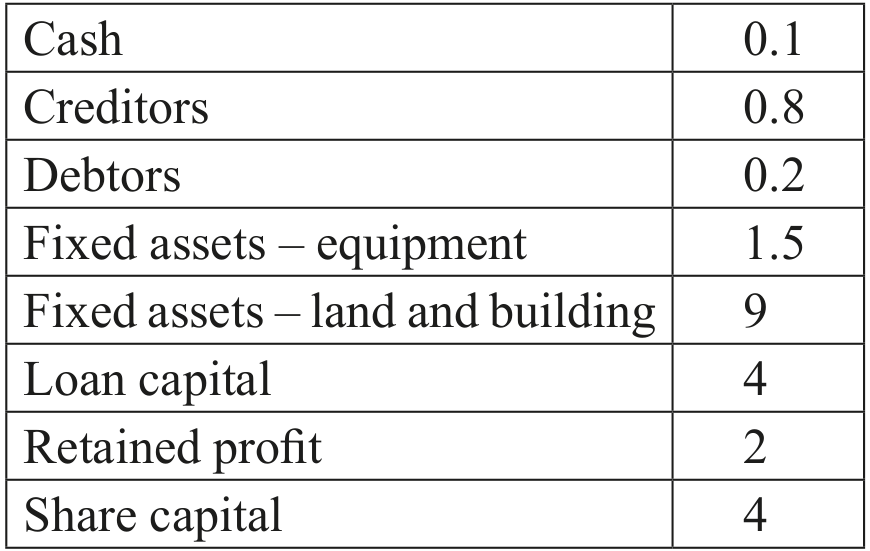
Table

Marco is concerned that the information from A H Ltd's accounts does not show a true reflection of AH Ltd's financial position. For example, Jose has not made any provisions for depreciating the value of the equipment since purchasing it three years ago. Marco has informed Jose that the equipment should be depreciated using the reducing balance method at a rate of 40 % per year.

Jose wishes to expand the business to offer more climbing opportunities. Marco, however, warns that the current equipment needs to be replaced to meet international quality standards. Additional funding from the NGO is not possible, and banks in Ecuador give few loans to small businesses such as AH Ltd.

Question 1(b)

(a)

Explain one advantage and one disadvantage for A H Ltd of working at full capacity.
[ 4 ]

Question 1

[Maximum number: 2]

1. Joyce Trucking (JT)
Joyce Trucking (JT) is a small transport company that operates in Kent, United Kingdom (UK). JT currently has ten trucks and operates at high-capacity utilization. The company plans to buy one more truck, at a cost of £ 120000, on 1 January 2024.
J T must decide on which depreciation method to use for the new truck: the straight-line method or the reducing/declining balance method. The new truck has an expected life of four years, and its residual value is expected to be £ 20000.
JT anticipates very high revenue and profitability in 2024 and 2025, because of several major construction projects that are due to take place in Kent. When those projects are completed, JT anticipates a fall in sales revenue and profits.

Question 1(a)

(a)

State two disadvantages of operating at high-capacity utilization.

[ 2 ]

Question 1

[Maximum number: 2]

1. Roscas
Roscas produces and sells sugar donuts. Monthly fixed costs are $15000, monthly sales revenue is $ 70000, and total variable costs per month are $ 25000. To increase its productivity rate, Roscas wants to buy a new high-efficiency machine that produces chocolate-filled donuts. The finance manager has forecasted the following information.

Table 1: Forecasted information for the production of chocolate-filled donuts

Table 1: Forecasted information for the production of chocolate-filled donuts

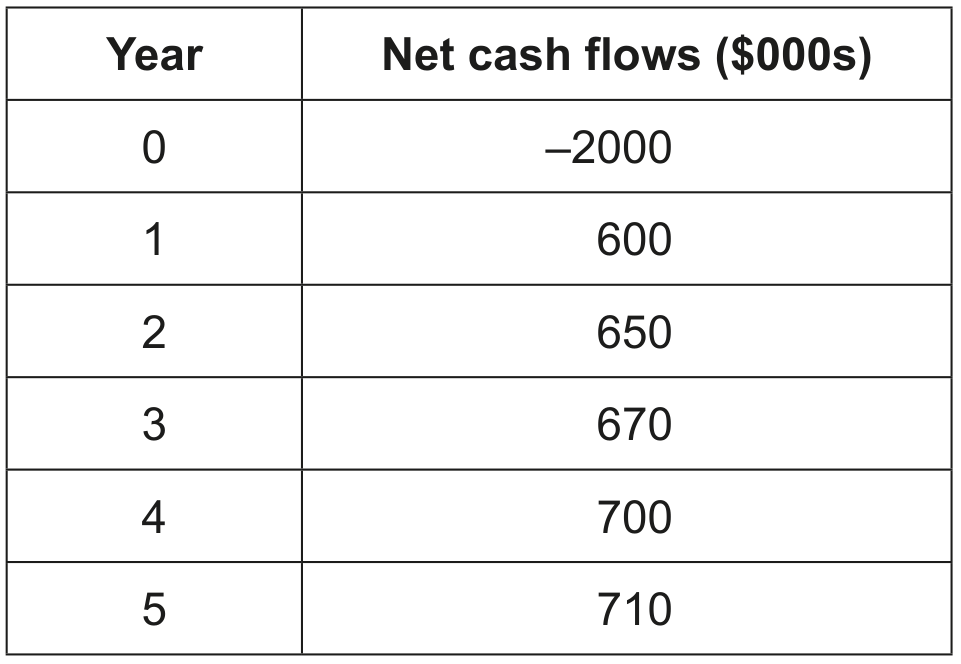
Table 2: Forecasted cash flow for the new machine

Table 2: Forecasted cash flow for the new machine

Question 1(a)

(a)

Define the term productivity rate.

[ 2 ]

Question 1

[Maximum number: 2]

1. Sassy
Sassy, a partnership between fashion designers, produces clothes for teenagers. Capacity utilization is very high.
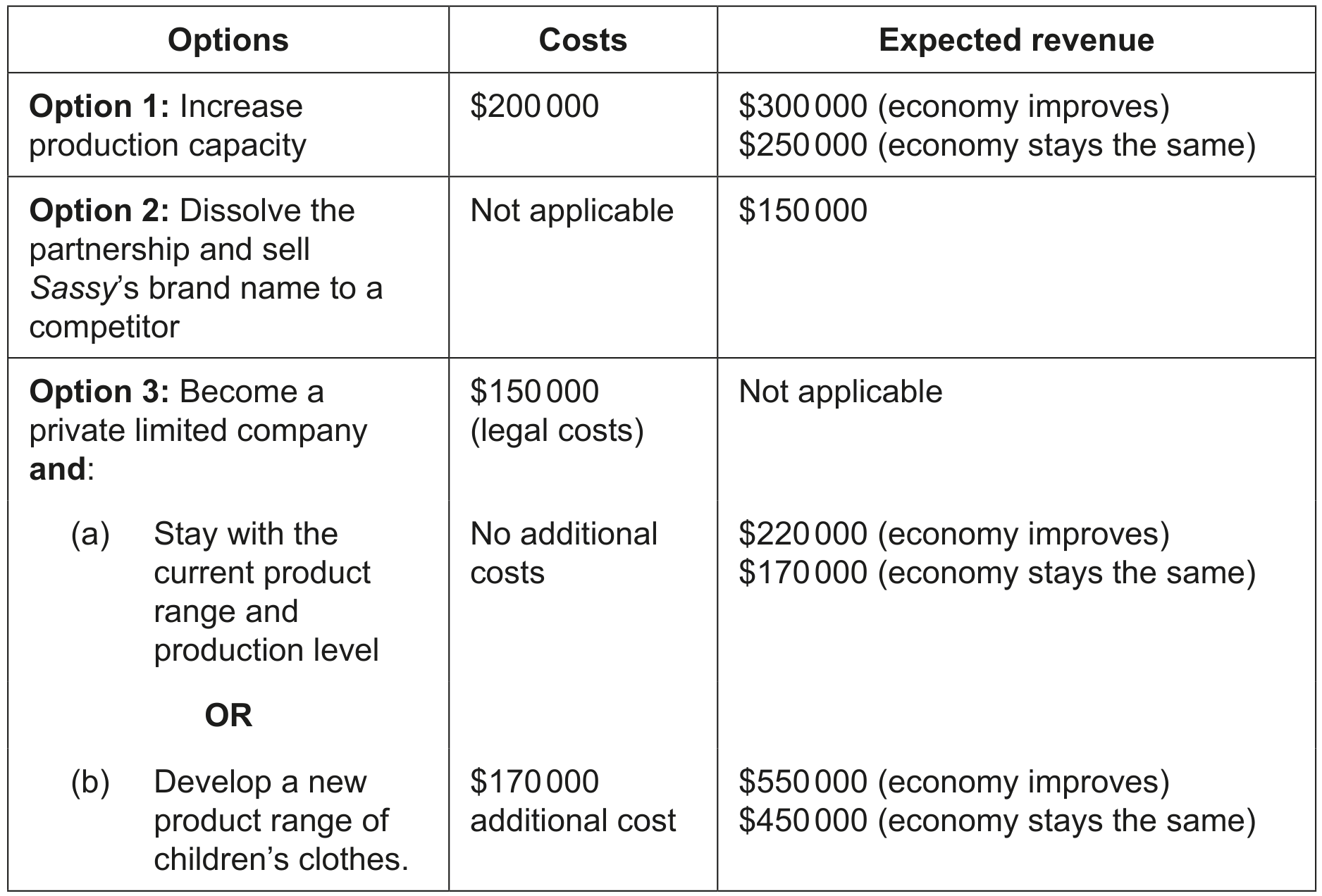
The partners are considering some strategic changes. After conducting research, they presented three options and outlined the costs and expected revenue. They also predicted that the economy would either improve or stay the same. The probability of the economy staying the same is 0.3 .
The options, costs and expected revenue are given below:

Table 1: Information relating to the three strategic options for change

Table 1: Information relating to the three strategic options for change

Question 1(a)

(a)

Describe one disadvantage for an organization of operating at high capacity utilization.

[ 2 ]

Question 1

[Maximum number: 8]

1. Fair Coffee (FC)
David is about to open a small coffee shop, Fair Coffee (FC), at a central city location. On opening day FC will have a stock level of 500 kg of coffee beans. David estimates that the coffee beans will be used at a constant rate for the first six months of operation.
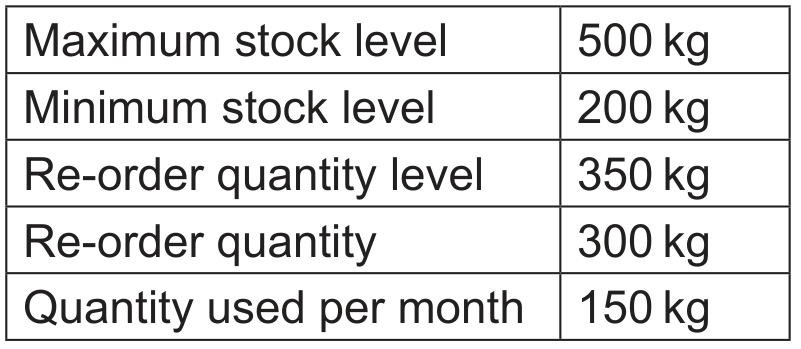
David's planned stock management figures for the coffee beans are shown below:

Table

Lead time for delivery of the coffee beans: 1 month.

Question 1(b)

(a)

Using the information in the table, construct a fully labelled stock control chart for FC, for the first six months of operation.

[ 4 ]

Question 1(c)

(b)

A delivery of coffee beans was 1 month late, arriving on the last day of the seventh month rather than the last day of the sixth month. Using figures from the chart you constructed in part (b), explain the effects of:

[ 4 ]

Question 1(c)(i)

(i)

the late delivery on FC's stock level and;

[ 2 ]

Question 1(c)(ii)

(ii)

the late arrival delivering only 75 kg of coffee.

[ 2 ]

Question 1

[Maximum number: 2]

1. Designer Dolls (DD)
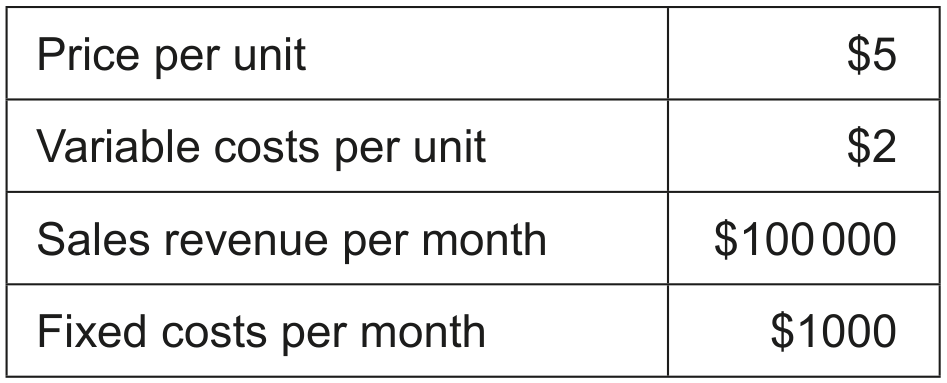
Designer Dolls (DD) is a start-up business that will create hand-crafted unique dolls using a job/customized production method. As part of their business plan DD undertook a break
even analysis.

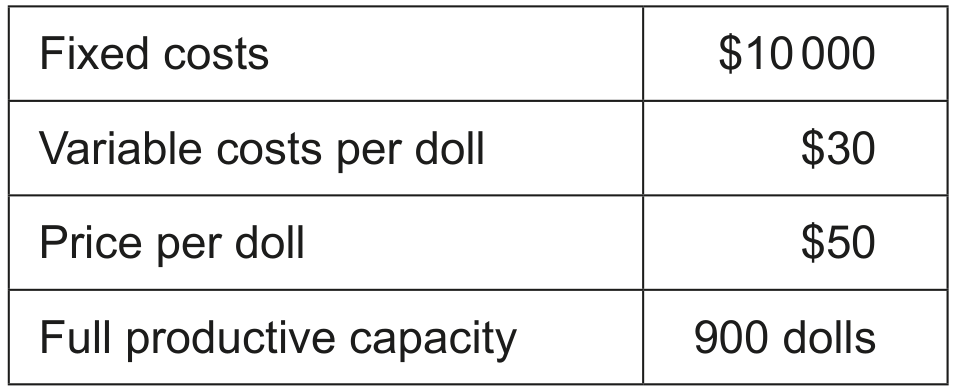
Table 1: Forecasted figures for DD for the first year of operation

Table 1: Forecasted figures for DD for the first year of operation

Question 1(b)

(a)

Calculate:

[ 2 ]

Question 1(b)(ii)

(i)

the capacity utilization rate at the break-even quantity for D D for the first year of operation (show all your working);

[ 2 ]

Question 2

[Maximum number: 4]

2. Jill Anderson
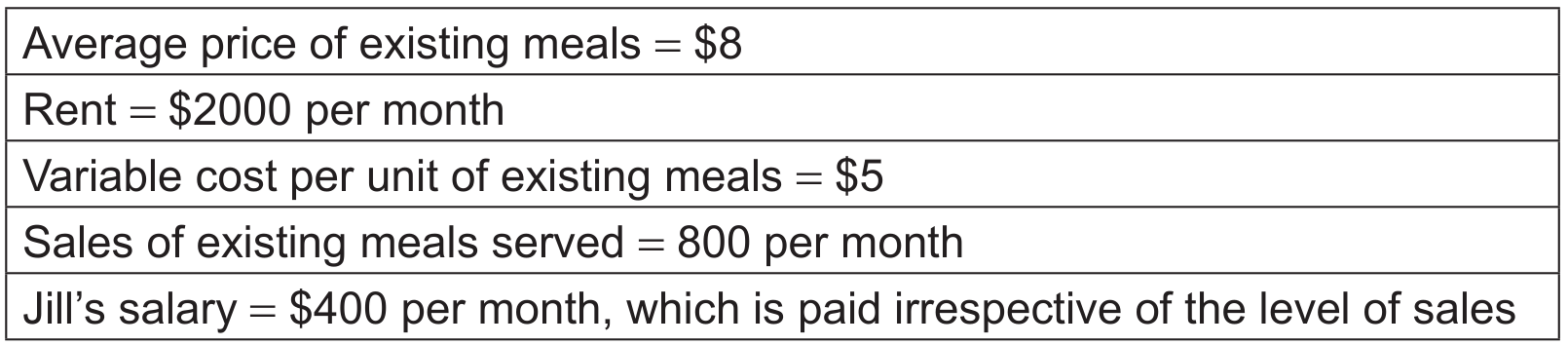
Jill Anderson operates a restaurant. Although Jill's meals are viewed as being excellent quality, sales are slowing. Jill is considering replacing existing meals with gluten-free meals. The following financial and forecast information is for the month of May 2018. Jill's restaurant can only produce either existing or gluten-free meals.

Table 1: Existing meals

Table 1: Existing meals

Table 2: Estimated costs and price if Jill produces the gluten-free meals

Table 2: Estimated costs and price if Jill produces the gluten-free meals

A local gluten-free manufacturer, which is not part of Jill's existing supply chain, has offered to supply already prepared gluten-free meals at $ 8 per meal. Jill is unsure whether to make or buy the gluten-free meals.

Question 2(a)

(a)

Define the term supply chain.

[ 2 ]

Question 2(c)

(b)

Using your answer from (b) (iii) and (iv), explain whether Jill should buy-in or make the gluten-free meals herself.

Answer two questions from this section.

[ 2 ]

Question 2

Question 2(a)

(a)

By the 1970s, Japanese companies had moved to just-in-time production (line 26). Outline one advantage and one disadvantage of just-in-time production.

[ 4 ]

Question 2

[Maximum number: 9]

2. GF
Barbara Johnson manages a small business ( G F ) that produces and sells gluten-free* bread. G F has been recognized for meeting national quality standards for gluten-free bread which has helped increase sales. Local supermarkets sell their own label brands of gluten-free bread which do not meet national quality standards at a price 20 % cheaper than G F. Barbara aims to make national quality standard gluten-free bread more affordable and in larger batches.
G F has 21 employees. Four are gluten-sensitive (intolerant) testers who check the quality of the final bread. This traditional method of quality control is important, but takes significant time and resources.
Several hospitals have asked if G F can provide them with an additional 1200 loaves of gluten-free bread every day for the next year. Barbara is keen, however in a small market like this, becoming larger does not automatically result in economies of scale. GF's suppliers cannot provide larger quantities of gluten-free flour without increasing their prices and consequently G F 's costs.
Barbara has two options:
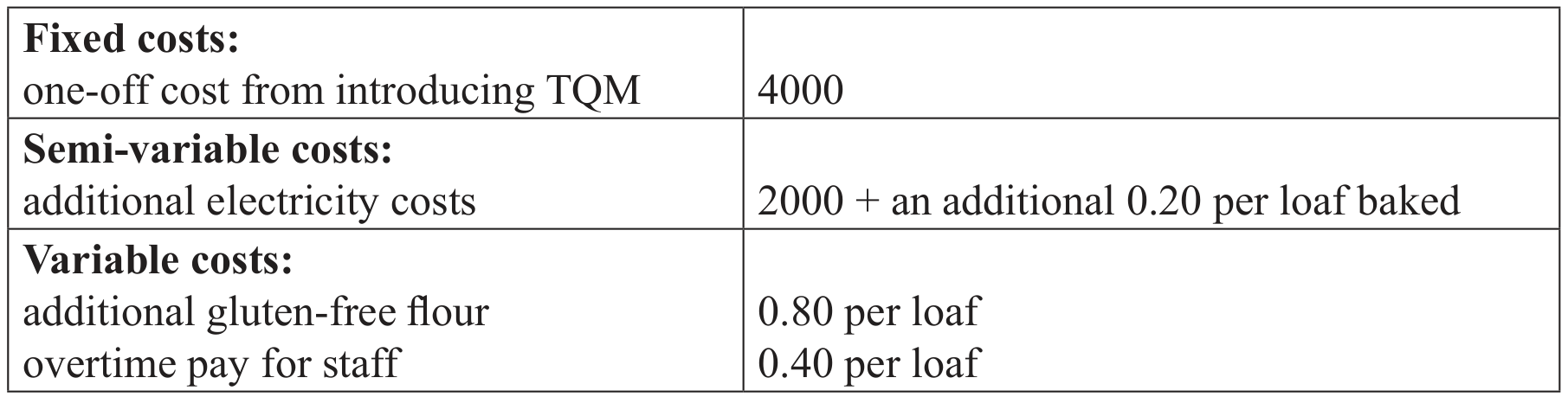
- Option 1: Increase G F 's production of gluten-free bread and maintain national quality standards by introducing total quality management (TQM) control at a one-off cost of $ 4000. This should also speed up the batch production process.
- Option 2: Buy-in the additional 1200 loaves from the company that supplies the local supermarkets and then sell this bread to the hospitals. However this supplier uses flow production and does not meet national quality standards.
The sales price per loaf of G F bread is $ 6.80 regardless of the option chosen.
Barbara prepared the following figures for each option (in $):
Option 1: Increase GF's production to make the additional 1200 loaves.

Table

Option 2: Buy-in the additional 1200 loaves.
Total variable cost of buying in 12007200 loaves from local supermarkets' supplier

\footnotetext{
* gluten: a protein found in wheat (flour) which causes health problems for those who are sensitive (intolerant) to it
}

Question 2(d)

Question 2(d)(i)

(a)
(i)

Calculate the variable cost per loaf to G F if they buy-in the additional 1200 loaves from the local supermarkets' supplier.

[ 1 ]

Question 2(d)(ii)

(ii)

Using relevant information given, calculate whether G F should either buy-in the additional 1200 loaves from the local supermarkets' supplier, or make the loaves themselves (show all your working and state any assumptions you make).

[ 5 ]

Question 2(d)(iii)

(iii)

Comment on whether G F should make or buy-in the additional 1200 loaves.

[ 3 ]

Question 3

[Maximum number: 2]

3. Pedro
Pedro is a farmer who operates as a sole trader in a developing country. Like other farmers in his community, he grows oranges, which are sold to buyers in developed communities and large cities. Working in the primary sector often results in very low income and poverty for some of the farmers. Most children do not go to school, as they are needed in the fields for manual work. Cooperation between the farmers in this community is very limited due to linguistic and cultural differences.
Recently, farmers' incomes have fallen further. Pedro has conducted social, technological, economic, environmental, political, legal and ethical (STEEPLE) analysis and identified two main external threats that are impacting on farmers' incomes:
- competition from orange producers from developed communities and large cities with improved technology and higher productivity rates
- a severe and sustained drought affecting the level of orange production in all developing countries.
Pedro would like to improve productivity as an orange producer. Investing in new technology is risky and would require extensive research and development. The internet is unreliable and Pedro is unable to raise funds for this investment himself to change current production methods.
Pedro has arranged an emergency meeting of local farmers. He proposes that all farmers in his community create an agricultural cooperative and collectively raise funds to invest in new capital-intensive farming methods. The investment in technology could allow them to diversify into the manufacturing of bottled orange juice drinks.

Question 3(a)

(a)

Define the term productivity rate.

[ 2 ]
0 selected