EduNinja

IB Business Management HL4.1 Introduction to marketingQuestion Bank

Question 4

[Maximum number: 4]

In 2010, ELE owned 4.5 % of the European Union (EU) car rental market. In 2019, ELE's car rental division had revenues of EUR 0.9 billion in a market worth EUR 16.8 billion. Initially, ELE only provided car rentals in its gasoline stations in Belgium. By 2014, ELE had expanded the service to its stations in France, Spain and the UK.

In 2016, Giselle also reorganized ELE's car rental offices so that each office operated as a profit centre. An entrepreneurial approach was adopted. Office teams received substantial bonuses if they exceeded profit targets, but only offices that met their targets qualified for these bonuses. These targets were set, without consultation, by Giselle. Over a five-year period, targets were met by 85 % of offices. Giselle's reorganization was not welcomed by employees.

In 2021, Monica recommended that ELE trial the business model she had proposed for the new In3T brand in two major cities in the EU for one year: if successful, the brand and its model could then be launched in all major cities in the EU. Monica said, "We must do it. I'm convinced that our rivals will adopt this business model within two years. If we don't act now, we will be left behind and our rivals will beat us to it."

Giselle, however, disagreed strongly. She had built the car rental division from its inception. She believed high levels of customer service and well-trained staff were two reasons why the car rental division remained successful. She was also unhappy with the EUR 100 million cost and payback of three years.

Question 4(b)

Question 4(b)(i)

(a)
(i)

Calculate ELE's market share for car rentals in 2019 (show all your working).

[ 2 ]

Question 4(b)(ii)

(ii)

Explain one reason why ELE's market share has grown.
[ 2 ]

Question 3

[Maximum number: 2]

3. Chan Manufacturing (CM)
20 years ago, Chi Chan set up Chan Manufacturing (CM) to produce electrical components on a just-in-time (JIT) basis for car manufacturers.
High quality and quick delivery have increased CM's market share and profit. CM's manual-skilled employees are loyal, productive, motivated and feel secure in their jobs. Employees admire Chi as a leader. Labour turnover at CM is low. Chi is paternalistic. He believes in a top-down approach to management. He cares for the financial welfare of his employees. Employees are paid a basic wage and receive additional financial rewards for working overtime. Proud of CM, employees regularly work harder than expected so that CM always meets client demand, which changes often. Chi and union representatives successfully negotiate pay and work conditions through collective bargaining.
Mei, Chi's daughter, joined CM as Chief Operations Manager. She relies on new business theory to guide her management decisions. Many current workers are approaching retirement age. She wants to restructure CM and use job enlargement, job enrichment and empowerment. Individual employment contracts are to be determined annually based on individual performance appraisal. Some employees do not like the proposal and speed of the change and are becoming demotivated. For the first time, they are considering industrial action (industrial/employee relations methods).
Mei insists that these changes are required, but wants to avoid conflict. She is considering approaches to conflict resolution.

Question 3(a)

(a)

Define the term market share.

[ 2 ]

Question 3

[Maximum number: 2]

3. Speedy Delivery (SD)
Speedy Delivery (SD) is a private limited company that delivers freshly cooked meals by bicycle. SD only delivers. Restaurants subcontract SD to deliver meals to customers who place orders online and expect quick and efficient delivery. SD has been operating profitably for two years. Currently, it has the highest market share in the city.
SD is now facing two issues:
- It operates at 98 % capacity utilization. Recently, some restaurant owners complained to SD that meals arrived late and cold to customers.
- The market for home delivered, freshly cooked meals is growing quickly and some new delivery companies have just entered the market.
The CEO wants to address the delivery quality issues and the threat of competitors, two of whom recently merged. He is considering an internal growth strategy involving investing in new electric scooters and employing more staff to deliver a greater number of meals more efficiently. SD must raise a large sum of finance. Major shareholders are in disagreement regarding the internal growth strategy.
The financial manager has provided some financial information.

Table 1: Current information

Table 1: Current information

Table 2: Predicted return on the investment

Table 2: Predicted return on the investment

Question 3(a)

(a)

Define the term market share.

[ 2 ]

Question 3

[Maximum number: 4]

3. Soft Skin Cosmetics (SSC)
Soft Skin Cosmetics (SSC) is a private limited company that produces a small range of face creams and soaps. Its products are designed and produced in the United States, and are made from safe, natural ingredients.
SSC has a product-orientated marketing approach. Tiffany Presley, one of the company's co-founders, believes that SSC's consumers value health above fashion. "The skincare market is full of toxic products, but ours are healthy even if they don't smell or look as nice," she says. Chelsea Presley, SSC's other co-founder, wants to develop the first sunscreen free of synthetic chemicals. However, product innovation is costly and risky. If the new sunscreen is a failure, several years of research and development costs will be wasted, which SSC cannot afford. SSC currently lacks the scale to innovate.
SSC does not pay for advertising. It relies on social media and word-of-mouth promotion. Its brand awareness is very high among young women, and customer reviews are very positive about SSC's quality and effectiveness. The company only sells online, not in retail outlets. To reach unsatisfied demand domestically and internationally, SSC would have to broaden its current distribution channels.
SSC practises corporate social responsibility (CSR). It does not test its products on animals, and supports several charities protecting endangered species. Pressure groups publicly recognize SSC's commitment to animal welfare.
Currently, multinational companies dominate the global skincare market. Small emerging companies rarely survive. Chelsea wants to convert SSC to a public limited company, but Tiffany disagrees: she argues that shareholder pressure toward profit maximization could jeopardize consumer and animal safety.

Question 3(b)

(a)

Explain one advantage and one disadvantage for SSC of having a product-orientated marketing approach.

[ 4 ]

Question 4

[Maximum number: 2]

4. Top Star (TS)
Top Star (TS) manufactures sports footwear. Its products are sold through retail outlets and online. Sales of TS' footwear in retail outlets are falling. However, because e-commerce is growing rapidly, online sales are increasing. In 2018, TS' total domestic sales were $ 5000000 and total domestic market sales for the same time period were $ 50000000.
TS must consider several challenges:
- Some businesses in the sports footwear industry are finding that selling online leads to many problems and higher costs
- TS' website is not user friendly. Customer complaints about the website and ordering problems are increasing
- TS' presence in international markets is weak and its product range is limited. The directors of TS want to develop a new line of running shoes but the company has insufficient finance for research, development and creating brand awareness.
The directors think that T S should follow an external growth strategy. Two options are being considered:
- Option 1: Some directors propose a merger with a footwear manufacturer, the multinational company All Champion, which would allow TS to be more competitive
- Option 2: Other directors propose a merger with a footwear retailer that has a strong presence in domestic and international markets.
The finance manager believes that merging with All Champion could hurt TS' reputation. TS′T S^{\prime} factories may have to close, which the local population may resent.

Question 4(b)

(a)

Calculate TS' market share in 2018 (show all your working).

[ 2 ]

Question 5

[Maximum number: 2]

5. KapTan
KapTan (K T), which manufactures rechargeable batteries for cordless consumer products like vacuum cleaners, began five years ago as a business with a product orientation. It sells business to business (B2B). Multinational companies dominate the rechargeable battery industry, and K T suffered from cash-flow problems in its first year of trading. Its profits are small and, in the last two years, have fallen.
K T has now developed an innovative battery that is small and lightweight. This battery is an emergency power source allowing electric cars to reach a charging station. However, the battery can only be used ten times before it runs out. K T has insufficient finance to create a battery that can be recharged an unlimited number of times.
Through market research, K T has discovered that:
- no other emergency batteries for electric cars exist
- owners of electric cars fear running out of power
- KT's new battery could be obsolete in five years.
K T has the capacity to produce 90000 of these new batteries each year. The average cost is $ 200 per unit. KT has insufficient funds to invest in additional capacity.
K T is considering two options:
Option 1: Market and sell directly to existing car owners through business to consumer (B2C) at a retail price of $ 400. KT will need to borrow significant capital to finance this option.
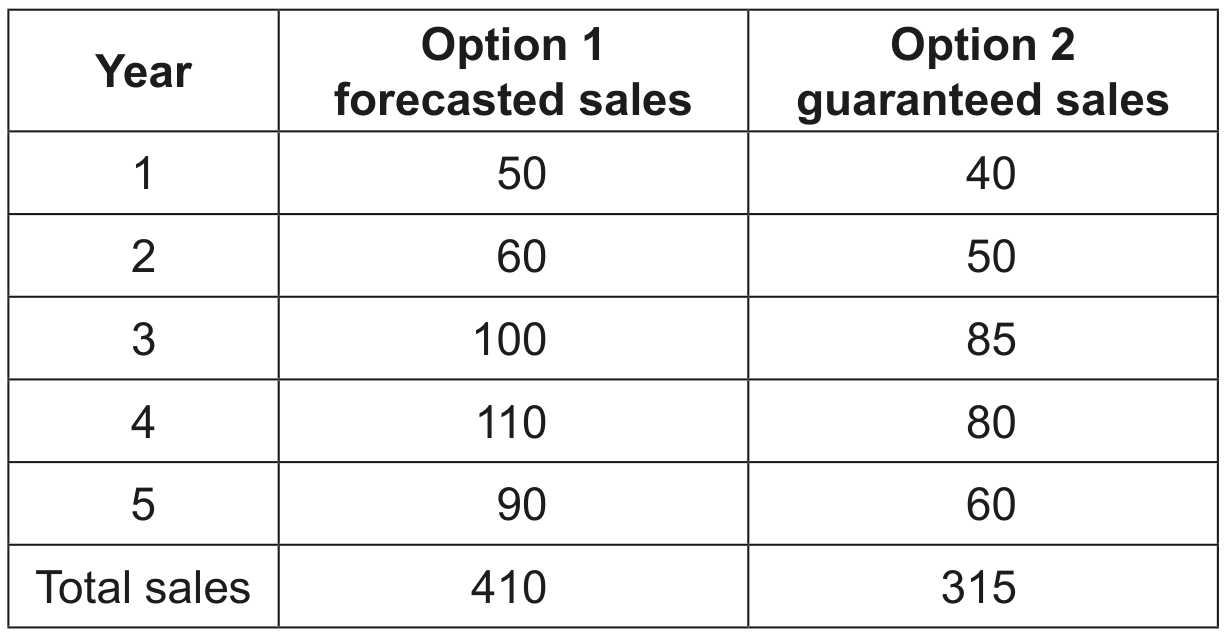
Option 2: Accept an offer of a five-year strategic alliance with a manufacturer of electric cars. K T would provide its product exclusively at $ 250 per unit. Sales are guaranteed.

Table 3: KT's forecasted and guaranteed worldwide unit sales (in 000s) for the two options

Table 3: KT's forecasted and guaranteed worldwide unit sales (in 000s) for the two options

Question 5(a)

(a)

Define the term product orientation.

[ 2 ]

Question 5

[Maximum number: 2]

5. Columbo Coffee (CC)
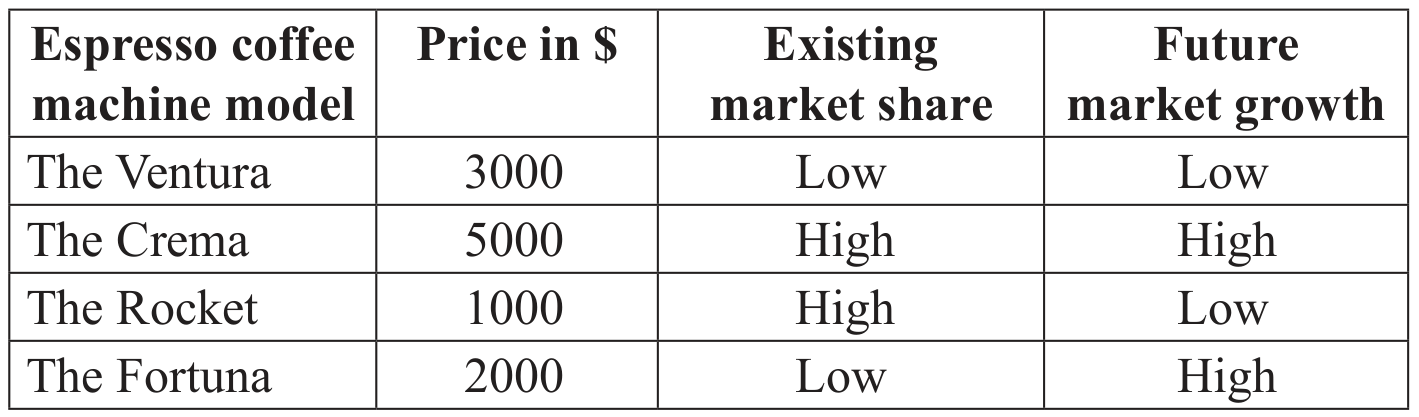
Columbo Coffee ( C C ) is a family business that produces four espresso coffee machines. C C 's objective is to provide the highest quality machines, but it is currently unprofitable.

Table

A marketing audit of the four espresso machines had the following results:
- The Ventura was CC's best selling espresso coffee machine. It has the strongest brand loyalty of all four machines, but has been suffering from overseas competition. Many customers of The Ventura want a new, improved version. However, because of its weak financial position, the company has not been able to develop it.
- The Crema is CC's exclusive luxury espresso coffee machine. Considerable publicity for CC was gained when it featured in a recent popular television series. Sales of The Crema are forecasted to grow further despite its high price.
- The Rocket has been very successful. However, technical problems have resulted in many customers returning their machines. Reduced brand loyalty and quality control are significant concerns.
- The Fortuna is the company's newest model. It was developed to replace The Ventura but consumer resistance has forced C C to keep The Ventura in production. The Chief Executive Officer (CEO) of C C sees The Fortuna as a potential market leader, but to achieve brand awareness this would require most of C C 's limited marketing budget.

The CEO of C C is considering reorganizing the four espresso coffee machines into separate cost centres.

However, before any decision is made the CEO receives an offer from its main competitor to work together. As part of a strategic alliance, the competitor will provide funds to allow C C to finance extension strategies or enter new international markets. The only condition is that The Ventura is discontinued. The family is divided. Some family members are worried about the impact of the business losing its most recognizable brand. Others think the competitor's offer will allow CC's other three machines to achieve their full market potential.

Question 5(a)

(a)

Define the following terms:

[ 2 ]

Question 5(a)(i)

(i)

market share

[ 2 ]
0 selected