EduNinja

IB Business Management HL5.7 Crisis management and contingency planningQuestion Bank

Question 1

[Maximum number: 6]

1. Safe Passage (SP)
Trent Peters is one of seven partners at Safe Passage (SP). It provides bodyguard* services to film stars, politicians and other important people in Europe and the Americas. Trent would like to satisfy a growing demand from Asia but has to choose from two options for the recruitment and training of bodyguards. These are:
- offshoring by setting up it's own overseas branch in Asian country X or Y or Z
- subcontracting by using an external agency in Asian country X or Y or Z .
The forecast costs and revenues of offshoring are given below (all figures in US$ millions):
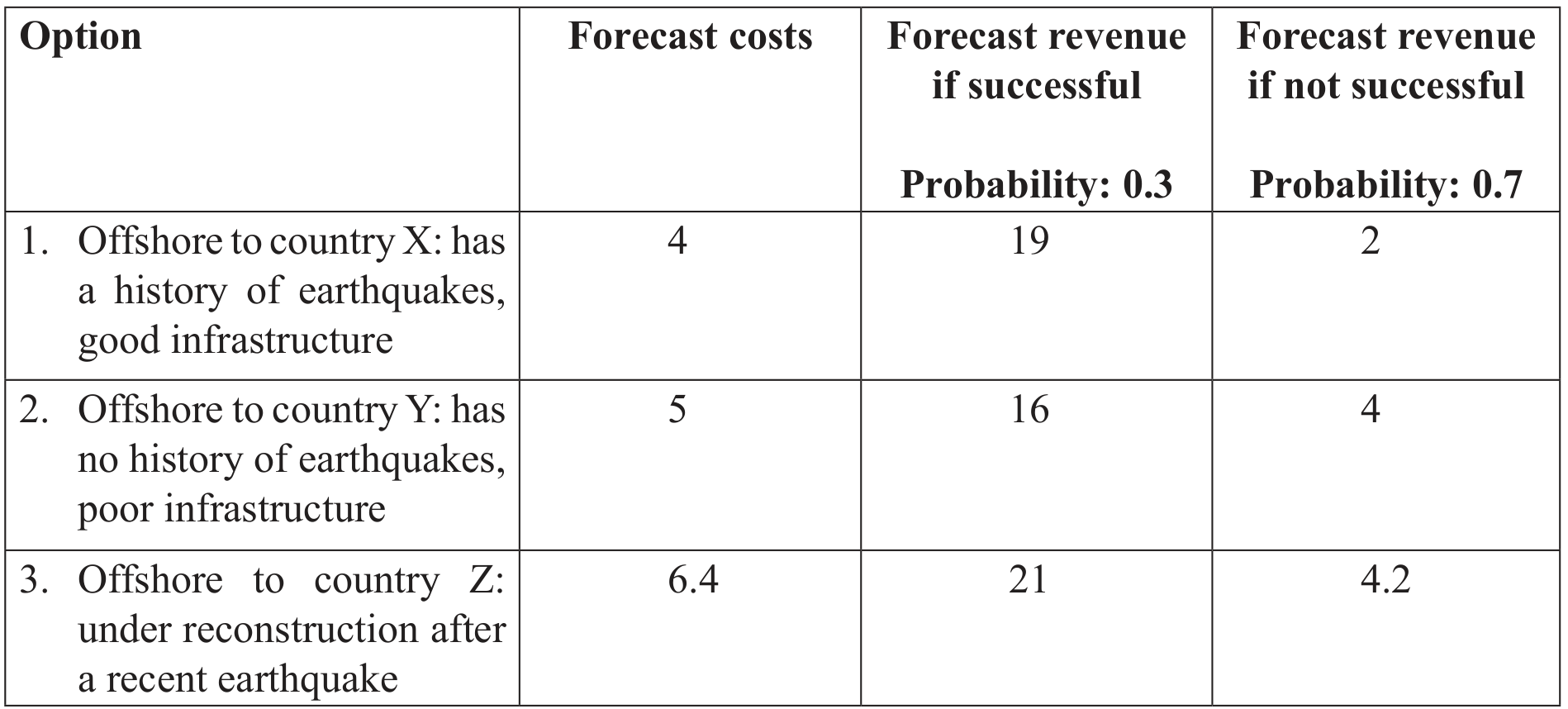
Table

The forecast costs of subcontracting to the same Asian countries are given below:

Country X: US$1.5 million.
Country Y: US$2.8 million.
Country Z: US$4.2 million.

\footnotetext{
* bodyguard: a person who is responsible for protecting a person from harm
}
The three suitable Asian countries are located in earthquake zones. An earthquake expert assured Trent that all three areas are safe. Trent is concerned and decides to prepare a contingency plan for each possible location in Asia.

Control over recruitment and training of bodyguards is vital to S P. Customer service and trust are their unique selling propositions (USP). Clients will pay high fees to ensure their safe transport to concerts, meetings and important events. However, Trent is refusing valuable contracts in Asia due to a lack of suitably trained bodyguards. As a result S P is missing out on large profits.

Trent has mentioned to a previous customer of his plans to subcontract the recruitment and training of bodyguards. She has threatened not to use S P again and would tell her friends if the plans went ahead. Trent is concerned as word-of-mouth promotion is crucial to S P.

He calls a meeting of all the partners. Three partners prefer subcontracting the recruitment and training as it is cheaper, quicker and less risky. The three other partners prefer offshoring. They believe that subcontracting will damage SP's USP. They argue that the higher costs of offshoring will be covered by the forecast high revenue.

Question 1(b)

(a)

Explain two benefits and one cost to S P of preparing a contingency plan of the three possible locations in Asia.
[ 6 ]

Question 2

[Maximum number: 12]

2. Crisis management and Mapa

Image removed for copyright reasons

The Portuguese company Mapa manufactures a handheld global positioning system (GPS)* device. In the winter of 2012, Mapa received reports that its GPS devices often failed in extremely cold weather. According to the media, the problem first appeared in 2011, when mountain climbers with the Mapa GPS devices discovered inaccuracies in the coordinates the devices provided. Rumours of the GPS failure began to circulate in the climbing community. Then, after several accidents in the mountains, including fatalities, television news programmes began to report the problem. Only then did Mapa begin to take action.

Engineers concluded that the problem resulted from where and when the quality testing was being performed. The production of a component part outsourced to a company in Iceland was being quality tested in Portugal in the summer. There was also poor communication between the producer of the component part and Mapa because of differences in language and culture.

Mapa's tall organizational structure, bureaucracy (and bureaucratic corporate culture) and centralized decision making meant that no manager acted until the Chief Executive Officer (CEO) formally apologized. As a result, Mapa had taken too long to admit that there was a problem and so consumer confidence fell and Mapa's reputation suffered.

The production process of the GPS device is shown in the table below:

Table

\footnotetext{
* global positioning system (GPS): provides location, including geographic coordinates and time information to users anywhere on earth as long as their receivers (commonly a handheld device such as a smartphone with a GPS application) have unobstructed lines of wireless transmission to various GPS satellites
}

Question 2(c)

(a)

Using a (cause-and-effect) fishbone diagram, explain why Mapa was slow to respond to the problem with its GPS devices.

[ 6 ]

Question 2(d)

(b)

Examine the importance of communication for Mapa in its management of the crisis.

Answer two questions from this section.

[ 6 ]

Question 4

[Maximum number: 4]

M M uses just-in-time (JIT) production in its Oil Production Division.

The long-term demand for oil is usually predictable, and production is reliable unless major problems occur. In 2020, however, there was an unexpected decrease in demand for oil. Uncertainties in the world economy and responses to climate change now make predictions more difficult.
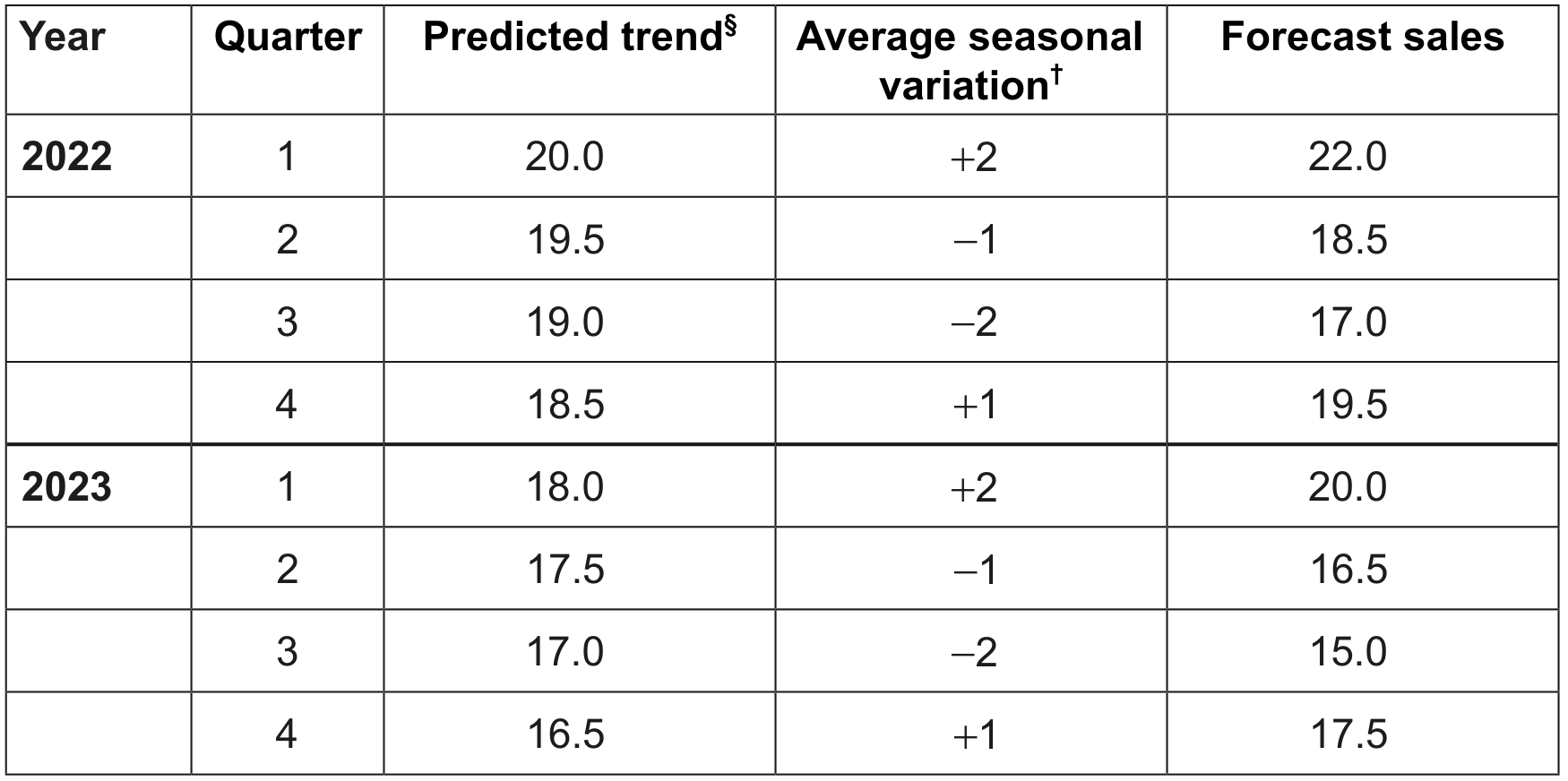
M M has prepared a sales forecast for its oil production for 2022 and 2023 (Table 2).

Table 2: Sales forecast for oil production for 2022 and 2023 (millions of barrels)

Table 2: Sales forecast for oil production for 2022 and 2023 (millions of barrels)

§ calculated using a four-quarter moving average based on six years of historic data
† calculated by comparing actual sales with a four-quarter moving average

In 2020, M M had some major problems:
- A catastrophic fire occurred at one of its oilfields.
- The gold mine in Egypt collapsed, trapping 23 miners.
- It experienced a cyber-attack on its computer network.
- An earthquake in Chile damaged the country's transport system.

In response to these problems, M M had to rely on its contingency planning and its crisis management procedures.

JG Mining (JG) wants to buy MM's tar sands mining operation for $50 million, but the board of directors are divided. MM recently invested $15 million in their tar sands operation in addition to the original $ 30 million set-up cost in 1986 . Production is at designed capacity, and, although the long-term average rate of return (ARR) for the tar sands operation is below those of most of MM's other investments, it provides a reliable source of income. However, M M has difficulty selling sulphur, a by-product of tar sands production.

Employees at the tar sands operation are against selling the operation to JG. However, the income from the sale would help M M finance other investments, such as lithium mining, and the sale could help improve MM's corporate image. MM's Finance Director, Ethan, estimates that the net present value (NPV) of the tar sands operation is $46 million.

Question 4(c)

(a)

With reference to M M, explain the difference between crisis management and contingency planning.

[ 4 ]

Question 4

[Maximum number: 2]

In January 2021, a respected guide to universities rated P U top in two categories:
- Sustainability - for reducing its pollution, waste and carbon footprint.
- Teaching excellence - for developing innovative teaching methods resulting in highly positive feedback from students.

Before the accident at the nearby chemical plant in September 2021, PU's student accommodation and teaching facilities were highly rated. However, the university was rated poorly for digital innovation and support services, with support staff not always understanding the needs of students.

In surveys, students generally rated P U highly for the quality of its courses and facilities. The campus was also voted one of the best in the country, but this changed after the accident.

After the accident, P U continued to experience unexpected changes to its culture:
- The level of diversity in classes and university accommodation has fallen, as there are fewer international students.
- The shortage of students has meant a continuing fall in income for P U. This has increased competition between faculties for available finance.
- Less time and effort is spent on student welfare.
- Lecturers have to meet demanding targets to produce online courses and materials.
- There is greater emphasis on contingency planning.

The government grants received by P U for the purchase of IT equipment did not address all equipment shortages. Due to an increase in online teaching, P U purchased 500 laptops for students, at a cost of $ 500 each. Each laptop has a useful life of three years. After three years, each laptop will be sold to local schools for $ 50.

Question 4(a)

(a)

Define the term contingency planning.

[ 2 ]

Question 4

[Maximum number: 2]

MSS is in Central Tanzania. This area of the country is subject to severe droughts every few years, and in other years there can be very heavy rain, causing floods and significant damage to roads. Malaria has been a concern, but a government health scheme is reducing cases of this disease in children of school-going age. Jacob is considering having a school contingency plan for such natural disasters.

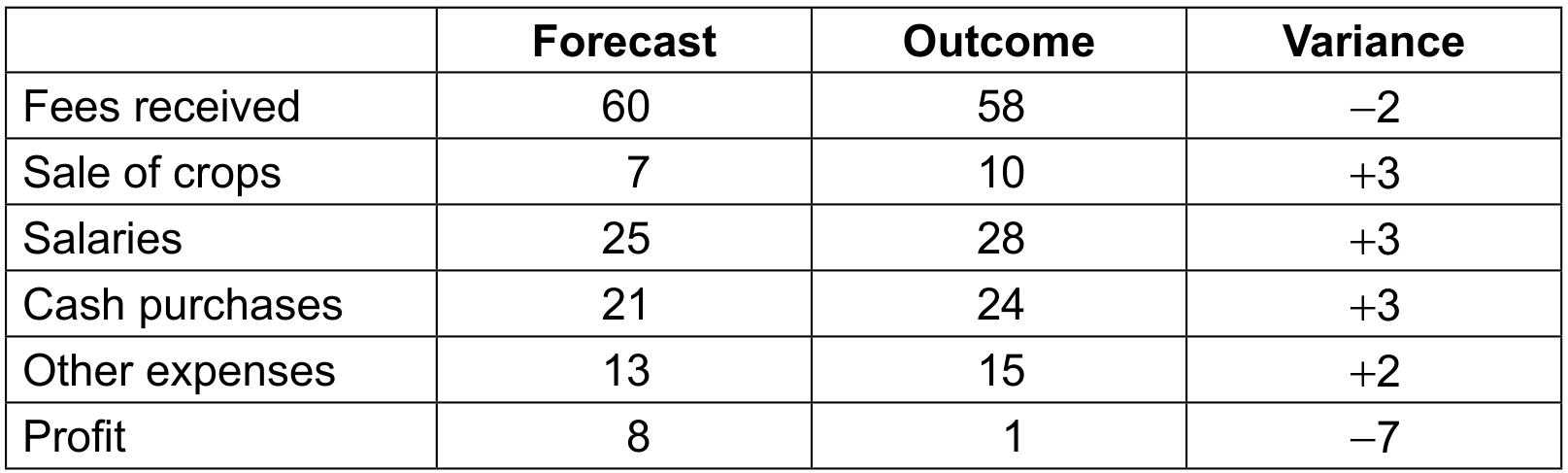
Jacob is concerned that the financial position of the school is not as good as it could be. He has prepared a variance analysis for the most recent six months.

Table 1: Variance analysis for the most recent six months (figures in \$000s)

Table 1: Variance analysis for the most recent six months (figures in \$000s)

Jacob recognizes the need for change, but his experience tells him that change needs careful management and that if something works well it is best left alone. He is planning to create an internet connection for the school to help teachers and students to access more educational resources. However, this is likely to be expensive and a technical challenge due to the school's remote location and underdeveloped infrastructure. He also has plans to improve classroom facilities, but the school does not, at the moment, have sufficient finance.

Mrs K is discussing with Jacob ways in which the school could become more efficient and improve examination results. She wants to increase teacher contact time with students. This would mean a better use of resources and should help students to learn more. She also wants teachers to observe each other's lessons with the aim of making suggestions for improvements of teaching and learning methods. There could be additional duties for teachers, such as supervising students' spare time and study time. Supervision is particularly important at weekends, when some teachers currently go home to their families.

Question 4(a)

(a)

Define the term contingency plan.

[ 2 ]

Question 4

[Maximum number: 4]

SVT organizes each of its water treatment plants as a profit centre. SVTs water treatment plant in a Middle Eastern country extracts water from a local river to supply households in Dalgera, the capital city. In 2019, many people complained about the water's bad taste. A television documentary suggested that SVT was negligent.

SVT investigated and found that employees at its water treatment plant had failed to treat the water properly. This failure resulted in lead* from inside old pipes entering the water that was supplied, exposing the inhabitants of Dalgera to water with high levels of lead.

In 2020, SVT dismissed the regional director of Dalgera and installed automated monitoring equipment (which was already being used in its European water treatment plants) in all of SVT plants across the world. This equipment, which monitors lead levels, costs $ 100 million and depreciates on a declining-balance basis at a rate of 20 % per annum to a residual value of $ 10 million. However, in 2021, a court ordered SVT to pay $ 300 million in damages to the affected people in Dalgera, which was widely publicized across the world, badly damaging SVT's brand image.

By 2022, the global home water filter market was $14 billion, and 90\% of SVTs water filter sales were to Europe and the USA. SVT now wants to increase sales in Asia, a market with significant growth potential. In the same year, SVT closed its European and USA water filter manufacturing factories, partly because of increasing costs of energy and labour. These factories were replaced by a huge new factory in Asia.
* lead: a chemical element that is a soft, heavy, grey metal. In the past, it was widely used to make pipes, cover roofs, and in paint; it is harmful when ingested

Question 4(c)

(a)

Explain two ways in which effective contingency planning at SVT could have prevented the problems experienced in Dalgera.

[ 4 ]

Question 2

[Maximum number: 6]

2. Icarus
Icarus is an adventure tourism company. It has developed a family brand of innovative tourism products, such as the World's first underwater theme park. Its next objective is to build the first hotel in outer space by 2016. Icarus conducted market research using stratified samples of businessmen/businesswomen and families with incomes over $ 10000000. Most said that they would pay the proposed price of $ 140000 per room per night. Although the hotel should create significant profits, Icarus' Board of Directors is concerned about both safety and financial risks.

Question image

Icarus has invested significant funds to develop safety procedures and to train the employees of the future hotel. Icarus wants to protect its brand image as the most trusted adventure tourism company in the world.

The hotel will have a capacity of 500 rooms. Originally (in 2012) Icarus forecasted the following (in $):
- price per room per night (room rate): 140000
- fixed costs: 10000000
- variable cost per room per night: 100000 .

Now (in 2013) the costs of construction, fuel and insurance have increased and affected the forecast. To ensure a 2016 opening, Icarus has identified a potential investor. The problem is that he expects a $ 2000000 guaranteed (target) profit in the first year, but Icarus has promised not to increase its room prices. The following shows the revised forecasted figures (in $):
- price per room per night (room rate): 140000
- target profit required by investor: 2000000
- fixed costs: 12000000
- variable cost per room per night: 108000 .

The Board of Directors are concerned that:
- keeping room prices the same will reduce profits
- other adventure tourism companies are considering entering the outer space tourism market
- withdrawing from the project would damage Icarus' brand image and would cost millions of dollars.

Question 2(e)

(a)

Analyse Icarus' decision to open the first hotel in outer space.

Answer two questions from this section.

[ 6 ]

Question 5

[Maximum number: 12]

Just before the Board of Directors voted on "RDB 2020", Anna Holstein had a serious car accident. She would require years of physical therapy before working again.

Board members now have two important decisions to make:
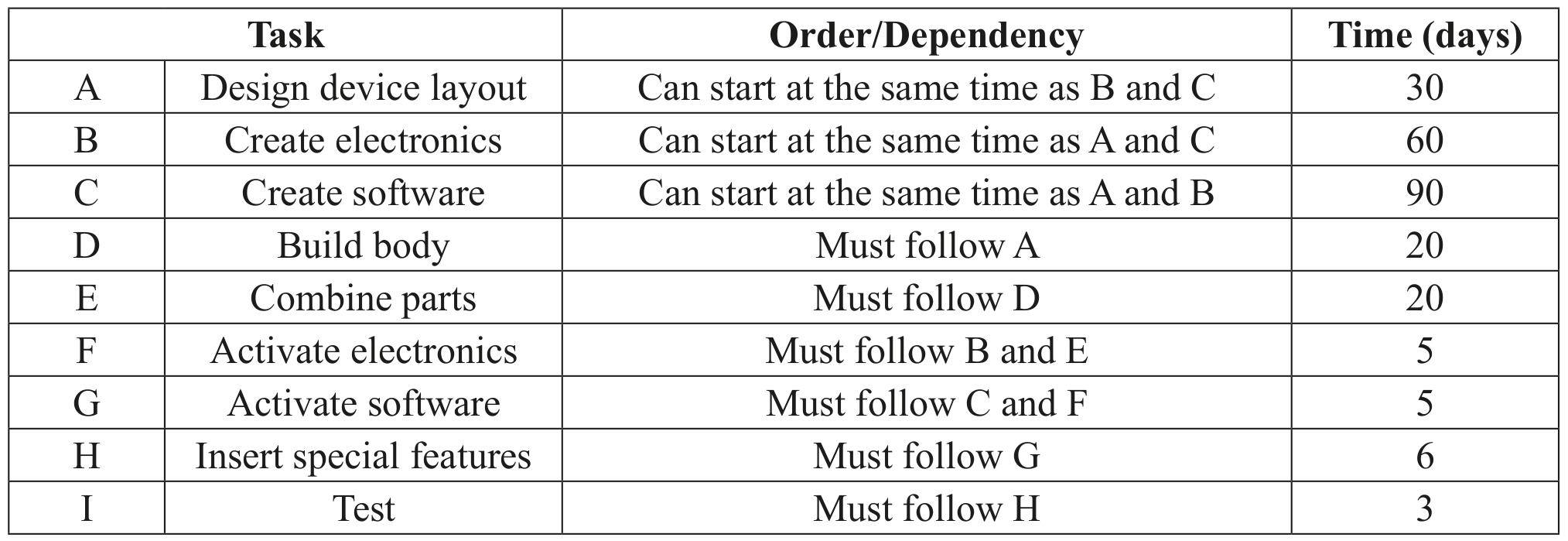
- Whether to approve the "RDB 2020" strategic plan. Despite Valdemar Holstein's opposition, some board members still supported it, especially because of a recent workforce planning study (Item 1). To help them decide, the board requested and received a decision tree and critical path analysis (Items 2 and 3).
- Who would replace the 83 -year-old Valdemar? The succession plan had always been to promote his daughter Anna to Chief Executive Officer (CEO).

There are two candidates for Valdemar's post:
- Jens Holstein, 68, is Valdemar's younger brother. He currently manages the large law firm responsible for most of RDB's legal affairs. He understands all the legal issues related to "RDB 2020". He always pays close attention to detail. In the law firm, he is well respected for his efficient management style, although some lawyers feel that he monitors their work too closely.
- Per Pederson, 44, is the manager of RDB's Swedish megafactory. Though originally hired because of his engineering degree, he was rapidly promoted thanks to his excellent "people skills". Quickly bored with budgeting and industrial planning meetings, Per preferred building relationships with employees and mentoring junior managers. He loved talking to workers and giving speeches about RDB. Valdemar was proud of having "discovered" Per, though some employees criticise his lack of attention to detail.

Regarding the management succession, Valdemar said that "choosing between Jens and Per is the same as choosing between a manager and a leader: it is a key strategic decision for R D B ".

Question 5(d)

(a)

Using information contained in the case study and Items 1 to 5, discuss how R D B could plan strategically for any future crises.

[ 12 ]
0 selected