
EduNinja

IB Business Management HL2.1 Introduction to human resource managementQuestion Bank

Question 1

[Maximum number: 4]

1. Creative Toys (CT)
Creative Toys (CT) manufactures toys and markets them business-to-customers (B2C) online only. The business operates in a leased industrial site and relies on word-of-mouth promotion only. To make customers believe that CTs toys are better than its competitors, CT sets prices slightly higher than the competition. Production and sales are mostly between 1 October and 24 December. Most of the employees work on temporary contracts during this busy period. For the remainder of the year, CT operates well below capacity utilization.
Table 1 contains selected data for CT, for 2014:
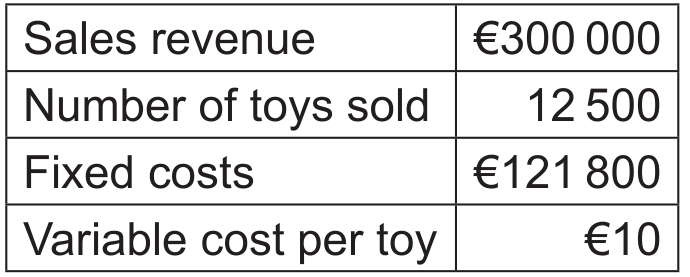
Table 1

Table 1

In 2014, the management of CT considered a change of the marketing mix to include above the line promotion, lower prices, and an additional sales method called "toy parties". Toy parties would be hosted by newly recruited CT sales representatives and attended by parents and their children. At the parties parents could see the toys and children could play with them. Sales would be made at the parties by the new sales representatives, who would be paid on a commission-only basis.

Toy parties could be held throughout the year and make CTs total sales less seasonal. Based on market research, management has estimated that the parents' demand for toys is price elastic and is planning to set lower prices for all toys sold online and at toy parties. The management has prepared forecasted financial data for CT, for 2015, based upon the proposed change to the marketing mix, shown in Table 2 below.
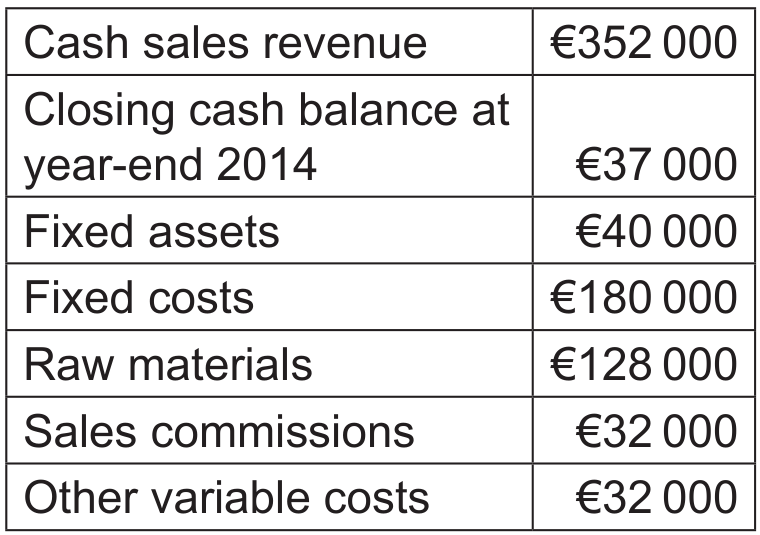
Table 2

Table 2

The Finance Manager will carry out a variance analysis in order to determine whether the proposed change to the marketing mix has been successful.

Question 1(c)

(a)

Explain two possible human resource implications for CT's management given the proposed change to introduce "toy parties" as an additional sales method.
[ 4 ]

Question 4

[Maximum number: 4]

In 2010, ELE owned 4.5 % of the European Union (EU) car rental market. In 2019, ELE's car rental division had revenues of EUR 0.9 billion in a market worth EUR 16.8 billion. Initially, ELE only provided car rentals in its gasoline stations in Belgium. By 2014, ELE had expanded the service to its stations in France, Spain and the UK.

In 2016, Giselle also reorganized ELE's car rental offices so that each office operated as a profit centre. An entrepreneurial approach was adopted. Office teams received substantial bonuses if they exceeded profit targets, but only offices that met their targets qualified for these bonuses. These targets were set, without consultation, by Giselle. Over a five-year period, targets were met by 85 % of offices. Giselle's reorganization was not welcomed by employees.

In 2021, Monica recommended that ELE trial the business model she had proposed for the new In3T brand in two major cities in the EU for one year: if successful, the brand and its model could then be launched in all major cities in the EU. Monica said, "We must do it. I'm convinced that our rivals will adopt this business model within two years. If we don't act now, we will be left behind and our rivals will beat us to it."

Giselle, however, disagreed strongly. She had built the car rental division from its inception. She believed high levels of customer service and well-trained staff were two reasons why the car rental division remained successful. She was also unhappy with the EUR 100 million cost and payback of three years.

Question 4(c)

(a)

Explain two reasons why ELE's employees may have resisted the reorganization implemented by Giselle.

[ 4 ]

Question 4

[Maximum number: 4]

If RDM builds a new production facility in Europe, an immediate consequence will be an increase in capacity. At current levels of output this would lead to a reduction in capacity utilization. The current output of RDM's factory is 20000 units a year, with a productive capacity of 21000 units a year before the new facility is built. If the new production facility is built, the greater capacity for the whole business will, at current levels of output, result in the capacity utilization falling to 50 % until production at the new facility starts.

Xi, the marketing manager, suggests that this increased capacity provides the opportunity for market development to be achieved by entering the United States (US) market.

The US market has similarities with Europe, with an aging population and low birth rate. Demand for customized healthcare devices is high. However, the healthcare system in the US is very different, with a much greater role for private sector healthcare compared to Europe, where much of the healthcare is state funded. In the US, 18 % of gross domestic product (GDP) is spent on healthcare compared with an average of 11 % in Europe. Advertising spend in the US is very high for the typical healthcare equipment business, which uses TV and the internet to reach individuals, whereas in Europe healthcare equipment businesses typically negotiate with government organizations. Average incomes in the US are higher than in Europe. Competition in the US is very high, although some major healthcare equipment businesses dominate the market. Industrial/ employee relations in the US are generally more decentralized than in Europe, with a lower level of unionization.

To assess the best way to enter the US market, some senior managers may have to move to the US and Xi may need to recruit some new staff in the US with specialized knowledge of US laws and regulations, as well as some additional marketing employees. Xi is aware that industrial/ employee relations are different in the US.

Existing staff will have to get used to new ways of working and are concerned about having to work with new staff in the US.

Question 4(c)

(a)

Explain two possible reasons for RDM employees' resistance to change if RDM enters the US market.

[ 4 ]

Question 4

[Maximum number: 10]

MSS is in Central Tanzania. This area of the country is subject to severe droughts every few years, and in other years there can be very heavy rain, causing floods and significant damage to roads. Malaria has been a concern, but a government health scheme is reducing cases of this disease in children of school-going age. Jacob is considering having a school contingency plan for such natural disasters.

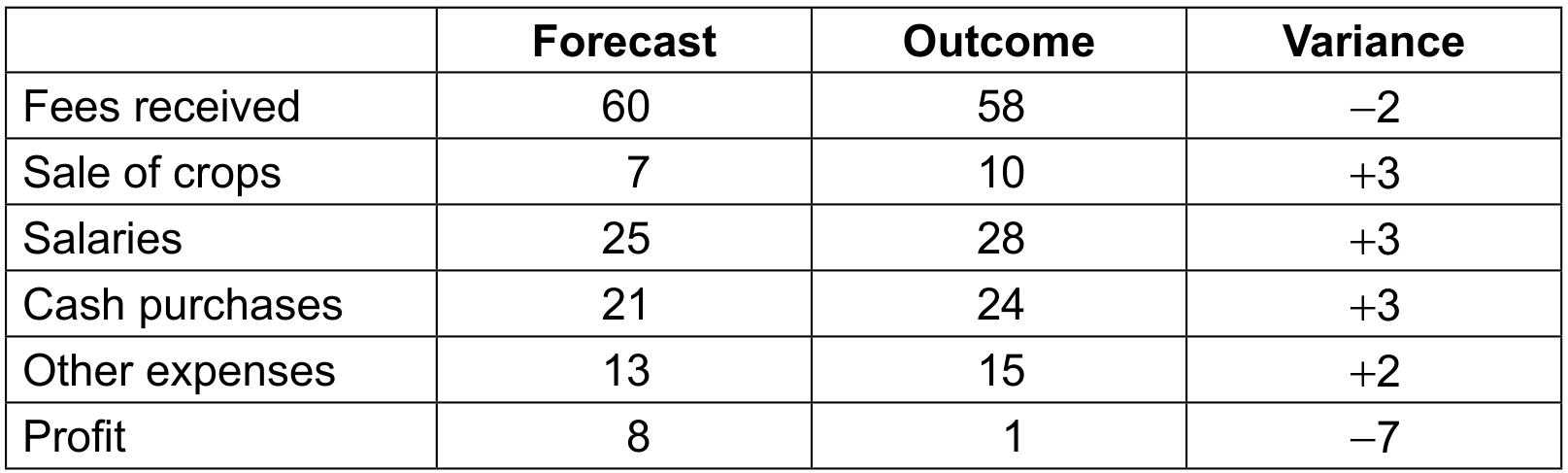
Jacob is concerned that the financial position of the school is not as good as it could be. He has prepared a variance analysis for the most recent six months.

Table 1: Variance analysis for the most recent six months (figures in \$000s)

Table 1: Variance analysis for the most recent six months (figures in \$000s)

Jacob recognizes the need for change, but his experience tells him that change needs careful management and that if something works well it is best left alone. He is planning to create an internet connection for the school to help teachers and students to access more educational resources. However, this is likely to be expensive and a technical challenge due to the school's remote location and underdeveloped infrastructure. He also has plans to improve classroom facilities, but the school does not, at the moment, have sufficient finance.

Mrs K is discussing with Jacob ways in which the school could become more efficient and improve examination results. She wants to increase teacher contact time with students. This would mean a better use of resources and should help students to learn more. She also wants teachers to observe each other's lessons with the aim of making suggestions for improvements of teaching and learning methods. There could be additional duties for teachers, such as supervising students' spare time and study time. Supervision is particularly important at weekends, when some teachers currently go home to their families.

Question 4(d)

(a)

Discuss human resource strategies that could reduce the impact on employees of the changes suggested by Mrs K.
Section C
Answer the following question.

[ 10 ]

Question 3

[Maximum number: 10]

3. Healthy Nation (HN)
Healthy Nation (HN) is a pharmaceutical organization that used to operate in the public sector, selling its medicines (drugs) to hospitals at very low prices.
With increasing government funding over several years, H N increased the number of employees in its Research and Development Department, which was staffed by scientists, and in the Manufacturing Department. However, both departments were inflexible and inefficient. Resources were significantly under-utilized, and innovation limited.
HN's structure used to be hierarchical, with a very long chain of command and channels of communication. Senior management made the decisions and set the production levels. Consequently, the scientists in the Research and Development Department never developed decision-making skills, and development of new medicines was slow. In 2021, after many years of losses, the government sold H N to a profit-maximizing global pharmaceutical manufacturer, Global Pharma (GP).
To improve productivity, efficiency and flexibility, the management of GP reorganized HN as a shamrock organization by:
- outsourcing the production function to a well-known manufacturer
- retaining the Research and Development Department, along with its scientists and support staff, and employing additional staff when required.
In addition, two major changes were announced:
- Establishing performance-related pay for the scientists based on a new appraisal system to increase productivity levels.
- Using an expensive external company to provide cognitive training to the scientists to develop innovative decision-making and improve teamwork.
These changes have proved to be very unpopular, and the scientists in particular are resisting the changes and the short time frame in which they will be implemented.

Question 3(d)

(a)

Discuss two human resource strategies that GP could use to reduce the scientists' resistance to the changes.

[ 10 ]

Question 3

[Maximum number: 4]

3. KA
K A is a public limited company that designs, manufactures and sells air conditioners. K A 's unionized employees are motivated and efficient despite not being involved in any decision making. However, they are resistant to change.
The market and competition for air conditioners are growing rapidly. K A operates at full capacity but stock turnover has slowed.
Primary market research revealed that:
- consumers do not differentiate KA air conditioners from those of its competitors. All products are perceived as medium price and medium quality
- KA's customer service is rated as poor
- customers demand energy-efficient products using ecologically sustainable production methods.
To exploit opportunities and overcome weaknesses and threats, KA's management has decided to redesign its products so that they are energy efficient. K A is considering two options:
- Option1: Implement lean production methods, which includes investing in ecologically sustainable machines that will increase capacity by 10 %. Total quality management (TQM) will also be implemented. However, the financial manager is worried about K A 's ability to meet high initial costs. The forecasted payback period is three years and average rate of return (ARR) is 4 %.
- Option 2: Outsource the production to QS, a company known for its reliability and high capacity to produce excellent quality air conditioners using cradle to cradle manufacturing principles. However, QS refuses to sign an exclusive long-term contract with KA, insisting instead on renegotiating the contract every two years. KA will have to close its production facility and will use the cost savings to improve customer service and to reposition and differentiate its air conditioners.
Employees have heard rumours of both options and fear for their jobs. Strike action is being considered.

Question 3(c)

(a)

Explain two possible human resource strategies that K A management could use to reduce employees' resistance to change.

[ 4 ]

Question 5

[Maximum number: 9]

Martin Kimathi received shocking news: G P had sold The Imperial to the National Wealth Fund (NWF) of Kumali, a small Arabian country.

NWF representatives told Martin that as long as he agreed to assist them in bringing about the changes that were best for N W F, he could keep his job for at least three years.

NWF is considering the following two strategies:
Modified Option 1: extensively upgrade The Imperial in order to make it one of the most luxurious hotels in Africa. Although this strategy is similar to Option 1, the renovation of the hotel would be to a much higher standard. Martin read a consultant's engineering report (Item 1) indicating that The Imperial would be closed for 18 months for the renovation.

To implement modified Option 1, NWF representatives would need Martin to do the following:
- promote Susan Chapman to Assistant Manager.
- dismiss all other employees within 60 days.
- develop a workforce plan according to NWF Human Resources Guidelines (Item 2).

Modified Option 2: half the hotel would be converted to apartments for sale, all the spare land converted to a golf course, and the other half of the hotel kept open as a hotel which would be gradually renovated over 9 months. Martin and Susan would keep their current jobs. Around half of the remaining employees would be made redundant. The other half could keep their jobs during the renovations, but their positions would be reviewed after 6 months according to NWF Human Resources Guidelines (Item 2).

Question 5(d)

(a)

Analyse N W F 's human resource plan for The Imperial.

[ 9 ]

Question 5

[Maximum number: 2]

General Diane Pierce concluded that building a hospital was a better option than building a university.

The situation around Beral was deteriorating (Item 1). Soon the city would be unable to obtain sufficient food supplies. Moreover, the loss of control of the area surrounding Beral would psychologically impact on the residents, perhaps causing greater resistance to the UWP Mission. General Pierce decided to increase the frequency of the UWP patrols in the UWP-protected area. This, however, would require several changes to the overall plan for the UWP Mission in Beral. With an increase in the frequency of patrols, fewer troops would be available for the construction project.

General Pierce instructed Colonel Michael Donovan to prepare a new critical path analysis. He developed two possible timetables and approaches to constructing the hospital (Items 2 and 3). Either way, completing the project would take longer than 30 weeks as originally planned. Colonel Donovan also recommended a change to the workforce planning scheme, shifting from a traditional construction approach where the construction team moves from one job to the next sequentially; to a cell production approach where smaller teams work simultaneously on different jobs (Item 5). He warned, however, that regardless of the approach taken, building the hospital under the new circumstances would put huge physical and mental pressure on the troops. In light of the deteriorating situation in Beral, Colonel Donovan's warnings, and of recent demographic data about Loyka (Item 6), General Pierce had to re-evaluate her strategy of building a hospital.

Question 5(a)

(a)

Identify two factors that may affect the UWP's workforce planning in Beral.

[ 2 ]

Question 5

[Maximum number: 2]

5. Frez PLC (FR)
Frez PLC (FR) has 6000 employees in its 100 supermarkets and 250 in its head office. FR operates a 360-degree feedback appraisal system for head office employees. FR's directors believe that this system has improved retention and morale of head office employees. This year, to reduce head office costs, FR offered head office employees the option of teleworking, which 60 % accepted. They will work at the head office only one day per month.
Each FR supermarket has 10 departments. Departmental managers have concerns about their workload caused by their large span of control. Labour turnover at F R supermarkets is increasing each year because departmental managers are leaving. In January, FR increased its supermarket opening hours and hired an additional 1000 part-time employees. FR is considering extending its 360-degree feedback appraisal system to all supermarket employees.
Recently, demand from supermarket shoppers for a home delivery service increased, although industry experts disagree on whether this demand will continue. FR's main competitors already provide delivery services.
FR has decided to launch a home delivery service. It will require 500 vans, which would be replaced every five years. FR is considering two options:
- Option 1: purchase the vans at a unit cost of $ 34000 each, financed by a five-year bank loan at 3 % interest.
- Option 2: Lease the vans at a unit cost of $ 13000 per year per van. The minimum term for the lease will be 24 months.
FR already borrowed $50 million in 2019 to finance the modernization of its supermarkets.

Question 5(b)

Question 5(b)(ii)

(a)
(i)

Explain one disadvantage for F R, other than the impact on employee motivation, of introducing teleworking.

[ 2 ]

Question 5

[Maximum number: 2]

Just before the Board of Directors voted on "RDB 2020", Anna Holstein had a serious car accident. She would require years of physical therapy before working again.

Board members now have two important decisions to make:
- Whether to approve the "RDB 2020" strategic plan. Despite Valdemar Holstein's opposition, some board members still supported it, especially because of a recent workforce planning study (Item 1). To help them decide, the board requested and received a decision tree and critical path analysis (Items 2 and 3).
- Who would replace the 83 -year-old Valdemar? The succession plan had always been to promote his daughter Anna to Chief Executive Officer (CEO).

There are two candidates for Valdemar's post:
- Jens Holstein, 68, is Valdemar's younger brother. He currently manages the large law firm responsible for most of RDB's legal affairs. He understands all the legal issues related to "RDB 2020". He always pays close attention to detail. In the law firm, he is well respected for his efficient management style, although some lawyers feel that he monitors their work too closely.
- Per Pederson, 44, is the manager of RDB's Swedish megafactory. Though originally hired because of his engineering degree, he was rapidly promoted thanks to his excellent "people skills". Quickly bored with budgeting and industrial planning meetings, Per preferred building relationships with employees and mentoring junior managers. He loved talking to workers and giving speeches about RDB. Valdemar was proud of having "discovered" Per, though some employees criticise his lack of attention to detail.

Regarding the management succession, Valdemar said that "choosing between Jens and Per is the same as choosing between a manager and a leader: it is a key strategic decision for R D B ".

Question 5(a)

(a)

Referring to Item 1, identify for R D B one opportunity and one threat as a result of demographic changes forecasted in the twenty-first century.

[ 2 ]
0 selected