EduNinja

IB Business Management HL3.6 Efficiency ratio analysisQuestion Bank

Question 1

[Maximum number: 2]

1. Las Rosas (LR)
Las Rosas (LR) is a large commercial dairy farm owned and managed by the D'Aremberg family since 1986. It has 3800 cows. L R sells milk, cheese and yoghurts. In 1996, L R started to export some of its dairy products. Profits and cash flow have been improving year on year. L R has no outstanding loans and therefore its current gearing ratio is zero.
LR's unique selling proposition (USP) comes from the organic quality of its products as they are made without chemical additives. The cows' diet does not include hormones and other supplements. The farm's products also meet national and international quality standards.
LR's corporate culture encourages innovation and the use of cell production. To stay ahead of the competition L R has increased its spending on research and development (R\&D) and workers are given the opportunity to create new products, or to add value to existing ones. L R 's financial manager, however, believes that the R\&D budget is too high and needs to be cut. He also argues that there are too many legal constraints limiting the development of new products.
LR's management is considering buying El Remanzo, a large sheep farm located nearby. This acquisition will cost $ 24 million and L R will need to cut its R\&D budget to zero and organize a new loan to finance the takeover. A significant restructuring would need to occur at both L R and El Remanzo to allow both companies to combine resources and knowledge. However, the potential economies of scale experienced by L R could be substantial.
Total capital employed at L R is $ 45 million.
Table

Question 1(c)

(a)

Calculate the following for L R (show all your working):

[ 2 ]

Question 1(c)(iv)

(i)

the gearing ratio if the acquisition of E l Remanzo by L R is financed by a loan.
[ 2 ]

Question 2

Question 2(b)

(a)

Using data from the additional information on page 3, calculate RDB's:

[ 2 ]

Question 2(b)(ii)

(i)

stock turnover in 1965 and 1975.

[ 2 ]

Question 2(c)

(b)

Interpret your results from part (b).

[ 7 ]

Question 4

[Maximum number: 4]

Sam and Finn are having difficulties resolving their disagreements. Finn was convinced that the problems at AFA should be resolved by a change in the organizational structure. Sam, however, was convinced that he should strengthen the organizational culture. Sam reluctantly accepted the need for greater delegation but insisted that there should be more training for all employees on the culture and ethics of AFA.

As part of greater delegation, Kim was given responsibility for the relationship between AFA and its suppliers. Kim is concerned that she spends a lot of time chasing orders that do not arrive and dealing with the poor quality of orders. Some products have to be thrown away because they have passed their sell-by dates*. Others have to be returned to suppliers because the outlet managers do not accept the poor quality and therefore cannot be sold.

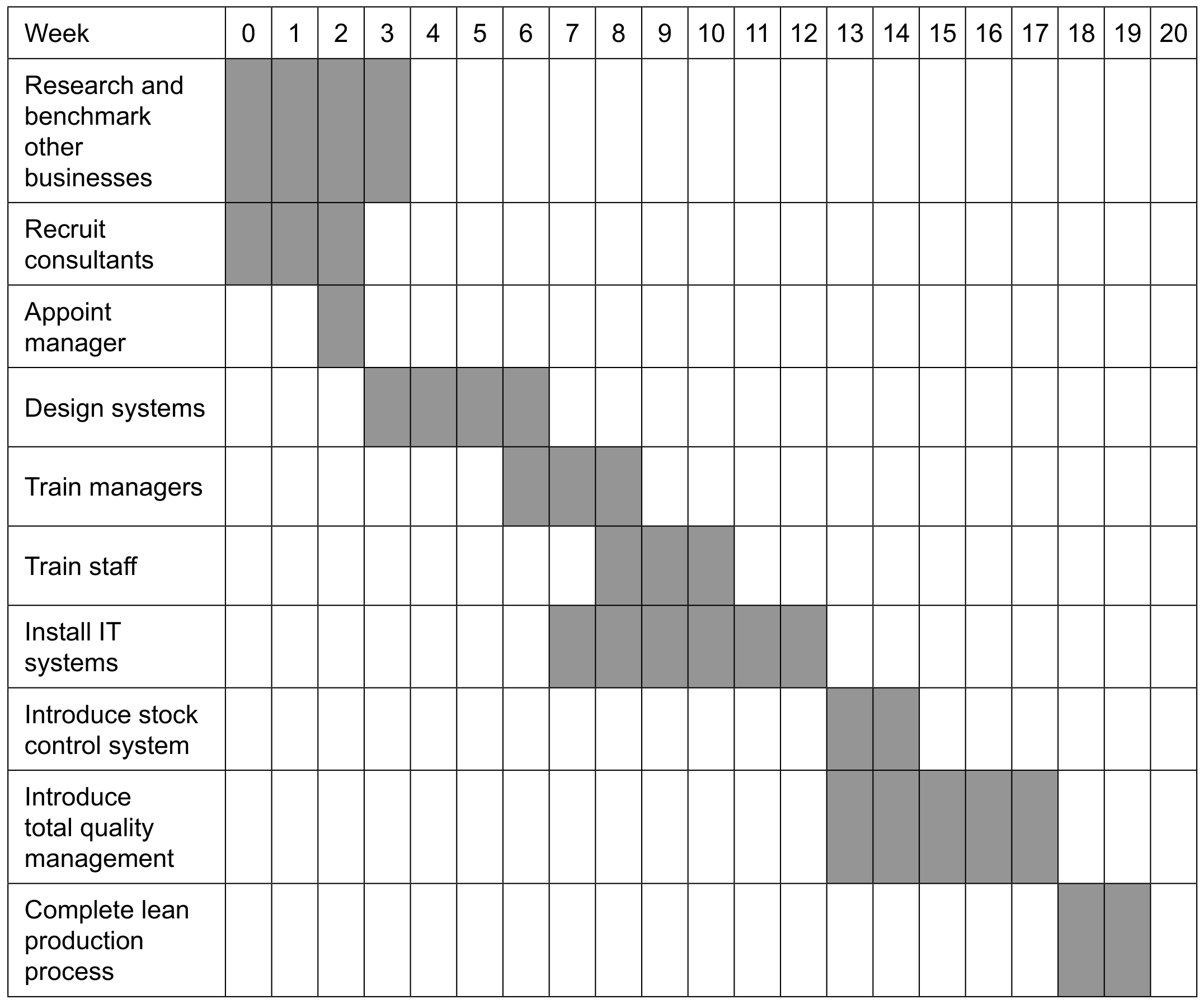
AFA's stock of fair trade woollen hats has now reached 500 , with an annual sales average of around 1250 for the whole business. Kim wants to introduce lean production including total quality management (TQM) throughout AFA's operations and has created a Gantt chart to show the stages in implementation.
* sell-by dates: dates printed on the packaging of products that state the date after which the product can no longer be sold.

Figure 1: Gantt chart for the implementation of lean production including TQM at AFA

Figure 1: Gantt chart for the implementation of lean production including TQM at AFA

Question 4(b)

Question 4(b)(i)

(a)
(i)

Calculate the inventory/stock turnover for woollen hats (show all your working).

[ 2 ]

Question 4(b)(ii)

(ii)

Comment on your result in (b)(i).

[ 2 ]

Question 4

[Maximum number: 2]

MM's growth has been helped by its unique selling point/proposition (USP) of rapid response to customer needs and by its high-quality customer service. New employees undergo detailed training to become skilled in:
- finding out what a customer's objectives are
- helping the customer work towards a marketing plan
- working closely with the customer as M M develops a marketing strategy for them
- maintaining links with the customer to provide an effective after-sales service.

The business takes a multicultural approach to its customers, employees and other stakeholders. MM's approach to diversity is one of the features that stakeholders say they like about the business. The company also ensures that it accommodates many cultural differences.

According to a business service that provides measures of social behaviour for every country, in British businesses:
- employees are accustomed to working in a competitive, individualistic society
- employees often take individual responsibility for their own actions and decisions
- competition is high between both employees and customers
- customers are accustomed to changing contracts when service is bad or competitors offer a better deal.

In comparison, Indian businesses:
- are based on power structures with a greater focus on teamwork than individuality
- are more likely to be hierarchical
- have greater loyalty from their customers
- have greater formality with their customers
- place importance on building business relationships
- are subject to greater variety in culture between businesses and regions.

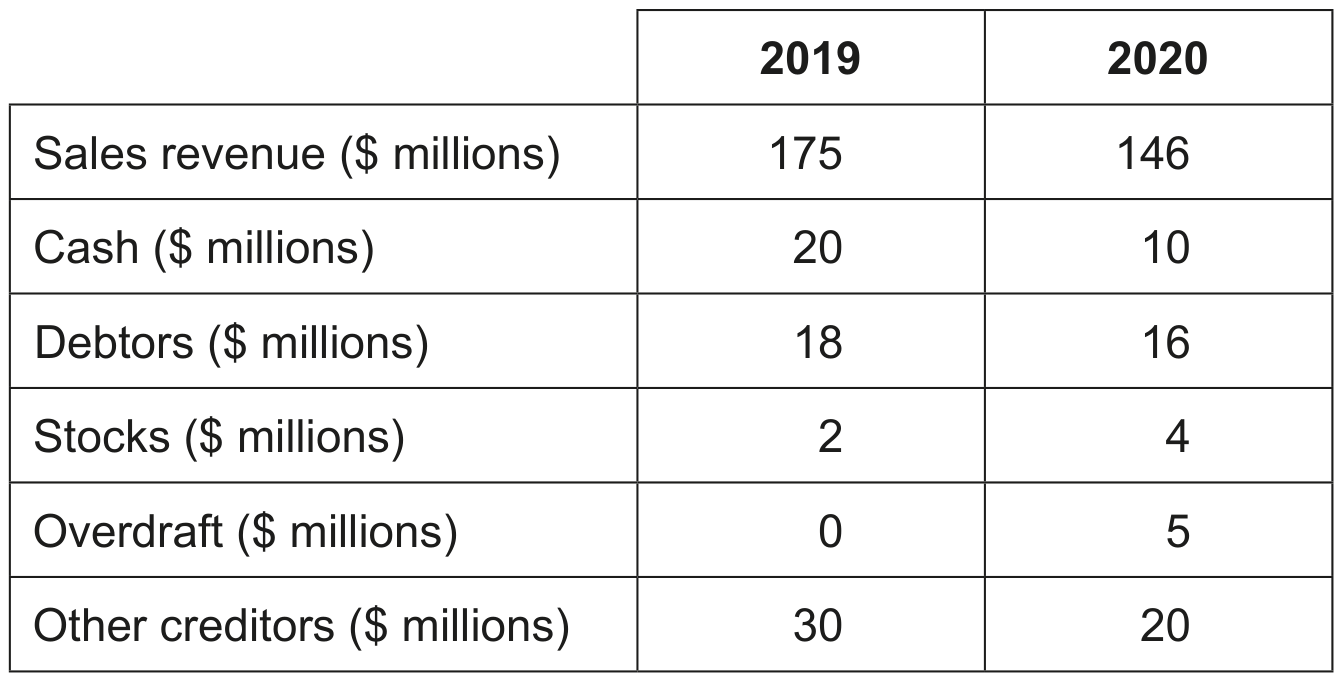
Maintaining high levels of customer service is expensive. MM has increasing costs (line 107). Rachel is concerned about MM's finances and is examining the latest accounts for the company for 2019 and 2020 (Table 1) to identify problems.

Table 1: Selected financial information for \(\boldsymbol{M

Table 1: Selected financial information for \(\boldsymbol{M

Question 4(b)

Question 4(b)(i)

(a)
(i)

Calculate the debtor days for M M at the end 2020 (show all your working).

[ 2 ]

Question 3

[Maximum number: 2]

3. The $ 1.99 toy shop
James Lai's toy shop is popular with no toy priced above $ 1.99. The toy shop uses psychological pricing at a level much lower than its competitors. James imports 90 % of his stock from China. It is located in a poor part of the city centre. Its target market is low-income families. The shop is very busy at weekends with a long queue (line) at the one cash register. Most employees are teenagers, who are very low paid.
Several stakeholder groups have complained:
- parents are concerned about the quality and safety of the toys and have set up an online social networking web site urging people to stop purchasing from the shop
- older customers have complained about the long queue at the one cash register
- one employee representative (union official) contacted James about employing teenagers on very low wages
- local toy manufacturers have questioned James' use of Chinese suppliers.
Competitors have argued that the $ 1.99 toy shop's psychological pricing method is unethical. James replied to stakeholder concerns, in a letter to a local newspaper, by stating that his shop allows young children to purchase affordable toys and provides job opportunities for teenagers. James has decided to create a social networking web site to respond to critics and to manage customers' perceptions.
James admits that the rate of stock turnover could be improved. He admits that the long queue is causing many customers to leave without buying anything. James is considering opening a second, larger toy shop called $ 4.99. He announced the opening on his social networking web site, informing stakeholders that he would stock higher quality products and have more cash registers. However, he immediately received negative online feedback from customers who saw the $ 4.99 toy shop as just a $ 3 price increase for the same toys.

Question 3(a)

(a)

Define the following terms:

[ 2 ]

Question 3(a)(ii)

(i)

stock turnover.

[ 2 ]

Question 4

[Maximum number: 2]

4. BDM
BDM manufactures motors used in small kitchen appliances. It operates in its original factory built in 1977, which is located near the centre of a large and growing city. Since 1977, property values have risen significantly and are forecasted to increase further. Most of BDM's workers purchased their homes decades ago and live near the factory. Younger workers, however, complain that accommodation near the city centre costs too much for them to live nearby. Older workers are loyal to the company and in many cases have specialized skills.
Recently, BDM's sales have rapidly increased through internal growth, and the factory should reach full capacity within several years. BDM's loyal customers value its unique selling proposition (USP): lower prices than competitors of comparable quality. Customers are small businesses located in the city which use BDM's motors to help with the manufacture of inexpensive appliances for local markets. 5 % of BDM's sales are made through business-to-business (B2B) e-commerce. Sales are increasing.
BDM is profitable. Stock turns over in 35 days and creditor accounts are settled in 30 days. Last year, BDM's sales revenue was $ 24000000 and its debtor's accounts balance was $ 2176000 at the end of its financial year. The industry standard of credit terms is for customers (debtors) to pay in 30 to 35 days. Because of the poor management of sales growth and use of just-in-case stock control, BDM has a liquidity problem.
To resolve its liquidity problem, B D M is considering two options:
- (Option 1) sell the factory and relocate to a much larger one located 27 kilometres from the city centre. The new factory (for BDM) would cost significantly less.
- (Option 2) sell the factory and lease it back from the purchaser. Change to just-in-time stock control management and shorten the credit terms given to customers from 30 to 15 days.

Question 4(c)

(a)

Calculate the debtor days ratio (show all your working).

[ 2 ]

Question 5

[Maximum number: 2]

As details about "RDB 2020" spread, several stakeholder groups began to express their concern. One stakeholder group was the workers, who were upset because of the planned closure of their workplaces. Another stakeholder group was the governments of Denmark, Germany and Sweden who wanted R D B to continue manufacturing in northern Europe. The three governments agreed to offer two incentives for R D B to remain.
1. All three governments promised to pay 25 % of the budgeted cost of making the R D B factories "green", if R D B chose to be a real "green" company. The budget for the renovations would have to be approved by the three governments before the work on the factories could begin. With this money from the government, R D B would not have to sell shares. Details of the governments' assistance and some of the implications were explained to Valdemar Holstein in a memo from Sofia de Carvahlo, RDB's Chief Financial Officer (Item 1).
2. In addition, the Danish government promised to feature the story of "Green Bearings, an RDB Company" (Valdemar's rebranding suggestion) as the lead article in the Danish Global Business Directory for 2015. This directory is well respected and is published annually by the Danish government. The directory is mostly purchased by public libraries and embassies. Gloria Woolrich, a marketing consultant, informed Valdemar that this would not be sufficient for R D B to successfully rebrand (Item 3).

Valdemar produced a simple decision tree framework to visualize the three strategic options:

Question 5(b)

(a)

Using relevant information from Item 2, calculate:

[ 2 ]

Question 5(b)(i)

(i)

the current gearing ratio for R D B.

[ 1 ]

Question 5(b)(ii)

(ii)

the forecasted gearing ratio for R D B after the conversion to "green" production.

[ 1 ]
0 selected