
EduNinja
[Maximum number: 4]

Fig. 1.1 shows a transmission electron micrograph of part of a chloroplast.
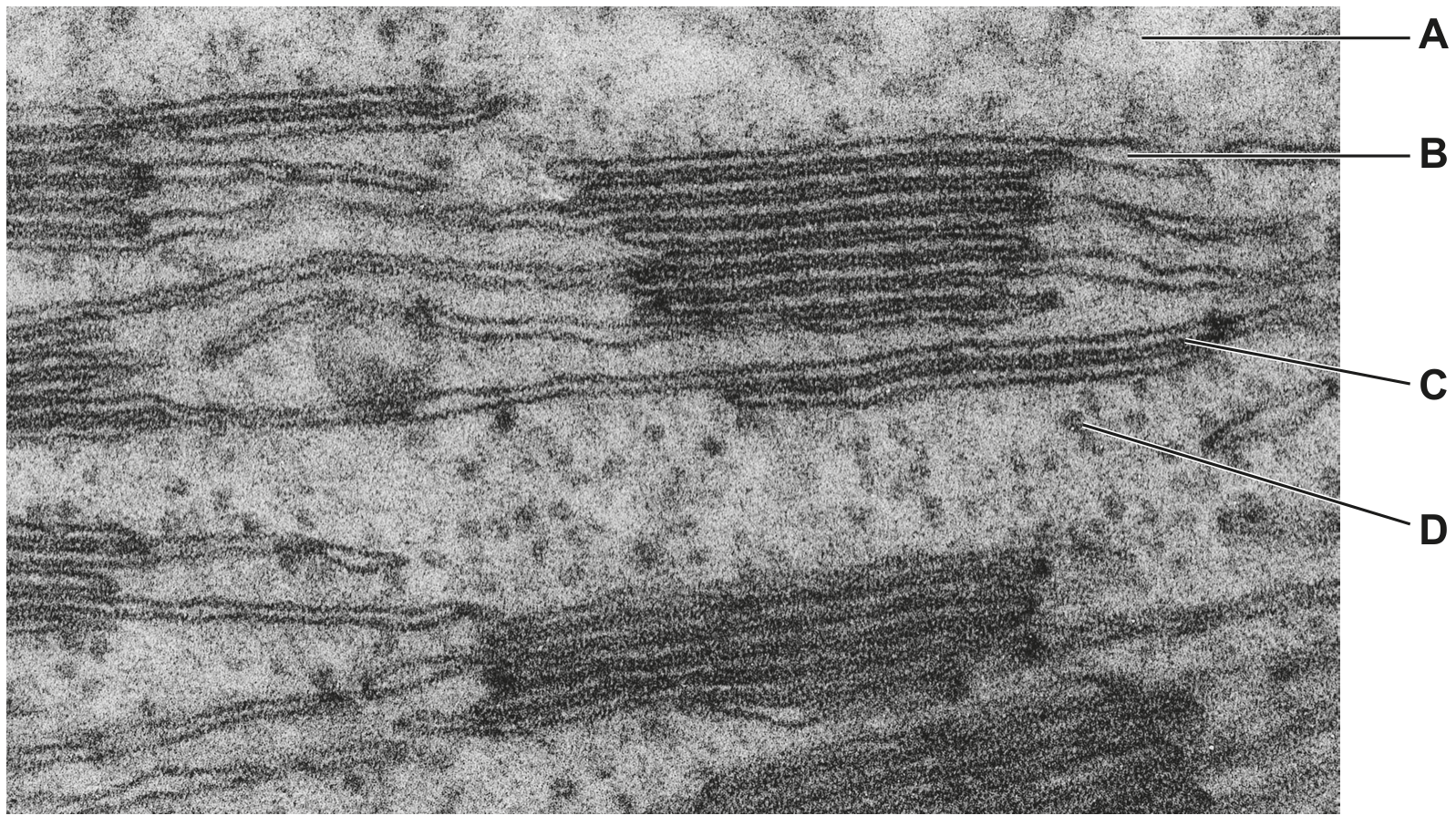
Fig. 1.1

Fig. 1.1

(a)

Membranes of the type labelled C in Fig. 1.1 were made into a liquid extract. Chromatography was then used to separate and identify the coloured components (pigments) in this extract. The resulting chromatogram showed that these membranes contain a yellow pigment, an orange pigment, a green-brown pigment and two different green pigments.

[ 4 ]
(i)

Describe how you would carry out chromatography to separate and identify the coloured pigments in the liquid extract of C.

[ 4 ]
(a)

Photosynthesis is a complex process involving the transfer of light energy into chemical energy.

[ 1 ]
(i)

Name a practical technique to separate photosynthetic pigments.

[ 1 ]
[Maximum number: 4]

Chloroplasts belong to a group of organelles called plastids. Although different types of plastid have different structures and functions, one type of plastid can change into another type of plastid in response to environmental or developmental signals.
- Example 1: plants grown in the dark have plastids called etioplasts which lack chlorophyll. If these plants are exposed to light, the etioplasts quickly change into chloroplasts.
- Example 2: chloroplasts in surface tissues of tomato fruits change into plastids called chromoplasts as the fruits ripen. Thylakoid membranes break down and chlorophyll synthesis stops. Chromoplasts synthesise and accumulate red lycopene and orange β\beta-carotene pigments.

(a)

Outline the method you would use to separate and identify the pigments in an extract of tomato chromoplasts.

[ 4 ]
[Maximum number: 4]

Corals grow in shallow seawater. Corals consist of colonies of small animals called polyps. These polyps have photosynthetic protoctists called algae inside their cells, which is advantageous both to the coral polyps and to the algae.

The algae that live within the cells of the polyps can also live independently as free-living algae.

(a)

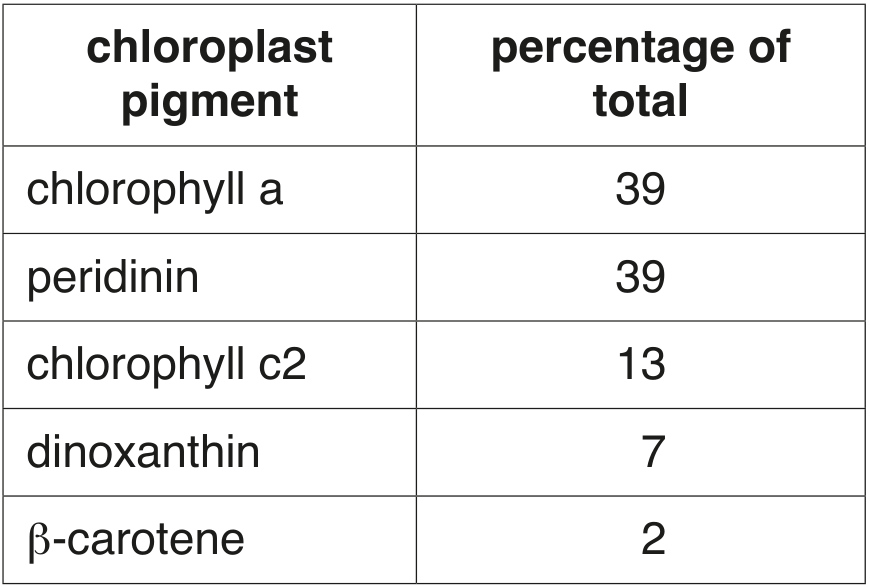
The relative abundance of five different chloroplast pigments in the algae of corals was determined. The results are shown in Table 2.1.

Table 2.1

Table 2.1

Outline the method you would use to separate and identify the pigments present in an extract of these algae.

[ 4 ]
[Maximum number: 4]

Genetic technology uses many different enzymes and techniques.

(a)

Electrophoresis is a technique used in genetic technology.

Paper chromatography is a technique used to investigate the photosynthetic pigments found in chloroplasts.

Compare the similarities and differences between electrophoresis and chromatography.

[ 4 ]
[Maximum number: 4]

Red algae are multicellular photosynthetic protoctists that contain phycoerythrin. Phycoerythrin is a photosynthetic pigment.

(a)

Phycoerythrin is rarely found in plants that have green leaves.

[ 4 ]
(i)

State the name of a technique that can be used to separate and identify photosynthetic pigments.

[ 1 ]
(ii)

Explain how the results of this technique would be used to confirm that phycoerythrin is present in red algae and not present in a plant with green leaves.

[ 3 ]
[Maximum number: 4]

Mining may result in the release of heavy metal ions, causing pollution of lakes and rivers.
High concentrations of these heavy metal ions, such as cadmium ( Cd2+\mathrm{Cd}^{2+} ) and copper ( Cu2+\mathrm{Cu}^{2+} ), decrease the rate of photosynthesis in plants.

(a)

Chromatography is a method that can be used to separate and identify different photosynthetic pigments in a chloroplast extract.

Describe how chromatography is used to identify chlorophyll a in an extract from chloroplasts.

[ 4 ]
(a)

Describe how you would separate chloroplast pigments using chromatography.

[ 7 ]
(a)

Describe how you would separate chloroplast pigments using chromatography.

[ 6 ]
0