EduNinja
[Maximum number: 5]

Chloroplasts carry out photosynthesis.
Fig. 1.1 shows some structural features of a chloroplast and some processes that occur within it.
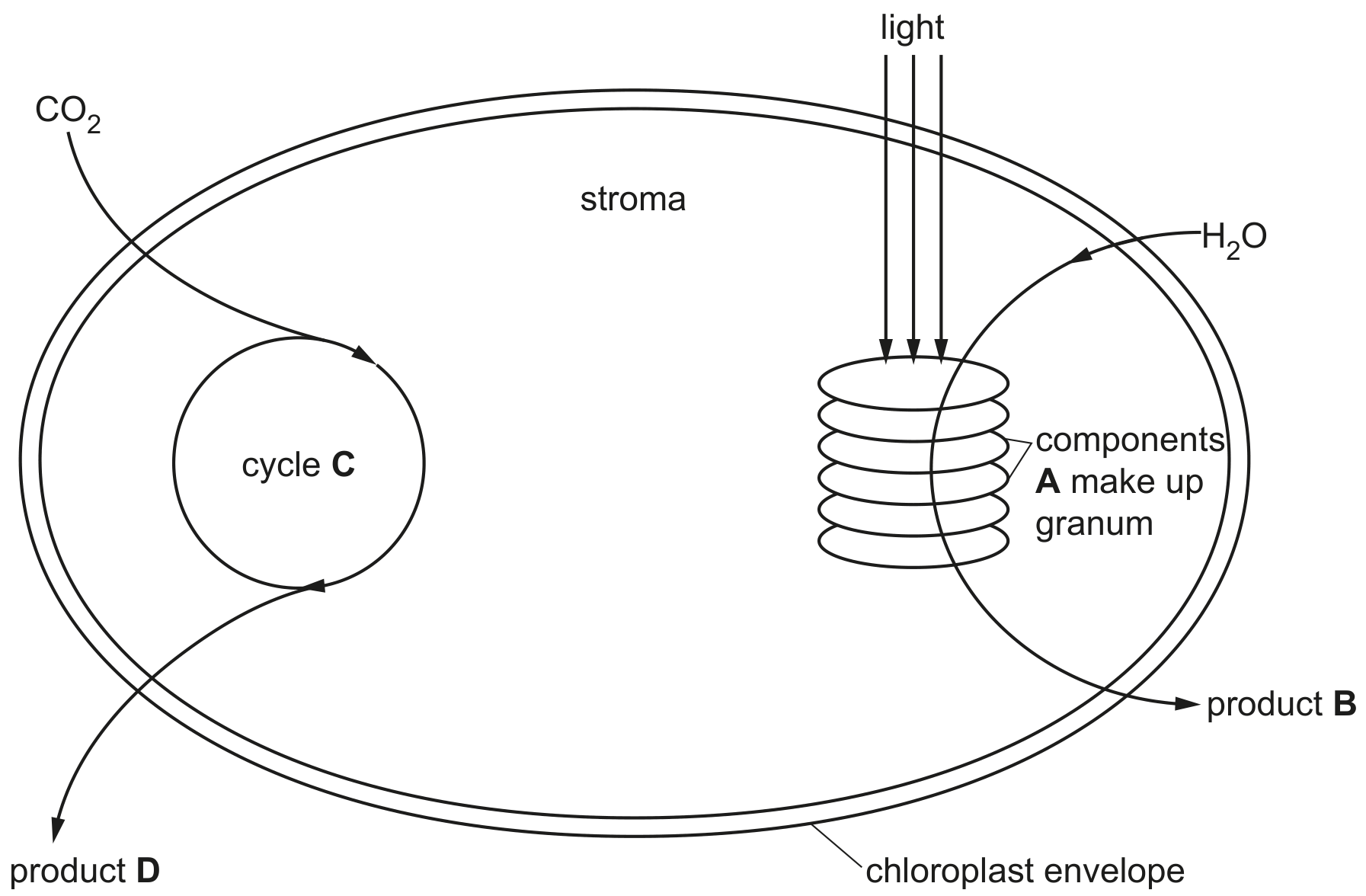
Fig. 1.1

Fig. 1.1

(a)
(i)

Identify the products of photosynthesis labelled B and D in Fig. 1.1.

B

D

[ 2 ]
(ii)

Suggest and explain the importance of glucose and the product labelled B in Fig. 1.1 to ecosystems.

[ 3 ]
[Maximum number: 2]

Photosynthesis is an energy transfer process that results in the production of carbohydrate. It has two stages: the light-dependent stage and the light-independent stage.

Cyclic photophosphorylation and non-cyclic photophosphorylation are essential pathways in photosynthesis that occur in the light-dependent stage.

(a)
(i)

Explain why herbicides that prevent cyclic photophosphorylation and non-cyclic photophosphorylation stop carbohydrate being produced in the chloroplast.

[ 2 ]
[Maximum number: 2]

Corals grow in shallow seawater. Corals consist of colonies of small animals called polyps. These polyps have photosynthetic protoctists called algae inside their cells, which is advantageous both to the coral polyps and to the algae.

The algae that live within the cells of the polyps can also live independently as free-living algae.

(a)

The rate of photosynthesis of algae that live within the cells of coral polyps is higher than that of free-living algae.

Suggest and explain how living inside the cells of coral polyps increases the rate of photosynthesis in these algae compared to free-living algae.

[ 2 ]
[Maximum number: 2]

The light dependent stage of photosynthesis in a suspension of isolated chloroplasts can be investigated using the Hill reaction.

Dichlorophenolindophenol (DCPIP) can be used to follow the process. DCPIP is a blue dye which turns colourless when it is reduced by accepting hydrogen and electrons.

 oxidised DCPIP  reduced DCPIP  blue  colourless \begin{array}{clc} \text { oxidised DCPIP } & \rightarrow & \text { reduced DCPIP } \\ \text { blue } & \rightarrow & \text { colourless } \end{array}
(a)
(i)

The natural hydrogen acceptor in chloroplasts that is replaced by DCPIP in the Hill reaction is NADP. Reduced NADP is then used in the light independent stage of photosynthesis.

State the role of reduced NADP in the light independent stage.

[ 2 ]
[Maximum number: 3]

Corals grow in shallow sea water. Corals consist of colonies of small animals called polyps. These polyps have photosynthetic protoctists called algae within their cells, which is advantageous both to the coral polyps and to the algae.

The algae that live within the cells of coral polyps can also live independently as free-living algae.

(a)

The rate of photosynthesis of algae that live within the cells of coral polyps is higher than that of free-living algae.

Suggest and explain why the rate of photosynthesis in algae that live within the cells of coral polyps is higher than that of free-living algae.

[ 3 ]
[Maximum number: 2]

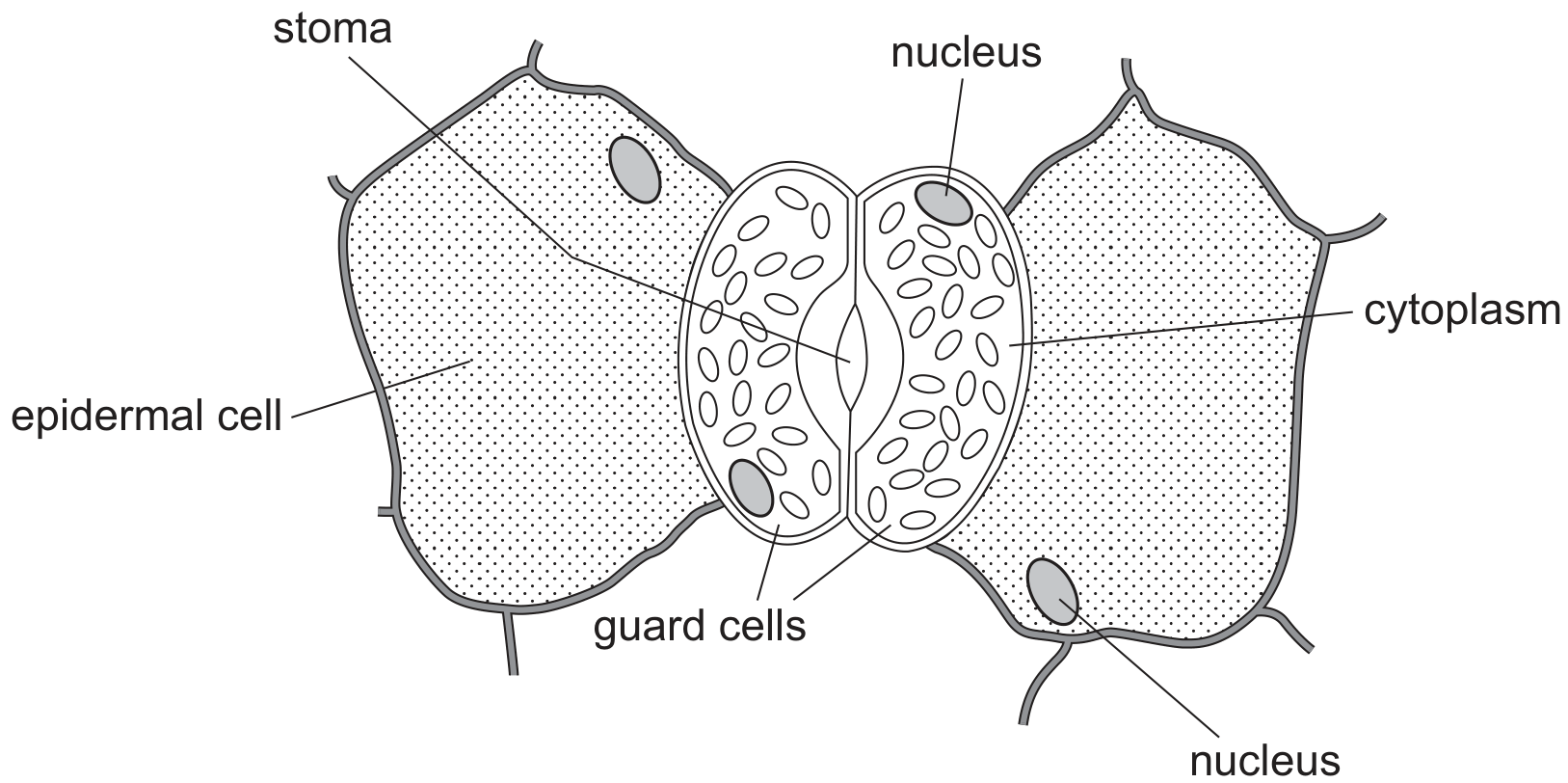
Fig. 4.1 shows a diagram of a stoma, its guard cells and adjacent epidermal cells.

Fig. 4.1

Fig. 4.1

(a)

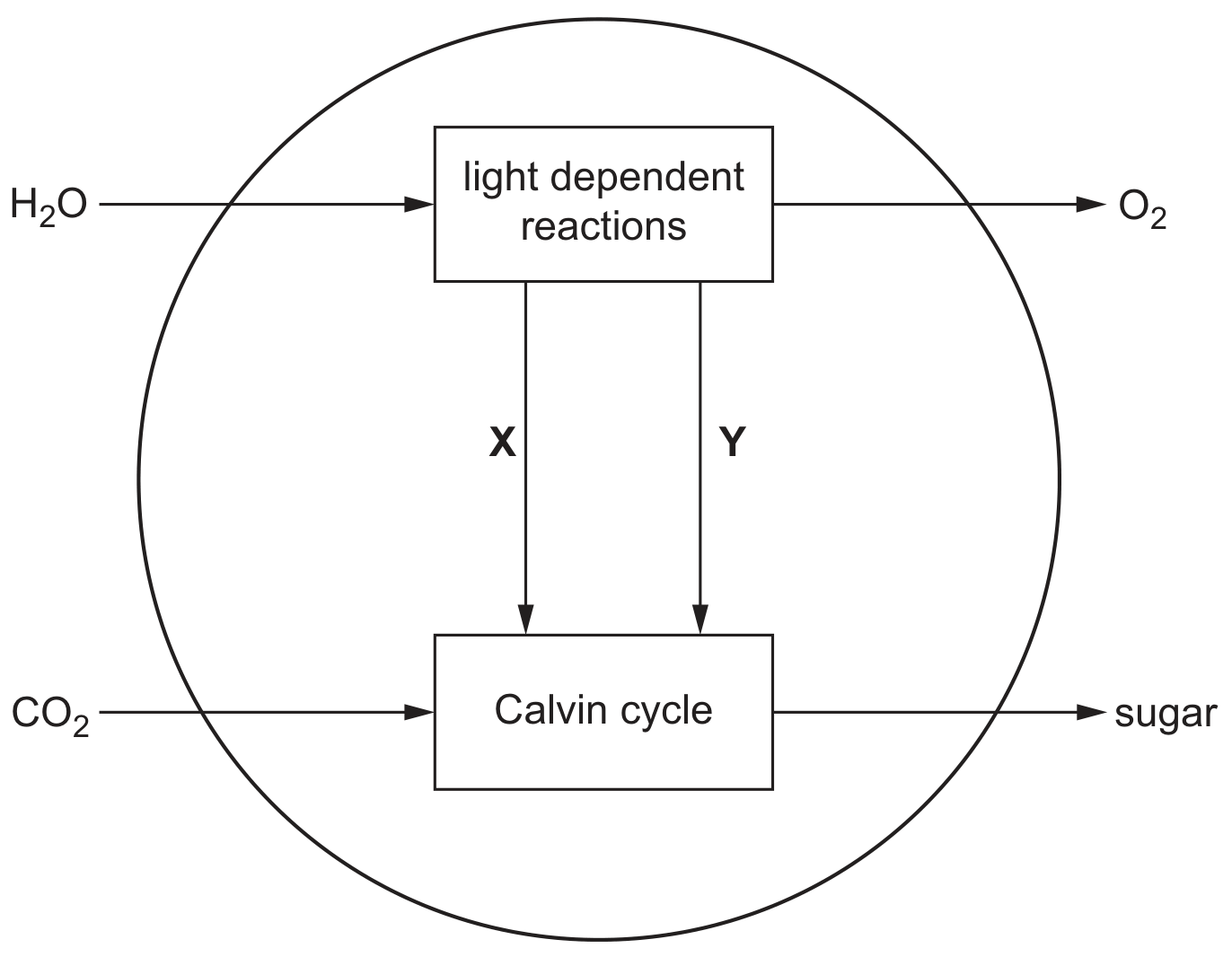
Fig. 4.3 shows the relationship between the light dependent and light independent reactions in a chloroplast.

Fig. 4.3

Fig. 4.3

Name substances X and Y in Fig. 4.3.
X
Y

[ 2 ]
[Maximum number: 1]

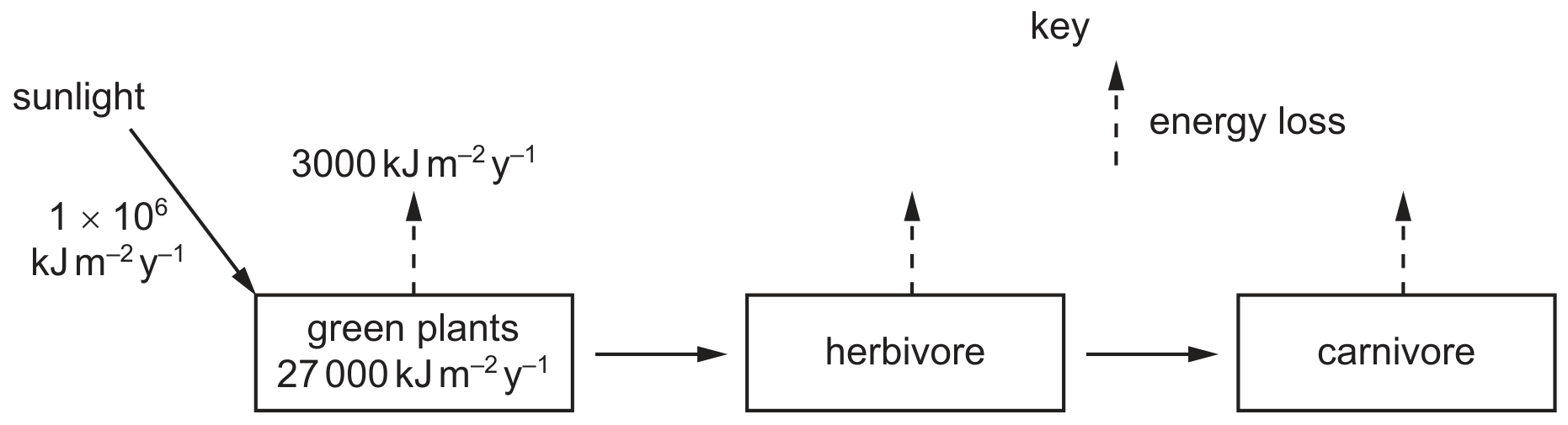
The diagram shows the flow of energy through a food chain.

Question image

What percentage of the energy is used by the green plants for photosynthesis?

A

0.03\%

B

0.30\%

C

2.70\%

D

3.00\%

(a)
(i)

Name two products of the light-dependent stage of photosynthesis that are used in the light-independent stage.

1
2.

[ 2 ]
[Maximum number: 4]

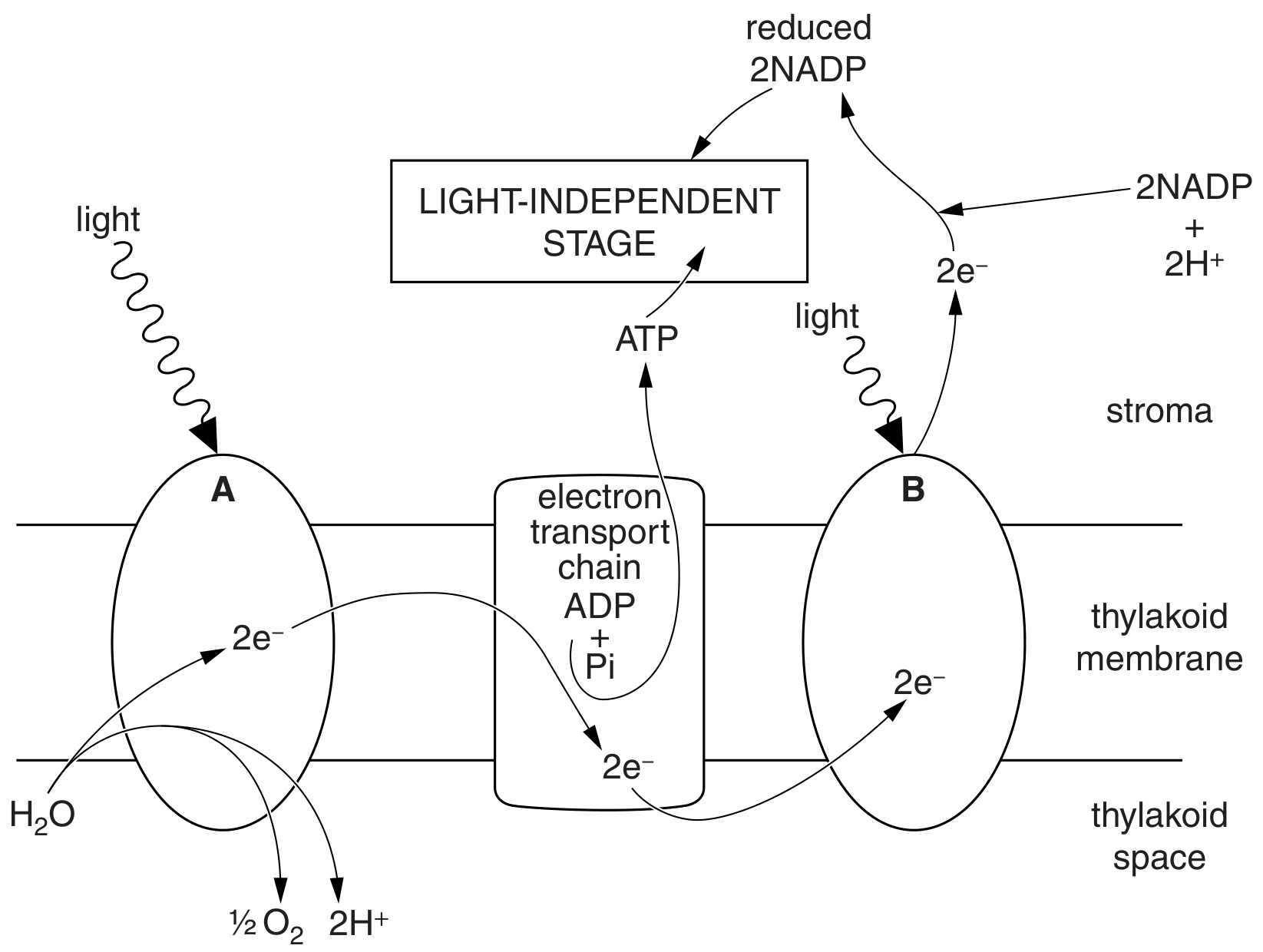
The light-dependent stage of photosynthesis takes place on the thylakoids of the chloroplast.

Fig. 7.1 shows some of the components involved in the light-dependent stage.

Fig. 7.1

Fig. 7.1

(a)

Describe the roles of the following substances in the light-independent stage of photosynthesis:

[ 4 ]
(i)

reduced NADP

[ 2 ]
(ii)

ATP.

[ 2 ]
(a)

Explain briefly how reduced NADP is formed in the light-dependent stage and how it is used in the light-independent stage.

[ 7 ]
0