

EduNinja

3.9 Budgets Topic Practice

3.9 Budgets Topic Practice
IB Business Management syllabusBusiness Management SL/HLFirst assessment 2025

Students practise defining budgeting terms, distinguishing cost and profit centres, and using variance analysis to inform strategic planning and control.

Exam points

  • define cost centre and profit centre precisely using syllabus-aligned phrasing
  • explain how variance analysis identifies deviations between budgeted and actual figures to improve future

Question 1(b)

[Maximum number: 2]

1. Creative Toys (CT)
Creative Toys (CT) manufactures toys and markets them business-to-customers (B2C) online only. The business operates in a leased industrial site and relies on word-of-mouth promotion only. To make customers believe that CTs toys are better than its competitors, CT sets prices slightly higher than the competition. Production and sales are mostly between 1 October and 24 December. Most of the employees work on temporary contracts during this busy period. For the remainder of the year, CT operates well below capacity utilization.
Table 1 contains selected data for CT, for 2014:
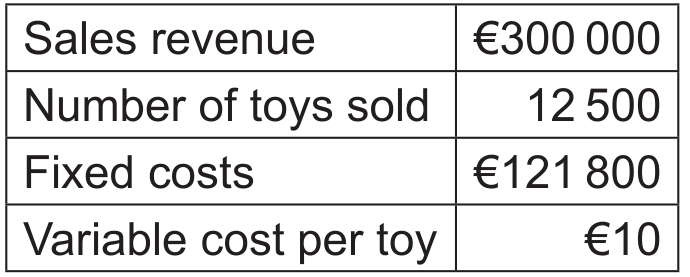
Table 1

Table 1

In 2014, the management of CT considered a change of the marketing mix to include above the line promotion, lower prices, and an additional sales method called "toy parties". Toy parties would be hosted by newly recruited CT sales representatives and attended by parents and their children. At the parties parents could see the toys and children could play with them. Sales would be made at the parties by the new sales representatives, who would be paid on a commission-only basis.

Toy parties could be held throughout the year and make CTs total sales less seasonal. Based on market research, management has estimated that the parents' demand for toys is price elastic and is planning to set lower prices for all toys sold online and at toy parties. The management has prepared forecasted financial data for CT, for 2015, based upon the proposed change to the marketing mix, shown in Table 2 below.
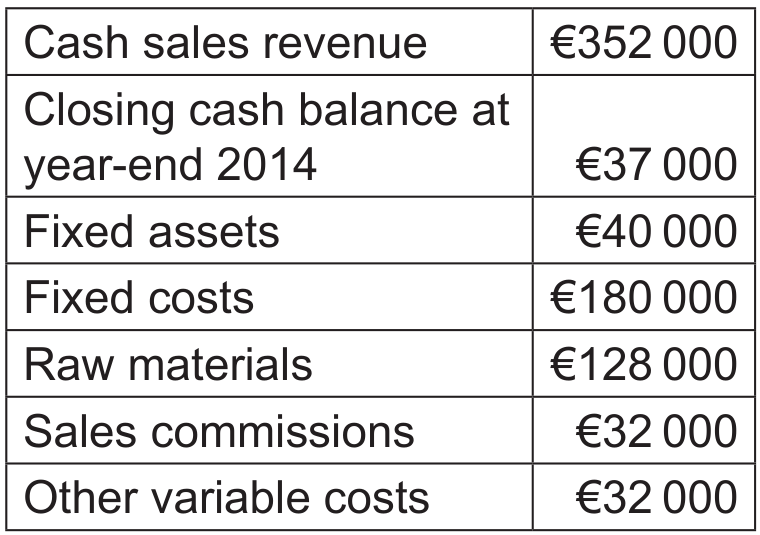
Table 2

Table 2

The Finance Manager will carry out a variance analysis in order to determine whether the proposed change to the marketing mix has been successful.

Define the term variance analysis.
Question 4(a)

[Maximum number: 2]

SVT organizes each of its water treatment plants as a profit centre. SVTs water treatment plant in a Middle Eastern country extracts water from a local river to supply households in Dalgera, the capital city. In 2019, many people complained about the water's bad taste. A television documentary suggested that SVT was negligent.

SVT investigated and found that employees at its water treatment plant had failed to treat the water properly. This failure resulted in lead* from inside old pipes entering the water that was supplied, exposing the inhabitants of Dalgera to water with high levels of lead.

In 2020, SVT dismissed the regional director of Dalgera and installed automated monitoring equipment (which was already being used in its European water treatment plants) in all of SVT plants across the world. This equipment, which monitors lead levels, costs $ 100 million and depreciates on a declining-balance basis at a rate of 20 % per annum to a residual value of $ 10 million. However, in 2021, a court ordered SVT to pay $ 300 million in damages to the affected people in Dalgera, which was widely publicized across the world, badly damaging SVT's brand image.

By 2022, the global home water filter market was $14 billion, and 90\% of SVTs water filter sales were to Europe and the USA. SVT now wants to increase sales in Asia, a market with significant growth potential. In the same year, SVT closed its European and USA water filter manufacturing factories, partly because of increasing costs of energy and labour. These factories were replaced by a huge new factory in Asia.
* lead: a chemical element that is a soft, heavy, grey metal. In the past, it was widely used to make pipes, cover roofs, and in paint; it is harmful when ingested

Define the term profit centre.

Question 4(a)

[Maximum number: 2]

In 2010, ELE owned 4.5 % of the European Union (EU) car rental market. In 2019, ELE's car rental division had revenues of EUR 0.9 billion in a market worth EUR 16.8 billion. Initially, ELE only provided car rentals in its gasoline stations in Belgium. By 2014, ELE had expanded the service to its stations in France, Spain and the UK.

In 2016, Giselle also reorganized ELE's car rental offices so that each office operated as a profit centre. An entrepreneurial approach was adopted. Office teams received substantial bonuses if they exceeded profit targets, but only offices that met their targets qualified for these bonuses. These targets were set, without consultation, by Giselle. Over a five-year period, targets were met by 85 % of offices. Giselle's reorganization was not welcomed by employees.

In 2021, Monica recommended that ELE trial the business model she had proposed for the new In3T brand in two major cities in the EU for one year: if successful, the brand and its model could then be launched in all major cities in the EU. Monica said, "We must do it. I'm convinced that our rivals will adopt this business model within two years. If we don't act now, we will be left behind and our rivals will beat us to it."

Giselle, however, disagreed strongly. She had built the car rental division from its inception. She believed high levels of customer service and well-trained staff were two reasons why the car rental division remained successful. She was also unhappy with the EUR 100 million cost and payback of three years.

Define the term profit centre.

Question 4(b)

[Maximum number: 4]

There are several important items to be discussed at DA's board meeting, three of which are outlined below.

Item 1: Budgets. DA produces its budgets based on the functional areas of the business. For example, the Marketing, Production, Innovation and Corporate Social Responsibility (CSR) Departments are all separate cost centres. Pierre is proposing that budgets should be more detailed so that, for example, each of DA's products has its own cost centre and each separate innovation project is also a cost centre.

Item 2: Recommendations from the management consultants. The management consultants propose bringing DA more up to date with employment practices by replacing the many benefits that employees get with a low basic pay and a profit-related bonus, and charging market rents for the housing in Ville d'Ablet. There will also be penalties on employees for failing to meet targets. The CSR department are opposed to this idea because they believe it will change the culture of the business, which has built up over many years.

Item 3: The manufacture of rechargeable batteries used in cordless products. DA currently makes its own rechargeable batteries. In 2019, it made 10000 batteries. The variable cost is € 15 per battery and the fixed costs are € 30000. XL, a public limited company, is a major manufacturer of batteries. DA has contacted X L to manufacture the rechargeable batteries, which they will buy from XL at €17 each.

Explain one advantage and one disadvantage for D A of changing from function-based cost centres to the cost centres proposed by Pierre.

Question 2(e)

[Maximum number: 6]

2. Bip Bip (BB)
Nicolás and Loura want to start up a vehicle rental business in Punta del Este, a seaside resort in the Southern Hemisphere. The business will operate as a partnership and be called Bip Bip (BB). Tourist numbers are very high during the summer (December to February months in the Southern Hemisphere); the beach and water sports attract many tourists. B B will rent out convertible cars, electric cars and minivans. BB will purchase these vehicles through a leasing scheme.
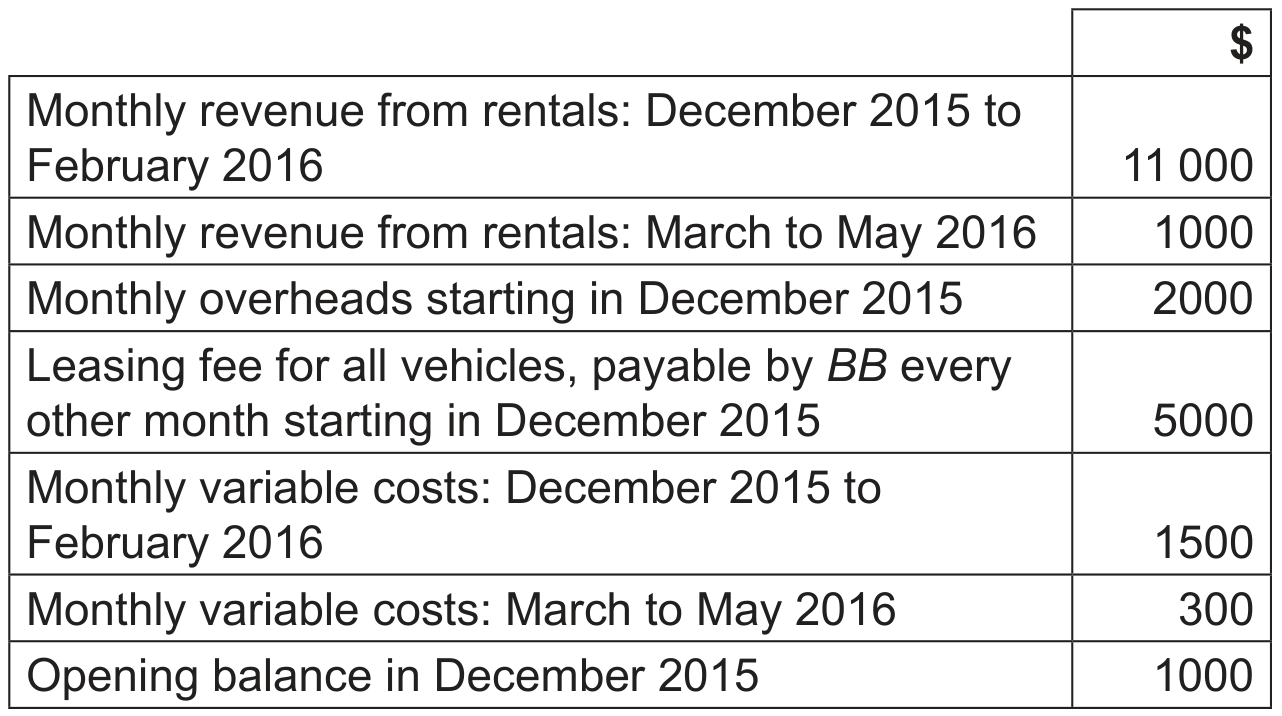
"Because most rental income will occur in a few months of the year, we must forecast our cash position during the slow months and we must follow a budget," says Loura. She has forecasted the following figures for the first six months of operation, beginning in December 2015. All revenues received and costs paid will be in cash. All cash sales are paid at the time of the vehicle rental.

Table

Due to the increasing importance of e-commerce, B B would like to offer an online booking service in addition to their website. Nicolás believes that an online booking service will allow B B to reach a wider national and international market, and will also reduce marketing costs. However, Loura argued that e-commerce also has some limitations.

After further discussion, Nicolás and Loura decided not to set up an online booking service. However, after May 2016, they will examine the budget and variances with care to determine if B B should offer an online booking service the following year.

Analyse the role of budgets and variances, in strategic planning, for businesses such as B B.

Answer two questions from this section.

Question 5(b)

[Maximum number: 4]

5. Thorns Hill (TH)
Thorns Hill (TH) is a hotel. Its mission statement is "to provide the highest standard of customer service and to be the best employer". TH has three profit centres, each with its own manager:
- sleeping accommodation
- restaurant
- function room for weddings, conferences and other events.
The function room offers entertainment facilities and purchases catering from the hotel restaurant. The function room employees are mostly students working in their spare time. They have flexible contracts that do not guarantee hours of work nor provide benefits such as paid sick leave or holidays.
The use of flexible contracts has reduced the function room's annual wage cost by 40 % over the last five years. The de-layering of supervisory posts (positions) has further reduced the cost of wages. With these cost savings, the profits of the function room have increased significantly. Recently, issues with punctuality, absenteeism and labour turnover increased.
30 % of the restaurant's sales revenue comes from catering for the function room. The restaurant recently won an award and, in the summer season, is always full of diners. In summer the restaurant has difficulty meeting the catering demands of the function room. Meals ordered often arrive late from the restaurant.
Competition in the market for function rooms is high. The owners are considering a proposal to improve the reputation of the function room by outsourcing all the services of the function room to a private contractor. The private contractor will charge TH more than the direct cost of the function room.

Explain two advantages for TH of having three separate profit centres.

Question 3(d)

[Maximum number: 6]

3. Transfer
Transfer is a publicly traded shipping business. Its success has been built on its ambitious mission statement:
"Our shipping business will always be about providing a first class service to our customers and making it last. Whatever it takes."
Managers at individual regional profit centres were empowered to make their own decisions in response to local market conditions. Transfer's financial reward package allowed employees to share in their regional profit centre's performance through an employee share-ownership scheme. Transfer had consistently won awards for its excellent customer service. Management and staff turnover was very low.
However, after years of profits that were low by industry standards, Transfer suffered a significant financial loss. The current chief executive officer (CEO) claimed it was due to increased global competition and rising direct costs. Transfer's non-employee shareholders, who owned 60 % of Transfer, demanded that immediate action be taken. At the most recent annual general meeting (AGM) the CEO was forced to resign. A new CEO, Heather Davies, was appointed.
Heather had a reputation as an autocratic leader. She had a successful record of returning loss making companies to high profits, but only after making significant changes. At her first press conference, Heather announced her plan to:
- reduce two-way communication and create a much higher degree of centralization within Transfer
- remove all profit centres.
Immediately, Heather dismissed many managers who were, in her opinion, unproductive.
She defended her actions by arguing that Transfer had become inefficient, with poor decision making at regional levels. Heather argued that regional profit centre managers were setting their own objectives which did not follow the mission statement.
At the same time, an unknown manager gave a national newspaper interview which was highly critical of Heather's leadership style, with examples of workplace unrest. When Heather found out, she threatened to dismiss any manager who questioned her authority or the new plan. Six months later, Transfer's share price had grown by 15 % and profits had begun to significantly increase.

Examine the decision to remove all profit centres.

0 selected