
EduNinja

2.5 Organizational (corporate) culture Topic Practice

2.5 Organizational (corporate) culture Topic Practice
IB Business Management syllabusBusiness Management SL/HLFirst assessment 2025

Students practise analysing how shared values, leadership style, and norms shape HR decisions, ethics, and strategy—using real cases like DA’s culture shift or MM’s UK–India…

Exam points

  • identify how a change in leadership style alters cultural elements
  • explain how cultural clashes between UK and Indian offices affect employer

Question 4(b)

[Maximum number: 4]

In January 2021, a respected guide to universities rated P U top in two categories:
- Sustainability - for reducing its pollution, waste and carbon footprint.
- Teaching excellence - for developing innovative teaching methods resulting in highly positive feedback from students.

Before the accident at the nearby chemical plant in September 2021, PU's student accommodation and teaching facilities were highly rated. However, the university was rated poorly for digital innovation and support services, with support staff not always understanding the needs of students.

In surveys, students generally rated P U highly for the quality of its courses and facilities. The campus was also voted one of the best in the country, but this changed after the accident.

After the accident, P U continued to experience unexpected changes to its culture:
- The level of diversity in classes and university accommodation has fallen, as there are fewer international students.
- The shortage of students has meant a continuing fall in income for P U. This has increased competition between faculties for available finance.
- Less time and effort is spent on student welfare.
- Lecturers have to meet demanding targets to produce online courses and materials.
- There is greater emphasis on contingency planning.

The government grants received by P U for the purchase of IT equipment did not address all equipment shortages. Due to an increase in online teaching, P U purchased 500 laptops for students, at a cost of $ 500 each. Each laptop has a useful life of three years. After three years, each laptop will be sold to local schools for $ 50.

Explain two elements of P 's organizational culture after the accident at the nearby chemical plant.
Question 4(d)

[Maximum number: 10]

There are several important items to be discussed at DA's board meeting, three of which are outlined below.

Item 1: Budgets. DA produces its budgets based on the functional areas of the business. For example, the Marketing, Production, Innovation and Corporate Social Responsibility (CSR) Departments are all separate cost centres. Pierre is proposing that budgets should be more detailed so that, for example, each of DA's products has its own cost centre and each separate innovation project is also a cost centre.

Item 2: Recommendations from the management consultants. The management consultants propose bringing DA more up to date with employment practices by replacing the many benefits that employees get with a low basic pay and a profit-related bonus, and charging market rents for the housing in Ville d'Ablet. There will also be penalties on employees for failing to meet targets. The CSR department are opposed to this idea because they believe it will change the culture of the business, which has built up over many years.

Item 3: The manufacture of rechargeable batteries used in cordless products. DA currently makes its own rechargeable batteries. In 2019, it made 10000 batteries. The variable cost is € 15 per battery and the fixed costs are € 30000. XL, a public limited company, is a major manufacturer of batteries. DA has contacted X L to manufacture the rechargeable batteries, which they will buy from XL at €17 each.

Discuss the likely impact on D A 's organizational culture of the changes recommended by the management consultants.
Section C
Answer the following question.

Question 4(a)

[Maximum number: 2]

Sam and Finn are having difficulties resolving their disagreements. Finn was convinced that the problems at AFA should be resolved by a change in the organizational structure. Sam, however, was convinced that he should strengthen the organizational culture. Sam reluctantly accepted the need for greater delegation but insisted that there should be more training for all employees on the culture and ethics of AFA.

As part of greater delegation, Kim was given responsibility for the relationship between AFA and its suppliers. Kim is concerned that she spends a lot of time chasing orders that do not arrive and dealing with the poor quality of orders. Some products have to be thrown away because they have passed their sell-by dates*. Others have to be returned to suppliers because the outlet managers do not accept the poor quality and therefore cannot be sold.

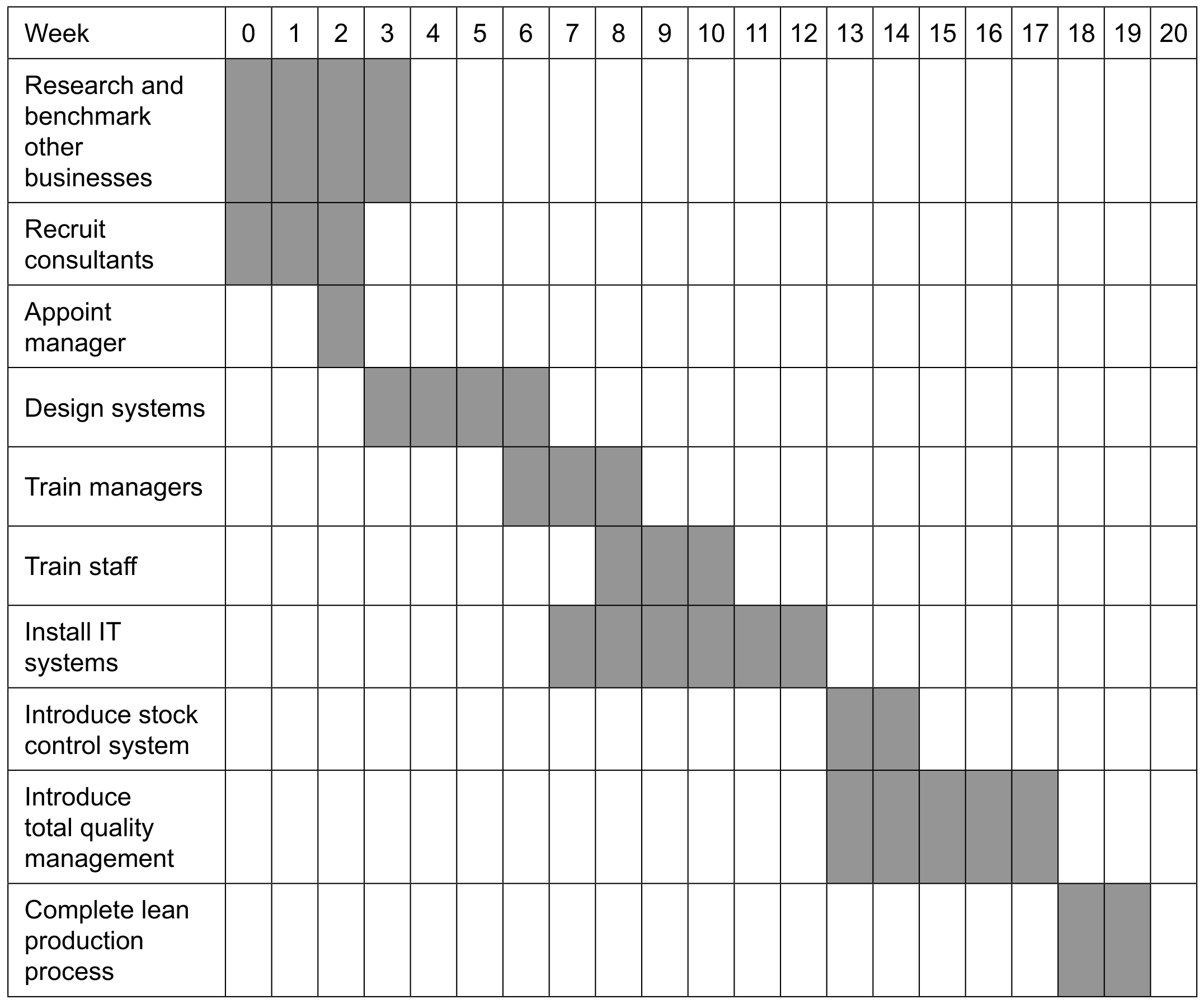
AFA's stock of fair trade woollen hats has now reached 500 , with an annual sales average of around 1250 for the whole business. Kim wants to introduce lean production including total quality management (TQM) throughout AFA's operations and has created a Gantt chart to show the stages in implementation.
* sell-by dates: dates printed on the packaging of products that state the date after which the product can no longer be sold.

Figure 1: Gantt chart for the implementation of lean production including TQM at AFA

Figure 1: Gantt chart for the implementation of lean production including TQM at AFA

State two elements of an organizational culture.

Question 4(d)

[Maximum number: 10]

MM's growth has been helped by its unique selling point/proposition (USP) of rapid response to customer needs and by its high-quality customer service. New employees undergo detailed training to become skilled in:
- finding out what a customer's objectives are
- helping the customer work towards a marketing plan
- working closely with the customer as M M develops a marketing strategy for them
- maintaining links with the customer to provide an effective after-sales service.

The business takes a multicultural approach to its customers, employees and other stakeholders. MM's approach to diversity is one of the features that stakeholders say they like about the business. The company also ensures that it accommodates many cultural differences.

According to a business service that provides measures of social behaviour for every country, in British businesses:
- employees are accustomed to working in a competitive, individualistic society
- employees often take individual responsibility for their own actions and decisions
- competition is high between both employees and customers
- customers are accustomed to changing contracts when service is bad or competitors offer a better deal.

In comparison, Indian businesses:
- are based on power structures with a greater focus on teamwork than individuality
- are more likely to be hierarchical
- have greater loyalty from their customers
- have greater formality with their customers
- place importance on building business relationships
- are subject to greater variety in culture between businesses and regions.

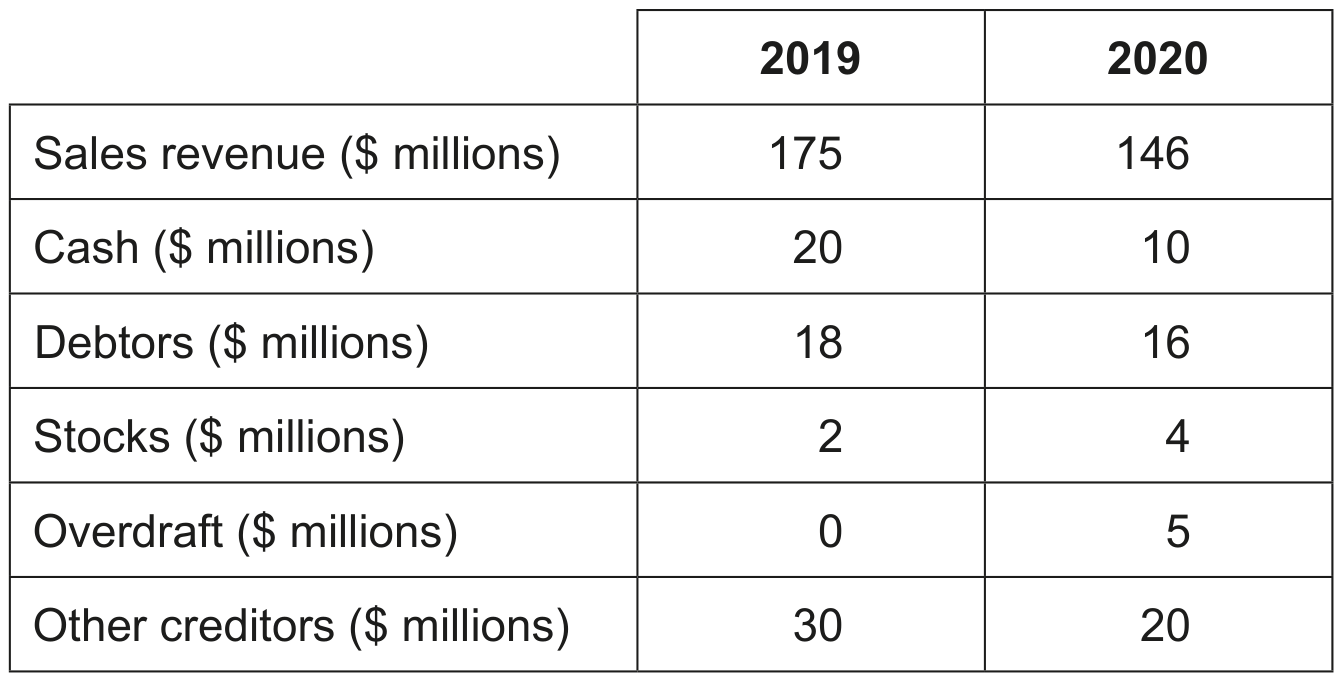
Maintaining high levels of customer service is expensive. MM has increasing costs (line 107). Rachel is concerned about MM's finances and is examining the latest accounts for the company for 2019 and 2020 (Table 1) to identify problems.

Table 1: Selected financial information for \(\boldsymbol{M

Table 1: Selected financial information for \(\boldsymbol{M

Discuss how cultural differences within M M may influence employer-employee relationships.

Question 3(a)

[Maximum number: 2]

3. Davidson Studios Ltd. (DS)
Davidson Studios Ltd. (DS) is a private limited company created in 2018 and equally owned by two sisters, Emma and Laura Davidson. Both recent graduates, they design and produce fantasy board games, which are sold to local retailers.
Emma specializes in game design and Laura is the operations manager. The design of a new game takes 12 months. DS's first board game was a success and enabled DS to rent workspace and hire employees. The second game, Held Captive, was a massive commercial success.
DS had to move to larger premises and recruit more design, marketing and production staff. DS's organizational culture empowers employees to solve problems and gives them the opportunity to manage tasks. Employees also enjoy modern office spaces, generous breaks and competitive salaries. Quality circles and job rotation are common. Labour turnover is low and employee morale is high.
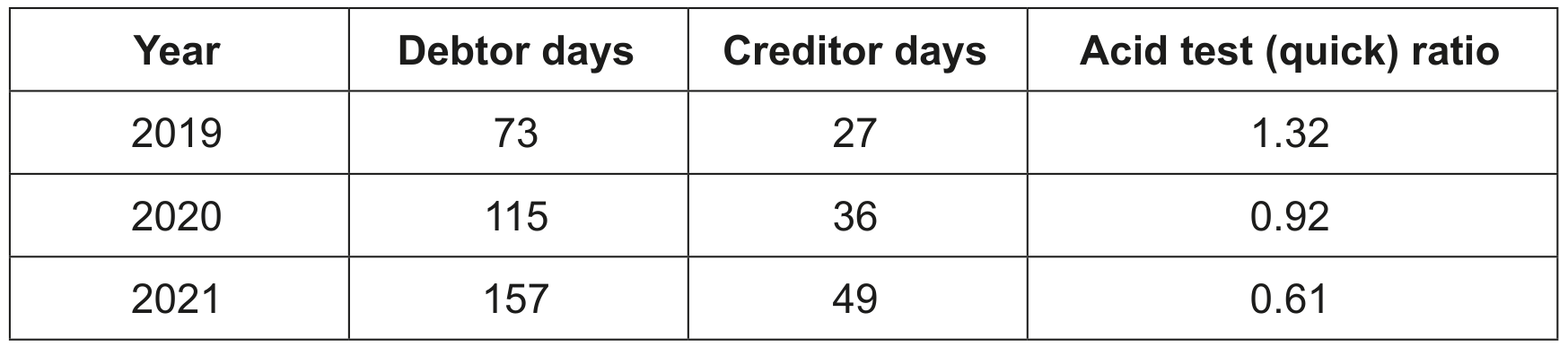
As production increased, however, DS ran into problems. With more employees to pay and invoices due, D S had almost run out of working capital (see Table 4).

Table 4: Selected financial ratios for DS

Table 4: Selected financial ratios for DS

Two options are being considered to avoid further liquidity problems and continue DS's rapid expansion:
- Option 1: Accept an offer from Big Game Industries (BGI), the market leader, to purchase 51 % of DS's shares. BGI would keep the DS brand and install a chief executive officer (CEO). Emma and Laura would have reduced roles in DS.
- Option 2: Accept an offer from a venture capitalist to purchase 35 % of shares. This would provide a cash injection sufficient for the next 12 months.

Define the term organizational culture.

Question 4(a)(i)

[Maximum number: 2]

Define the following terms:

organizational culture (line 11)

Question 4(a)

[Maximum number: 2]

4. Creative Bleu (CB)
Creative Bleu ( C B ) is an Australian media private limited company which has produced many innovative television (TV) commercials. Jennifer Joyce, the Chief Executive Officer (CEO), set up the company with three college friends. C B now employs 24 people.
The organizational culture is technological, collaborative, innovative and task-orientated. Flexible project teams of four are created and rotated to generate new and creative ideas. On occasions, decisions are made intuitively. All employees have equal input into the decision-making process. C B has an employee share-ownership scheme, and profits are shared among all of the shareholders. Jennifer has a democratic leadership style. Staff turnover at C B has been very low.
C B has received a substantial contract to produce a TV commercial. The commercial will be for a new product. The commercial will also help C B gain entry into a new international market: South Korea. The long-term financial benefits for C B could be significant, but Jennifer is worried that C B will use all its working capital on this operation. Moreover, C B does not have a Korean speaker amongst its staff.
Jennifer and the staff see the production of the TV commercial as an opportunity for C B to enter a new market and grow. Jennifer has two strategic options for C B :
- grow internally by producing the TV commercial in Australia. CB would finance the whole operation and employ additional staff: translators, local Korean actors, and technical support staff.
- form a joint venture with a Korean media company. C B would share the costs of the operation with them. The TV commercial would be produced in Seoul, South Korea. Given the size of the operation, C B would relocate one of their teams to Seoul.

Define the term organizational culture.

0 selected