D4.2.9—Biomagnification

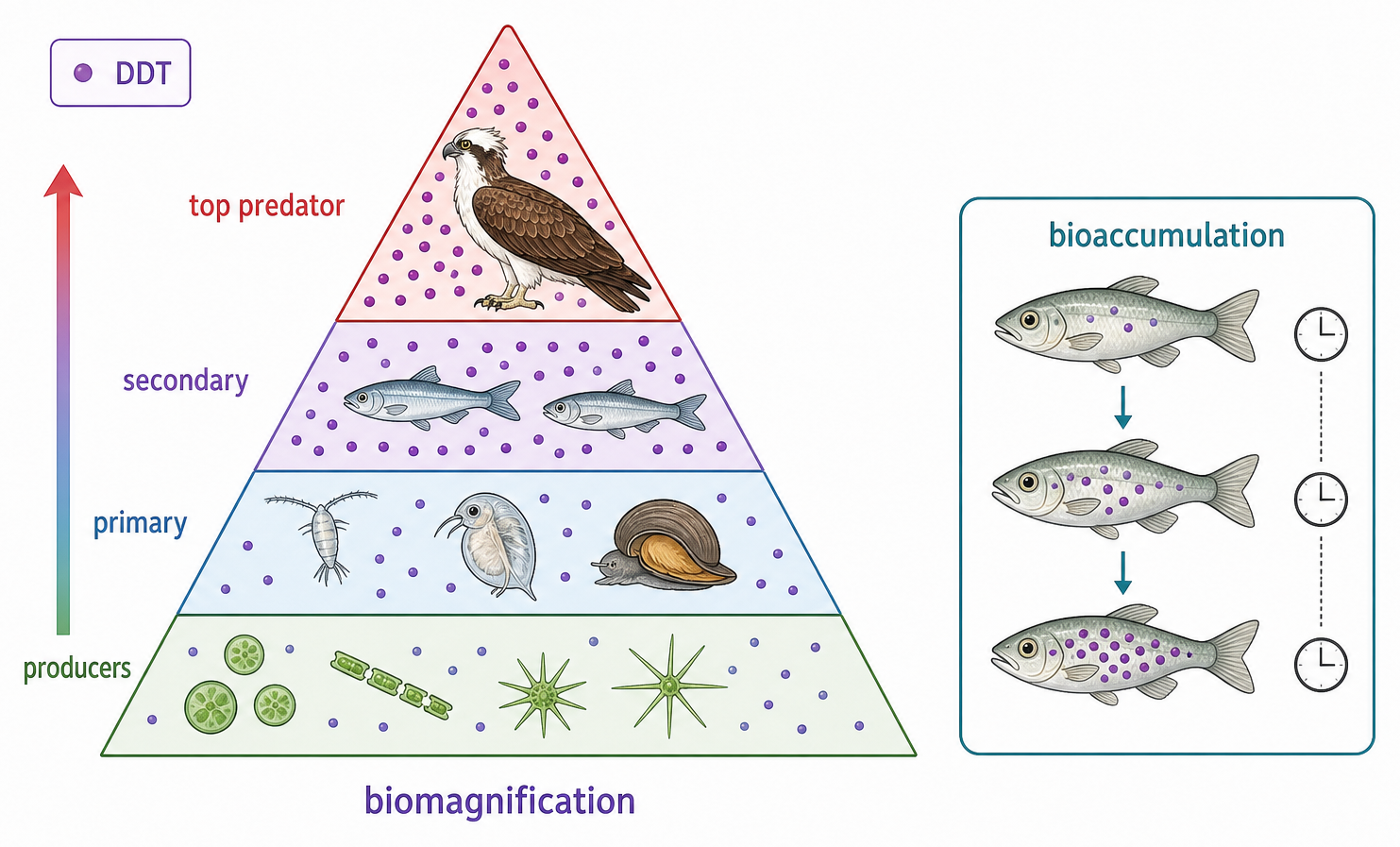
Biomagnification raises persistent toxin concentrations at higher trophic levels because consumers ingest many contaminated organisms and cannot rapidly eliminate pollutants.

Syllabus
First assessment 2025
Objective
D4.2.9
Level
HL

Exam analysis

Chance of appearing8%of analysed past papers
Latest appearanceMay 2025
Most common paperPaper3
Typical marks2–3

Common command terms

  • Explain
  • Define
  • State
  • Discuss
  • Identify
  • Suggest
  • Deduce
  • Outline
  • Justify

Scoring notes

Common mistake
Describing biomagnification as any pollution effect, without explaining increasing concentration at successive trophic levels.

Recent exam appearances

May 2025Paper1B ["HL"] · TZ22(a)[ 2 ]D4.2.9—Biomagnification
November 2024Paper3 ["HL"] · TZ018[ 6 ]D4.2.9—Biomagnification
May 2023Paper3 ["HL"] · TZ218(c)[ 3 ]D4.2.9—Biomagnification
May 2018Paper3 ["HL"] · TZ116(e)[ 2 ]D4.2.9—Biomagnification
May 2017Paper3 ["HL"] · TZ216(e)[ 2 ]D4.2.9—Biomagnification
Practice this objective

Coverage 2012–2025 · Updated 16 Jul 2026

Persistent Toxins Biomagnify through Food Chains

Biomagnification is increasing tissue concentration of a persistent pollutant in consumers at successively higher trophic levels.

DDT and mercury are retained or eliminated slowly. Predators consume many contaminated prey, so their total intake produces a higher tissue concentration than in organisms below them.

Mercury can be low in water or plankton, higher in fish and highest in fish-eating birds or mammals; DDT similarly reached damaging concentrations in top predators.

Bioaccumulation is increase within one organism over time; biomagnification is increase between trophic levels. Not every pollutant does either.

Biomagnification exam focus

Assessment in practice

2–3 marks
How it is assessed

This objective is assessed through essay response, commonly using Explain / Define / State.

Command terms

Explain / Define / State / Discuss / Identify / Suggest / Deduce / Outline / Justify

What earns marks

Build the answer around this relationship: Biomagnification requires a pollutant that persists and accumulates in organism tissues.

Watch for

Describing biomagnification as any pollution effect, without explaining increasing concentration at successive trophic levels.

Representative question

Question 1

[Maximum number: 6]

Discuss the use of DDT (dichlorodiphenyltrichloroethane) in the control of the malarial parasite.

Core Stability and Change

Core D4.2 is secure when students can judge whether a system is being stabilized or pushed toward change. The route is: identify the stability support or disturbance, explain the mechanism, and state the ecosystem consequence using evidence.

  • energy, nutrient cycling, diversity, and tolerance ranges maintain persistence
  • Amazon deforestation and keystone removal can push systems toward instability
  • harvest and agriculture require recovery, soil, nutrients, biodiversity, and monitoring
  • eutrophication, biomagnification, and plastics harm ecosystems through specific mechanisms

Ecosystem Stability and Human Impact

Core transfer questions ask students to explain why an ecosystem remains stable or why a disturbance pushes it toward change. Strong answers do not list threats; they explain mechanisms such as lost rainfall recycling, trophic cascade, overharvest, nutrient enrichment, toxin biomagnification, plastic movement, or restoration through rewilding.

  • Use stability requirements: energy input, nutrient cycling, biodiversity, genetic diversity, and abiotic tolerance ranges.
  • Explain disturbance mechanisms such as Amazon tipping points, trophic cascades, overharvesting, agricultural damage, eutrophication, biomagnification, plastics, or rewilding.
  • Support claims with evidence from controlled models, monitoring, food webs, or pollution pathways.

Concept essentials

  • Biomagnification requires a pollutant that persists and accumulates in organism tissues.
  • Predators at higher trophic levels receive larger pollutant loads by eating many contaminated prey.
  • DDT, DDE, mercury, PCBs, and triclosan illustrate toxic effects on top consumers and humans.