D4.2.4—Mesocosm model

Mesocosms model ecosystem stability by enclosing simplified communities where matter cycling, energy input, variables, and population changes can be observed.

Syllabus
First assessment 2025
Objective
D4.2.4
Level
HL

Exam analysis

Chance of appearing4%of analysed past papers
Latest appearanceMay 2024
Most common paperPaper3
Typical marks1–3

Common command terms

  • Discuss
  • Outline
  • State
  • Suggest
  • Explain

Scoring notes

Common mistake
Assuming a sealed mesocosm exchanges no energy, when light or heat can still pass between the system and surroundings.

Recent exam appearances

May 2024Paper2 ["HL"] · TZ25(b)[ 2 ]D4.2.4—Mesocosm model
May 2023Paper3 ["HL"] · TZ23(b)[ 1 ]D4.2.4—Mesocosm model
November 2018Paper3 ["HL"] · TZ014(d)[ 2 ]D4.2.4—Mesocosm model
May 2017Paper3 ["HL"] · TZ13(b)[ 3 ]D4.2.4—Mesocosm model
Practice this objective

Coverage 2017–2024 · Updated 16 Jul 2026

Use Mesocosms as Controlled Ecosystem Models

A mesocosm is a contained ecosystem model used to test how a controlled variable affects stability.

Design choice Purpose
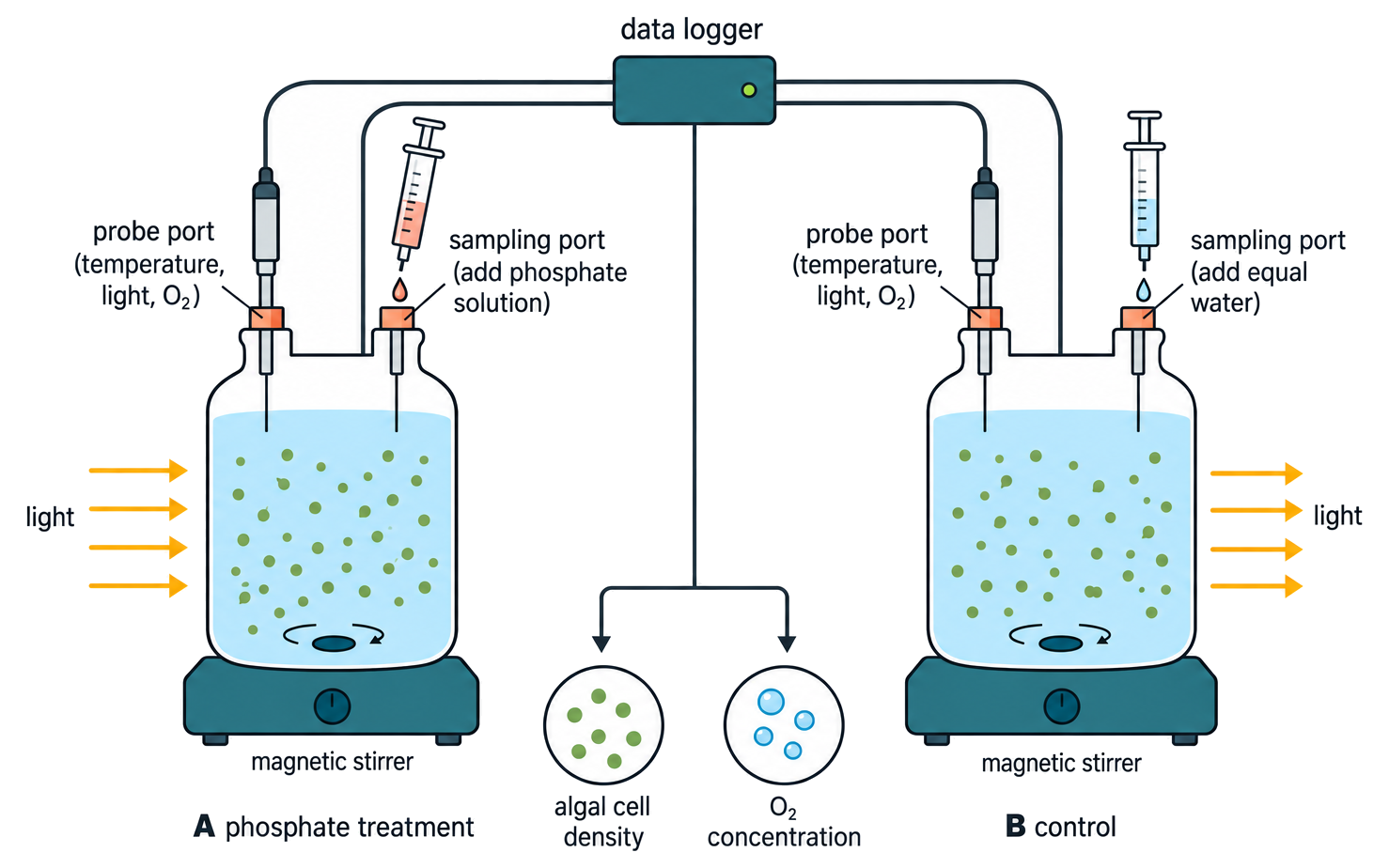
Sealed glass vessel preferred to an open tank Prevents matter entering or leaving while allowing energy transfer such as light and heat
Aquatic or microbial community More likely than a terrestrial system to function at small contained scale
Replicated control and treatment vessels Separates the manipulated variable from background variation
Repeated abiotic and biotic measurements Tracks stability, disturbance and recovery through time

Replicated sealed aquatic mesocosms can receive different light treatments while temperature, starting organisms and nutrient quantities are held constant.

A mesocosm supports causal inference about its model conditions but does not reproduce every migration, weather event or interaction in a natural ecosystem; it also requires ethical care and maintenance.

Mesocosm model

Assessment in practice

1–2 marks
How it is assessed

This objective is assessed through essay response, commonly using Discuss / Outline / State.

Command terms

Discuss / Outline / State / Suggest / Explain

What earns marks

Build the answer around this relationship: A sealed mesocosm restricts matter exchange but can still exchange energy with its surroundings.

Watch for

Assuming a sealed mesocosm exchanges no energy, when light or heat can still pass between the system and surroundings.

Representative question

Question 1

[Maximum number: 3]

Mesocosm experiments using water from Narragansett Bay were completed in the laboratory during a six month period. Discuss advantages and limitations of carrying out mesocosm investigations. be marked.

Core Stability and Change

Core D4.2 is secure when students can judge whether a system is being stabilized or pushed toward change. The route is: identify the stability support or disturbance, explain the mechanism, and state the ecosystem consequence using evidence.

  • energy, nutrient cycling, diversity, and tolerance ranges maintain persistence
  • Amazon deforestation and keystone removal can push systems toward instability
  • harvest and agriculture require recovery, soil, nutrients, biodiversity, and monitoring
  • eutrophication, biomagnification, and plastics harm ecosystems through specific mechanisms

Ecosystem Stability and Human Impact

Core transfer questions ask students to explain why an ecosystem remains stable or why a disturbance pushes it toward change. Strong answers do not list threats; they explain mechanisms such as lost rainfall recycling, trophic cascade, overharvest, nutrient enrichment, toxin biomagnification, plastic movement, or restoration through rewilding.

  • Use stability requirements: energy input, nutrient cycling, biodiversity, genetic diversity, and abiotic tolerance ranges.
  • Explain disturbance mechanisms such as Amazon tipping points, trophic cascades, overharvesting, agricultural damage, eutrophication, biomagnification, plastics, or rewilding.
  • Support claims with evidence from controlled models, monitoring, food webs, or pollution pathways.

Concept essentials

  • A sealed mesocosm restricts matter exchange but can still exchange energy with its surroundings.
  • Mesocosms support replication and variable control while preserving some ecological interactions.
  • Model limitations arise because natural environments vary more than small enclosed systems.