D1.3.2—Base substitution consequences

Base substitutions can be silent, missense or nonsense because genetic-code degeneracy changes how codon changes affect proteins, traits and disease phenotypes.

Syllabus
First assessment 2025
Objective
D1.3.2
Level
HL

Exam analysis

Chance of appearing4%of analysed past papers
Latest appearanceMay 2025
Most common paperPaper1
Typical marks1–4

Common command terms

  • Describe
  • Explain
  • Outline

Scoring notes

Common mistake
Stopping at the DNA substitution without tracing the codon and amino acid consequence.

Recent exam appearances

May 2025Paper2 ["HL"] · TZ19(a)[ 4 ]D1.3.2—Base substitution consequences
May 2023Paper1 ["HL"] · TZ211[ 1 ]D1.3.2—Base substitution consequences
November 2020Paper1 ["HL"] · TZ06[ 1 ]D1.3.2—Base substitution consequences
May 2014Paper2 ["HL"] · TZ26(b)[ 5 ]D1.3.2—Base substitution consequences
November 2013Paper1 ["HL"] · TZ011[ 1 ]D1.3.2—Base substitution consequences

Coverage 2013–2025 · Updated 16 Jul 2026

One Base Substitution Can Be Silent, Missense or Nonsense

A base substitution replaces one nucleotide without changing sequence length. In a population, a one-base variant present among individuals is a single-nucleotide polymorphism (SNP).

Coding outcome Why it happens Possible protein effect
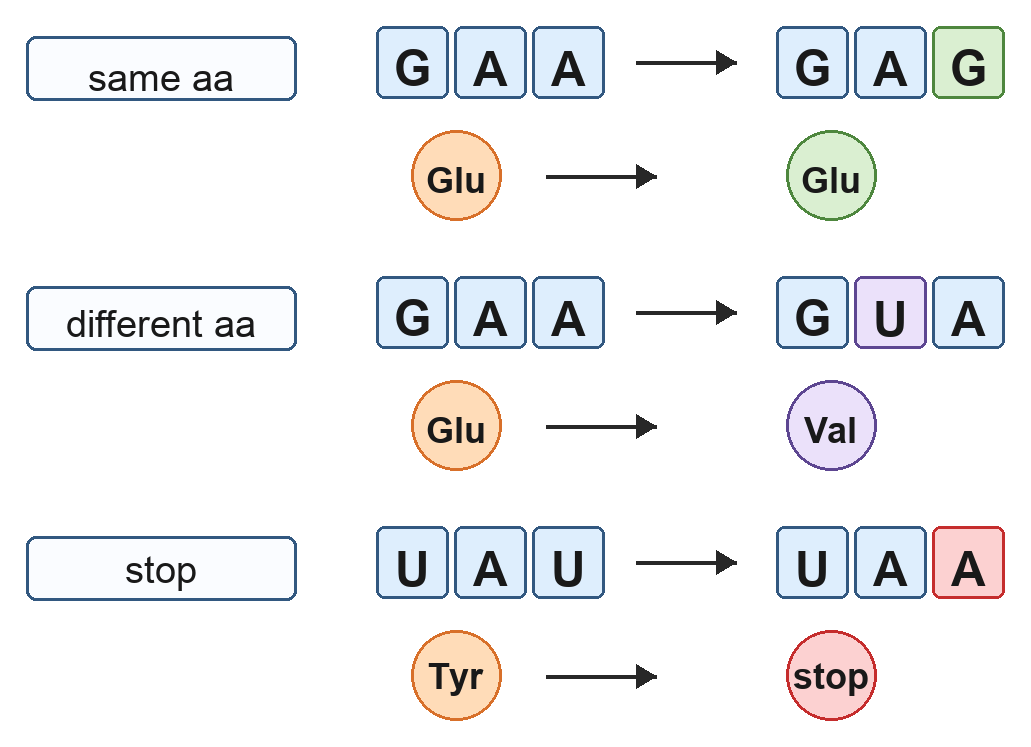
silent altered codon still specifies the same amino acid because the code is degenerate primary structure unchanged
missense altered codon specifies a different amino acid folding or function may change
nonsense altered codon becomes a stop codon translation ends early

A substitution outside a coding sequence can still matter if it changes a promoter or other regulatory sequence; some substitutions have no detectable effect.

Three codon substitutions illustrate unchanged amino acid, changed amino acid and a new stop codon.

Predict a Mutation's Consequence by Following Four Decisions

Ask What the answer predicts
What changed in the DNA? substitution, insertion, deletion or duplication
Where is the change? coding, regulatory or other sequence; possible molecular consequence
Which cell lineage carries it? local somatic clone or possible inheritance through gametes
Does it alter reproductive success? whether selection may change its frequency

The causal chain can stop at any stage: a DNA change can be repaired, lie in a tolerant region, preserve the amino acid, or make no detectable phenotypic difference.

Mutation generates variants without foresight. Cell lineage controls their reach, and natural selection later filters heritable variation according to environmental conditions.

Base substitution consequences

[ 4 ]

Outline how a base substitution leads to sickle cell anemia.

Concept essentials

  • A substitution changes one base in a DNA sequence.
  • Degeneracy can make some substitutions silent.
  • A missense substitution changes one amino acid in a polypeptide.
  • A nonsense substitution can create a premature stop codon.
  • Sickle-cell anemia links a base substitution to altered haemoglobin structure.